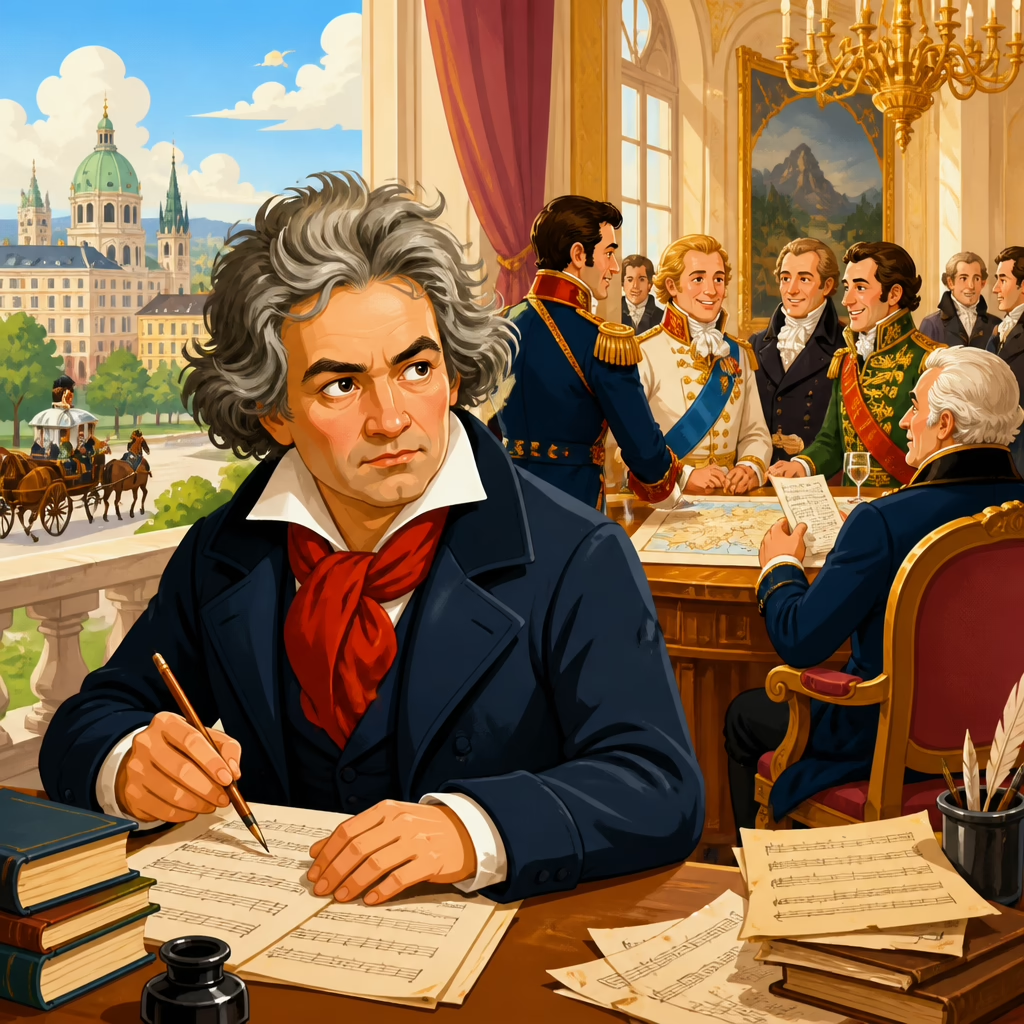
How Beethoven Experienced the Congress of Vienna Years
How Beethoven experienced the Congress of Vienna years can only be understood by looking at Vienna between 1814 and 1815 as both a diplomatic stage and a working city where musicians, servants, copyists, aristocrats, and police all shaped daily life. The Congress of Vienna was the meeting of European powers after Napoleon’s defeat, convened to redraw borders and stabilize the continent. For Ludwig van Beethoven, those same months brought unusual visibility, exhausting social demands, valuable income, artistic validation, and deep personal strain. He was already famous in Vienna, yet he was also increasingly deaf, financially insecure in practical ways despite elite patrons, and entangled in the routines of commissioning, rehearsing, copying, and performance that made success possible. These years matter because they reveal Beethoven not as an isolated genius above history, but as a composer responding directly to international politics, ceremonial culture, and the expectations of powerful listeners gathered in one city.
By 1814 Beethoven was forty-three years old and living through a turning point. The heroic middle-period image often attached to him can obscure how adaptive he was during moments of political spectacle. He wrote music suited to public celebration, accepted commissions tied to current events, and benefited from the arrival of rulers, diplomats, military officers, and wealthy visitors hungry for symbolic art. At the same time, his notebooks, letters, and accounts from contemporaries show a man whose hearing loss had become severe enough to complicate conversation and rehearsal management. The Congress years therefore combine triumph and difficulty in unusually concentrated form. They show Beethoven at once celebrated and burdened, politically useful and artistically ambitious, financially rewarded and emotionally unsettled. To understand his experience of the Congress of Vienna, it helps to trace what he composed, whom he met, how Vienna functioned during the gathering, and why this brief period changed his career trajectory.
Vienna as a city of diplomacy, ceremony, and opportunity
The Congress of Vienna officially opened in late 1814, but diplomatic entertaining had already transformed the city months earlier. Vienna became a capital of receptions, balls, military parades, banquets, private musicales, and public ceremonies. Statesmen such as Metternich, Tsar Alexander I, and the Duke of Wellington brought entourages, and with them came an appetite for cultural display. In my own work with early nineteenth-century performance history, this is the point I stress most: diplomacy was never only negotiated across conference tables. It was enacted through visibility, etiquette, and sound. Music in Vienna during the Congress was not decorative background. It was part of political theater.
For Beethoven, that atmosphere created a rare market for large, topical, extroverted works. He had long depended on aristocratic patronage, but the Congress concentrated influential listeners in one place. Publishers, patrons, and organizers all recognized that a celebrated composer could contribute to the city’s ceremonial prestige. This was especially true because Beethoven was already associated with grandeur, public emotion, and instrumental force. His music could dramatize victory, commemoration, and European solidarity in ways that spoken speeches often could not. In practical terms, the Congress years increased demand for performances and raised Beethoven’s profile beyond the normal circles of Viennese concertgoers.
Yet Vienna’s festive reputation should not be mistaken for simple ease. The city was crowded, expensive, and intensely managed. Surveillance under Metternich’s system shaped public life, and every high-level event required planning, approvals, and social coordination. Beethoven, who was never known for administrative elegance, had to navigate this world through patrons, intermediaries, copyists, and performers. He benefited from the machinery of Congress Vienna, but he did not control it. He entered it as a famous composer whose work could be showcased, interpreted, and sometimes simplified for political effect.
Wellington’s Victory and Beethoven’s public moment
No work captures Beethoven’s Congress-era visibility more clearly than Wellingtons Sieg, or Wellington’s Victory, Op. 91. The piece commemorated the Duke of Wellington’s victory over Joseph Bonaparte at Vitoria in 1813, and it quickly became one of Beethoven’s most popular public successes. Today many critics rank it below his major symphonic achievements, but during the Congress years it was a sensation. It used battle effects, patriotic tunes, and vivid orchestration to create an immediately legible narrative. Audiences did not need specialist training to understand it. They heard cannon, conflict, and triumph.
The work had originated in connection with Johann Nepomuk Mälzel, inventor and promoter of mechanical devices including the metronome and the panharmonicon. Beethoven’s collaboration with Mälzel was complicated and eventually litigious, but in 1813 the partnership helped produce a work with broad public appeal. During the Congress period, that appeal mattered enormously. Rulers and visitors wanted art that reflected recent military events and affirmed the defeat of Napoleon. Wellington’s Victory did exactly that, and it reinforced Beethoven’s reputation as a composer capable of speaking to the political moment.
Its success also reveals something essential about Beethoven’s experience. He was not only the creator of inward, structurally daring masterpieces. He was also a shrewd professional who understood when occasion-driven music could broaden his audience and generate revenue. The popularity of the piece, especially alongside the Seventh Symphony, gave him a level of public acclaim few instrumental composers had enjoyed. That acclaim did not erase his artistic seriousness, but it did place him at the center of a civic and international celebration that rewarded immediacy as much as depth.
The concerts of 1814 and the peak of public recognition
The months surrounding the Congress saw Beethoven benefit from a sequence of high-profile performances. The Academy concert of 8 December 1813 had already introduced the Seventh Symphony and Wellington’s Victory to great success, with a distinguished orchestra including leading virtuosi. In 1814, repeated performances magnified that success. Beethoven’s music was heard by audiences unusually rich in titled visitors and foreign dignitaries. This was the period when his name became almost inseparable from Vienna’s image as Europe’s musical capital.
One important event was the revival of his opera Fidelio in its final version in 1814. This was not incidental to the Congress atmosphere. The opera’s themes of unjust imprisonment, moral courage, and liberation resonated strongly in a Europe emerging from war and political upheaval. Beethoven reworked the score carefully, and the opera finally achieved a more durable form. While Fidelio was never a simple allegory of Congress politics, its ethical seriousness fit a city presenting itself as restored and orderly after Napoleonic disruption.
Accounts from the time make clear that Beethoven was personally visible during these months, though not always comfortable in that visibility. He was admired, toasted, and sought out. He met important visitors, and his music became a social asset for hosts eager to display refined taste. But public celebration came with pressures: extra rehearsals, the need to negotiate fees and permissions, dependence on collaborators, and the fatigue of being present in rooms where conversation itself was difficult because of his deafness.
| Year | Event | Why it mattered for Beethoven |
|---|---|---|
| 1813 | Premiere of the Seventh Symphony and Wellington’s Victory | Established momentum for the public triumph that carried into Congress Vienna |
| 1814 | Revival of Fidelio | Linked Beethoven to themes of liberation and moral seriousness during a political reset |
| 1814 | Congress visitors attended Viennese musical events | Expanded his audience to rulers, diplomats, and international elites |
| 1815 | Congress concluded amid shifting alliances and Napoleon’s return | Marked the end of the concentrated public environment that had boosted his visibility |
How deafness shaped his experience of Congress society
Any accurate account of Beethoven in 1814 and 1815 must place his deafness near the center. By this time his hearing impairment was severe, and ordinary conversation could be frustrating or humiliating. He could still conduct and supervise music in limited ways, but social ease was gone. In a city overflowing with receptions and diplomatic gatherings, that mattered. Congress Vienna rewarded sociability, quick exchanges, strategic networking, and constant attendance. Beethoven could participate, but never without cost.
Contemporaries often described him as abrupt, distracted, or difficult. Some of that reputation reflected temperament, yet some of it came from the practical consequences of hearing loss. When I compare reports from this period with rehearsal documents and correspondence, the pattern is consistent: Beethoven remained authoritative in musical matters, but the space between his public fame and his private strain widened. The very months that made him internationally visible also intensified the isolation built into his disability.
This tension helps explain why the Congress years should not be romanticized as uncomplicated glory. He was celebrated in public ceremonies, yet he increasingly inhabited a world mediated through written notes, close acquaintances, and managed interactions. His later conversation books begin in 1818, so we lack that exact source for the Congress period, but the surrounding evidence is sufficient. Beethoven experienced these years as triumph under pressure, not effortless ascent.
Patrons, visitors, and the politics of admiration
Beethoven’s social world during the Congress years included aristocratic patrons, foreign dignitaries, fellow musicians, publishers, and opportunists. Archduke Rudolph remained crucial, as did long-standing noble supporters such as Princes Lobkowitz and Kinsky, though the annuity arrangements promised in 1809 had already proved vulnerable to inflation and political instability. The Congress did not solve Beethoven’s financial anxieties, but it did place him before people with money, influence, and symbolic power.
One famous anecdote from the period concerns Beethoven’s encounter with European rulers who showed him marked respect. These stories, even when embellished in retelling, point to a real shift in the status of the composer. Beethoven was not treated merely as a hired craftsman. He was increasingly honored as a cultural authority whose presence enhanced political spectacle. That distinction matters historically. The Congress years helped confirm the newer model of the autonomous artist who could receive deference from nobles rather than existing wholly beneath them.
Still, admiration had limits. Elite praise did not automatically produce stable systems of support, nor did ceremonial attention shield Beethoven from everyday disputes. His dealings with Mälzel deteriorated. His domestic life remained disordered. His relations with some performers and theater personnel could be tense. For readers wanting wider biographical context before this period, the main guide at this Beethoven biography resource usefully anchors the basics. Within the Congress years specifically, the key point is that public honor coexisted with private friction.
After the celebrations: why these years were a turning point
The Congress of Vienna did not transform Beethoven into a court propagandist, nor did it permanently secure his happiness. What it did was crystallize a brief phase in which political history, urban spectacle, and musical celebrity aligned unusually well in his favor. He gained broad public recognition, earned substantial applause, and saw works such as the Seventh Symphony, Fidelio, and Wellington’s Victory circulate in a charged international context. He also experienced the exhausting demands of fame while confronting worsening deafness and unstable personal circumstances.
After 1815, Beethoven moved into a different life rhythm. The death of his brother Caspar Carl in 1815 and the long guardianship battle over his nephew Karl absorbed enormous emotional energy. His compositional path increasingly turned toward the late style: more concentrated, exploratory, inward, and structurally radical than the public ceremonial mode that had served him during Congress Vienna. In retrospect, the Congress years look like the last great moment when Beethoven stood at the center of European public festivity as a living emblem of musical power.
That is why these months deserve focused attention. They reveal Beethoven in contact with events rather than sealed off from them. He responded to military victory, public ceremony, theatrical opportunity, aristocratic patronage, and the demands of a city hosting the most important diplomatic gathering of its age. He enjoyed acclaim, but he paid for it in energy, patience, and emotional resilience. If you want to understand Beethoven as he actually lived, not as legend later simplified him, the Congress of Vienna years offer one of the clearest views: a master composer navigating history in real time, absorbing its pressures, and turning them into music that made Vienna hear itself.
Frequently Asked Questions
What was the Congress of Vienna, and why did it matter so much to Beethoven’s life in 1814 and 1815?
The Congress of Vienna was the great diplomatic gathering held after Napoleon’s defeat, when the leading European powers met in Vienna to redraw borders, restore political balance, and try to prevent another era of continental upheaval. For statesmen, it was a high-level political negotiation. For Beethoven, it was something more immediate and personal: a sudden transformation of Vienna into the center of European attention. During 1814 and 1815, the city filled with emperors, princes, diplomats, military leaders, aristocratic hosts, servants, police agents, publishers, performers, and visitors of every rank. That influx changed the rhythm of daily life, and Beethoven experienced the Congress through that altered city.
These years mattered because Beethoven’s position was unusual. He was already famous, but the Congress gave him a level of public visibility that was difficult to ignore. He was not merely composing in private while diplomacy unfolded elsewhere. He was drawn into a citywide culture of celebration, ceremony, patronage, performance, and elite sociability. His music became part of the public face of Vienna. Patriotic and ceremonial works, especially those connected to Napoleon’s defeat and the allied victory, gained renewed value in a political atmosphere hungry for symbols of unity and triumph. That meant opportunities, income, and prestige—but also pressure.
To understand why the Congress mattered to Beethoven, it helps to see Vienna not just as a diplomatic stage but as a working city. Copyists had to prepare music, organizers had to arrange concerts, aristocratic patrons had to invite and recommend artists, and officials had to monitor public gatherings in a tightly supervised political environment. Beethoven’s daily experience depended on all of these structures. He moved through salons, rehearsal spaces, lodgings, streets, and performance venues while also dealing with worsening hearing loss, professional obligations, and constant social demands. In short, the Congress mattered because it intensified everything around him: fame, fatigue, opportunity, and the sense that his art was being heard within a moment of major European history.
How did Vienna itself feel during the Congress years, and what kind of city was Beethoven living and working in?
Vienna during the Congress was both glittering and crowded, ceremonial and practical. It is often remembered through images of balls, receptions, diplomatic intrigue, and aristocratic display, but Beethoven would have known that this surface brilliance depended on a vast urban system of labor and control. The city was full of movement: carriages arriving, guests being housed, concerts being planned, households expanding to serve temporary residents, printed notices circulating, and police watching public behavior. It was a capital staging magnificence while also functioning through the work of ordinary people.
For Beethoven, this meant living in an environment where elite culture and everyday urban realities constantly overlapped. He might be associated with noble patrons and celebrated before distinguished audiences, yet his practical world also included copying parts, negotiating payments, revising scores, relying on intermediaries, and managing domestic frustrations. Vienna was not simply a backdrop to genius. It was an ecosystem. Musicians, instrument makers, publishers, servants, coachmen, innkeepers, and household staff all helped sustain the social world in which great music could be performed and heard.
The Congress years also made Vienna noisier and more demanding. The presence of so many foreign dignitaries created heightened social activity and intensified expectations for public entertainment. Music was not an optional decoration; it was one of the ways the city projected prestige. Beethoven thus lived in a place where artistic production became entwined with hospitality, politics, and representation. At the same time, the city remained heavily policed. Post-Napoleonic Europe was deeply concerned with order, surveillance, and political stability, so Vienna’s public culture operated under watchful authority. Beethoven’s experience of the city was therefore shaped by contradiction: glamour and regulation, acclaim and exhaustion, official celebration and personal strain.
Did the Congress of Vienna help Beethoven’s career, or did it mainly create stress and distraction?
It did both, which is exactly why these years are so revealing. On one hand, the Congress created exceptional visibility for Beethoven. Vienna was packed with influential listeners, and music occupied a central role in the city’s public life. In that setting, Beethoven’s reputation as the foremost living composer in Vienna could be displayed before an international elite. He benefited from attention, from performances connected to the victorious political mood, and from the prestige that came when his work was heard in a city temporarily serving as Europe’s ceremonial capital. The period could bring valuable income, important contacts, and a broadening of his public image.
On the other hand, visibility came at a cost. Beethoven was not naturally suited to constant social performance. The Congress intensified invitations, demands, interruptions, and expectations. There were more people to meet, more occasions to navigate, more ceremonial frameworks in which music served political and social purposes. For someone already contending with profound hearing difficulties, irregular routines, personal frustrations, and the need to protect time for composition, this atmosphere could be draining. Success in such an environment often depended on tact, patience, scheduling, and sociability—the very things Beethoven frequently found burdensome.
So the Congress did not simply “boost” or “damage” his career. It exposed the tension at the center of his life. He was famous enough to be indispensable to Vienna’s cultural prestige, yet independent enough in temperament to resist easy absorption into courtly entertainment. He could profit from the moment while also feeling harried by it. That is why historians often treat the Congress years as unusually concentrated examples of Beethoven’s broader condition: he stood at the center of European musical culture, but the mechanisms that sustained that centrality could also wear him down. In practical terms, the period brought recognition and opportunity; in human terms, it brought fatigue, overexposure, and pressure.
How did ordinary working people and behind-the-scenes figures shape Beethoven’s experience during the Congress years?
One of the most important ways to understand Beethoven in 1814 and 1815 is to stop imagining him as moving only among monarchs and noble patrons. His experience depended just as much on the labor of less visible people. Copyists prepared orchestral parts and vocal materials so performances could happen on time. Servants and household staff kept aristocratic residences functioning during an extraordinary season of hosting. Publishers, messengers, and assistants moved papers, contracts, letters, and scores. Instrument makers and tuners helped maintain the material conditions of performance. Theater personnel, stage workers, and ensemble musicians turned written music into public event. Without this network, Beethoven’s visibility during the Congress would have remained abstract.
This matters because the Congress years intensified logistical complexity. A city full of guests required more entertainment, more coordination, and more speed. Music had to circulate efficiently, and celebrated composers depended on systems of labor that are easy to overlook. Beethoven may be remembered as an artistic genius, but genius in Vienna was never detached from urban work. Rehearsals had to be arranged, parts had to be copied correctly, venues had to be staffed, audiences had to be seated, and patrons had to be served. Even frustration—something strongly associated with Beethoven—often arose from these practical realities: delays, errors, shortages, misunderstandings, missed appointments, and financial disputes.
At the same time, police and officials formed another kind of invisible framework around daily life. Postwar Vienna was politically cautious, and surveillance was part of the city’s normal functioning. Public events, visiting foreigners, and large gatherings all existed within an atmosphere of observation and regulation. Beethoven’s world therefore included not only admirers and workers, but also administrators and authorities. Taken together, these behind-the-scenes figures reveal the real texture of the Congress years. Beethoven experienced them not from an isolated pedestal but from inside a densely interconnected city where artistic life depended on labor, hierarchy, and control.
What is the best way to picture Beethoven personally during the Congress of Vienna years?
The most accurate picture is of a man living at the intersection of triumph and strain. Beethoven in 1814 and 1815 was highly visible, internationally admired, and deeply embedded in one of the most symbolically charged moments in Vienna’s history. He was not a detached observer of events. He was a working composer in a capital temporarily transformed into the political center of Europe. Important people wanted to hear music; patrons wanted association with cultural greatness; Vienna wanted to display itself; and Beethoven’s name carried enormous value in that environment.
Yet the personal reality was far more complicated than a simple story of acclaim. He was coping with severe hearing impairment, which shaped every social encounter and every professional demand. He had to negotiate a city in which public life was exceptionally crowded and ceremonial. He depended on patrons and collaborators while also guarding his independence. He enjoyed prestige, but prestige did not remove inconvenience, irritation, or loneliness. If anything, the Congress years sharpened those tensions by placing him in constant relation to audiences and elites at the very moment when ordinary communication had become more difficult for him.
It is also useful to picture Beethoven not only in grand settings but in transitional ones: moving between residences, rehearsals, meetings, and performances; dealing with papers and practicalities; responding to requests; relying on others to mediate interactions; and trying to preserve compositional focus amid a city overloaded with spectacle. That