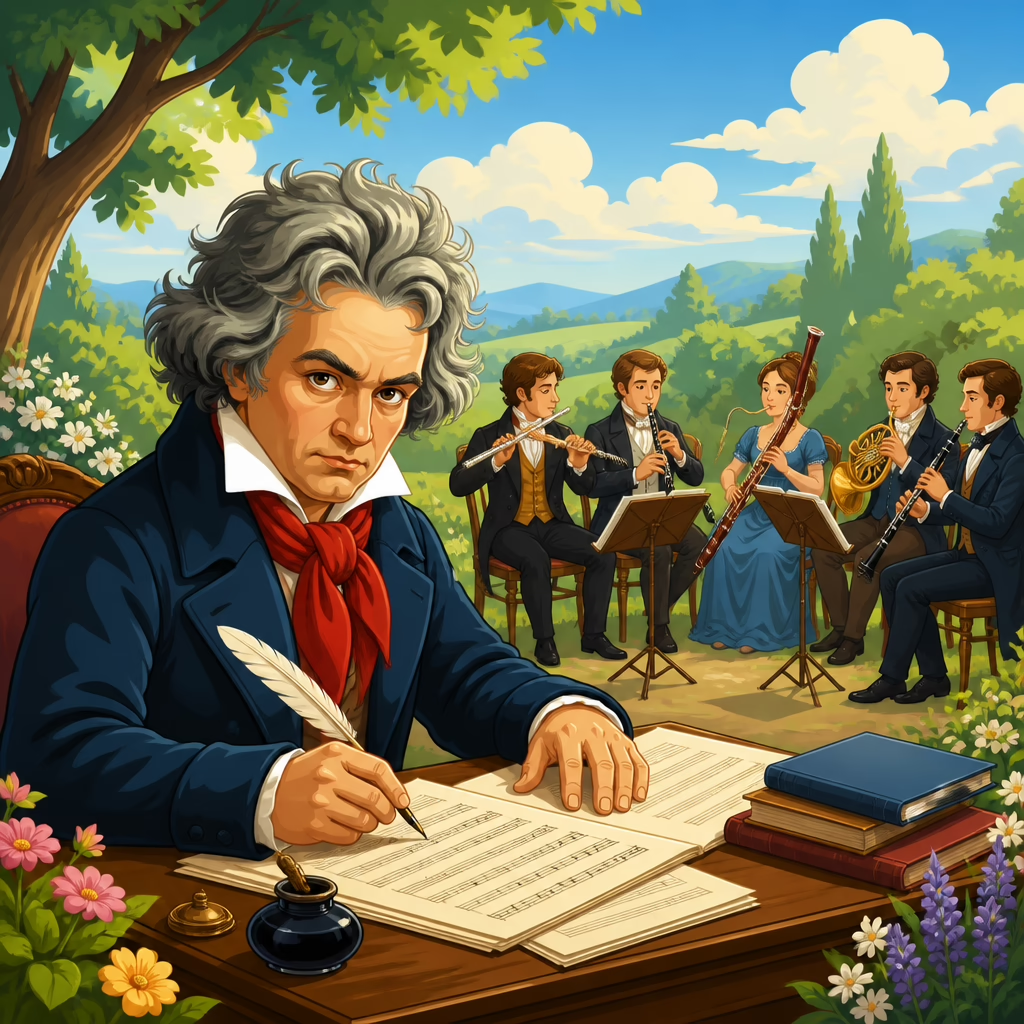
Beethoven’s Rondino WoO 25 and Wind Serenade Style
Beethoven’s Rondino WoO 25 and Wind Serenade style meet at a fascinating point in his early career, where craft, convention, and emerging individuality can be heard with unusual clarity. The Rondino in E-flat major, catalogued as WoO 25, belongs to the world of Harmoniemusik, the late eighteenth-century tradition of writing elegant outdoor and ceremonial music for wind ensemble. In practical terms, that style usually meant pairs of oboes, clarinets, bassoons, and horns, a scoring prized across aristocratic Europe for its color, portability, and ability to project in open air. Beethoven’s piece is often discussed alongside the larger Serenade in D major, Op. 25, because both works show how he handled wind writing before the explosive innovations of his middle period changed the language of instrumental music.
Understanding the Rondino matters because it reveals Beethoven not as a revolutionary in full stride, but as a young composer mastering inherited forms from the inside. I have worked through this score with performers, and what stands out immediately is how idiomatic it is for winds: phrases breathe naturally, cadences speak cleanly, and the distribution of melodic weight shows real awareness of ensemble balance. At the same time, the music is not merely functional entertainment. Its motivic neatness, tonal pacing, and refined dialogue between instruments point toward the compositional discipline that later underpinned the mature chamber works. For listeners interested in Beethoven’s development, WoO 25 offers a compact case study in how style, social function, and technical invention interact within a seemingly modest occasional piece.
What WoO 25 is, and where it sits in Beethoven’s early output
WoO stands for “Werke ohne Opuszahl,” the standard category for works without opus numbers in the Kinsky-Halm catalogue. That designation does not imply insignificance; it simply reflects publication history and cataloguing practice. The Rondino WoO 25 was composed during Beethoven’s Bonn years, generally dated to the early 1790s, and survives as part of the repertory associated with courtly wind music. E-flat major is not an accidental choice. For classical wind ensembles, especially those using natural horns, E-flat was a comfortable and resonant key, allowing brilliance without strain. The title “Rondino” signals a compact rondo-like finale or independent movement built on recurring thematic returns, lighter in scale than a fully extended sonata-form argument.
In Beethoven’s chronology, this work stands near other youthful efforts that show him absorbing Viennese and south German models while writing for actual court musicians. Bonn’s Electorate maintained capable wind players, and composers serving such institutions wrote with practical knowledge of available forces. That context helps explain the music’s polish. This was not abstract desk composition. It was made for performance situations where immediate clarity counted. If a line sat badly on the instrument, if a horn entry cracked the texture, or if a bassoon doubling muddied the cadence, the weakness would be heard at once. The Rondino therefore preserves evidence of Beethoven learning through real ensemble conditions, not just through private study.
How Wind Serenade style shapes the piece
Wind Serenade style in the late eighteenth century combined social utility with compositional discipline. These works often accompanied dinners, festivities, evening gatherings, and noble entertainments, yet the best examples are carefully proportioned and expertly scored. Mozart’s Gran Partita, K. 361, and his Serenade in C minor, K. 388, represent the richest edge of the genre, while countless smaller serenades by composers such as Krommer, Druschetzky, and Wranitzky supplied the broader performance culture. Beethoven’s Rondino fits this ecosystem. Its charm depends on surface grace, but that grace is engineered through balanced phrase lengths, antiphonal exchanges, and harmonic timing designed to sound effortless.
The style favors lucid melody over dense development. Instead of extended contrapuntal working-out, a serenade movement generally succeeds by presenting a memorable idea, varying its return, and letting timbral contrast do much of the expressive work. WoO 25 follows that logic. The principal theme is shaped to be instantly graspable, then refreshed by changes in instrumental color and supporting figures. Winds make this especially effective because each instrument family carries a distinct social and sonic identity: oboes can brighten and articulate, clarinets smooth and connect, bassoons ground and comment, and horns crown cadences with ceremonial warmth. Beethoven uses those identities with tact rather than flamboyance, which is exactly what the idiom requires.
Another hallmark of Wind Serenade style is conversational writing. Instead of treating the ensemble like a keyboard reduction spread among parts, the composer creates exchanges that sound like well-timed speech. In rehearsal, I have found that WoO 25 comes alive when players shape these handoffs as questions, completions, and polite interruptions. That quality links the piece to eighteenth-century notions of taste. Music for sociable settings had to invite attention without coercing it. Beethoven’s solution is to keep the lines intelligible and the texture mobile. Nothing lingers too long in one color, and no single player monopolizes the argument for extended stretches.
Instrumentation, texture, and ensemble craft
The standard scoring associated with the work is octet writing for pairs of oboes, clarinets, bassoons, and horns. This was the classic Harmonie formation used widely in courts and military-adjacent ceremonial contexts. Each pair has a structural role. Oboes often carry the brightest thematic edge; clarinets soften and widen the middle register; bassoons provide bass support but also agile inner counterlines; horns reinforce harmony and formal punctuation. In WoO 25, Beethoven avoids overloading the texture. He understands that eight wind players can sound heavy if all move continuously at once, especially in a resonant hall or outdoor setting. As a result, he thins the writing strategically, letting pairs answer one another rather than constantly doubling.
This restraint is one reason the piece sounds more sophisticated than its modest scale might suggest. Effective wind writing is less about adding notes than about managing attack, decay, and register. Strings can sustain through bow pressure; eighteenth-century winds rely more on articulated breath and resonance. Beethoven writes phrases that acknowledge this physical reality. Cadential figures often align with natural breathing points, and accompanimental motion is distributed so that support remains present even when individual players release. That practical intelligence separates convincing Harmoniemusik from clumsy transcription-like writing. WoO 25 feels composed from within the medium.
| Instrument pair | Primary function in WoO 25 | Characteristic effect |
|---|---|---|
| Oboes | State and sharpen thematic material | Brightness, definition, forward motion |
| Clarinets | Blend melody and inner harmony | Warmth, legato continuity, tonal depth |
| Bassoons | Support bass line and add commentary | Weight, wit, rhythmic lift |
| Horns | Mark cadences and stabilize harmony | Nobility, resonance, ceremonial breadth |
Texture in this piece depends on pairing and release. Beethoven frequently lets one choir begin an idea and another complete it, preventing monochrome scoring. The result is music that sounds spacious even without large formal ambition. It also rewards historically informed performance. On period instruments, the contrast between reed attack, clarinet bloom, bassoon grain, and natural horn color becomes vivid. Modern instruments can produce a smoother blend, but they risk flattening the rhetorical contrasts if players do not actively shape them. The score itself invites differentiated articulation, and that is central to its style.
Form, thematic design, and harmonic language
As its title suggests, the Rondino is built around return. The principal idea acts as a recurring anchor, allowing contrast episodes to provide motion without destabilizing the listener’s bearings. This is ideal for Wind Serenade style because audiences in social settings benefit from immediate orientation. Beethoven’s handling of return is disciplined. He does not simply repeat blocks unchanged; instead, he adjusts scoring, spacing, and transition energy so that each recurrence feels earned. That small-scale formal management is one of the work’s most attractive features. It shows a composer already attentive to proportion and refreshment, even when operating inside conventional expectations.
The thematic material is concise and singable. Rather than aiming at the dramatic compression found in later Beethoven, WoO 25 relies on clear motives that can circulate easily among instruments. This circulation matters. In wind music, transfer of motive is itself a compositional event because timbre alters meaning. A phrase first heard in oboes can sound public and alert; the same phrase in clarinets becomes rounder and more intimate. Beethoven exploits that shift economically. The harmonic language likewise stays within classical bounds, but it is never inert. Dominant preparation is paced carefully, secondary areas bring enough contrast to justify the return, and cadences arrive with satisfying inevitability.
Listeners sometimes underestimate early Beethoven because they listen mainly for rupture. WoO 25 rewards a different kind of attention. Its intelligence lies in control. Harmonic rhythm, phrase extension, and registral placement are calibrated to keep the piece buoyant. There are no gratuitous detours. Everything serves replay value and performability. That is not a limitation; it is a mark of professional writing for a specific genre. For readers exploring Beethoven’s smaller-scale works, the broader context at https://lvbeethoven.com/a-complete-guide-to-beethovens-bagatelles/ is useful, but WoO 25 deserves attention on its own terms as a sharply made wind composition.
Comparison with other serenade models and Beethoven’s distinctive voice
The closest stylistic comparisons are Mozart’s and Haydn’s wind works, yet Beethoven’s voice is already audible in subtler ways. Mozart often luxuriates in color, turning wind ensemble into a miniature opera cast of characters. Haydn tends to be terser, more motivically economical, with a dry brilliance that suits outdoor genres well. Beethoven in WoO 25 leans toward economy, but with a distinctive firmness in phrase profile. His cadences land with unusual decisiveness, and even decorative figures tend to support structural clarity rather than mere ornament. That trait becomes central in his later output, where gestures are often defined by what they accomplish formally, not simply by how attractive they sound.
There is also a particular Beethovenian seriousness beneath the surface ease. The piece never becomes heavy, yet it avoids the anonymous pleasantness that fills much period Harmoniemusik. Transitions are tidier, balances are more considered, and returns feel more architecturally integrated. In performance, this means the work benefits from being played neither as background music nor as proto-symphony. The right approach recognizes its courtly function while honoring its precision. I have heard excellent ensembles miss the mark in both directions: some over-romanticize the phrasing, adding weight that blurs the style, while others underplay the rhetoric and reduce the piece to polite wallpaper. Beethoven asks for elegance with backbone.
The relationship to the later Serenade, Op. 25, is illuminating. Although scored differently and conceived on a larger scale, that work shows Beethoven continuing to think carefully about sociable instrumental genres and about how lightness can coexist with structural intention. WoO 25 is not simply a precursor, but it does reveal habits that persist: concise thematic cells, active inner parts, and clear formal signaling. These continuities matter because they challenge the simplistic idea that Beethoven moved from imitation to originality in a straight line. In reality, originality often appears first as heightened control within existing norms. That is exactly what this Rondino demonstrates.
Why the Rondino still matters for performers and listeners
WoO 25 remains valuable because it teaches listening through proportion, color, and instrumental rhetoric. For performers, it is a primer in classical wind balance. Every exposed entrance tests intonation, blend, and timing; every exchange requires awareness of who leads and who supports. For listeners, the reward is hearing Beethoven’s mind at work in miniature. The piece shows how much can be accomplished without grand rhetoric, large development sections, or overt struggle. It also preserves the sound world of aristocratic wind music just before the nineteenth century transformed public concert life and expanded the scale of instrumental ambition.
If you want to understand Beethoven more fully, this is exactly the kind of work to hear closely. The Rondino WoO 25 proves that style is not a decorative surface but a working system of choices about form, sonority, and occasion. Its wind serenade character is not incidental; it is the framework that gives the music its poise, clarity, and durable appeal. Listen for the recurring theme, the clean handoffs between pairs, and the way horns crown the cadence without dominating it. Then revisit the piece with the score if possible. The more precisely you follow its craft, the more persuasive its modest scale becomes, and the more vividly Beethoven’s early mastery comes into focus.
Frequently Asked Questions
What is Beethoven’s Rondino WoO 25, and why is it important in the context of his early music?
Beethoven’s Rondino in E-flat major, WoO 25, is an early work for wind ensemble that offers a remarkably clear view of the young composer working within a fashionable late eighteenth-century genre while also testing the boundaries of it. The piece is associated with the tradition of Harmoniemusik, the cultivated repertoire written for pairs of oboes, clarinets, bassoons, and horns that flourished in aristocratic, civic, and ceremonial settings. In that sense, the Rondino belongs to a practical musical world: music designed to be elegant, sociable, and sonically effective outdoors or in large rooms. Yet the work is important because it does more than simply fulfill that function. It reveals Beethoven’s command of form, instrumental color, and thematic shaping at a stage when his style was still developing.
What makes WoO 25 especially valuable is the balance it strikes between convention and individuality. The piece draws on familiar serenade-era expectations such as graceful melody, balanced phrase structure, and clear tonal planning, but listeners can also hear Beethoven’s instinct for stronger contrast, more pointed motivic work, and a richer sense of dialogue among the instruments. Rather than treating the ensemble as a block of sound, he gives the winds personality and interplay. For historians and listeners alike, the Rondino matters because it captures Beethoven at a transitional moment: he is still speaking in the language of Mozart-era wind music, but his own expressive profile is already beginning to emerge.
How does Rondino WoO 25 reflect the wind serenade or Harmoniemusik style?
Rondino WoO 25 reflects the wind serenade style through its instrumentation, social character, and musical design. Harmoniemusik was built around a standardized wind ensemble, most often pairs of oboes, clarinets, bassoons, and horns, and Beethoven’s work participates directly in that tradition. This scoring was not accidental. It provided a rich but transparent palette that could project clearly in open-air or semi-public environments while also allowing for elegant blend and contrast. The oboes could carry bright melodic lines, the clarinets could add warmth and flexibility, the bassoons could support harmony while contributing wit and agility, and the horns could supply both harmonic breadth and ceremonial brilliance.
Stylistically, the work reflects serenade conventions through its charm, poise, and accessibility. Wind serenade music was generally expected to be appealing rather than heavily dramatic, and Beethoven honors that expectation with tuneful writing, lucid phrasing, and a pleasing sense of momentum. At the same time, he uses the rondo principle in a way that suits the genre very well: recurring material provides familiarity and coherence, while contrasting episodes introduce variety without disturbing the overall ease of the piece. This is exactly the kind of structure that would work effectively in a social setting, where listeners might appreciate both recognizability and freshness.
Another hallmark of the style is conversational ensemble writing, and that is central to WoO 25. Rather than assigning all importance to one leading voice, Beethoven allows motifs and melodic gestures to pass among the players. This creates the refined give-and-take associated with late eighteenth-century chamber winds. In short, the piece reflects Harmoniemusik not only because of its scoring, but because it embodies the style’s broader ideals: elegance, clarity, instrumental color, and a cultivated public-facing charm.
What musical features in the Rondino show Beethoven’s emerging individuality?
Although Rondino WoO 25 clearly belongs to a recognized genre, it also contains features that point toward Beethoven’s growing artistic independence. One of the most noticeable is his handling of motivic material. Even in a work designed for light entertainment, he shows a tendency to build interest from small musical ideas that can be repeated, varied, and redistributed across the ensemble. This creates a stronger internal logic than one might find in more purely decorative wind music of the period. The themes are memorable, but they also feel active, as if they are being worked with rather than simply presented.
His sense of contrast is another sign of emerging individuality. Beethoven often sharpens the distinction between sections through dynamics, register, texture, or instrumental color. In many serenade-style works, contrasts are present but gently managed; in Beethoven, they can feel more assertive and structurally meaningful. He is interested not just in pleasing alternation, but in creating momentum and shape. That instinct would later become one of the defining features of his mature style, and WoO 25 gives an early glimpse of it in a more modest frame.
The instrumental writing also suggests a composer who is listening carefully to what each voice can contribute. The winds are treated with sensitivity to blend, but also with a sense of character. Beethoven exploits contrasts between reed timbres and horn sonority in ways that animate the music from within. Even when the overall tone remains graceful, there is often a feeling of purpose behind the scoring choices. For that reason, the Rondino can be heard as more than an accomplished genre piece. It is an early document of Beethoven’s habit of taking inherited forms and energizing them through stronger motivic thinking, more vivid interaction, and a heightened dramatic instinct.
Why is the key of E-flat major especially fitting for a wind ensemble work like this?
E-flat major was one of the most natural and effective keys for Classical wind writing, and that makes it an especially apt choice for Beethoven’s Rondino WoO 25. In the late eighteenth century, wind instruments were closely tied to certain key areas because of their construction, fingering systems, and natural resonance. E-flat major was particularly comfortable and brilliant for horns, and it also worked favorably for the other members of the Harmonie ensemble. The result was a sonority that could sound both noble and warm, making the key well suited to ceremonial, outdoor, and serenade contexts.
Beyond practicality, E-flat major carried a distinct expressive profile. In Classical repertoire, it is often associated with breadth, dignity, and genial grandeur. That does not mean every work in E-flat sounds monumental, but it does suggest a coloristic and rhetorical identity that composers understood and used deliberately. In a wind piece, this key can produce a rounded, resonant ensemble sound that feels both festive and refined. Beethoven takes advantage of that character, allowing the music to project clearly while maintaining elegance and balance.
There is also an important historical dimension here. Many celebrated works for winds and many orchestral works with ceremonial overtones gravitated toward E-flat because it reinforced the natural strengths of the instruments. By placing WoO 25 in this key, Beethoven situates the piece firmly within the established sound world of Harmoniemusik. At the same time, he uses that familiar tonal space as a platform for imaginative detail, making the key both traditional and expressive. For listeners, E-flat major helps explain why the Rondino sounds so idiomatic: the music seems to grow naturally out of the ensemble’s tonal and timbral possibilities.
How should listeners approach Beethoven’s Rondino WoO 25 when comparing it with Mozart-era wind serenades?
The best way to approach Beethoven’s Rondino WoO 25 alongside Mozart-era wind serenades is to listen for continuity first and difference second. The continuity is unmistakable. Beethoven is working in a musical environment shaped profoundly by late eighteenth-century taste, where wind ensemble music served social, ceremonial, and sometimes outdoor functions. Like Mozart and other composers writing for Harmonie, he values elegance, balance, melodic immediacy, and colorful ensemble conversation. If a listener begins by hearing WoO 25 as part of that shared tradition, the piece makes immediate sense.
Once that framework is established, the more individual features become easier to notice. Compared with many earlier serenade-style works, Beethoven often gives the musical material a stronger sense of drive. Phrases can feel more goal-directed, transitions more purposeful, and thematic returns more structurally weighted. The dialogue among instruments may also sound less merely decorative and more developmental, as if each exchange contributes to a larger plan. These are subtle distinctions in an early work, but they matter. They show Beethoven not rejecting the style, but intensifying it from within.
It also helps to adjust expectations. WoO 25 is not trying to be a symphony for winds, nor is it simply background music. It occupies a middle ground that is actually very revealing. Listeners should appreciate the grace, sociability, and polish that connect it to the serenade tradition, while also paying attention to the firmer musical profile that hints at Beethoven’s future direction. In that sense, comparison with Mozart-era wind music is most rewarding when it avoids simplistic ranking and instead asks a more interesting question: how does a young Beethoven inhabit an inherited genre while quietly beginning to transform it? That question is exactly what makes the Rondino so engaging.