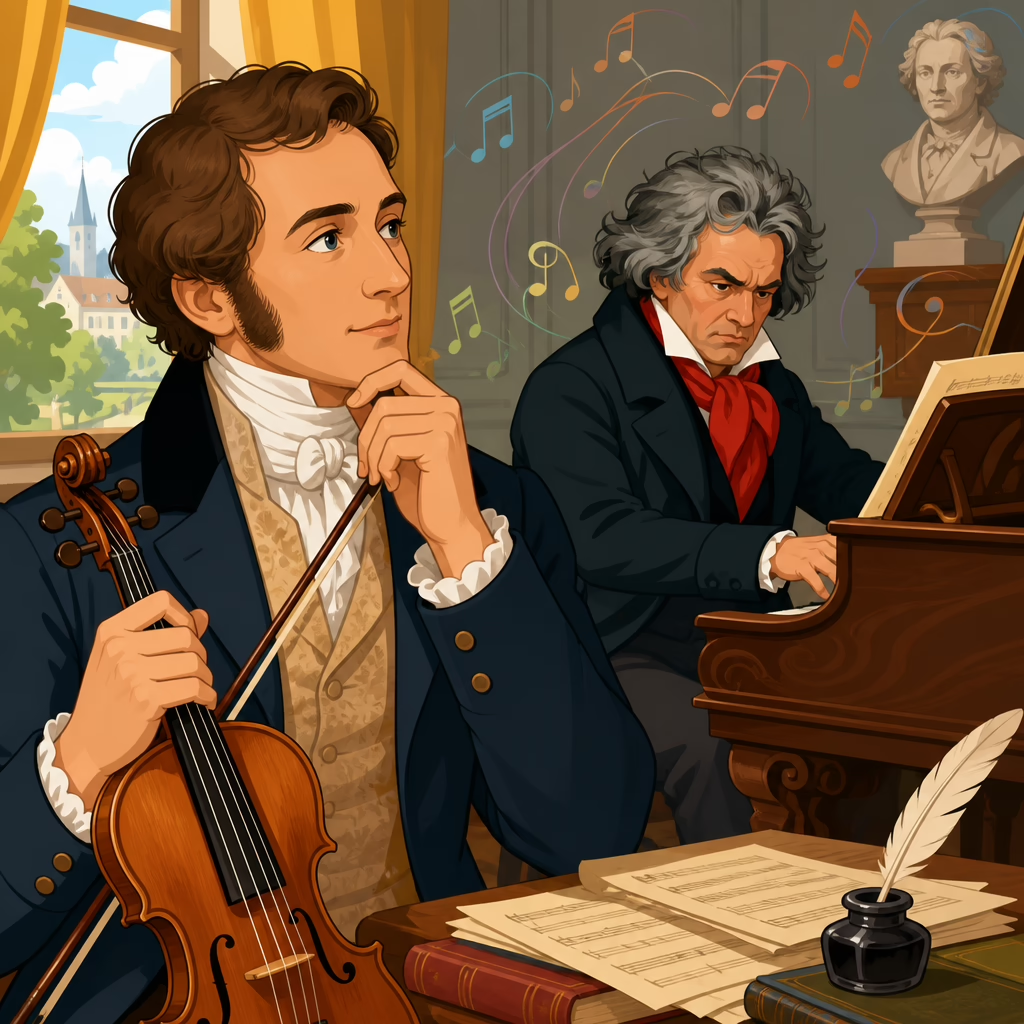
Louis Spohr on Hearing and Judging Beethoven
Louis Spohr’s comments on Beethoven are among the most revealing testimonies we have from a major contemporary who knew both the public legend and the private man. As a violin virtuoso, conductor, composer, and careful observer of musical life in Vienna, Kassel, and beyond, Spohr occupied a vantage point few others shared. He heard Beethoven’s works early, saw him in person, interacted with him socially, and later recorded judgments that mixed admiration, discomfort, and frank criticism. When historians examine Louis Spohr on hearing and judging Beethoven, they are really studying two intertwined subjects: how Beethoven’s advancing deafness shaped social and musical encounters, and how one accomplished nineteenth-century musician assessed a genius whose style often exceeded accepted norms.
The topic matters because Spohr was not a casual commentator writing from hearsay. He belonged to Beethoven’s world. Born in 1784, only fourteen years after Beethoven, he came of age within the same fast-changing musical culture that stretched from late Classicism into early Romanticism. He understood orchestral balance, violin writing, chamber idiom, and the practical realities of performance. His memoirs and remarks therefore offer more than colorful anecdote. They show how Beethoven sounded to trained ears before later canonization softened the shock of his innovations. They also preserve a human record of what it was like to meet a creator struggling with hearing loss while still commanding immense artistic authority.
Three key terms help frame the discussion. First, hearing refers both to literal auditory capacity and to musical perception: what Beethoven could physically hear, what he could infer internally, and what Spohr believed he could no longer monitor accurately in performance. Second, judging means aesthetic evaluation rather than moral condemnation. Spohr weighed Beethoven’s works according to craftsmanship, proportion, beauty of sound, and expressive truth. Third, contemporaries describes fellow musicians living within the same historical moment, not later critics who inherited a settled masterpiece tradition. Reading Spohr closely keeps us inside that unsettled moment, when Beethoven’s reputation was enormous but not untouchable, and when even admirers debated whether certain late works were profound, eccentric, or both.
What makes Spohr especially valuable is his dual response. He revered Beethoven’s genius, yet he did not surrender his own standards. In my experience working through nineteenth-century memoirs and performance reports, that combination is rarer than it seems. Many witnesses either worship Beethoven in generalities or dismiss what they do not understand. Spohr does neither. He gives precise scenes, such as Beethoven’s awkward social hearing, and precise artistic objections, such as excessive harshness or obscurity in some later compositions. Those details help modern readers separate the mythology of deaf genius from the lived reality of collaboration, rehearsal, and listening in an era before recordings.
Spohr’s position as witness and critic
Any serious use of Spohr’s testimony begins with his stature. He was one of the leading violinists of his age, a prolific composer of symphonies, concertos, operas, chamber music, and sacred works, and a conductor whose practical musicianship was widely respected. This matters because his judgments were grounded in craft. He knew what it meant to write idiomatically for strings, maintain structural coherence over large spans, and achieve sonorous clarity in ensemble performance. When he praised Beethoven’s originality, the praise carried weight. When he objected to roughness, density, or perceived extravagance, those objections came from a musician who understood compositional difficulty from the inside.
Spohr’s memoirs, published later in the century but based on personal recollection, are not neutral transcripts. Memory compresses events, and self-presentation always shapes autobiography. Yet the broad reliability of his perspective is strengthened by consistency with other evidence. Numerous contemporaries described Beethoven’s hearing problems, abrupt manners, and increasing social difficulty. Likewise, many early listeners admired works we now call central while remaining baffled by others, especially later quartets. Spohr’s account fits that wider pattern. It should not be treated as perfect fact in every phrase, but it remains one of the strongest first-hand windows onto Beethoven as perceived by a sophisticated musical contemporary.
It also helps that Spohr was neither a dependent pupil nor a hostile outsider. He stood near Beethoven culturally without being absorbed into Beethoven’s circle. That middle distance gave him freedom. He could respect the achievement of the Eroica or Fidelio while retaining reservations about later mannerisms. For readers exploring Beethoven’s artistic formation, the earlier network of teachers and influences also matters, including the foundation discussed in the broader guide at Christian Gottlob Neefe and Beethoven’s earliest training. Spohr enters the story later, not as a formative instructor, but as a discerning peer whose reactions show how Beethoven’s mature art landed in expert ears.
What Spohr observed about Beethoven’s hearing
Spohr’s most cited observations concern Beethoven’s deafness in social settings. He describes having to speak loudly and notes Beethoven’s reliance on close attention to catch words. Such details may seem obvious today, because Beethoven’s deafness has become one of the most familiar facts in music history. Yet contemporary description is crucial. Deafness was not a romantic abstraction. It affected table conversation, rehearsal communication, facial expression, and ordinary etiquette. For a composer whose professional life depended on exchange with players, patrons, and audiences, impaired hearing created continuous friction.
Spohr’s reports align with documented stages of Beethoven’s condition. Beethoven acknowledged serious hearing trouble by the early 1800s, most poignantly in the Heiligenstadt Testament of 1802. By the 1810s and especially the 1820s, he depended increasingly on conversation books, written notes, ear trumpets, and visual inference. Hearing loss of this severity does not simply lower volume; it can distort pitch perception, blur speech discrimination, and impair the judgment of timbre and balance. That context is essential when evaluating Spohr’s comments about Beethoven’s later performance habits. Spohr was not merely observing inconvenience. He was witnessing the practical consequences of a severe auditory disability in a profession built on sound.
He also noticed the social strain produced by deafness. Beethoven could appear distracted, suspicious, or abrupt because conversation no longer flowed normally around him. I have seen this dynamic repeatedly in nineteenth-century accounts: observers interpret the behavior first as temperament, then realize hearing loss is driving the awkwardness. Spohr’s value lies in showing both layers at once. He does not deny Beethoven’s difficult personality, but he presents situations in which deafness clearly intensified misunderstanding. That distinction matters because it restores Beethoven’s humanity. He was not simply a volcanic genius raging at the world; he was a man compensating constantly for a loss that isolated him even in crowded rooms.
Hearing Beethoven conduct and the problem of performance control
One of Spohr’s most important judgments concerns Beethoven as conductor or musical director after his hearing had declined severely. Spohr believed Beethoven could no longer reliably control ensemble results. This was a sensitive claim, because Beethoven’s authority as composer remained unquestioned. Yet conducting demands different skills from composing. It requires instant feedback about tempo unity, dynamic proportion, entries, articulation, and the difference between what is intended and what the room is actually producing. A deaf or nearly deaf musician can imagine the score perfectly and still miss what performers are doing in real time.
Other witnesses support the general substance of this view. The famous 1824 premiere of the Ninth Symphony required practical intervention by musicians around Beethoven because he could not fully oversee the performance. Accounts differ in detail, as historical sources often do, but the central fact is clear: Beethoven’s symbolic role and his functional control were no longer identical. Spohr’s remarks fit this broader pattern. He saw that reverence for Beethoven could coexist with the need for others to stabilize execution. In modern terms, Beethoven remained the supreme authorial mind, but not always the dependable auditory supervisor.
| Area Spohr judged | What he observed | Historical significance |
|---|---|---|
| Conversation | Beethoven struggled to hear speech and required forceful communication | Confirms severe practical deafness, not merely partial inconvenience |
| Conducting | Ensemble control suffered because Beethoven could not monitor sound accurately | Shows the gap between compositional genius and live performance oversight |
| Orchestral sonority | Spohr sometimes heard harshness or imbalance in later effects | Suggests concern about how deafness might influence audible result |
| Late style | He admired originality but resisted what he considered obscurity or excess | Documents mixed contemporary reception before later canonization |
This does not mean Beethoven ceased to understand orchestration. His late scores prove the opposite. But Spohr’s concern highlights a real distinction between inner hearing and external verification. Beethoven’s mental ear remained astonishingly powerful. He could conceive large forms, complex counterpoint, and bold instrumental combinations beyond the reach of many fully hearing composers. Still, rehearsal and performance expose countless variables no internal imagination can completely predict. Spohr’s testimony is therefore best read not as an attack on Beethoven’s musicianship but as a practical assessment of the limits imposed by deafness in live execution.
Spohr’s admiration for Beethoven’s genius
For all his criticism, Spohr never denied Beethoven’s greatness. He recognized extraordinary imaginative power, structural ambition, and expressive depth. This is a point modern summaries sometimes flatten. Because quotations about the late quartets or rough orchestral writing attract attention, readers can miss the scale of Spohr’s respect. He knew Beethoven had transformed instrumental music. The expansion of symphonic argument, the heightened role of motivic development, the deepened seriousness of chamber music, and the fusion of dramatic and formal thinking were impossible to ignore for any serious composer active after 1800.
Spohr’s admiration becomes clearest when he writes as a musician confronted by a mind of unusual force. Beethoven’s themes often look simple on the page, yet they generate vast musical consequences. That kind of economy impressed contemporaries who understood craft. A short rhythmic cell in the Fifth Symphony, the funeral-march gravity of the Eroica, or the concentrated motivic world of the Opus 95 Quartet showed a command that was not merely emotional but architectural. Spohr, whatever his reservations, recognized this command. His testimony matters precisely because admiration survived disagreement.
He also responded to Beethoven as an historical turning point. By Spohr’s maturity, the inherited language of Haydn and Mozart was no longer enough for the largest expressive ambitions. Beethoven intensified contrast, enlarged form, and treated instrumental music as capable of philosophical seriousness. Even composers who preferred smoother melodic surfaces or more polished sonority had to reckon with that fact. Spohr did. His own music often preserved elegance where Beethoven pursued collision, but the comparison itself shows how Beethoven reset expectations across Europe.
Where Spohr resisted Beethoven’s later style
The sharpest edge in Spohr’s testimony appears in his response to some later works, especially where he perceived eccentricity, opacity, or a decline in sensuous beauty. He reportedly found certain late compositions difficult to admire, and in the case of the late string quartets he voiced strong reservations that have often been quoted by historians. Such reactions were not unique. Many skilled contemporaries struggled with music that abandoned conventional symmetry, shifted abruptly between moods, or embedded severe contrapuntal thinking within fragmented surfaces. What later generations celebrated as visionary could initially sound resistant, even anti-gracious.
Understanding this resistance requires historical discipline. Spohr was not “wrong” because posterity later embraced the late style. He was hearing with criteria formed in a world that still prized lucidity of design, singable line, proportionate development, and immediate sonic attractiveness. Beethoven’s late works often challenge exactly those expectations. The C-sharp minor Quartet, Opus 131, unfolds in seven connected movements; the Große Fuge, Opus 133, compresses extreme contrapuntal conflict into a sound world many first listeners found nearly unplayable; the late piano sonatas juxtapose intimacy, violence, learned style, dance, and abstraction with little concern for conventional decorum. Spohr’s unease records that shock honestly.
He also appears to have associated some harshness in Beethoven’s later output with deafness. That idea deserves careful handling. Deafness did not cause Beethoven’s originality, and it is simplistic to attribute every unusual texture to damaged hearing. Yet severe hearing loss can reduce a composer’s access to immediate confirmation of blend, register balance, and raw acoustic impact. Spohr sensed this possibility. He was drawing attention to audible roughness as a practical musician, not inventing a medical theory. His implication was limited but serious: genius can persist while tactile control of sonority becomes less dependable.
Why Spohr’s mixed judgment still matters
Spohr’s value today lies in the tension he preserves. He shows that reverence and resistance can coexist in the same informed listener. That matters for Beethoven scholarship because it restores historical texture. We often inherit Beethoven as a monument. Spohr encountered him as a living, difficult, astonishing colleague whose deafness altered interaction and whose works did not always invite immediate consensus. This perspective is healthier than simple hero worship. It reminds us that great art can be disruptive at first contact, and that expert disagreement is part of serious reception, not a failure of understanding.
His testimony also sharpens how we think about disability and authorship. Beethoven’s deafness neither erased his powers nor left them untouched. Spohr helps map the middle ground. Internally, Beethoven could still conceive music of unprecedented scope. Externally, he faced growing barriers in conversation, rehearsal, and perhaps acoustic checking. That dual reality is more accurate than the sentimental extremes of tragedy or triumph alone. It honors the achievement without ignoring the impairment.
For readers focused on influences and contemporaries, Spohr offers a uniquely disciplined mirror. He did not merely praise Beethoven because fashion demanded it, nor reject him because novelty offended him. He listened, compared, and judged from within the craft. His account teaches a simple lesson: to understand Beethoven fully, we must hear both the awe he inspired and the objections he provoked. Revisit Spohr’s evidence, then return to Beethoven’s music with fresh ears and test the judgment for yourself.
Frequently Asked Questions
Why are Louis Spohr’s comments on Beethoven considered so important?
Louis Spohr’s remarks matter because they come from someone who stood unusually close to Beethoven’s world while still retaining enough independence to judge it critically. Spohr was not a distant historian writing decades later, nor was he merely a partisan admirer repeating received legends. He was a major working musician: a celebrated violinist, an active conductor, a respected composer, and a figure deeply involved in the musical culture of German-speaking Europe. That gave him a rare combination of firsthand experience and professional authority.
His testimony is especially valuable because he knew Beethoven in more than one sense. He encountered Beethoven’s music as it was entering public life, he observed Beethoven personally, and he reflected on both the man and the works later in memoir-like form. That means his comments bridge several perspectives at once: the immediate reaction of a contemporary listener, the practical judgment of a performing musician, and the retrospective evaluation of a seasoned artist thinking about Beethoven’s place in musical history.
Spohr’s views are also revealing because they are mixed rather than purely celebratory. He admired Beethoven’s genius, originality, and transformative force, but he did not suspend his own standards of taste in the process. He could praise the power of the music while objecting to what he perceived as harshness, eccentricity, or excess. He could acknowledge Beethoven’s greatness while finding aspects of his personality difficult. That tension is exactly what makes Spohr useful to readers today. His account helps us recover a time when Beethoven was not yet simply a monumental cultural icon, but a living, controversial artist whose work inspired awe, confusion, resistance, and debate among fellow musicians.
What did Spohr actually think of Beethoven’s music?
Spohr’s opinion of Beethoven’s music was deeply respectful but not unqualified. He recognized Beethoven as a composer of extraordinary force and originality, and he understood that Beethoven had expanded the expressive and structural possibilities of instrumental music in ways that few of his contemporaries could match. At the same time, Spohr did not accept every aspect of Beethoven’s style without reservation. He belonged to a generation shaped by classical balance, clarity, and proportion, so when Beethoven pushed toward heightened intensity, abrupt contrasts, or unusual formal and harmonic behavior, Spohr sometimes responded with discomfort.
That ambivalence is one of the most instructive features of his testimony. It shows that Beethoven’s music did not arrive in the world as universally accepted “masterpieces” in the modern museum-like sense. Even highly accomplished musicians could hear genius and disturbance at once. Spohr admired the boldness and emotional breadth of Beethoven’s writing, but he could also feel that some late developments crossed beyond what he considered good judgment or beautiful style. In other words, he was impressed by Beethoven’s greatness without believing that greatness exempted the composer from criticism.
For modern readers, this is not a sign that Spohr failed to understand Beethoven. It is better seen as evidence of a real historical encounter between artistic values. Spohr heard Beethoven from inside a musical culture in transition. He was responding as a professional musician who cared about line, coherence, sonority, and listener comprehension. His reservations therefore tell us almost as much as his praise. They show where Beethoven sounded revolutionary, where he sounded difficult, and where even sympathetic contemporaries felt the strain of his innovations.
How did Beethoven’s hearing loss affect the way Spohr judged him?
Beethoven’s hearing loss forms an unavoidable part of how contemporaries understood both the man and his music, and Spohr’s perspective is particularly significant because he was well placed to observe the practical and social consequences of deafness in musical life. For a composer, pianist, conductor, and public figure, hearing loss was not just a medical condition; it shaped conversation, rehearsal, performance, and personal demeanor. To someone like Spohr, who moved fluently through these professional settings, Beethoven’s deafness would have been visible not merely as a tragedy but as a condition affecting artistic interaction in real time.
That said, Spohr’s judgments cannot be reduced to a simplistic claim that deafness “caused” Beethoven’s musical style or explained everything difficult about him. Contemporary observers often tried to connect Beethoven’s increasing isolation, abrupt manners, or uncompromising artistic choices to his hearing loss, and there is truth in that at the human level. Deafness undoubtedly intensified Beethoven’s social distance, frustration, and independence from ordinary musical exchange. Yet Spohr’s comments are more interesting when read carefully: he was responding both to a suffering individual and to a creative mind that continued to produce astonishing work despite, and perhaps in some ways through, that suffering.
In practical terms, hearing loss may have influenced the way Spohr evaluated Beethoven’s conducting, interaction with musicians, and public presence. In aesthetic terms, Spohr may have heard in some late works a departure from conventional sonic expectations that he and others found challenging. But it is important not to overstate the point. Spohr did not simply see Beethoven as a deaf genius cut off from reality; he saw a complicated artist whose physical condition, personality, and musical imagination were all entangled. That is one reason his testimony remains so compelling. It preserves the human difficulty of judging Beethoven fairly without flattening either the tragedy of deafness or the magnitude of artistic achievement.
Did Spohr admire Beethoven personally, or was his respect mainly professional?
Spohr’s attitude appears to have combined genuine admiration with personal unease. Professionally, he clearly respected Beethoven’s stature and creative power. He knew he was dealing with a composer of exceptional significance, and he did not write as though Beethoven were just another colleague among many. There is a seriousness in Spohr’s assessments that reflects recognition of Beethoven’s historical importance even while the composer was still within living memory.
Personally, however, the picture is more complicated. Like many who encountered Beethoven, Spohr seems to have been struck by traits that did not always invite easy intimacy: bluntness, unpredictability, social awkwardness, and a certain roughness of manner. These qualities were often noted by contemporaries and were likely intensified by Beethoven’s deafness and the frustrations surrounding it. Spohr’s testimony belongs to a wider body of evidence in which Beethoven appears both commanding and difficult, noble in artistic purpose yet often uncomfortable in ordinary social exchange.
What makes Spohr’s account so useful is that he does not turn Beethoven into either a saint or a caricature. He does not deny the force of Beethoven’s personality, but neither does he romanticize every harsh edge as proof of genius. Instead, he presents a recognizably human figure: formidable, gifted, admirable, but not necessarily easy. That balance gives readers a more trustworthy view of Beethoven as a contemporary presence rather than a polished legend. Spohr respected him enough to take him seriously, and he remained independent enough to describe the friction as well as the greatness.
What do Spohr’s judgments tell us about how Beethoven was received in his own time?
Spohr’s judgments reveal that Beethoven’s reputation during his lifetime and shortly afterward was already immense, but not simple or uniform. Today, Beethoven is often treated as a universally acknowledged summit of Western music, as though his greatness had always been self-evident to everyone. Spohr helps correct that assumption. His responses show that Beethoven inspired admiration alongside puzzlement, reverence alongside resistance. A major contemporary could recognize his genius and still question elements of his style, manners, or artistic direction.
This is historically important because it reminds us that reception is always dynamic. Beethoven’s music altered expectations about form, expression, scale, and emotional intensity. Such change does not occur without friction. Musicians trained in earlier ideals of elegance and proportion often had to decide how far they were willing to follow him. Spohr stands at precisely that point of decision. He is neither a hostile conservative dismissing Beethoven outright nor an uncritical disciple applauding everything. He is a witness to the process by which Beethoven became Beethoven in the cultural imagination: admired, debated, resisted, and gradually canonized.
His comments also show how personal observation and artistic judgment interacted in Beethoven’s reception. Contemporaries were not evaluating abstract scores in a vacuum; they were responding to a living person whose deafness, temperament, and public image affected how the music was heard. Spohr’s recollections therefore help modern readers understand Beethoven not only as a composer of masterpieces but as a disruptive force within an evolving musical culture. That broader perspective makes the history richer and more honest. It shows us Beethoven’s greatness in motion, as contemporaries actually encountered it, rather than as later generations retrospectively simplified it.