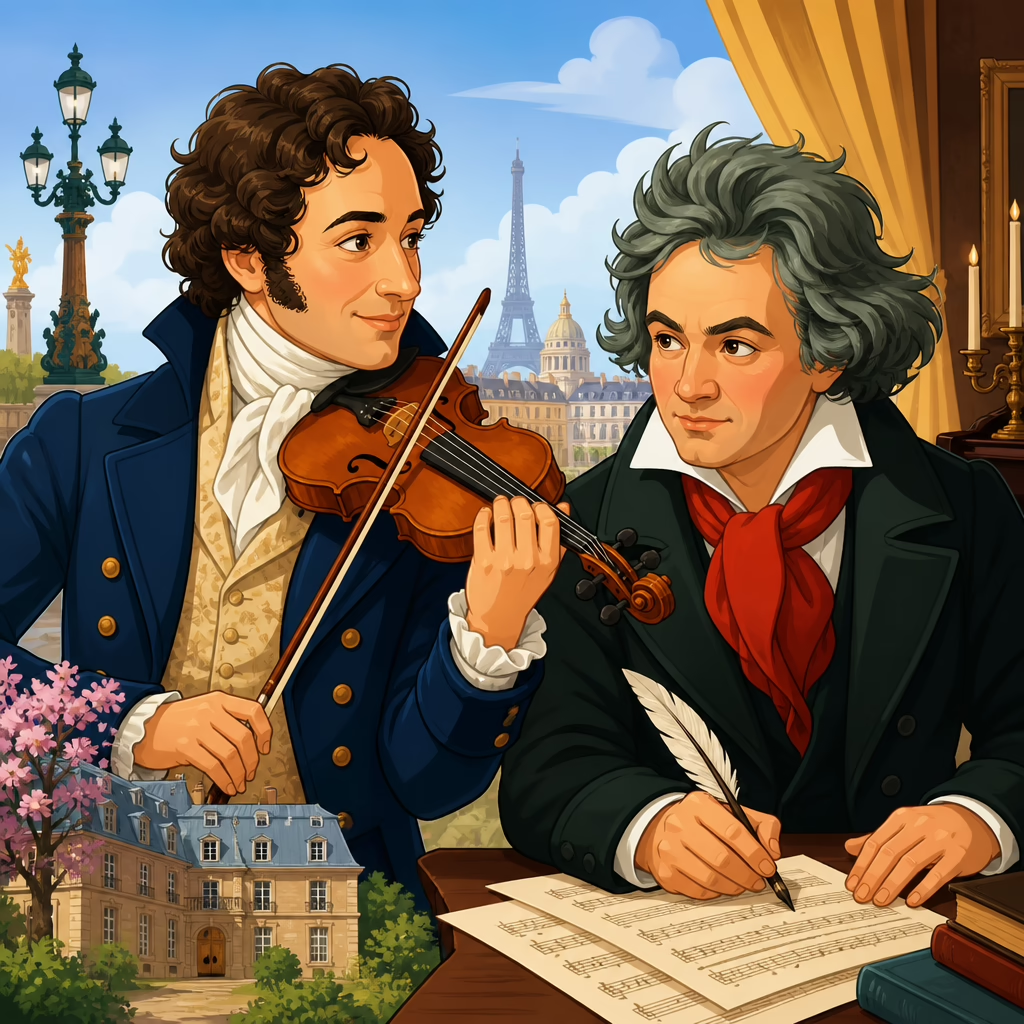
Pierre Rode and Beethoven’s French Violin Connections
Pierre Rode’s relationship to Beethoven reveals a precise and often overlooked channel through which French violin style entered the composer’s world, not as a vague cultural influence but as a set of real players, scores, performance habits, and personal encounters that shaped how Beethoven wrote for the instrument. In this focused context, “French violin connections” means the network around the Paris Conservatoire school, especially figures associated with Giovanni Battista Viotti and the generation that included Pierre Rode, Rodolphe Kreutzer, and Pierre Baillot. Beethoven did not become a French violin composer, and Rode did not redirect his musical identity; the importance lies instead in the points of contact where Beethoven measured his own violin writing against a highly developed, elegant, technically disciplined French manner.
That matters because Beethoven’s violin works sit at a crossroads. They grow from Austro-German structures, yet they were heard, judged, and sometimes first embodied by performers trained in other traditions. I have found that when musicians discuss Beethoven’s violin music only in terms of German classicism evolving toward romantic heroism, they miss how sharply he responded to violinists in front of him. Rode was one of the clearest examples. His style represented polish, line, evenness of bow, and controlled cantabile, all values central to the French school. Beethoven engaged that style directly, admired parts of it, resisted other parts of it, and in doing so clarified his own expectations for violin playing.
The subject becomes especially vivid around Beethoven’s Sonata in G major, Op. 96, written in 1812 for the French violinist Pierre Rode. This is not a minor footnote. When a composer of Beethoven’s stature tailors a sonata to a specific player, the performer’s strengths and limits become part of the work’s DNA. Contemporary reports and Beethoven’s own comments indicate that he adapted the piece to Rode’s refined manner and avoided excessive brilliance that would conflict with the violinist’s taste. That practical accommodation opens a wider historical window. Through Rode, one can see Beethoven negotiating with French aesthetics at the highest level.
Rode himself was not an isolated virtuoso. Born in Bordeaux in 1774, he studied with Viotti, the dominant formative force behind modern French violin playing. Viotti’s legacy emphasized noble tone, broad singing phrases, rhythmic command, and a bow arm capable of both brilliance and restraint. Rode carried that inheritance across Europe through performance, teaching, and publication. By the time he entered Beethoven’s orbit, he embodied a recognized school. Understanding Beethoven’s response to Rode therefore helps explain not just one sonata, but the composer’s practical knowledge of French violin ideals during a crucial middle-period moment. For a close study of Beethoven’s formative foundations before these later artistic encounters, see the broader pillar guide on Christian Gottlob Neefe and Beethoven’s earliest training.
Who Pierre Rode Was in Beethoven’s Musical World
Pierre Rode was among the most prominent violinists of his generation, and his reputation rested on more than touring prestige. He was one of the leading carriers of the Viotti tradition, a style codified through concert performance, violin methods, and the institutional influence of the Paris Conservatoire. Alongside Kreutzer and Baillot, Rode contributed to the technical and aesthetic environment that defined French violin playing around 1800. That environment favored clarity of articulation, elegance over rough display, tasteful ornament control, and a disciplined legato that projected vocal nobility rather than aggressive theatricality.
For Beethoven, this mattered because violinists were not interchangeable executants. He knew the difference between a player who excelled in brilliance, one who specialized in expressive breadth, and one whose technical profile encouraged different kinds of writing. Rode was heard as a refined aristocrat of tone. Critics often praised the grace and finish of his playing, though some later found his style emotionally cool compared with more forceful romantic approaches. That combination helps explain Beethoven’s mixed but respectful engagement with him. Rode represented excellence, but excellence of a particular type.
It is also important to place Rode chronologically. By 1812 Beethoven had already written the earlier violin sonatas, the Violin Concerto, and major chamber works requiring strong instrumental personalities. He was no novice discovering what the violin could do. If he altered his compositional manner for Rode at this stage, that choice was deliberate. It reflected practical listening experience, not deference. Beethoven understood Rode’s musical language well enough to write into it and around it.
Op. 96 as the Central Document of the Connection
The Beethoven work most closely tied to Rode is the Violin Sonata No. 10 in G major, Op. 96. Composed in 1812 for Archduke Rudolph and Rode, it stands apart from the more extroverted Kreutzer Sonata, Op. 47, and from the muscular public rhetoric listeners often associate with Beethoven’s middle years. Op. 96 is inward, conversational, and deliberately resistant to empty display. The sonata’s first movement opens not with confrontation but with poised lyric exchange. The violin enters in a manner that privileges line and blend over attack. Across the work, technical demand remains real, yet virtuosity is integrated into musical continuity rather than flung outward as spectacle.
Beethoven himself pointed toward this intention. A commonly cited remark associated with the sonata is that it should not be played too fast, especially in the final movement, because Rode did not like hurried or brilliant execution. Whether one treats every surviving wording with caution, the broader evidence aligns: Beethoven tailored the sonata to Rode’s strengths in cantabile, balance, and polished finish. The finale’s variation form is especially telling. Instead of closing with a blazing race, Beethoven chooses an architecture that lets nuance, character differentiation, and tonal poise carry the argument.
From a performer’s standpoint, Op. 96 feels like Beethoven listening to a violinist who valued sustained beauty. The writing frequently asks for long-breathed shaping, seamless register connection, and exact coordination with the piano. The result is not less Beethovenian, but Beethoven operating with a finer grain. He channels energy into texture, pacing, and motivic conversation. Rode’s influence here is best understood as catalytic: he did not soften Beethoven’s personality; he drew out one of its most cultivated forms.
How French Violin Style Appears in the Music
French violin style in Beethoven is easy to exaggerate if treated superficially. Op. 96 is not a Paris Conservatoire exercise wearing Beethoven’s name. Yet several features line up convincingly with the Rode connection. The first is cantabile priority. French violinists of the Viotti line aimed for a vocal, sustained phrase supported by bow distribution and tonal evenness. In Op. 96, the violin often sings within the texture rather than dominating it, requiring control of line rather than merely brilliance.
The second feature is elegance of articulation. Beethoven’s writing for Rode avoids the abrasive edge found in some other works and often favors supple detail. Phrasing must remain lucid even when rhythm becomes subtle. This matches the French school’s concern for polished execution and rhetorical balance. Third, there is restraint in overt virtuoso display. Difficulties are present in intonation, ensemble, and tonal control, but Beethoven does not build the sonata around public dazzle. That decision corresponds closely with what contemporaries recognized in Rode’s playing.
A practical comparison makes the point clearer:
| Feature | French violin ideal associated with Rode | How Beethoven responds in Op. 96 |
|---|---|---|
| Tone production | Even, noble, singing sound | Long melodic spans that reward sustained bow control |
| Articulation | Clarity without harshness | Refined phrase endings and balanced conversational entries |
| Virtuosity | Tasteful, integrated, not merely spectacular | Technical demands embedded in chamber dialogue, not showpiece effects |
| Tempo character | Composure over impulsive speed | Finale shaped as variations, favoring poise and differentiation |
These are not accidental overlaps. They form a coherent response to a known artist. Beethoven retained his structural command and harmonic individuality, but he presented them through a violinistic surface compatible with Rode’s artistic identity.
Rode, Kreutzer, and the Spectrum of Beethoven’s French Contacts
Rode becomes even more revealing when set beside Kreutzer. Both were French violinists linked to the Viotti tradition, yet Beethoven wrote for them very differently. The Sonata in A major, Op. 47, later nicknamed the Kreutzer Sonata, is explosive, public, and confrontational. Ironically, Kreutzer himself reportedly never played it, finding it unintelligible or excessively extravagant. That anecdote, whether slightly colored by later retelling or not, captures a truth: Beethoven could collide with French violin expectations as easily as he could collaborate with them.
With Rode, the collaboration was more exact. Beethoven did not ask him to become a vessel for pianistic thunder transferred onto strings. He wrote within a narrower expressive channel, and that channel was productive. The contrast between Op. 47 and Op. 96 demonstrates that “French violin connections” cannot be reduced to one style stamp. Beethoven encountered distinct personalities inside the same national school, then adjusted his musical rhetoric accordingly.
This distinction also corrects a common misconception. French influence on Beethoven’s violin writing did not necessarily mean increased lightness or decorative surface. In Op. 96 it meant a recalibration of how expressive seriousness could be delivered. Beethoven found a way to write chamber music of depth using means associated with grace, poise, and tonal civility. That is historically significant because it expands the usual image of him as a composer who only deepened expression through intensified struggle.
Performance History and What It Tells Us
The first performance context of Op. 96 underscores the practical nature of the Rode connection. It was intended for Archduke Rudolph at the piano and Rode on violin, a pairing that already tells us something about scale and setting. This was cultivated chamber music for elite listeners, not a public virtuoso contest. In such a context, refinement mattered as much as projection. Beethoven knew the social and acoustic environment in which the sonata would live initially, and Rode’s manner fit that environment.
Accounts of Rode later in life suggest that his playing, though still admired, could seem reserved when compared with emerging romantic expectations. That retrospective judgment should not be projected too crudely backward. In Beethoven’s time, restraint was not deficiency. It could signify finish, authority, and style. Modern players sometimes misread Op. 96 by trying to impose dramatic weight through enlarged tone and urgent tempo. The sonata can bear intensity, but its intensity often lies in exact proportion, transparent texture, and the tension between intimacy and sophistication.
Historically informed performers have increasingly recognized this. Using classical bows, lighter setup, and speech-based phrasing, they often reveal how naturally the sonata aligns with a refined French-inflected violin aesthetic. The goal is not to imitate Rode exactly, which is impossible, but to understand why Beethoven avoided a more declamatory profile. The score rewards moderation in vibrato, carefully terraced dynamics, and rhythmic buoyancy. Those choices make the French connection audible rather than merely academic.
Why This Connection Still Matters
Pierre Rode matters in Beethoven studies because he shows the composer responding to living performers with unusual precision. The French violin connection is not a decorative side issue; it helps explain why Op. 96 sounds the way it does and why Beethoven’s violin output cannot be read as a single uninterrupted march toward greater force. Through Rode, we hear Beethoven valuing elegance, cultivated tone, and measured virtuosity without sacrificing structural depth. That balance is the real lesson.
The connection also sharpens how we listen across Beethoven’s career. It reminds us that influence often works through collaboration, not imitation. Rode brought with him the authority of the Viotti school and the prestige of French violinism at its peak. Beethoven answered not by copying that school, but by composing a sonata that translated its strengths into his own language. The result is one of his most subtle chamber works and one of the clearest documents of cross-European musical exchange in the early nineteenth century.
If you want to understand Beethoven more accurately, follow the performers around him as closely as the scores themselves. Rode is one of the most revealing guides. Revisit Op. 96 with his sound world in mind, compare it with Op. 47, and listen for how Beethoven reshapes expression when the violinist before him speaks French through the bow. That comparison turns a historical footnote into a vital insight, and it makes the sonata’s poise feel not accidental but profoundly intentional.
Frequently Asked Questions
Who was Pierre Rode, and why does he matter in discussions of Beethoven’s French violin connections?
Pierre Rode was one of the leading violinists of the early nineteenth century and a central representative of the French violin school that emerged around Giovanni Battista Viotti and the Paris Conservatoire. He was not simply a famous touring virtuoso whose name happened to cross Beethoven’s path. He mattered because he embodied a specific style of violin playing: elegant but disciplined phrasing, a cultivated singing tone, clear articulation, controlled bow distribution, and a strong concern for line rather than empty display. When scholars and listeners talk about Beethoven’s “French violin connections,” Rode is one of the most concrete figures in that story because he links Beethoven to real performance practice rather than to a vague idea of French taste.
Rode’s importance also lies in the fact that Beethoven knew his playing and wrote with him in mind. That is a much stronger historical connection than general awareness of trends abroad. Through Rode, Beethoven encountered not only a performer but an entire network of assumptions about what violin music could sound like and how it could be projected in performance. This included the legacy of Viotti, the pedagogical methods and aesthetics associated with the Paris Conservatoire, and a broader Franco-European circulation of violin repertory and technique. In other words, Rode matters because he serves as a visible channel through which Beethoven could absorb living aspects of the French violin tradition and translate them into his own musical language.
How exactly did Beethoven’s contact with Rode influence the way he wrote for the violin?
The influence is best understood not as imitation, but as adaptation. Beethoven did not suddenly become a French composer, nor did he abandon his own musical priorities. Instead, his contact with Rode sharpened his sense of what a top-level violinist trained in the French tradition could do expressively and technically. That meant writing that relied on refined cantabile playing, sustained line, balanced phrase architecture, and nuanced articulation rather than constant bravura for its own sake. Beethoven’s violin writing in this context often seems aware of a player who values poise, tonal beauty, and expressive restraint as much as technical command.
A particularly important example is the Violin Sonata in G major, Op. 96, which is closely associated with Rode. This sonata is often described as more inward, lyrical, and conversational than some of Beethoven’s earlier works in the genre. That character is not accidental. It aligns well with what contemporary observers associated with Rode’s playing: polish, sweetness of tone, nobility of utterance, and a dislike of rough or aggressively theatrical effects. Beethoven appears to have calibrated elements of the work with that style in mind. The result is violin writing that asks for subtle inflection, long-breathed melodic control, and elegance within complexity. So the effect of Rode on Beethoven was not merely personal or anecdotal; it helped shape the expressive profile of actual compositions.
What does “French violin style” mean in Beethoven’s time, and how was Rode connected to it?
In Beethoven’s era, “French violin style” referred to a recognizable artistic and pedagogical tradition, not just to nationality. Its roots ran strongly through Giovanni Battista Viotti, whose playing and compositions had enormous influence on violinists active in Paris, and through the institutional culture of the Paris Conservatoire. This tradition emphasized beautiful tone production, clarity of execution, carefully graded dynamics, disciplined bowing, expressive but controlled ornamentation, and a preference for noble, vocal phrasing. It cultivated brilliance, certainly, but generally brilliance governed by taste and formal proportion.
Rode was one of the most visible heirs to that tradition. Alongside figures such as Pierre Baillot and Rodolphe Kreutzer, he helped define the violin culture associated with the Conservatoire generation. He was therefore more than an individual celebrity; he was a carrier of a method, a sound ideal, and a repertorial outlook. When Beethoven encountered Rode, he was effectively encountering a mature branch of the Viotti-influenced French school. That matters because it clarifies what “French violin connections” really means in this context. It means Beethoven’s exposure to a concrete community of players, educational ideas, and stylistic habits that were already shaping European violin performance at the highest level. Rode’s role makes the connection historically specific and musically traceable.
Why is Beethoven’s relationship with Rode considered an overlooked but important historical link?
It is often overlooked because broad narratives about Beethoven tend to focus on Austro-German traditions, heroic individuality, or the larger arc of his symphonic and pianistic achievements. In those stories, violin writing can seem secondary, and transnational performance networks can disappear from view. But Beethoven lived and worked in a Europe connected by travel, publication, diplomacy, and virtuoso circulation. In that world, performers were not passive recipients of scores. They influenced what composers heard, what they expected from instruments, and what kinds of musical gestures seemed viable or desirable. Rode stands out as one of the clearest examples of this process.
The importance of the link lies in its precision. Rather than speaking loosely about “French influence,” the Beethoven-Rode connection points to direct artistic contact and to identifiable stylistic consequences. It allows us to see how Beethoven’s violin writing could respond to a performer shaped by the French school’s technical and expressive ideals. It also reminds us that Beethoven’s creative environment was more international than simplified textbook accounts suggest. Once Rode is placed back into the picture, Beethoven’s engagement with violin writing looks less isolated and more dialogic, shaped by encounters with major players whose styles carried institutional and national traditions with them.
Which works or musical features best show Beethoven absorbing these French violin connections through Rode and his circle?
The most frequently cited work is the Violin Sonata No. 10 in G major, Op. 96, written for performance by Rode. It is one of the clearest windows into Beethoven’s responsiveness to a French-trained violinist’s strengths and preferences. Compared with more overtly dramatic or confrontational Beethoven works, Op. 96 often unfolds with unusual tact, lyric refinement, and chamber-like balance. The violin and piano interact in a way that prizes conversation over contest. The melodic writing asks for poise, evenness, and singing tone, all qualities strongly associated with the French school represented by Rode.
Beyond any single piece, the relevant musical features include supple cantabile lines, finely differentiated articulations, transparent textures that let bow nuance matter, and passagework that rewards grace and finish instead of sheer force. These are not superficial details. They shape the listener’s entire impression of the music. In works touched by this aesthetic, Beethoven’s violin writing can seem especially sensitive to the instrument’s vocal capacity and to the expressive use of restraint. That does not mean the music lacks depth or originality; on the contrary, it shows Beethoven integrating external performance traditions into his own highly personal language. Looking at Rode and the French violin network helps explain why some of Beethoven’s violin music speaks with such polish, elegance, and subtle expressive control, even while remaining unmistakably Beethoven.