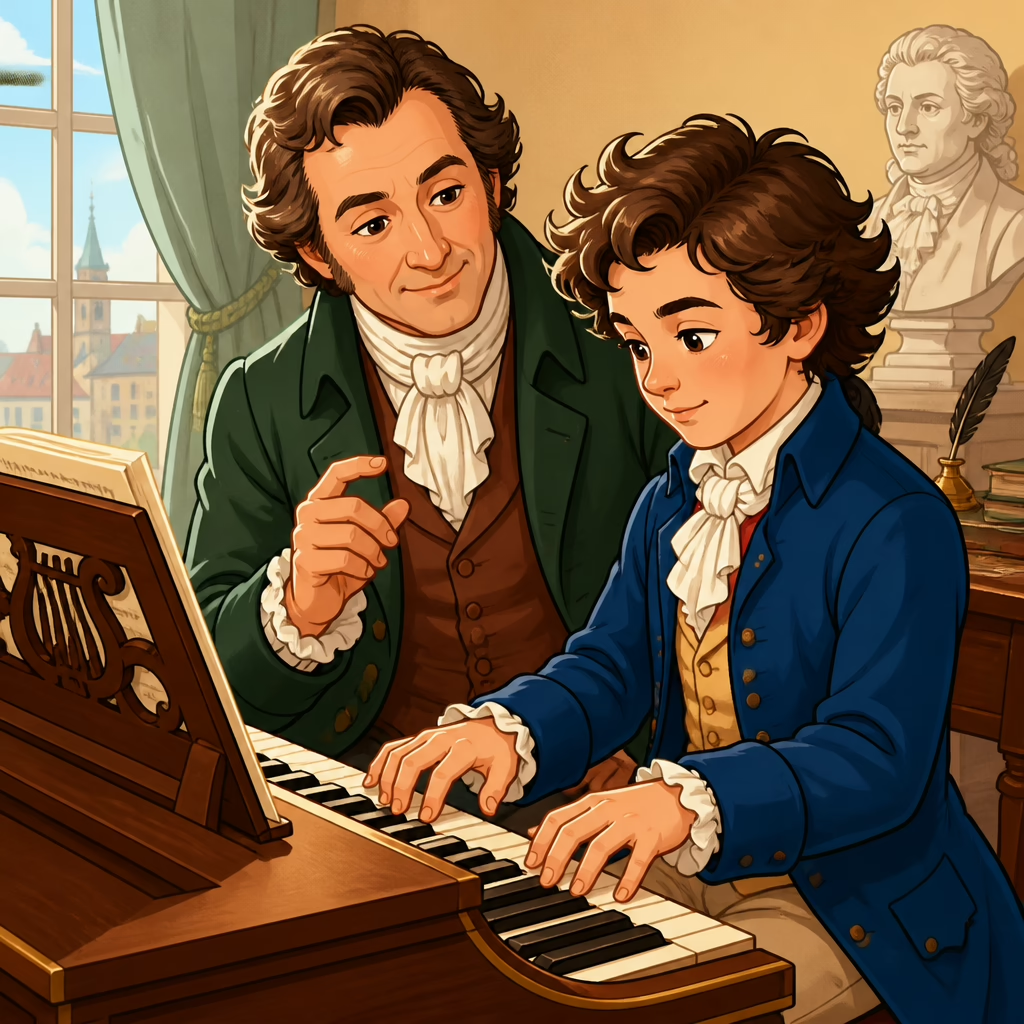
Christian Gottlob Neefe and Beethoven’s Earliest Training
Christian Gottlob Neefe stands at the threshold of Ludwig van Beethoven’s career as the teacher who recognized unusual promise, supplied disciplined keyboard and composition training, and connected the young musician in Bonn to the wider intellectual and artistic world that shaped late eighteenth-century German music. Any serious account of Beethoven’s development must begin not in Vienna with Haydn, Mozart’s shadow, or heroic middle-period masterworks, but in the Rhineland court culture where Neefe worked as organist, conductor, writer, and educator. Beethoven’s earliest training was not a vague apprenticeship under an older Kapellmeister. It was a concrete formation in keyboard technique, figured bass, counterpoint, repertoire, literary taste, and professional conduct, and Neefe was the central organizing force in that process.
Understanding Neefe matters because early instruction leaves deep marks that remain audible long after the student surpasses the teacher. When I trace Beethoven’s habits back to their sources, I repeatedly return to skills that do not appear out of nowhere: the ability to improvise at the keyboard, readiness to accompany from figured bass, interest in Bach and Handel, comfort with variation form, confidence in public performance, and the practical discipline required of a court musician. These were cultivated in Bonn. The phrase “earliest training” refers not simply to childhood lessons but to the decisive years in which a talented adolescent moved toward professional competence. In Beethoven’s case, that means the period in the Electorate of Cologne, especially the early 1780s, when Neefe entered his life and began directing his education more systematically than Beethoven’s father had done.
Neefe himself deserves definition beyond the brief label of “Beethoven’s first important teacher.” Born in 1748 in Chemnitz, Christian Gottlob Neefe was a German musician and man of letters associated with Enlightenment culture. He studied law before turning fully toward music and theater, a path that helps explain his unusual breadth. He worked in Leipzig, became connected with theatrical activity, and eventually served at the electoral court in Bonn. There he rose to prominence as court organist and later held responsibilities that included directing performances. He was not one of the century’s canonical great composers, but he was exactly the kind of cultivated, versatile musician who transmitted style, method, and repertoire across generations. Such figures often matter more to development than to posterity.
This subject also belongs within the larger field of influences and contemporaries, because Beethoven did not develop in a vacuum or through one master alone. Neefe’s significance lies partly in what he represented: a channel through which the young Beethoven encountered Johann Sebastian Bach, Carl Philipp Emanuel Bach, Handel, keyboard pedagogy, Protestant intellectual seriousness, and the working realities of German court music. Around Neefe stood other forces: Beethoven’s father Johann, court patrons such as Maximilian Franz, fellow Bonn musicians, visiting performers, and the broader network of Enlightenment-era reading circles and theater culture. To understand Neefe properly is therefore to understand how a provincial court could still be artistically fertile and how a teacher can shape a genius by building foundations rather than dictating final style.
This article examines Neefe’s life, Beethoven’s Bonn environment, the practical content of the young composer’s studies, the works and methods that marked his training, and the circle of contemporaries that framed those years. It also addresses a common question directly: did Neefe “make” Beethoven? No. Beethoven’s genius was his own, and his later originality exceeded any single teacher’s program. Yet another direct answer is equally important: without Neefe’s instruction, advocacy, and example, Beethoven’s path into professional musicianship would almost certainly have been slower, narrower, and less intellectually grounded. The relationship was formative because it transformed raw ability into disciplined capacity.
Table of Contents
| Section | Focus | Why It Matters |
|---|---|---|
| Christian Gottlob Neefe | Biography, court career, intellectual profile | Shows what kind of mentor Beethoven had |
| Bonn in the 1780s | Electoral court, church music, theater, patronage | Explains the ecosystem of Beethoven’s earliest training |
| Teacher and Student | How Neefe taught Beethoven | Clarifies the practical content of lessons |
| Repertoire and Technique | Bach, Handel, keyboard playing, improvisation | Connects instruction to Beethoven’s later strengths |
| Early Works and Opportunities | Publications, organ duties, court service | Shows training becoming professional experience |
| Influences and Contemporaries | Family, colleagues, patrons, wider musical currents | Places Neefe within Beethoven’s broader formation |
| Lasting Legacy | What endured after Bonn | Explains Neefe’s continuing importance in Beethoven studies |
Christian Gottlob Neefe: The Teacher Behind the Beginning
Neefe came from the generation between the high Baroque masters and the mature Classical titans, and that middle position is crucial. He was young enough to participate in newer keyboard and theatrical styles, yet old enough to transmit older contrapuntal traditions with seriousness. His early legal studies suggest methodical training, and his work in theater points to practical flexibility. By the time he arrived in Bonn in 1779, he had experience that combined composition, performance, rehearsal leadership, and literary engagement. This was ideal preparation for mentoring an exceptionally gifted adolescent who needed not only musical drills but entry into a profession.
At the electoral court in Bonn, Neefe served first as court organist and later took broader responsibilities while the Kapellmeister Andrea Luchesi remained an important official figure. Court service in this setting demanded versatility. A musician might play organ for liturgy, rehearse singers, accompany instrumentalists, compose or adapt pieces, prepare theatrical performances, and teach younger players. Neefe’s posts therefore made him more than a private instructor. He occupied a node where sacred music, secular entertainment, administration, and education met. Beethoven’s access to him meant access to the machinery of professional music-making.
Neefe was also associated with Enlightenment ideals that encouraged reading, reflection, and intellectual exchange. Sources connect him with literary interests and with circles that valued education beyond narrow craft. That matters because Beethoven’s development in Bonn included contact with educated laymen and reform-minded aristocrats, not just technical practice. The result was an early formation in which music belonged to a wider world of ideas. Later Beethoven’s notebooks, literary interests, and moral seriousness would seem entirely his own, but Bonn already offered models of the thinking musician, and Neefe was among them.
One of the most frequently cited pieces of evidence for Neefe’s regard for Beethoven is his 1783 notice in Cramer’s Magazin der Musik, where he praised the boy in terms that have echoed through music history. Neefe described the eleven-year-old, or perhaps nearly twelve-year-old, Beethoven as a talent of promise who would surely become a second Wolfgang Amadeus Mozart if he continued as he had begun. The comparison was not casual. In the eighteenth century, Mozart represented astonishing precocity joined to compositional and keyboard mastery. By invoking that benchmark publicly, Neefe did two things at once: he testified to Beethoven’s ability and he signaled to readers that Bonn housed a prodigy worthy of attention.
Bonn as a Training Ground for Young Beethoven
Beethoven was born in Bonn in 1770 into a family already linked to court music. His grandfather, also named Ludwig van Beethoven, had been a respected Kapellmeister and remained a symbolic figure of professional dignity in family memory. His father Johann van Beethoven worked as a tenor at court and gave the boy his first instruction, but Johann’s teaching was uneven and was complicated by financial strain and alcoholism. By the time Neefe assumed a major role, Beethoven had shown ability but needed steadier discipline and broader artistic direction than his father could provide.
The Bonn of Beethoven’s youth was not Vienna, but it was far from musically barren. As the seat of the Elector of Cologne, it maintained a court chapel, orchestral resources, theatrical life, and a culture of educated administration. The accession of Archduke Maximilian Franz as Elector in 1784 further encouraged reformist tendencies and a more cultivated environment. Court musicians performed sacred works, accompanied liturgy, presented instrumental music, supported opera, and interacted with local elites. For a gifted youth, this was an unusually rich apprenticeship site because responsibilities could arrive early.
I find that modern readers often underestimate the educational power of such a court because they imagine greatness emerging only in capital cities. Yet the structure of eighteenth-century musical labor meant that provincial centers could offer precisely the hands-on experience a teenager needed. In Bonn, Beethoven learned by doing. He was not merely practicing scales in isolation. He was hearing liturgical music in real time, watching professionals rehearse, covering duties at the organ, absorbing operatic style, and understanding how musicians served both church and state. That combination of observation and participation gave his training practical depth.
The environment also connected music to social mobility. A talented youth in court service could gain patronage, recommendation letters, travel opportunities, and eventual access to larger markets. Neefe understood this clearly. Training Beethoven was not just about making him a better keyboard player for local use. It was about preparing him for recognition beyond Bonn. The publication of early works, public appearances, and introductions to patrons all formed part of that developmental ladder. A teacher in this world had to identify not only what a student could play, but what career path his abilities justified.
How Neefe Taught Beethoven
Precise lesson notes do not survive in the modern pedagogical sense, but the outline of Neefe’s teaching can be reconstructed from Beethoven’s duties, early publications, repertory, and later strengths. The instruction clearly included keyboard study at a high level, organ practice, figured bass, composition, and the study of model works. In eighteenth-century terms, this was a comprehensive musician’s training rather than a specialized conservatory track. A young player learned to read, realize, transpose, improvise, accompany, and compose because professional life demanded all of it.
Keyboard training under Neefe would have involved touch, articulation, fingering habits suited to the instruments of the day, and, above all, fluency. On clavichord, harpsichord, and emerging fortepiano instruments, expressive control required a refined physical technique different from that of the modern concert grand, but mental agility mattered just as much. Beethoven had to learn to read rapidly, navigate patterns, manage ornaments, and sustain coherence in performance. Organ work added pedal discipline, registration awareness, and a heightened sense of contrapuntal line. These skills nourished the structural hearing later evident in Beethoven’s writing.
Figured bass was central. A modern student often begins with fully written scores, but in Beethoven’s youth a competent musician was expected to derive harmonic realization from shorthand notation. This trained the ear, the hand, and the mind simultaneously. By realizing bass lines, the student internalized harmonic progression, voice leading, and texture. It also cultivated improvisatory reflexes. When Beethoven later displayed extraordinary command of harmony and accompaniment patterns, that did not come solely from inspiration. It emerged from the routine discipline of continuo practice and keyboard realization that teachers like Neefe enforced.
Composition lessons likely proceeded through imitation, variation, and the study of formal models. Before a student could invent freely, he needed to understand phrase structure, cadence types, sequence, binary and ternary designs, dance forms, and the logic of thematic development as then practiced. The publication of Beethoven’s Dressler Variations in 1783 suggests training in variation technique, a standard pedagogical path because it taught both invention and control. Taking an existing theme and reshaping it in several distinct ways demanded harmonic awareness, keyboard command, and sensitivity to character, all within manageable dimensions.
Neefe’s method almost certainly involved exposure to exemplary composers rather than isolated exercises alone. Eighteenth-century pedagogy relied heavily on copying, arranging, memorizing, and performing recognized models. For Beethoven, the most decisive of these was Johann Sebastian Bach, especially The Well-Tempered Clavier. Later accounts indicate that Beethoven knew Bach’s preludes and fugues early. Neefe’s role here cannot be overstated. To place Bach before a gifted youth in the 1780s was to offer a rigorous school of counterpoint, keyboard architecture, and tonal thinking. The discipline of studying fugue subjects, invertible textures, and long-range harmonic direction left lasting marks on Beethoven’s musical language.
Repertoire, Bach, and the Discipline of Form
The association between Neefe and Bach repertory is one of the most important facts in Beethoven’s early formation. The Well-Tempered Clavier was not simply a prestigious book on a shelf. It was a method of training the musical mind. Each prelude and fugue presents a compact lesson in harmony, voicing, motivic concentration, and formal proportion. A young player who learned from it absorbed a way of thinking in which every note participates in an ordered argument. Beethoven’s later capacity to build large spans from terse motives has many sources, but Bach study in Bonn belongs near the top of the list.
Handel also mattered, especially as a model of grandeur, choral solidity, and contrapuntal strength. Beethoven’s mature reverence for Handel is well documented, and the seed of that admiration was planted early. Neefe, as a cultivated German Kapellmeister, stood within a tradition that still treated Handel and Bach as monuments of learned style. This did not mean rejecting newer Classical idioms. Rather, it meant that the young Beethoven encountered old and new together: contrapuntal rigor beside galant clarity, expressive empfindsamer turns beside more public ceremonial writing. That blend helped make his later style unusually broad.
Another likely influence in Neefe’s teaching orbit was Carl Philipp Emanuel Bach, whose keyboard works and treatises embodied expressive nuance, surprising rhetoric, and flexible phrase shaping. C. P. E. Bach’s Versuch über die wahre Art das Clavier zu spielen was one of the period’s essential keyboard authorities. Even where direct documentary proof is limited, the pedagogical environment Neefe inhabited was one in which such sources mattered. Beethoven’s eventual command of rhetorical contrast, sudden dynamic energy, and searching slow-movement expression makes more sense when placed against that northern German tradition of sensitive keyboard speech.
Form in Beethoven’s earliest training was therefore not abstract theory detached from sound. It was learned through repertoire. A prelude taught harmonic pacing. A fugue taught subject handling. A variation set taught ornamental and structural transformation. A sonata movement taught thematic contrast and tonal planning. Church accompaniment taught practical voice leading under pressure. What makes Neefe’s contribution remarkable is not that he gave Beethoven one secret lesson, but that he immersed him in a curriculum where craft became habit. Later, when Beethoven stretched sonata form or intensified variation technique, he was transforming principles first made secure in youth.
Early Works, Court Duties, and the Move from Student to Professional
Training became visible in output. Beethoven’s first published work, the Nine Variations on a March by Ernst Christoph Dressler, WoO 63, appeared in 1783, when he was still very young. The choice of genre is revealing. Variation writing was both accessible and demanding. It allowed a student composer to demonstrate invention while staying tethered to a recognizable theme. In these variations, one already sees a competent handling of keyboard texture and a willingness to push beyond mere ornament. While no one would mistake them for mature Beethoven, they show that Neefe’s instruction had moved composition from exercise to public artifact.
That same year, the three early piano sonatas usually known as the Kurfürstensonaten, dedicated to the Elector, were completed and published shortly afterward. Their attribution once raised questions because of the composer’s youth, but they are accepted as genuine early Beethoven. These works reveal ambition. The young composer was not confined to miniatures; he was attempting multi-movement sonatas, engaging with current keyboard style, and presenting himself through print. Publication in the eighteenth century required money, connections, confidence, and advocacy. Neefe’s support and the court environment made that possible.
Professional responsibility arrived early as well. Beethoven served as assistant organist and at times deputized for Neefe, especially when the latter was absent. This mattered enormously. Nothing accelerates growth like real responsibility in worship services or court functions where mistakes are public and timing is fixed. A teenager covering organ duties had to be dependable, not merely talented. He had to start on cue, support singers, manage transitions, and sustain composure. Such work trains concentration in ways private study cannot match.
By 1784 Beethoven had been appointed assistant court organist, a formal sign that his abilities were recognized institutionally. This appointment is one of the clearest indicators that Neefe’s mentorship had produced professional trust. Courts did not hand such duties to a child merely for novelty. They needed utility. Beethoven could deliver it. He was becoming a working musician capable of contributing to the chapel and theater apparatus. That practical grounding helps explain why, when he later arrived in Vienna, he was more than a dazzling improviser. He already knew how musical labor functioned within a professional hierarchy.
Influences and Contemporaries in Bonn
Although Neefe was central, Beethoven’s earliest training unfolded amid several overlapping influences. Johann van Beethoven, for all his failings, initiated the boy into music and pushed him toward discipline, sometimes harshly. Family pressure, unstable though it was, created urgency. Beethoven’s grandfather, already dead by the time these decisive years unfolded, remained a powerful emblem of professional seriousness. Portraits and family memory made him a model of what a court musician could be. Even absent figures can influence a young artist by embodying standards the household continues to revere.
At court, Andrea Luchesi formed part of the musical background, though his exact direct role in Beethoven’s instruction remains debated. As Kapellmeister, he represented the established order into which Beethoven was entering. Court singers, string players, and wind players likewise influenced the young composer simply by surrounding him with sound and craft. Beethoven’s later sensitivity to winds, for example, can be understood partly through the quality of the Bonn Hofkapelle, whose players were well regarded. A gifted composer does not learn instrumental writing only from books; he learns by hearing actual players phrase, blend, and project.
Political and aristocratic figures also mattered. Elector Maximilian Franz supported educational and cultural initiatives and helped maintain a climate in which talented musicians could be cultivated. Count Ferdinand von Waldstein, though more important slightly later as Beethoven prepared to leave for Vienna, belongs in the Bonn circle that recognized his potential. Patronage in this period was not optional decoration. It provided the financial and social mechanism by which instruction could turn into opportunity. Neefe’s advocacy worked because patrons and administrators were prepared to notice.
The literary and intellectual circles of Bonn should not be overlooked. Beethoven became connected with educated friends including members of the Breuning family, whose home offered refinement, conversation, and emotional stability that contrasted sharply with difficulties in his own household. Such environments broadened taste. They encouraged reading, social ease, and contact with ideas beyond daily court routine. Neefe’s own Enlightenment orientation makes it likely that he reinforced, rather than contradicted, this widening of Beethoven’s cultural horizon. Early training was therefore moral and intellectual as well as technical.
What Beethoven Carried Forward from Neefe
When Beethoven left Bonn for Vienna permanently in 1792, he entered a new phase under larger public scrutiny and in contact with more famous teachers, especially Haydn, Albrechtsberger, and Salieri. Yet the groundwork from Bonn remained visible. His command of keyboard improvisation, which astonished Viennese listeners, rested on years of practical fluency. His attraction to counterpoint, sharpened later through formal study, had already been seeded by Bach. His seriousness about compositional craft was not a Viennese invention. It was part of the mentality Neefe had helped cultivate.
One can hear this continuity in Beethoven’s lifelong engagement with variation form, fugato textures, learned counterpoint, and keyboard-centered invention. From the early published variations to the Diabelli Variations, from youthful sonatas to the late piano works, the impulse to transform concise material with structural intelligence never disappears. Likewise, the eventual grandeur of works such as the Missa solemnis and the late quartets does not spring from nowhere. Their confidence in handling dense polyphony reflects a long relationship with contrapuntal thinking that began early, even if it later expanded far beyond Neefe’s reach.
Neefe’s legacy also includes something less tangible but equally important: professional self-conception. Beethoven learned that a musician could be intellectually serious, practically competent, and socially engaged. He learned to see repertoire as a source of study, not just entertainment. He learned that publication and public duty mattered. He learned that praise from a respected senior figure could open doors, but only if the work justified it. These are durable lessons. In my view, they help explain the unusual combination in Beethoven of fierce individuality and relentless craft consciousness.
It would be misleading, however, to portray Neefe as the sole architect of Beethoven’s greatness. Teachers provide foundations, not finished monuments. Beethoven’s later radical expansion of form, harmony, expressive range, and musical rhetoric exceeded anything visible in Neefe’s own surviving compositions. The student outgrew the teacher, as history’s greatest students often do. But outgrowing a teacher does not diminish the teacher’s importance. It confirms that the instruction was strong enough to support independent ascent. Neefe’s achievement lies in recognizing what Beethoven could become and giving him the tools, repertory, and early opportunities to begin becoming it.
Why Neefe Still Matters in Beethoven Studies
Christian Gottlob Neefe matters because he anchors Beethoven’s story in concrete early training rather than myth. He reminds us that genius develops through teachers, institutions, repertory, and work. In Bonn, Neefe guided Beethoven from raw promise toward disciplined musicianship by teaching keyboard fluency, figured bass, composition, organ practice, and the study of Bach and other major models. He advocated for him publicly, helped create paths to publication, and trusted him with real professional responsibilities. Those contributions are historically specific and musically consequential.
The broader lesson is equally valuable. Influences and contemporaries do not diminish originality; they explain how originality acquires means. Beethoven’s later independence was built on foundations laid by family pressure, court culture, patrons, colleagues, repertory, and above all Neefe’s mentorship. To understand Beethoven’s earliest training is to hear the future master not as an isolated miracle, but as a young musician shaped by disciplined study in a vibrant if often underestimated Bonn environment. If you want to understand Beethoven more deeply, start where his craft began: with Neefe, the teacher who saw the path before the world did.
Frequently Asked Questions
Who was Christian Gottlob Neefe, and why is he so important in Beethoven’s early life?
Christian Gottlob Neefe was one of the most decisive figures in Ludwig van Beethoven’s childhood and adolescent musical formation. A composer, keyboard player, conductor, and intellectual active at the electoral court in Bonn, Neefe entered Beethoven’s life at the exact moment when raw talent needed structure, discipline, and opportunity. While Beethoven’s father had introduced him to music and pushed him toward public performance, it was Neefe who recognized that the young musician possessed something far beyond ordinary promise. He did not simply teach Beethoven how to play better; he helped shape him into a thinking musician.
Neefe’s importance lies in the breadth of his influence. He trained Beethoven in keyboard playing, guided him in composition, and exposed him to a more serious understanding of musical craft. Just as significantly, he helped place Beethoven within the cultural world of Bonn’s enlightened court, where literature, philosophy, and new artistic ideas circulated alongside music. This mattered enormously. Beethoven was not formed in isolation as a child prodigy alone at the keyboard. He developed in an environment where artistic seriousness and intellectual ambition reinforced one another, and Neefe was one of the main conduits to that environment.
In practical terms, Neefe also gave Beethoven responsibilities and visibility. He allowed the young musician to assist him and step into professional roles at court, which accelerated Beethoven’s growth from talented student to working musician. Because of this, Neefe was more than a teacher in the narrow sense. He was mentor, advocate, and gatekeeper to the wider musical world. Any account of Beethoven’s development that jumps straight to Vienna misses this essential truth: before Beethoven became the revolutionary composer history celebrates, he was a gifted Bonn musician whose earliest serious formation came under Neefe’s guidance.
What kind of musical training did Neefe give Beethoven?
Neefe’s training seems to have combined technical discipline with intellectual seriousness, a combination that proved foundational for Beethoven’s later career. At the keyboard, Beethoven was not merely drilled in dexterity or performance display. He was trained to think about musical structure, style, and expression. This kind of instruction would have included familiarity with repertory central to late eighteenth-century keyboard culture, especially works that cultivated contrapuntal awareness, harmonic control, and clarity of form. One of the most often cited elements of Neefe’s influence is his encouragement of Beethoven’s study of Johann Sebastian Bach, especially The Well-Tempered Clavier, which became a lifelong touchstone for Beethoven.
That detail is especially revealing. Exposure to Bach at an early stage meant that Beethoven’s musical imagination was grounded not only in current taste but also in a deep tradition of keyboard writing and contrapuntal craft. Under Neefe, Beethoven learned to hear music as an organized language rather than simply as melody and accompaniment. This kind of training is crucial for understanding why Beethoven, even when very young, showed unusual command in improvisation, variation, and eventually large-scale composition.
Neefe also appears to have guided Beethoven in composition directly. This would have involved exercises in harmony, figured bass, form, and probably the imitation of established models. In the eighteenth century, composition was learned through practice, correction, and internalization of style, not through inspiration alone. Neefe helped Beethoven acquire those tools. Just as importantly, he seems to have trusted him with real musical work, including keyboard duties and compositional tasks connected to court life. That transition from study to practice is one reason Beethoven matured so quickly. He was learning not only in lessons but in the living context of performance, administration, and professional music-making.
How did Neefe help Beethoven move beyond simple talent into a professional musician’s world?
One of Neefe’s greatest contributions was that he did not treat Beethoven merely as a gifted child to be admired. He treated him as someone who could be prepared for serious musical labor. In Bonn, this made a profound difference. The electoral court offered a functioning musical institution, and Neefe helped Beethoven gain access to it from the inside. By involving him in professional duties and recognizing his reliability as well as his talent, Neefe accelerated Beethoven’s development in ways that private lessons alone never could have done.
As Beethoven grew older, he took on practical responsibilities that exposed him to the realities of a musician’s working life: accompanying, playing organ and keyboard, assisting with rehearsals, reading music quickly, adapting to court expectations, and handling repertory in a disciplined way. These experiences built confidence and competence. They also taught him that music was not only a vehicle for expression but a profession requiring consistency, technical command, and social intelligence. This grounding helps explain Beethoven’s later resilience. Even as he became a more independent and forceful artistic personality, he had been trained from early on to function within demanding musical systems.
Neefe also advocated for Beethoven publicly. His recognition of the young musician’s gifts gave Beethoven credibility in a courtly environment where patronage, recommendation, and reputation mattered. Such endorsement was especially important in the late eighteenth century, when careers were shaped by networks as much as by ability. By presenting Beethoven as a worthy and promising musician, Neefe helped him move from local prodigy to emerging professional. That shift was essential. Before Beethoven could become a composer of European importance, he first had to become visible, employable, and respected within Bonn’s cultural infrastructure, and Neefe played a direct role in making that happen.
What was the cultural environment in Bonn, and how did Neefe connect Beethoven to it?
Bonn in Beethoven’s youth was far from a cultural backwater. As the seat of the Elector of Cologne, it sustained a court culture in which music, theater, literature, and intellectual life intersected. The late eighteenth century was a period shaped by Enlightenment currents, and Bonn participated in that broader German-speaking world of reformist thought, cultivated taste, and artistic ambition. This setting matters because Beethoven’s earliest formation took place not in isolation from ideas, but within a courtly and educated milieu that valued both performance and intellect.
Neefe was especially important as Beethoven’s bridge into that world because he himself was more than a practical musician. He belonged to a generation of musicians for whom art was tied to reading, philosophy, and broader cultural engagement. Through him, Beethoven encountered an atmosphere in which music was connected to drama, literature, and civic thought. This kind of environment likely deepened Beethoven’s sense that a musician could be more than an entertainer or servant. It encouraged the idea of the artist as a serious cultural participant, a notion that would later become central to Beethoven’s self-conception.
The Bonn circle around the court included people interested in opera, poetry, political ideas, and new forms of public culture. Neefe’s role in introducing Beethoven to this atmosphere helped widen the young musician’s horizons. It is easier to understand Beethoven’s later intensity, idealism, and intellectual ambition when we remember that his foundations were laid in a place where music was embedded in a broader conversation about human feeling, education, and modernity. Neefe did not create all of that by himself, of course, but he helped Beethoven enter it, absorb it, and benefit from it at a formative age.
Why should any biography of Beethoven begin with Neefe rather than only with Vienna, Haydn, or Mozart’s influence?
Because Beethoven’s achievements in Vienna make the most sense only when viewed against the training and cultural preparation he received in Bonn. It is tempting to begin his story with the famous names and major turning points: Mozart’s aura, Haydn’s instruction, the move to Vienna, the symphonies, the sonatas, the heroic style. But that approach can distort Beethoven’s development by implying that greatness arrived suddenly once he entered the imperial capital. In reality, Vienna refined, challenged, and expanded capacities that had already been seriously cultivated. Neefe was central to that earlier stage.
By the time Beethoven left Bonn, he was not an unformed provincial talent awaiting discovery. He was already an accomplished keyboard player, an able improviser, a developing composer, and a musician with firsthand experience in a professional court environment. He had encountered Bach, absorbed compositional discipline, participated in practical music-making, and been introduced to a culture that linked art with intellect. Those things did not happen automatically, and they did not happen primarily in Vienna. They happened under the influence of teachers and mentors in Bonn, above all Neefe.
Starting with Neefe also restores a more accurate picture of artistic formation. Great composers do not emerge from mythic genius alone; they are shaped by institutions, teachers, repertories, and cultural conditions. Neefe recognized what Beethoven could become and supplied early tools that proved lasting: rigor at the keyboard, respect for counterpoint, seriousness about composition, and access to a wider artistic community. In that sense, Neefe belongs at the beginning of Beethoven’s story not as a footnote, but as one of its essential first chapters.