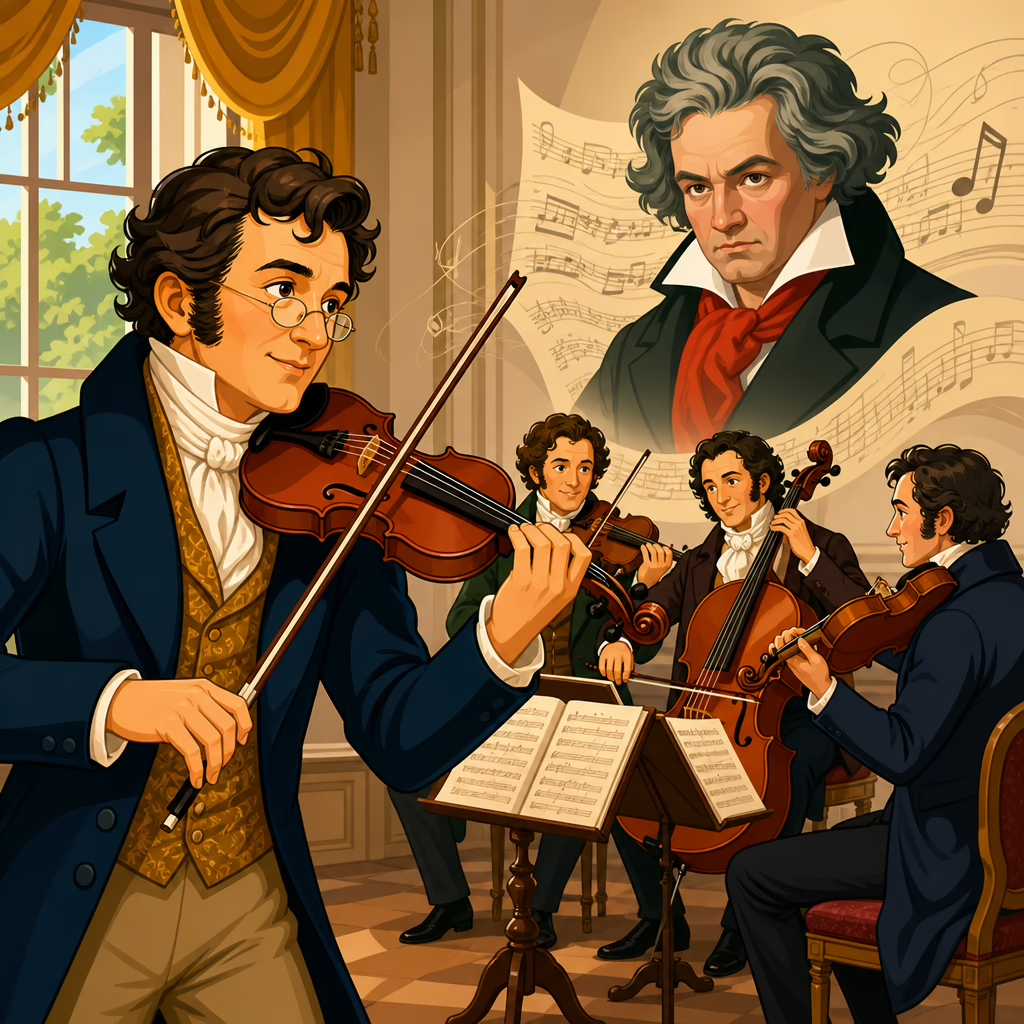
Ignaz Schuppanzigh and the Rise of Beethoven’s Quartets
Ignaz Schuppanzigh stands at the center of one of the most important partnerships in chamber music history: the alliance between a pioneering violinist and Beethoven’s expanding imagination for the string quartet. To understand the rise of Beethoven’s quartets, it is not enough to study scores in isolation. The works grew within a living performance culture, and Schuppanzigh was the performer most responsible for turning Beethoven’s quartet writing from ambitious manuscript into public event, critical controversy, and eventually canon. He was not merely a friend who happened to play first violin. He was a practical collaborator, ensemble leader, organizer of private and public performances, and trusted intermediary between composer, aristocratic patrons, publishers, and listeners.
Schuppanzigh, born in 1776, built his reputation in Vienna as a violinist of unusual authority in ensemble playing. He became closely associated with Count Razumovsky’s musical circle, where Beethoven’s middle-period quartets were first cultivated, and later led the group widely known as the Schuppanzigh Quartet. Beethoven’s quartets, meanwhile, refer here to the works from the Op. 18 set through the “Razumovsky” quartets, the “Harp,” the “Serioso,” and the late quartets that transformed the genre’s expressive possibilities. Their rise means more than increasing popularity. It means their emergence as works serious musicians had to reckon with, pieces that demanded repeated rehearsal, concentrated listening, and a new standard of quartet performance. From my work with nineteenth-century chamber music sources, one fact becomes unmistakable: without Schuppanzigh’s advocacy, Beethoven’s quartets would still be great, but they would not have entered musical life in the same way, or as quickly.
This matters because quartets are fragile cultural objects. Unlike a symphony, which can gather force through institutional orchestras, a quartet depends on four musicians sustaining a common discipline. New quartets survive only if performers commit to mastering them and if audiences believe the effort is worth following. Schuppanzigh supplied both conditions. He cultivated a stable ensemble identity, rehearsed difficult music beyond ordinary expectations, and gave Beethoven a platform for experimentation. He also absorbed criticism directed at works many contemporaries found too long, too dense, or simply strange. In that sense, Schuppanzigh did not just play the quartets. He helped create the conditions under which they could be heard, understood, and ultimately revered.
Schuppanzigh’s place in Vienna’s quartet culture
Vienna around 1800 already valued domestic and aristocratic chamber music, but Beethoven inherited a quartet world still dominated by Haydn and Mozart. Their quartets established the genre as intellectually serious while remaining sociable in scale. Schuppanzigh entered this environment with unusual advantages. He was active in circles that could sustain regular quartet playing, especially among noble patrons who maintained resident musicians and hosted private performances. These settings mattered because difficult new chamber works usually appeared first before informed listeners rather than the open ticket-buying public.
Schuppanzigh’s most decisive institutional connection was with Count Andrey Razumovsky, the Russian ambassador in Vienna. Razumovsky maintained an elite musical establishment, and Schuppanzigh led its quartet activities. That arrangement provided continuity, rehearsal time, and prestige—three things new music always needs. Beethoven could write for players he knew, rather than for hypothetical executants. He understood their strengths, technical limits, and ensemble habits. The result was not abstract quartet composition but tailored writing. When composers know the personalities of performers, they risk more. Beethoven clearly did so.
Schuppanzigh also represented a shift in the identity of quartet playing itself. Earlier chamber music often remained an accomplished amateur pursuit, especially among aristocrats. Schuppanzigh’s ensemble work pointed toward the professional string quartet as a specialized unit with its own standards. That distinction is crucial. Beethoven’s quartets required collective precision, sustained dynamic control, balance among inner voices, and structural comprehension over long spans. A casually assembled group could not reveal what was on the page. A disciplined quartet could.
Anyone tracing Beethoven’s path from early training to mature independence should also see how later collaborators expanded what those foundations made possible. For background on the formative years before Schuppanzigh’s central role, the main guide on Christian Gottlob Neefe and Beethoven’s earliest training provides the necessary context.
From Op. 18 to Op. 59: a performer shapes a composer’s courage
Beethoven’s Op. 18 quartets, published between 1801 and 1802, already show a composer testing the inherited model. These works converse with Haydn and Mozart, yet they push contrasts harder and build more muscular motivic arguments. Schuppanzigh’s importance at this stage was not that he inspired every note, but that he anchored a reliable performing environment. Beethoven could hear whether his experiments in texture, pacing, and thematic concentration actually worked in sound. For quartet composition, that feedback loop is invaluable.
By the time of the three Op. 59 quartets, commissioned by Razumovsky and completed in 1806, Beethoven’s confidence had become radical. These quartets are longer, architecturally broader, technically tougher, and emotionally more volatile than most listeners expected from the genre. They demand extreme registral contrasts, sudden dynamic turns, intricate passagework, and long developmental trajectories that can feel symphonic in ambition. Such music does not rise through publication alone. It rises when a committed ensemble repeatedly performs it until listeners can perceive coherence inside novelty.
Schuppanzigh’s group did exactly that. Contemporary reports and later recollections indicate that these quartets were difficult even for skilled musicians. One famous anecdote, whether polished by repetition or not, preserves Beethoven’s brusque response when a player complained about a passage being impossible: he supposedly answered that he did not think about the player’s “wretched fiddle” when inspiration spoke. The story survives because it captures a real tension. Beethoven wrote beyond routine practicality, and Schuppanzigh was the kind of performer who kept meeting the challenge instead of retreating into safer repertory.
| Quartet group | Period | What Schuppanzigh’s role made possible |
|---|---|---|
| Op. 18 | Early Vienna maturity | Regular testing of Beethoven’s adaptation of Classical quartet norms in dependable ensemble conditions |
| Op. 59 “Razumovsky” | Middle period expansion | Premieres and repeat performances of unusually long, difficult works requiring serious rehearsal |
| Op. 74 and Op. 95 | Compressed dramatic style | Maintenance of Beethoven’s quartet presence in public consciousness despite mixed reception |
| Late quartets | Final creative period | Authoritative first hearings that established these works as major artistic statements rather than curiosities |
The rise of Beethoven’s quartets therefore followed a practical sequence. First, Schuppanzigh and his players made performance feasible. Second, repeated hearings normalized difficulty. Third, audiences and critics gradually shifted from resistance to recognition. This pattern is common in musical history, but with Beethoven it is unusually visible because the works were so audacious.
The Schuppanzigh Quartet as a new model of authority
The ensemble associated with Schuppanzigh did more than premiere Beethoven. It modeled how Beethoven should be played. That may sound obvious now, but it was not obvious in the early nineteenth century. Performance traditions around new chamber music had to be built from scratch. Tempo relationships, articulation, rhetorical emphasis, and balance between first violin brilliance and conversational equality among parts all required decisions. Schuppanzigh’s authority mattered because he worked directly with Beethoven and because his ensemble had continuity over time.
Writers of the period often describe Schuppanzigh as large in physique and strong in personality, and jokes about his size circulated widely. Those details are trivial unless connected to musicianship, where they become revealing. He seems to have projected a broad, assertive, leadership-oriented style well suited to Beethoven’s demands. In the Razumovsky quartets, for example, the first violin must sometimes lead decisively and at other times merge into complex contrapuntal fabric. The leader cannot dominate indiscriminately. He must shape the whole architecture. Schuppanzigh appears to have excelled at that larger conception.
His quartet also helped establish the public prestige of quartet concerts. Instead of treating chamber music solely as private diversion, Schuppanzigh contributed to its emergence as a repertory for concentrated listening. That shift mattered enormously for Beethoven. The more chamber music could command attentive silence and repeated hearing, the more his quartets could be understood as serious art rather than polished entertainment. In practical terms, Schuppanzigh became a curator of difficulty. He persuaded listeners to sit with music that did not flatter them immediately.
This authority had economic implications as well. Publishers and patrons watched reception. If Schuppanzigh’s ensemble invested labor in Beethoven’s quartets, that signaled artistic value. In a period before recordings, performance endorsement was one of the strongest forms of validation available. A respected ensemble could effectively certify that a work deserved attention, even when first reactions were puzzled.
Premieres, reception, and the management of difficulty
Beethoven’s quartets did not rise because everyone instantly loved them. Many listeners found them taxing. Length was one issue, but not the only one. More disruptive was Beethoven’s handling of form. He often intensified development, displaced expected cadences, redistributed thematic importance among instruments, and pursued emotional extremity far beyond polite chamber conventions. In the Op. 59 quartets, listeners encountered fugato textures, expansive slow movements, and finales whose drive could seem relentless. In the late quartets, they faced even more radical discontinuity and introspection.
Schuppanzigh’s achievement was to manage this difficulty without diluting it. He did not make Beethoven easier by simplifying the music. He made it hearable through preparation and advocacy. That distinction is critical. When a work is hard, the answer is not explanation alone but persuasive performance. A well-rehearsed ensemble clarifies voice leading, rhythmic profile, and formal destination. Passages that look chaotic on paper begin to sound inevitable.
The premiere of the late Quartet in B-flat major, Op. 130, and originally the “Grosse Fuge,” Op. 133, in 1826, involved Schuppanzigh directly. By then Beethoven was writing for a future audience as much as for his immediate one. Yet even these forbidding works needed present-tense champions. Accounts from the period show admiration mixed with incomprehension. The “Cavatina” could move listeners deeply, while the fugue bewildered them. Schuppanzigh’s role was not to solve the problem permanently. It was to ensure the work entered circulation at all.
This is why the phrase rise of Beethoven’s quartets should include controversy. Canon formation is rarely smooth. A performer like Schuppanzigh acts as shock absorber between innovation and public taste. He absorbs the initial resistance, keeps the repertory alive, and allows time to work in the music’s favor.
Collaboration, criticism, and durable legacy
Beethoven and Schuppanzigh did not maintain a sentimental, conflict-free friendship. Their relationship included strain, teasing, separation, and reconciliation. That is exactly what makes it historically credible. Working relationships around difficult art are often abrasive because standards are high and personalities forceful. Beethoven could be impatient with performers; performers could find Beethoven unrealistic. Yet the connection endured because each needed what the other supplied. Beethoven needed a quartet leader willing to inhabit unprecedented music. Schuppanzigh needed Beethoven’s works to define the highest level of his art.
The long-term legacy of this partnership is visible in how later quartet culture developed. Professional ensembles in the nineteenth century increasingly treated Beethoven as their central proving ground. Rehearsal discipline intensified. Interpretive seriousness deepened. Programming Beethoven quartets became a declaration of artistic ambition. That lineage runs through Joseph Hellmesberger, the Joachim Quartet, the Busch Quartet, the Budapest Quartet, the Alban Berg Quartet, and leading modern groups such as the Takács, Emerson, and Belcea quartets. All inherit, directly or indirectly, the idea that Beethoven quartets demand a stable ensemble identity and a public willing to listen deeply.
Schuppanzigh’s influence therefore extends beyond the premieres he led. He helped define the social role of the quartet player as interpreter rather than mere executant. He demonstrated that a chamber ensemble could shape musical history by sustained commitment to a composer whose work exceeded current norms. He also proved that repeat performance is not secondary to composition but part of a work’s creation in cultural terms. Beethoven wrote masterpieces, but Schuppanzigh helped the world recognize them as such.
Ignaz Schuppanzigh’s importance in the rise of Beethoven’s quartets can be stated plainly. He provided the ensemble discipline, performance authority, institutional support, and artistic loyalty that these works required at every crucial stage. From the relatively classical poise of Op. 18 to the vast reach of the Razumovsky set and the spiritual complexity of the late quartets, Schuppanzigh turned difficult new scores into audible realities. He gave Beethoven a trusted testing ground, audiences a guide through unfamiliar terrain, and posterity a first model for serious quartet interpretation.
The main lesson is simple: great music does not rise by genius alone. It rises when exceptional performers recognize that genius early, commit to it publicly, and keep returning to it until the world catches up. If you want to understand Beethoven’s quartets more fully, listen for Schuppanzigh’s hidden presence in their history—the rehearsals, premieres, and repeated acts of advocacy that made lasting greatness visible. Then revisit the quartets themselves with that partnership in mind.
Frequently Asked Questions
Who was Ignaz Schuppanzigh, and why is he so important to the story of Beethoven’s string quartets?
Ignaz Schuppanzigh was one of the most influential violinists of the early nineteenth century and a central figure in the development of the modern string quartet as a public art form. He is especially important because he was not simply a performer who happened to play Beethoven’s music. He was the musician most closely associated with bringing Beethoven’s quartets to life before audiences, helping to transform them from challenging written works into major cultural events. At a time when chamber music often circulated in private aristocratic settings, Schuppanzigh and his ensemble gave Beethoven’s quartets a practical, audible presence in Vienna’s musical life.
His significance also lies in the unusually close relationship between composer and performer. Beethoven wrote with real players in mind, and Schuppanzigh’s quartet became the ensemble best equipped to realize the composer’s increasingly demanding ideas. That included difficult textures, bold contrasts, unusual formal designs, and a new level of expressive intensity. In other words, Schuppanzigh was not just a messenger for Beethoven’s music; he was part of the ecosystem that allowed that music to evolve. His musicianship, leadership, and advocacy helped establish the quartet as a serious arena for innovation, making him indispensable to understanding how Beethoven’s quartet legacy rose to prominence.
How did Schuppanzigh help Beethoven’s quartets move from manuscript to public success?
Schuppanzigh played a crucial practical role in the journey from page to performance. Beethoven’s quartets were often technically demanding, structurally unconventional, and musically dense in ways that could intimidate less committed players. For such works to succeed, they needed performers who could master the details, rehearse carefully, and present them convincingly to listeners. Schuppanzigh provided exactly that. As leader of a highly respected quartet, he created the conditions under which Beethoven’s music could be heard not as an abstraction, but as a living, persuasive artistic statement.
Just as importantly, Schuppanzigh helped shape the audience for this repertoire. He and his colleagues made quartet performance into something worth attending and discussing, elevating chamber music beyond background entertainment. Their concerts gave Beethoven’s quartets visibility, prestige, and repeated exposure. Repetition mattered: audiences often needed multiple hearings to grasp music that stretched expectations so far. Through sustained advocacy, Schuppanzigh helped normalize Beethoven’s bold language and made listeners more receptive to the idea that string quartets could carry the same intellectual and emotional weight as symphonies or operas. That process was essential to the quartets’ rise in reputation.
What was distinctive about the partnership between Beethoven and Schuppanzigh?
The partnership between Beethoven and Schuppanzigh was distinctive because it was collaborative in a deep artistic sense, even if Beethoven remained the dominant creative force. Schuppanzigh represented the ideal kind of performer for a composer pushing boundaries: technically capable, experienced in ensemble leadership, and committed enough to wrestle seriously with difficult new music. Beethoven could rely on him and his players to engage with works that were more complex than the average quartet of the period. That trust created a rare feedback loop between composition and performance.
In practical terms, this meant Beethoven was writing for musicians he knew personally and whose strengths he understood. Schuppanzigh’s ensemble gave the composer a real-world testing ground for ideas about balance, sonority, pacing, and dramatic contrast. The relationship also reflects a broader shift in music history, where composers increasingly depended on specialist performers to realize ambitious works. Rather than viewing the score as the whole story, this partnership reminds us that performance culture mattered profoundly. Beethoven’s quartets became what they are in part because Schuppanzigh’s ensemble had the skill and conviction to make them audible, intelligible, and compelling to contemporary ears.
Why is performance culture so important when studying the rise of Beethoven’s quartets?
Performance culture is essential because Beethoven’s quartets did not become influential merely by existing as written texts. They gained power through rehearsal rooms, salons, concert gatherings, patronage networks, and public discussion. A score can preserve musical ideas, but it cannot by itself explain how listeners first encountered those ideas, how players solved the technical challenges, or how the works acquired prestige. Schuppanzigh stands at the center of this performance culture because he was the leading interpreter who connected Beethoven’s imagination with the realities of early nineteenth-century musical life.
Looking at performance culture also helps explain why Beethoven’s quartets seemed so groundbreaking. Their effect depended not only on harmony and form, but on timing, ensemble precision, tonal blend, and rhetorical delivery. Those qualities emerge only in performance. Schuppanzigh’s quartet was instrumental in making Beethoven’s language legible to audiences, especially when the music departed from established norms. This perspective shifts the story from solitary genius to a richer account of collaboration, reception, and advocacy. It shows that the rise of Beethoven’s quartets was not just a compositional achievement, but a performance achievement as well.
How did Schuppanzigh influence the long-term reputation of Beethoven’s string quartets?
Schuppanzigh’s influence on the long-term reputation of Beethoven’s quartets was substantial because first performances and early champions often shape how difficult music enters history. Beethoven’s quartets were not immediately easy listening, and without committed interpreters they might have remained admired by a small circle but struggled to gain wider acceptance. Schuppanzigh gave them authority in the public ear. When a respected ensemble repeatedly programmed, rehearsed, and defended a body of challenging works, it signaled that those works deserved serious attention. That kind of endorsement can be decisive in forming a canon.
His impact also extended beyond the premiere moment. By establishing high-performance standards and treating quartet playing as a serious artistic discipline, Schuppanzigh helped create a model for how Beethoven’s chamber music should be approached by future generations. Later musicians inherited not just the scores, but a tradition of taking them seriously as profound, demanding statements. In that sense, Schuppanzigh helped build the interpretive bridge between Beethoven’s own time and the enduring place the quartets hold today. His contribution was not only historical or biographical; it was foundational to the way Beethoven’s quartets came to be heard, valued, and remembered.