Beethoven at the Proms: Performances Worth Rehearing
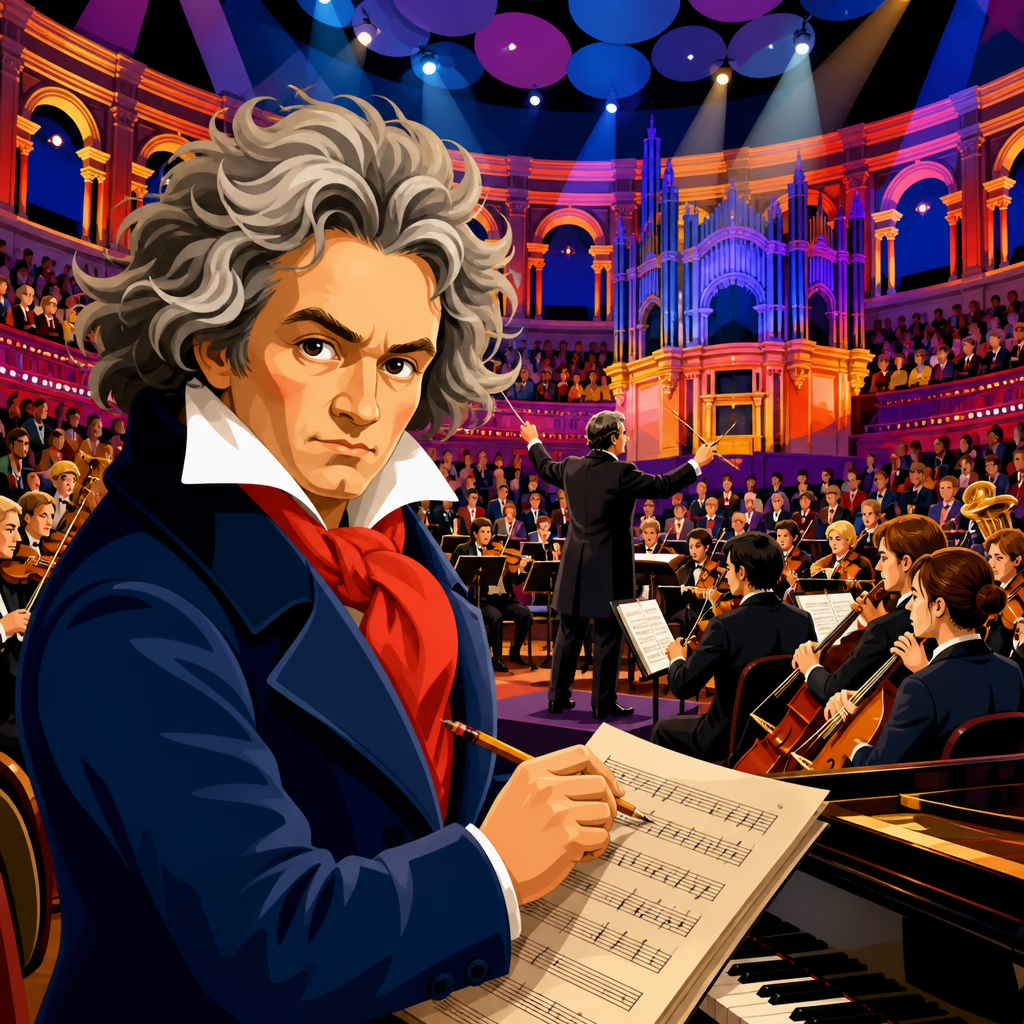
Beethoven at the Proms has long offered a special test of what live performance can reveal in music that many listeners think they already know. The Proms, founded in 1895 and centered on London’s Royal Albert Hall, combines festival intensity, repeat attendance, radio reach, and an unusually mixed audience of specialists and newcomers. In that setting, Beethoven’s symphonies, concertos, overtures, and choral works are not museum pieces. They become public arguments about tempo, articulation, orchestral size, balance, rhetoric, and emotional scale. When people ask which Beethoven Proms performances are worth rehearing, the real question is simpler: which evenings changed how the music sounded, felt, or meant in the hall and still justify return listening now?
That standard matters because the Proms generates abundance. Across decades, Beethoven has appeared in traditional symphony cycles, single gala concerts, historically informed readings, touring-orchestra showcases, and major vocal occasions such as the Ninth Symphony and Missa solemnis. Not every admired event survives equally well on rehearing. Some nights thrilled because of atmosphere alone; others retain their force because the interpretation was architecturally clear, technically disciplined, and communicative under broadcast conditions. Having compared archival relays, commercial issues, and later rebroadcasts, I have found that the most durable Beethoven at the Proms performances share three traits: a sharply profiled dramatic plan, transparent orchestral detail that carries in the Albert Hall acoustic, and a willingness to treat familiar scores as living speech rather than inherited ceremony.
Rehearing also means more than nostalgia. A performance worth returning to should answer concrete listening questions. Did the conductor find propulsion without breathlessness? Were Beethoven’s sforzandos weighted as structure rather than surface excitement? Could inner lines be heard, especially violas, bassoons, and timpani, which often tell the truth about ensemble discipline? Did soloists project character instead of generic nobility? These questions matter especially at the Proms because the hall magnifies both strengths and weaknesses. Big sonority can turn grand paragraphs into blur, while lean textures can sound revelatory. The best Beethoven Proms documents therefore reward close listening, whether on BBC archives, official releases, or private memory reinforced by later broadcasts.
Why certain Beethoven Proms performances endure
Enduring Beethoven at the Proms usually begins with acoustical intelligence. The Royal Albert Hall is generous but unforgiving: brass resonance expands quickly, choral sound can bloom magnificently or go cloudy, and string articulation must be unanimous to retain edge at distance. Conductors who succeed there shape attacks slightly more distinctly, keep bass lines active, and think in long spans. That is why some apparently moderate interpretations age better than high-voltage one-offs. The hall exposes inflation. It rewards coherence.
A second factor is the Proms’ broadcasting culture. Because major Beethoven evenings are often relayed live by the BBC, the microphone perspective preserves balances that listeners in the arena may only partly catch. Rehearing lets you test whether excitement came from execution or occasion. In my experience, performances that survive this test do not depend on applause lines. Their transitions make sense, codas land inevitably, and lyrical paragraphs sing without losing pulse. This is especially true in Beethoven, where a single misjudged tempo relationship can flatten an entire movement.
For listeners building their own reference shelf, it helps to compare Proms documents the way a critic compares symphony cycles: by consistency of phrasing, treatment of repeats, orchestral response, and dramatic profile across works. A practical framework appears in this guide to comparing Beethoven symphony cycles like a critic, and it applies remarkably well to standout Proms evenings. The question is not simply whether a concert was famous, but whether repeated listening uncovers more design and more character each time.
Proms Beethoven that rewards rehearing most consistently
Among modern Proms Beethoven, Claudio Abbado’s appearances with the Berlin Philharmonic remain essential because they fused orchestral luxury with tensile rhythm. In Beethoven, that combination is rarer than it sounds. Many plush orchestras smooth the edges that drive the argument; Abbado instead lightened texture, clarified woodwind dialogue, and kept brass brilliant without heaviness. In works such as the Fifth and Seventh Symphonies, the result was not merely polished. It was directional. You could hear where every crescendo was going and why every diminuendo created space for what followed.
Bernard Haitink’s Beethoven at the Proms deserves rehearing for opposite but equally persuasive reasons. Haitink was not a conductor of mannered intervention. His authority came from proportion, harmonic pacing, and a refusal to impose excitement where Beethoven had already written it. In the Royal Albert Hall, that steadiness often paid off. Slow introductions accumulated tension naturally, tuttis retained width without congestion, and climaxes arrived as the fulfillment of prior structure. On return listening, Haitink’s Beethoven often sounds wiser than flashier competitors because nothing is exaggerated beyond the score’s own logic.
John Eliot Gardiner and the Orchestre Révolutionnaire et Romantique changed Proms Beethoven listening by proving that historically informed practice could project power in a huge modern festival setting. Hard-stick timpani, natural brass, quick vibrato-light strings, and sharply sprung rhythms did not miniaturize the music. They rebalanced it. In the Eroica and Fifth especially, accents bit deeper, contrapuntal strands separated more clearly, and Beethoven’s disruptive energy sounded less like inherited monumentality and more like dangerous invention. Listeners who first heard these readings as polemical often find on rehearing that their real strength is narrative precision.
| Performer or conductor | Why rehear | Best listening focus |
|---|---|---|
| Claudio Abbado | Combines lyric refinement with cumulative tension | Transitions into codas and wind-to-string balance |
| Bernard Haitink | Reveals structure through proportion and pacing | Tempo relationships between introductions and allegros |
| John Eliot Gardiner | Restores rhythmic bite and period color | Timpani articulation and brass attack |
| Daniel Barenboim | Finds rhetorical breadth without losing line | Long crescendos and dynamic terracing |
| Mariss Jansons | Balances precision with emotional warmth | Inner string clarity and ensemble unanimity |
Daniel Barenboim’s Beethoven Proms performances, especially with the West-Eastern Divan Orchestra and Staatskapelle Berlin, are worth rehearing when you want Beethoven as public discourse rather than abstract perfection. Barenboim can broaden transitions and lean into rhetorical weight, which is not always to every taste, but in the Albert Hall that breadth often helps the music speak. He is especially effective in the Seventh and Ninth because he understands paragraphing. Climaxes feel prepared from far back, not merely pushed from the bar before.
Mariss Jansons belongs on any shortlist of rehearing-worthy Proms Beethoven because he solved one of the repertoire’s central problems: how to combine exact ensemble with spontaneous heat. His orchestra playing was controlled to the millimeter, yet never bloodless. In Beethoven’s symphonic finales that matters enormously. Jansons could maintain terrifying unanimity in repeated-note figures and fugal accumulations while preserving human urgency. On recordings of live Proms appearances, that discipline translates as excitement you can trust.
Symphonies that came alive in the Albert Hall
The Third Symphony, Eroica, is one of the strongest tests of a Beethoven Proms performance because it can sprawl if a conductor mistakes scale for breadth. The most rewarding Proms Eroicas tend to share two qualities: a first movement that balances propulsion with enough space for harmonic shock, and a Funeral March that sings in paragraphs rather than sinking into solemn tread. Gardiner’s approach sharpened conflict through period sonority, while Abbado illuminated chamber-like inner detail inside a modern orchestral frame. Both are worth rehearing because each makes the symphony’s length feel necessary.
The Fifth Symphony often succeeds immediately at the Proms, but relatively few performances improve on repetition. The reason is that sheer attack and audience tension can make almost any competent live account seem overwhelming in the moment. On rehearing, weaker interpretations reveal blunt phrasing, undercharacterized Andantes, or a finale that arrives too soon because the Scherzo transition lacked mystery. The best Proms Fifths preserve the work’s elemental urgency while differentiating every stage of its journey. Listen for bassoon and lower-string activity in the development and for whether the coda’s acceleration feels earned.
The Sixth Symphony, Pastoral, can be revelatory in the Albert Hall when conductors resist prettiness. Beethoven’s countryside is organized and dynamic, not vague atmosphere. Haitink’s kind of structural patience serves it well, as does a conductor who places woodwind conversation clearly within the string fabric. A rehearing-worthy Proms Pastoral lets you track scene, motion, storm, and thanksgiving as connected states rather than separate postcards. If the storm merely gets louder, the interpretation has missed the point. It should feel like accumulated weather breaking over a living landscape.
The Seventh Symphony is perhaps the most reliably electric Beethoven work at the Proms, yet also one of the most frequently vulgarized. Speed alone cannot sustain its obsessive rhythmic invention. The finest Proms Sevenths articulate dance weight, especially in lower strings and timpani, so that momentum arises from grounded pulse rather than generalized rush. Abbado and Jansons excelled here in different ways: Abbado through transparency and lift, Jansons through exactitude and muscular drive. In both cases, the Allegretto avoided funereal drag and the finale remained controlled enough for rhythmic cells to register distinctly.
The Ninth Symphony remains the ultimate Proms Beethoven occasion, but it is also the hardest work to carry from event to document. In the hall, chorus, soloists, and crowd expectation can produce undeniable emotional voltage. On replay, however, the first three movements must still stand independently, and the finale must unfold as argument, not pageant. Barenboim has often understood this best at the Proms. He prepares the choral entry from a genuine symphonic crisis, making the “Ode to Joy” theme sound discovered rather than ceremonially unveiled. When that happens, rehearing confirms rather than diminishes the impact.
Concertos, choral works, and what specialists listen for
Beethoven’s piano concertos at the Proms can be even more revealing than the symphonies because they expose the relationship between soloist, conductor, and orchestral rhetoric. In the Emperor Concerto, for example, the temptation is to treat grandeur as mass. The best Proms accounts avoid that by keeping the piano’s figurations speaking clearly and by ensuring the orchestra answers rather than accompanies. A worthwhile rehearing often turns on details such as whether the slow movement remains suspended without going slack, and whether the finale dances instead of marches.
In the Fourth Piano Concerto, great Proms performances usually succeed through intimacy maintained at scale. The opening piano statement must sound inward and inevitable despite the large hall. On archive listening, the best examples preserve chamber give-and-take between keyboard and winds, especially in the first movement and in the Orpheus-like exchanges of the Andante con moto. When those dialogues are shaped as drama rather than decoration, the concerto acquires unusual concentration. Rehearing lets you appreciate not merely brilliance, but the exact degree of restraint that makes the piece eloquent.
The Violin Concerto poses different challenges. The Albert Hall can flatter long violin lines, yet it can also blur articulation if tempo and accompaniment are too soft-edged. Performances worth revisiting usually feature a conductor attentive to timpani definition in the opening and a soloist who projects rhythm as clearly as tone. In Beethoven, beauty without profile quickly becomes generic. The finest Proms Violin Concertos maintain nobility while preserving spring in dotted figures, firmness in trills, and a sense that the first movement cadenza crowns an argument already under way.
Missa solemnis at the Proms is rarer and often more rewarding on rehearing than in the moment because its spiritual and contrapuntal density can overwhelm first hearing. The best performances separate planes cleanly: chorus text, orchestral counterpoint, brass ritual, and solo quartet line. Specialists listen especially for how the Credo is paced, whether the Sanctus opens a genuine new sound world, and whether the Agnus Dei’s military interruptions register as existential disturbance rather than effect. When those elements align, the work emerges not as pious massiveness but as Beethoven’s most searching public statement.
Fidelio excerpts and overtures at the Proms can also become diagnostic tools. Leonore No. 3, for instance, reveals instantly whether a conductor can sustain tension through long-breathed architecture. The offstage trumpet must sound both theatrical and structural; if it arrives as a mere coloristic thrill, the reading is too superficial. Coriolan tests compactness and tragic compression, while Egmont measures a conductor’s grip on political rhetoric. Rehearing these smaller-scale Beethoven Proms performances often clarifies a musician’s larger Beethoven instincts better than a single blockbuster symphony does.
How to choose the best Beethoven Proms recordings to revisit
If you want to rehear Beethoven at the Proms intelligently, start by matching repertoire to interpretive interest. Choose Gardiner when your priority is rhythmic edge and period sonority. Choose Haitink when you want to study proportion and unforced architecture. Choose Abbado for orchestral transparency within modern instrumental richness. Choose Barenboim when rhetoric, breadth, and public drama matter most. Choose Jansons when ensemble precision is the deciding factor. This method prevents the common mistake of treating all strong Beethoven performances as interchangeable expressions of “greatness.” They are not.
Next, compare live documents with a specific checklist. Does the exposition repeat, and if not, what is lost? Are timpani and basses audible enough to define pulse? Does the slow movement sustain line at the chosen tempo? Are transitions, especially before recapitulations and codas, controlled or merely loud? I have found that this practical listening discipline changes preferences over time. Performances once prized for intensity alone may recede, while those built on patient structural command rise steadily in esteem.
The reward of rehearing Beethoven at the Proms is not only the pleasure of reliving famous nights. It is the chance to hear how great performers solve recurring musical problems under pressure, in a hall that magnifies every decision. The best accounts make Beethoven sound newly argued, not merely faithfully reproduced. Start with a favorite symphony, compare two sharply different Proms interpretations, and listen for structure, character, and acoustic truth. Do that, and these performances will keep giving back more than memory ever could.
Frequently Asked Questions
Why does Beethoven at the Proms feel different from hearing the same music elsewhere?
Beethoven at the Proms often feels different because the festival setting changes the way familiar music is received. At the Royal Albert Hall, Beethoven is not simply presented as part of a routine concert season; he is heard within an atmosphere of concentrated listening, repeat attendance, and public comparison. Many audience members attend multiple concerts over a short period, which means interpretations are weighed against each other in real time. A symphony, concerto, or overture can suddenly sound less like a fixed masterpiece and more like a living proposition about what Beethoven meant by momentum, drama, lyricism, or structure.
The Proms also creates a rare kind of audience mix. Longtime concertgoers, scholars, performers, radio listeners, and first-time attendees all meet in the same acoustic and cultural space. That matters because Beethoven’s music has always lived in public tension between intellectual design and immediate emotional impact. In the Proms environment, those qualities are tested openly. A conductor’s tempo choices, a soloist’s approach to phrasing, or an orchestra’s handling of articulation becomes part of a wider conversation rather than a private specialist concern. The result is that even works listeners think they know thoroughly can regain unpredictability and urgency.
What kinds of Beethoven performances at the Proms are most worth rehearing?
The performances most worth rehearing are usually the ones that reveal a strong interpretive point of view without distorting the music for novelty’s sake. In Beethoven, that often means readings that make listeners newly aware of tension between grandeur and propulsion, or between architectural control and theatrical risk. A performance becomes memorable when it clarifies the shape of a symphony or concerto while also making the moment-to-moment drama feel alive. For example, a Fifth Symphony that avoids heaviness and drives forward with rhythmic bite can sound startlingly fresh, while a Ninth that balances scale with transparency may expose inner detail often blurred in more generalized accounts.
Rehearing is especially rewarding in works where performance decisions have major expressive consequences: the “Eroica,” the Fifth, the Seventh, the Ninth, the piano concertos, the Violin Concerto, the “Missa solemnis,” and concert overtures such as “Coriolan” or “Egmont.” In these pieces, apparently technical choices—tempo relationships, dynamic contrasts, treatment of repeats, string articulation, wind balance, choral diction—can reshape the listener’s understanding. The best Proms Beethoven performances are therefore not merely polished; they are explanatory in the deepest sense. They show why the music still provokes disagreement, admiration, and return listening.
What should listeners pay attention to in a live Proms performance of Beethoven?
Listeners should pay attention first to tempo and rhythmic character, because those choices often define the entire argument of a Beethoven performance. Is the conductor emphasizing weight, urgency, dance, nobility, or volatility? Beethoven’s music can collapse into monumentality if it becomes too broad, but it can also lose stature if driven without breadth or tension. How a performance moves between contrasting sections is just as important as the headline speed. The finest interpretations make transitions feel inevitable while preserving surprise.
Articulation is another key area. Beethoven’s orchestral writing depends heavily on attack, accent, and contrast. Short notes, sforzandos, string bowing, and the prominence of winds and timpani all affect whether the music sounds muscular, explosive, lyrical, or ceremonial. In the Royal Albert Hall, where acoustic bloom can magnify sonority, clarity becomes part of the interpretive challenge. A strong performance will not simply be loud or exciting; it will allow important lines to register cleanly across the hall.
Listeners should also notice how the performers handle structure. In Beethoven, big climaxes matter most when the route toward them is clearly shaped. That is true in the long first movement of the “Eroica,” the scherzo-to-finale transition in the Fifth, the rhythmic intoxication of the Seventh, or the vast cumulative plan of the Ninth. In concertos, observe the balance between soloist and orchestra: is the piano or violin set apart as a heroic individual, or woven into a larger symphonic fabric? In vocal works, the relationship between text, chorus, and orchestra is crucial. The most compelling Proms performances tend to combine local intensity with a very firm sense of long-range design.
Why do interpretation debates matter so much in Beethoven at the Proms?
Interpretation debates matter because Beethoven’s music sits at the center of the orchestral tradition, yet it resists passive consensus. These works are famous enough that many listeners arrive with ingrained expectations, but they are also rich enough to sustain sharply different approaches. At the Proms, that tension becomes especially visible. One conductor may stress classical discipline and transparency; another may pursue mass, gravity, and rhetorical breadth. One pianist may treat a concerto as chamber-like dialogue; another may project it as heroic public utterance. These are not minor differences in surface style. They alter the emotional profile and perceived meaning of the music.
The Proms amplifies such debates because of its scale and reach. Performances are heard in the hall, discussed immediately by dedicated audiences, and often transmitted to listeners far beyond London. That public dimension suits Beethoven, whose music itself often feels argumentative: themes are tested, disrupted, reassembled, and forced toward resolution. To hear competing interpretations in this festival context is to be reminded that Beethoven remains active repertoire rather than settled heritage. The enduring value of these debates is that they sharpen listening. They encourage audiences to hear beyond prestige, reputation, or familiarity and to ask what, exactly, a particular performance is saying.
How has the Proms helped keep Beethoven’s music alive rather than turning it into a museum tradition?
The Proms has helped keep Beethoven alive by repeatedly placing his music before a broad public under conditions that reward attention, comparison, and rediscovery. Since the festival’s founding in 1895, Beethoven has remained central not because of empty reverence but because his works continue to function as tests for performers and listeners alike. The repertory returns often enough to establish continuity, yet each performance enters a changing musical culture shaped by new scholarship, evolving instrument practices, different orchestral sounds, and shifting audience expectations. That balance between tradition and renewal is one of the Proms’ greatest strengths.
Just as important is the festival’s accessibility. The Proms has never belonged only to experts. Its identity has long depended on welcoming mixed audiences, and that openness helps prevent Beethoven from becoming sealed inside specialist ritual. New listeners encounter the music in a charged atmosphere, while experienced listeners are challenged to hear familiar works afresh. Radio and broadcast reach extend that process even further, allowing interpretations to circulate and be revisited. In that sense, Beethoven at the Proms remains a public event rather than a private ceremony. The music stays alive because it is continually performed, argued over, tested acoustically, and reheard as something unfinished in meaning—music that still asks questions instead of merely receiving homage.