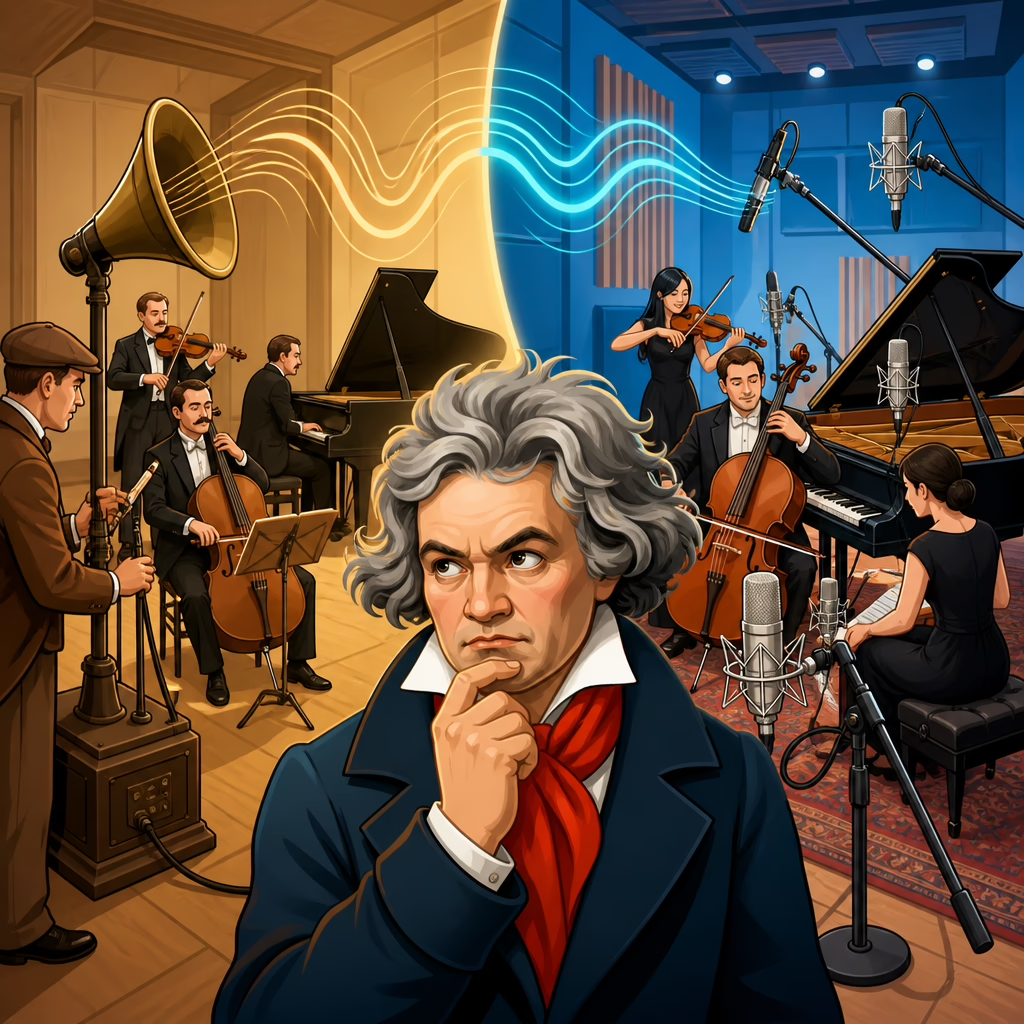
How Microphone Technique Changed Beethoven Recordings
How microphone technique changed Beethoven recordings can be heard in every era of the catalog, from shellac-era symphonies pressed with narrow dynamic ceilings to modern high-resolution releases that reveal bow weight, brass bloom, and hall decay with startling precision. Microphone technique, in this context, means the placement, number, type, and mixing use of microphones during a recording session. It is not a minor engineering detail sitting outside performance. In Beethoven, it shapes tempo perception, orchestral balance, perceived articulation, dramatic contrast, and even a listener’s judgment of whether an interpretation feels classical, monumental, or theatrically urgent. After years of comparing Beethoven sessions across labels, I have found that many debates attributed to conductors are really debates about pickup strategy.
This matters because Beethoven’s orchestral writing is unusually sensitive to recording perspective. His scores rely on rhythmic attack, contrasts between instrumental choirs, sudden sforzandi, and structural crescendos that can flatten if the microphones are too distant or turn aggressive if they are too close. A Fifth Symphony opening recorded with a single overhead array in a resonant hall can sound fatefully integrated but less incisive. The same passage captured with close spot microphones on strings, winds, and brass can sound cleaner and more explosive, yet less like a real orchestra in a room. Listeners often describe these differences as interpretive, but the underlying cause is frequently technical: microphone geometry, spot-mic level, polar pattern choice, and the relationship between direct sound and reverberant field.
Key terms are worth defining. Main pair refers to the primary stereo microphones that establish the recording image. Spot microphones are additional microphones placed near sections or solo instruments for clarity and control. Presence is the apparent nearness and detail of sound, often increased by close miking or upper-mid emphasis. Depth is the sense of front-to-back distance, usually created by a coherent main array and realistic hall reflections. Image width, center solidity, transient response, and ambient pickup all affect how a Beethoven performance lands emotionally. Once you understand these variables, recordings that once seemed merely old or new begin to reveal distinct philosophies of musical representation.
The history of Beethoven on record is therefore also a history of changing ideas about truth. Early engineers worked around severe technical limitations, then postwar teams pursued orchestral realism through carefully designed stereo arrays, and later producers embraced multi-microphone control that could spotlight inner lines previously buried in the hall. None of these approaches is automatically superior. Each uncovers some Beethoven values while obscuring others. To understand why one cycle feels lean and kinetic while another feels monumental and blended, you have to listen past the conductor’s name and ask a more precise question: where were the microphones, and what were they asked to do?
From acoustic constraints to electrical realism
The earliest Beethoven recordings were defined by mechanical and then early electrical limits that forced a compact, forward sound. In the acoustic era before microphones, performers balanced themselves around a recording horn, and large-scale Beethoven was drastically rearranged to fit the process. Once electrical recording arrived in the mid-1920s, condenser and ribbon microphones allowed greater frequency range and more flexible placement, but engineers still favored proximity because shellac discs had restricted noise performance and modest bass extension. The result was a Beethoven sound with compressed perspective: less hall, more direct tone, and a tendency to privilege strong midrange instruments over natural orchestral spread.
That technical profile changed interpretation as listeners received it. A 1930s Beethoven symphony side-set can make string articulation seem wirier and brass entries more abrupt than they would have felt live. Fast passagework often reads clearly because the room contributes relatively little blur, yet tuttis can harden when overloaded grooves or microphone saturation reduce dynamic gradation. Conductors who already favored taut textures, such as Arturo Toscanini, benefited from this immediacy, but part of the famous urgency was reinforced by recording practice. The microphones effectively pushed the orchestra toward the listener, reducing the spatial cushion that concert halls naturally provide.
By the 1940s and 1950s, better microphones from RCA, Neumann, and Telefunken, along with tape recording, widened the possibilities. Engineers could now preserve quieter passages, capture stronger bass, and tolerate greater dynamic range. Beethoven’s orchestral rhetoric became easier to record on its own terms. Still, mono technique mattered. A single well-placed microphone could deliver excellent coherence but limited sectional control. Multiple microphones mixed to mono could improve definition, though phase interactions and unnatural balances were risks. This period established a central tension that still shapes Beethoven recordings today: realism of ensemble versus legibility of detail.
Stereo arrays and the birth of orchestral perspective
Stereo transformed Beethoven recording because it allowed engineers to represent not just sound, but spatial relationships. With two-channel recording in the late 1950s and 1960s, the choice of main array became decisive. A Blumlein pair could deliver strong localization and realistic room pickup in a good hall. Decca’s famous tree, often supplemented by outriggers, created width, center stability, and a persuasive sense of scale. ORTF and spaced omnis offered other compromises between image precision and ambient openness. In Beethoven, these choices are not abstract. They determine whether violins seem to lead the attack from the left, whether horns emerge naturally from the rear, and whether climaxes expand or merely get louder.
When stereo was done well, Beethoven gained architecture. The opening of the “Eroica” could now unfold across a believable stage, with winds occupying a defined plane behind the strings and timpani energizing the rear image instead of punching from an undefined mono center. The Seventh Symphony’s rhythmic drive benefited from lateral separation because repeated figures in different desks were easier to distinguish without sounding surgically isolated. Many listeners associate this era with “golden age” orchestral sound for good reason: the best teams used relatively few microphones, trusted the room, and let Beethoven’s balances develop in air rather than on a console.
Yet even in this admired period, microphone technique shaped aesthetics in divergent ways. Some Deutsche Grammophon productions favored a bright, close, analytically clear image that highlighted attack and line. Many Philips and Decca releases often pursued warmer hall integration, though label stereotypes only go so far because venue and producer mattered as much as house style. Herbert von Karajan’s Beethoven recordings, for example, can sound dramatically different across decades not simply because his Berlin Philharmonic evolved, but because engineering practice moved from broader stereo naturalism toward more controlled, multi-miked textures. If you are learning to evaluate these differences across complete cycles, this deeper listening framework complements the broader guidance in this Beethoven symphony cycle comparison guide.
Close miking, spot microphones, and the rise of control
As multitrack capability and post-production sophistication increased from the 1970s onward, Beethoven recordings became more editable and more controllable. Close miking does not simply mean putting microphones near instruments; it means capturing a higher ratio of direct sound to room sound so producers can shape articulation, balance, and impact after the fact. Spot microphones on woodwinds can clarify inner counterpoint in the Pastoral Symphony. Brass spots can ensure that the Ninth’s climaxes cut through dense orchestration. Timpani spots can add visceral punch in the Seventh or Eighth. Used carefully, these tools reveal Beethoven’s construction with uncommon clarity.
The tradeoff is that control can weaken orchestral perspective. When spot microphones are mixed too prominently, instruments detach from the acoustic space established by the main pair. A flute line may sound supernaturally present, as if stepping forward without the physical consequences of movement in a hall. Brass can become larger than life, particularly if directional microphones are used very close and blended aggressively. String sections can lose the collective shimmer that comes from hearing many players through one coherent acoustic window. In Beethoven, where formal power often depends on cumulative mass and spatial logic, over-spotting can make a symphony sound assembled rather than performed.
I hear this most clearly in transitions and crescendos. In a naturally captured Beethoven crescendo, the orchestra seems to grow from within the room; the reverberant field thickens along with the direct tone. In a heavily controlled recording, loudness may increase faster than spatial energy, creating a thrill that is real but different in kind. The impact resembles cinema more than a concert seat. Some listeners love this because every line is intelligible, and modern playback environments often reward presence over depth. Others find that the emotional stakes shrink because the orchestra no longer behaves like a single organism responding to Beethoven’s architecture.
| Technique | Typical Sound in Beethoven | Main Strength | Main Risk |
|---|---|---|---|
| Distant main pair | Integrated sections, deeper hall perspective, softer attacks | Natural orchestral blend | Reduced inner detail |
| Main pair plus light spots | Clear image with added wind and brass definition | Balance of realism and clarity | Spot color may draw attention |
| Heavy close miking | High presence, strong transients, precise sectional control | Maximum detail and impact | Flattened depth, less cohesive ensemble |
| Wide ambient supplementation | Larger space, longer decay, broader scale | Monumental atmosphere | Blurred rhythm in fast passages |
Why Beethoven exaggerates microphone choices
Not every composer reacts equally to the microphone. Beethoven is especially revealing because his orchestration sits at a hinge point between classical transparency and romantic weight. He often doubles material across sections, uses sudden accents as structural markers, and depends on rhythmic unanimity to drive long spans. A recording that emphasizes close detail can make those accents feel more violent and those doublings more obvious. A recording that emphasizes room coherence can make the same passages feel more inevitable and symphonic. The score is unchanged, but the musical argument is reframed.
The Fifth Symphony offers a simple example. If the strings are captured from a moderate distance with limited spot support, the famous opening motive merges quickly into a single orchestral gesture. The music feels fated, compressed, and propelled. Add close string microphones and reinforce winds and brass, and the same bars become more sectional: one hears the grain of bow strokes, the edge of clarinet entrances, the bite of horns. That can sharpen drama and expose motivic workmanship, but it can also reduce the overwhelming unanimity that many conductors seek. Neither result is wrong. They are different answers to the same sonic problem.
The Ninth Symphony raises the stakes further because chorus, vocal soloists, and expanded orchestra challenge any microphone plan. In older Beethoven Ninth recordings, engineers often accepted some congestion in tuttis to preserve a believable overall space. Modern teams may use extensive spot coverage, sectional baffles, and separate choir arrays to maintain text clarity. This helps listeners follow Schiller’s words and Beethoven’s counterpoint, yet it can compromise the sense that the finale erupts from one massive performing body. Again, technique affects not just fidelity, but the work’s philosophical scale. Beethoven’s universalism can sound communal or curated depending on the mix.
What listeners should listen for when comparing recordings
If you want to hear how microphone technique changed Beethoven recordings, compare four things first: attack, depth, sectional balance, and reverberation tail. Attack tells you how much direct sound dominates. Crisp, almost tactile string onsets usually indicate closer pickup or brighter microphone voicing. Depth tells you whether front and rear desks occupy believable distance from each other. If horns and timpani feel pasted onto the same plane as first violins, spots are probably strong. Sectional balance reveals production priorities: unusually audible bassoons, triangle-like timpani presence, or hyper-clear violas often signal intervention. Reverberation tail shows whether the hall is carrying climaxes or whether the mix is generating size mainly through level.
A practical listening test is the slow introduction to the Fourth Symphony or the opening of the “Pastoral.” On a natural recording, you should sense air around woodwinds and a gentle continuum between direct tone and venue. On a more interventionist production, details may emerge beautifully, but the orchestra’s image can seem outlined rather than inhabited. Another useful test is a tutti sforzando followed by silence or softer texture. Does the sound bloom and recede as one event, or do individual spots hang momentarily in the ear? Once you start listening this way, production fingerprints become obvious.
The payoff is better critical judgment. Instead of saying one Beethoven cycle is simply more exciting, warmer, cleaner, or heavier, you can identify why. Excitement may come from spot-miked timpani and reduced hall wash. Warmth may come from omnidirectional mains in a favorable acoustic. Cleanliness may reflect editing and sectional control rather than superior ensemble alone. Heaviness may be the product of close brass pickup and bass-forward mastering. These distinctions matter because they let you evaluate performance and recording as related but separate achievements. For Beethoven, that separation is essential.
Conclusion
Microphone technique changed Beethoven recordings by changing what listeners perceive as the performance itself. From early electrical sessions that pushed the orchestra forward, to stereo arrays that restored width and depth, to modern multi-microphone productions that maximize detail and control, each era rebalanced clarity, impact, and realism. Beethoven’s music magnifies those choices because his symphonies depend on attack, structural contrast, and the relation between individual lines and collective mass. When microphones move closer, Beethoven often sounds more explicit, more forceful, and less architectural. When they move back and trust the hall, he often sounds more blended, more spacious, and more symphonically inevitable.
The most useful takeaway is simple: when comparing Beethoven recordings, do not treat sound as packaging around interpretation. Sound is part of interpretation. Ask how the main pair establishes space, whether spot microphones clarify or distract, and how the hall contributes to rhythm and scale. Those questions will explain why two acclaimed recordings of the same symphony can feel radically different even at similar tempos. Listen for microphone perspective the next time you play Beethoven, and you will hear not just a performance, but a recording philosophy shaping every bar.
Frequently Asked Questions
What does “microphone technique” actually mean in Beethoven recordings?
In Beethoven recordings, microphone technique refers to far more than simply turning on a few microphones and capturing an orchestra. It includes the type of microphones used, where they are placed, how many are deployed, how close or far they sit from the players, how the signals are balanced during the session, and how much those signals are adjusted later in editing and mixing. All of those choices directly affect what listeners believe they are hearing as “the performance.” In Beethoven especially, that matters because his music depends on contrast: attack and decay, mass and transparency, tension and release, lyrical line and rhythmic drive.
A close microphone setup can make inner lines sound unusually clear, bring string articulation to the front, and produce a more immediate, high-impact impression of the orchestra. A distant setup, by contrast, may present a broader, more blended picture, allowing the hall acoustic to shape the sound and making climaxes feel more architectural than aggressive. Neither approach is automatically right or wrong, but each creates a different Beethoven. A tightly miked Fifth Symphony can sound urgent, hard-edged, and rhythmically explicit, while a more natural, distant recording may emphasize grandeur, scale, and the way instrumental colors fuse together in the room.
That is why microphone technique should not be treated as a neutral technical footnote. It influences perceived tempo, because sharper transient pickup can make music feel faster. It influences orchestral balance, because microphones can favor winds over strings, brass over timpani, or vice versa. It even shapes our sense of interpretation, since a conductor’s phrasing, dynamic range, and structural planning are all filtered through the recording method. In Beethoven, microphone technique is part of the artistic result listeners take home.
How did early recording technology affect the way Beethoven sounded on record?
Early Beethoven recordings were limited by the technology of their time, and those limits profoundly shaped the listening experience. In the acoustic and early electrical eras, engineers had restricted frequency range, limited dynamic headroom, and short recording durations. On shellac discs, orchestras had to fit large-scale Beethoven works into a format that could not fully reproduce either the deepest bass or the most expansive dynamic swings. Loud passages could overload the system, while soft ones might disappear. As a result, recordings often compressed the true dramatic span of Beethoven’s music.
Microphone placement in the early electrical era also had to solve practical problems in ways that changed orchestral perspective. Engineers often used relatively simple setups with minimal flexibility compared with later multi-microphone methods. Because the system could not always capture a realistic concert-hall balance naturally, ensembles were sometimes arranged physically to suit the recording process rather than the ideal live layout. That could mean adjusting player positions so important lines projected into the pickup area more effectively. In Beethoven, where orchestral dialogue is crucial, these choices affected what listeners heard as foreground and background.
The result is that early Beethoven recordings can sound narrower, denser, and more centralized than modern ones. Yet they also reveal something valuable: performances were often shaped to communicate under technical pressure. Conductors and players knew that clarity had to be projected decisively, and engineers worked to preserve the essential drive of the music within severe constraints. So when listeners hear a shellac-era Beethoven cycle, they are not just hearing an old orchestra through primitive sound; they are hearing a version of Beethoven molded by the realities of early microphone and disc technology.
Why do different Beethoven recordings make the same orchestra or symphony sound dramatically different?
One major reason is that microphones do not merely document an orchestra; they define the listening position. A listener in a concert hall hears a constantly shifting blend shaped by distance, room acoustics, and seating location. A recording substitutes that with a chosen perspective created by engineering decisions. If the main microphones are placed high and at some distance, the orchestra may sound cohesive, spacious, and naturally blended. If many spot microphones are added close to individual sections, details become more vivid and present, sometimes beyond what a hall listener would naturally perceive.
That difference is especially audible in Beethoven because his orchestration thrives on structural contrast. The opening of the Fifth Symphony, the string propulsion in the Seventh, the choral mass in the Ninth, and the woodwind conversations in the Pastoral all respond differently to microphone choices. A close setup can sharpen attacks, making rhythmic cells sound more insistent and modern. A more distant setup can make the same passage feel less surgical but more symphonic in scale. Brass can sound noble and blended in one recording, or blazing and dominant in another. Timpani can either underpin the whole texture or leap forward with startling force.
Editing and mixing intensify those differences. Modern productions often combine a main stereo or surround image with section spots, then refine balances after the performance. This allows exceptional clarity but also means the final Beethoven sound is partly composed in the control room. Two recordings of the same orchestra in the same hall can therefore present very different identities depending on how much engineers prioritize realism, impact, detail, warmth, or spatial depth. What many listeners describe as interpretive difference is often, in part, a microphone and mixing difference.
Did modern microphone techniques improve Beethoven recordings, or just make them different?
Modern microphone techniques unquestionably improved many aspects of fidelity, but “improvement” depends on what a listener values most. Technically, contemporary methods allow far greater frequency extension, lower noise, more stable stereo imaging, higher dynamic range, and much finer control over balance. In Beethoven, that means listeners can hear details earlier recordings either blurred or lost entirely: the bite of bows at the beginning of a phrase, the resonance around horn entries, the woodgrain of bassoons, and the decay of the hall after a full-orchestra cadence. Large works such as the Missa solemnis or the Ninth Symphony particularly benefit from this expanded capacity.
At the same time, modern technique has not simply moved Beethoven closer to an objective truth. It has created new aesthetic possibilities and new risks. With many microphones and extensive post-production, engineers can produce extraordinary transparency, but they can also over-isolate instruments, flatten the natural depth of the orchestra, or create balances that feel assembled rather than performed. Some listeners love the analytical precision of modern recordings because it illuminates Beethoven’s construction. Others prefer older or more minimally miked recordings because they preserve a stronger sense of event, blend, and acoustic continuity.
So the best answer is that modern techniques made Beethoven both better captured and differently imagined. They expanded what recordings can reveal, but they also increased the degree to which the final sound reflects production philosophy. A superb modern Beethoven recording uses advanced tools not to show off detail for its own sake, but to serve musical structure, dynamic proportion, and emotional scale. When that balance is achieved, the listener hears not just more sound, but more meaning.
What should listeners pay attention to when comparing Beethoven recordings from different eras?
Listeners should begin by focusing on perspective. Ask where the orchestra seems to be. Does the recording place you several rows back in a hall, hearing a unified ensemble? Or does it put you almost inside the string section, with winds and brass emerging in sharply outlined layers? That basic sense of distance immediately affects how Beethoven’s architecture registers. Broad, long-range phrasing can feel more convincing in a spacious perspective, while rhythmic precision and motivic interplay may stand out more in a close one.
Next, pay attention to dynamic behavior and instrumental balance. Beethoven depends on sudden shifts of weight and intensity, so notice whether soft passages retain atmosphere or vanish, and whether climaxes expand naturally or hit a ceiling. Listen to how the strings, winds, brass, and timpani relate. In some recordings, inner voices are unusually exposed, making the score seem leaner and more intricate. In others, the orchestra blends into a larger block of sound, emphasizing mass and continuity. Neither result is inherently superior; each reveals a different set of priorities in microphone placement and mixing.
Finally, listen for space itself. Hall resonance, reverberation tail, stereo width, and depth all shape Beethoven’s emotional world. The Eroica can sound monumental when the room breathes around the orchestra; the late overtures can feel electrifying when attacks are dry and immediate. Comparing eras also means understanding that older recordings may sacrifice extension and realism while preserving striking interpretive concentration, and newer ones may reveal astonishing color while sometimes sounding more produced. The most rewarding approach is to hear microphone technique as part of the interpretation. Once you do, the history of Beethoven on record becomes not just a story of better sound, but a story of changing musical priorities.