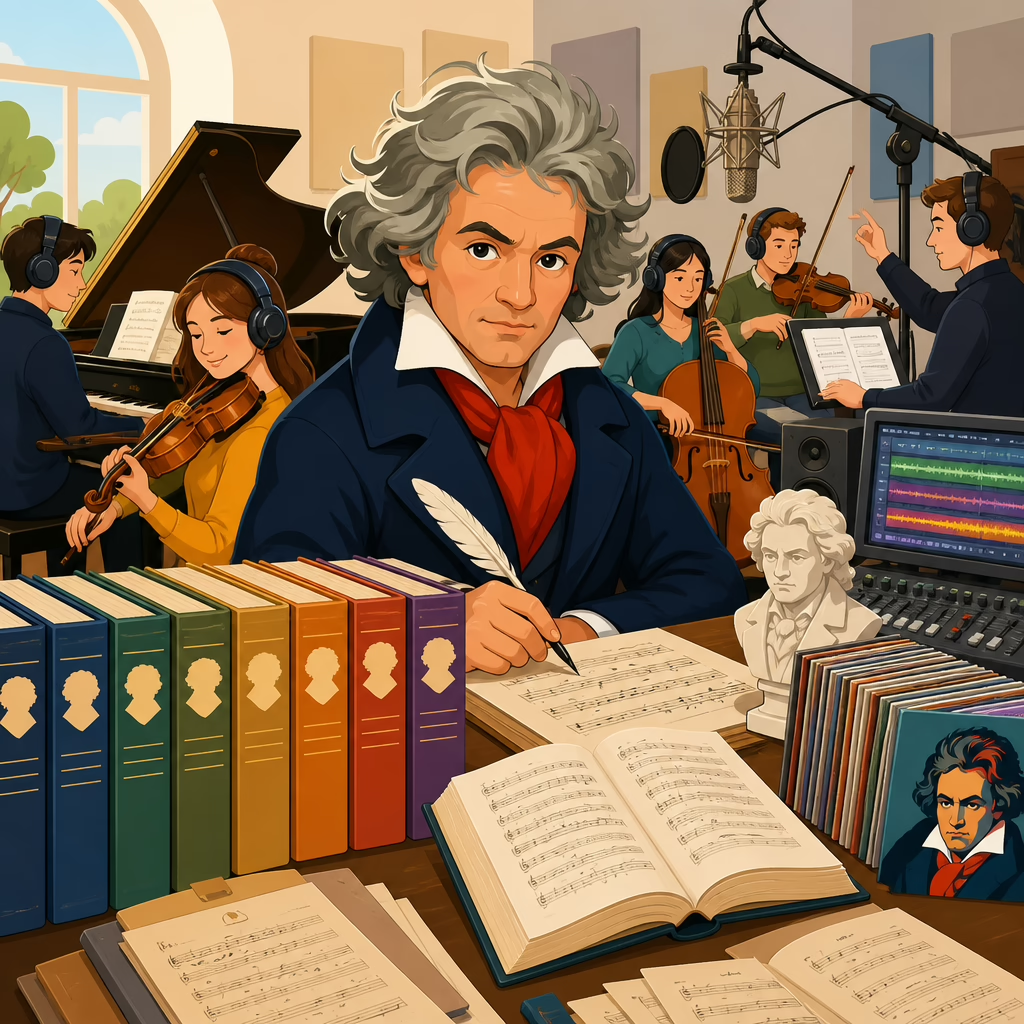
Beethoven Recording Projects Built Around Complete Editions
Beethoven recording projects built around complete editions occupy a special place in the catalog because they promise more than a box of familiar masterpieces. A complete edition aims to document the full surviving body of the composer’s work, or a clearly defined category of it, in a coherent editorial framework. In practice, that means recording not only the canonical symphonies, piano sonatas, and string quartets, but also lesser-known cantatas, fragmentary stage music, folk-song arrangements, occasional pieces, alternative versions, and works with disputed numbering. Having worked through large Beethoven sets in review, comparison, and library-building contexts, I have found that the term complete is never casual. It reflects decisions about sources, instrumentation, chronology, version control, and the balance between scholarship and listenability.
For collectors, performers, scholars, and streaming listeners, these projects matter because they shape what Beethoven means in recorded form. A standard cycle presents a curated image of greatness. A complete edition presents a working composer in full: experimental, uneven, practical, and often surprising. It can restore neglected repertoire, clarify editorial problems, and reveal how the famous works sit beside ceremonial commissions, pedagogical music, and arrangements made for the market of Beethoven’s day. Complete editions also expose the role of labels, musicologists, and producers. A set issued by Deutsche Grammophon, Brilliant Classics, Naxos, Hänssler, or Hyperion is not simply an inventory. It is an argument about authenticity, priorities, and audience.
The key terms are worth defining carefully. A complete edition in recording is a planned project that seeks comprehensive coverage within explicit boundaries. A complete works edition covers the broadest span. A complete instrumental edition or complete chamber edition narrows the field while still aiming for completeness inside that category. Urtext refers to an editorial approach grounded in the earliest authoritative sources, usually autograph manuscripts, first editions, and contemporary copies. Critical edition means the text has been established through documented scholarly comparison of sources, often with commentary about variants. Historically informed performance means period instruments, historical technique, and attention to eighteenth- and early nineteenth-century practice, though complete Beethoven editions may be modern-instrument, period-instrument, or mixed.
What makes a Beethoven complete edition different from an ordinary cycle
An ordinary Beethoven cycle usually centers on a prestige genre. Symphony cycles, for example, are abundant because nine works fit market expectations and critical habits. A complete edition works differently. Its planning starts with a catalog, often based on standard work lists such as the Beethoven Werke ohne Opuszahl numbers and the Hess catalog for doubtful, unfinished, or supplementary materials. Producers must decide whether to include early Bonn works, arrangements not fully authored by Beethoven, alternate endings, reconstructed fragments, and spoken-text elements in theater scores. Those decisions affect disc count, artist roster, rights, and cost.
In practical listening terms, completeness changes the experience from selective admiration to documentary immersion. You hear not just the heroic middle-period line but the whole ecosystem around it. One disc may move from a major sonata to a tiny bagatelle, another from the Missa solemnis to Scottish song settings. That juxtaposition is historically honest. Beethoven earned money through commissioned, occasional, and domestic music alongside the works later canonized in concert halls. A complete edition preserves that reality and prevents the familiar masterpieces from floating free of the professional conditions in which they were created.
Complete editions also differ because they depend heavily on editorial consistency. In smaller cycles, interpretive identity often comes from a single conductor or ensemble. In complete projects, consistency is usually created by production policy rather than one performer’s personality. Recording teams coordinate pitch standards, booklet notes, source choices, translation policy, movement titles, and cross-references among discs. When this is done well, the listener can move from quartets to lieder to incidental music without losing orientation. When it is done badly, the set feels like a warehouse rather than an edition.
How labels define completeness, and why the fine print matters
The most important question for any Beethoven complete edition is simple: complete according to whom. Labels use the word in at least three ways. First, some mean the complete canon of securely authenticated works. Second, some include authenticated works plus fragments, alternate versions, and doubtful attributions of historical interest. Third, some use complete more loosely for a genre-specific anthology that is not truly all-inclusive. Experienced buyers learn to read the track list, catalog references, and editorial notes before assuming scope.
I have repeatedly seen confusion arise around works for stage, vocal miniatures, and arrangement culture. Beethoven’s output does not fit neatly into modern categories, and labels handle that differently. Some include every known folk-song setting because Beethoven composed accompaniments and arrangements for commercial publishers. Others trim them, arguing that modern listeners want original works first. Similarly, Wellington’s Victory may appear in orchestral form alone, or alongside keyboard and chamber arrangements linked to the work’s reception history. Fidelio presents another challenge because Leonore and Fidelio involve multiple overtures, revised numbers, and version questions. A serious complete edition explains those relationships instead of hiding them under generic disc titles.
| Edition choice | Why it matters | Typical listener impact |
|---|---|---|
| Include alternative versions | Shows Beethoven’s revision process | Reveals how familiar works evolved |
| Use period instruments | Changes balance, articulation, and tempo feel | Makes orchestral texture leaner and more transparent |
| Add doubtful or fragmentary works | Expands documentary value | Increases completeness but can reduce replay value |
| Follow one critical edition | Improves textual consistency | Helps comparisons across discs and genres |
| Mix many artists | Broadens expertise by repertoire | Creates variety but may weaken interpretive unity |
This fine print matters because no complete edition is neutral. If your goal is listening pleasure, a selective box may outperform a sprawling documentary set. If your goal is understanding Beethoven’s working methods and reception, the broader edition wins. The right choice depends on whether you want a canon, an archive, or both.
Editorial scholarship, source choices, and version control
The backbone of any serious complete edition is editorial method. Beethoven’s music survives in autographs, sketch materials, copyists’ manuscripts, first editions, corrected proofs, and later printed versions with varying authority. That source landscape is complex enough in the symphonies and much more tangled in vocal and stage works. Labels that build complete editions around recognized critical texts, including the Beethoven Gesamtausgabe tradition and later scholarly revisions, usually produce more reliable results. The point is not academic prestige for its own sake. It is that wrong notes, missing repeats, normalized articulations, and simplified dynamics can distort how Beethoven sounds.
Version control is especially important. The Leonore Prohaska music, the different Fidelio states, the op. 18 quartets in revised forms, and smaller keyboard or chamber variants require explicit handling. Good sets identify what is being played and why. Better ones tell you whether the performance follows first publication, a later revision, or a conflated performing text. As a reviewer, I trust an edition more when the booklet states these choices plainly. Silence usually means compromise, and compromise is acceptable only when declared.
Scholarship also affects tempo relationships, repeat observance, ornament realization, continuo practice in early works, and the treatment of unfinished materials. Reconstructions can be illuminating, but they should never masquerade as settled Beethoven texts. The strongest complete editions separate authentic completions from editorial realizations and explain the boundary. That honesty builds confidence and makes the set useful not only for casual listening but for teaching, programming, and comparative study.
Performance strategy: one vision versus curated plurality
A complete Beethoven edition can follow one principal artistic vision, but most do not. The repertoire is simply too broad. No single pianist, quartet, conductor, chorus master, vocal roster, and period ensemble can cover every corner at equal level. Labels therefore face a strategic choice. They can pursue unity through a house style, often with related artists and shared production values, or they can assemble specialists for each repertoire group. In my experience, the second approach usually serves Beethoven better, provided the editorial center holds.
The piano sonatas and concertos reward pianists with long-form structural command. The late quartets demand ensembles with deep collective history. The masses require choral-orchestral forces capable of balancing monumentality with textual clarity. The folk-song arrangements call for singers who can treat them as intimate salon repertory rather than mini opera scenes. A mixed-artist complete edition can respect those needs. The risk is unevenness. One disc may feel revelatory, the next merely competent.
Historically informed performance adds another layer. Period-instrument orchestras can sharpen rhythm, lighten bass textures, and reveal wind writing obscured in heavier modern traditions. Yet complete editions often mix period and modern approaches because not every repertoire block has equally strong specialist performers available under one label. That is not automatically a weakness. What matters is whether the edition makes those choices coherent. If it explains that the symphonies use period instruments while the piano sonatas use a mix of fortepiano and modern piano according to repertorial goals, listeners can judge intelligently rather than guessing.
For readers comparing large-scale Beethoven sets, the most useful habit is to assess them by repertoire families rather than the marketing banner alone. The criteria used for symphony cycles are directly relevant, and this guide to how to compare Beethoven symphony cycles like a critic offers a strong framework for evaluating orchestral segments inside broader complete editions.
Major project models and what they reveal about Beethoven on record
Across the market, Beethoven complete editions tend to fall into a few recognizable models. The prestige label model emphasizes star performers, premium presentation, and selective scholarly framing. The budget-documentary model aims for maximum coverage at accessible price, often licensing or aggregating recordings from different sessions and years. The specialist-scholarly model, associated with labels comfortable serving conservatories and collectors, foregrounds source criticism, repertory completeness, and detailed annotation. Each model creates a different listening map of Beethoven.
The prestige approach often produces excellent core repertory and handsome books, but it may underplay obscure works or rely on older recordings not conceived as part of one integrated edition. The budget-documentary approach can be remarkably valuable because it restores neglected corners of the catalog and puts them in circulation. Some of the most educational Beethoven listening I have done came from discs that would never headline a marketing campaign: choruses for civic occasions, fragments, and songs with unusual obligato writing. The specialist-scholarly approach usually handles these best, though sometimes at the cost of immediate charisma in the central repertory.
These models reveal a basic truth. There is no single best Beethoven complete edition for every listener. The best one for analysis may not be the best one for repeated pleasure listening. The best one for repertoire discovery may not have your preferred Eroica or Hammerklavier. Complete editions succeed when they are clear about purpose and when the performances support that purpose with conviction.
How to judge a complete edition before you buy or stream
Start with documentation. A serious edition names performers, recording dates, venues, editors, and source bases. It distinguishes between opus-number works, WoO items, Hess items, fragments, and arrangements. It clarifies whether spoken texts are included in theater music and whether appendices contain alternate numbers. If that information is absent, the set is harder to trust. Next, sample across categories rather than only in famous works. Listen to one major orchestral disc, one chamber disc, one keyboard disc, one vocal disc, and one marginal repertory disc. This quickly shows whether the project maintains standards beyond the headline pieces.
Then test production values. Consistent engineering matters enormously in large editions. Beethoven’s dynamic contrasts, accents, and registral layering can be blurred by cramped sound or over-reverberant venues. Listen for bass definition in orchestral tuttis, vocal text clarity in the Missa solemnis, and attack detail in late piano sonatas. Booklets also matter more than many buyers expect. In complete editions, notes serve as navigation tools. Good annotation helps you understand why a tiny occasional piece is present and how it connects to more familiar works.
Finally, accept the tradeoff built into the format. A complete edition is not the same thing as a shelf of best-in-class individual recordings. It is a structured corpus. Judge it on comprehensiveness, editorial honesty, and broad musical quality. If it also contains benchmark performances, that is a bonus rather than the minimum requirement.
Beethoven recording projects built around complete editions reward listeners who want the composer whole rather than filtered through a greatest-hits lens. They matter because they restore neglected repertory, make editorial choices visible, and connect masterpieces to the wider body of work from which they emerged. A strong complete edition defines its boundaries clearly, uses reliable sources, manages version issues honestly, and matches performers thoughtfully to repertoire. Those elements are more important than glamorous branding or sheer disc count.
The central benefit is perspective. When you hear the famous works beside the occasional pieces, arrangements, early experiments, and revision layers, Beethoven becomes less monumental and more human, more industrious, and more inventive. That broader context can deepen your response even to the most familiar symphony or sonata. If you are considering a purchase or planning a streaming survey, compare editions by scope, scholarship, performer fit, and documentation, then choose the one that matches your purpose. Start with one well-curated complete edition, listen across categories, and let the full landscape of Beethoven’s recorded legacy come into view.
Frequently Asked Questions
What does “complete edition” mean in Beethoven recording projects?
In the context of Beethoven recordings, a complete edition is a project designed to present the full surviving body of the composer’s work, or at least a clearly defined and comprehensive category of it, under a unified editorial concept. That is what separates it from an ordinary anthology or “greatest works” box. Instead of focusing only on the universally recognized landmarks such as the nine symphonies, the piano sonatas, or the late string quartets, a complete edition tries to account for the broader artistic landscape: early pieces, occasional works, dances, choruses, songs, arrangements, fragments, and music that may be historically important even if it is not regularly programmed in concert halls.
Just as important, “complete” usually implies consistency in sourcing, scholarship, and presentation. The recordings are often organized around a particular musicological edition, manuscript tradition, or editorial policy, so listeners are not simply getting more Beethoven, but Beethoven framed in a more systematic way. In many cases, these projects include works that reveal how Beethoven composed for patrons, publishers, domestic music-making, theater, and public ceremony. That wider view gives a richer understanding of his career than a prestige box built only around the masterpieces most people already know.
Why are complete Beethoven editions so appealing to collectors and serious listeners?
Complete edition projects appeal to collectors because they offer both depth and coherence. Rather than assembling Beethoven’s most famous works from unrelated sessions, labels can create a catalog statement: here is Beethoven in full range, documented across genres and periods, with a defined artistic and scholarly rationale. For many listeners, that is deeply satisfying. It allows them to hear connections between major works and lesser-known pieces, trace Beethoven’s development over time, and understand how central compositions emerged from a much larger creative environment.
These editions also have documentary value. Beethoven’s reputation can make it easy to forget how much of his output lies outside the standard canon. A complete edition restores context by including works such as occasional cantatas, sets of folk-song arrangements, keyboard miniatures, canons, chamber rarities, and fragmentary theater music. Even when some pieces are not on the same artistic level as the “Eroica” Symphony or the late sonatas, they remain revealing. They show Beethoven responding to practical demands, experimenting with form, or working within conventions he later transformed. That combination of scholarly completeness and listening discovery is a major reason these projects hold such a special place in the catalog.
Do complete editions really include obscure and fragmentary Beethoven works, and why does that matter?
Yes, the most ambitious complete editions often go well beyond the familiar repertory and include obscure, unfinished, reconstructed, or historically peripheral works when there is a defensible editorial basis for doing so. That can mean early cantatas, music for stage projects that survive only in part, songs and arrangements written for publication markets, alternative versions, and short occasional pieces that rarely appear on standard recital or orchestral programs. Including this material matters because it reflects the actual breadth of Beethoven’s professional life rather than a retrospective image built only from the canonical masterpieces.
For listeners, these rarities are more than curiosities. They can illuminate Beethoven’s working methods, his relationships with patrons and publishers, and the musical culture in which he operated. Fragmentary stage music, for example, may reveal ideas about dramatic pacing or orchestral color that connect in surprising ways to more famous scores. Folk-song arrangements can show his craft in a more intimate and commercially practical setting. Even incomplete works have value because they document process, experimentation, and the historical realities of survival. A complete edition, at its best, helps listeners hear Beethoven not as an isolated monument, but as a working composer whose legacy includes both towering achievements and fascinating margins.
How do labels and performers handle editorial choices in Beethoven complete editions?
Editorial choices are central to any serious complete edition, because Beethoven’s works often exist in multiple sources, revised versions, and complicated publication histories. A label and its performers must decide which version of a work to record, whether to include alternate readings, how to deal with unfinished material, and which scholarly edition to follow. Those decisions can shape tempo relationships, articulation, ornamentation, movement order, instrumentation, and even the definition of what counts as an individual work within the edition.
That is one reason complete editions vary in character. Some are guided by historically informed performance practice, using period instruments and placing strong emphasis on contemporary phrasing, balance, and textual scholarship. Others use modern instruments but still rely on critical editions and detailed source study. In either case, the best projects make their editorial framework clear, whether in liner notes, documentation, or disc organization. For the listener, that transparency is valuable. It means the edition is not simply “everything Beethoven,” but a considered interpretation of Beethoven’s surviving output. The result is often more illuminating than a random accumulation of recordings, because the choices reflect a larger intellectual and musical plan.
Are Beethoven complete editions meant only for specialists, or can general listeners enjoy them too?
They are absolutely enjoyable for general listeners, even though specialists may be especially drawn to their completeness and scholarly rigor. A well-produced complete edition can function on several levels at once. For the experienced collector, it offers documentation, comparison, and rare repertory. For the curious listener, it opens doors beyond the standard concert staples and creates a broader, more human picture of Beethoven. You do not need to study source criticism to appreciate the excitement of encountering an unfamiliar cantata, a neglected chamber work, or a set of songs that reveals another side of the composer’s voice.
In fact, complete editions can be one of the best ways to move from passive admiration of Beethoven’s greatest hits to a more engaged understanding of his musical world. You can listen selectively, following your own interests by genre, period, or ensemble type, rather than treating the edition as an academic assignment. Many listeners begin with the core masterpieces and then branch outward into adjacent repertory included in the set. That gradual exploration often becomes the real pleasure of a complete edition. It turns Beethoven from a fixed monument of famous titles into a living, varied, and sometimes surprising creative presence.