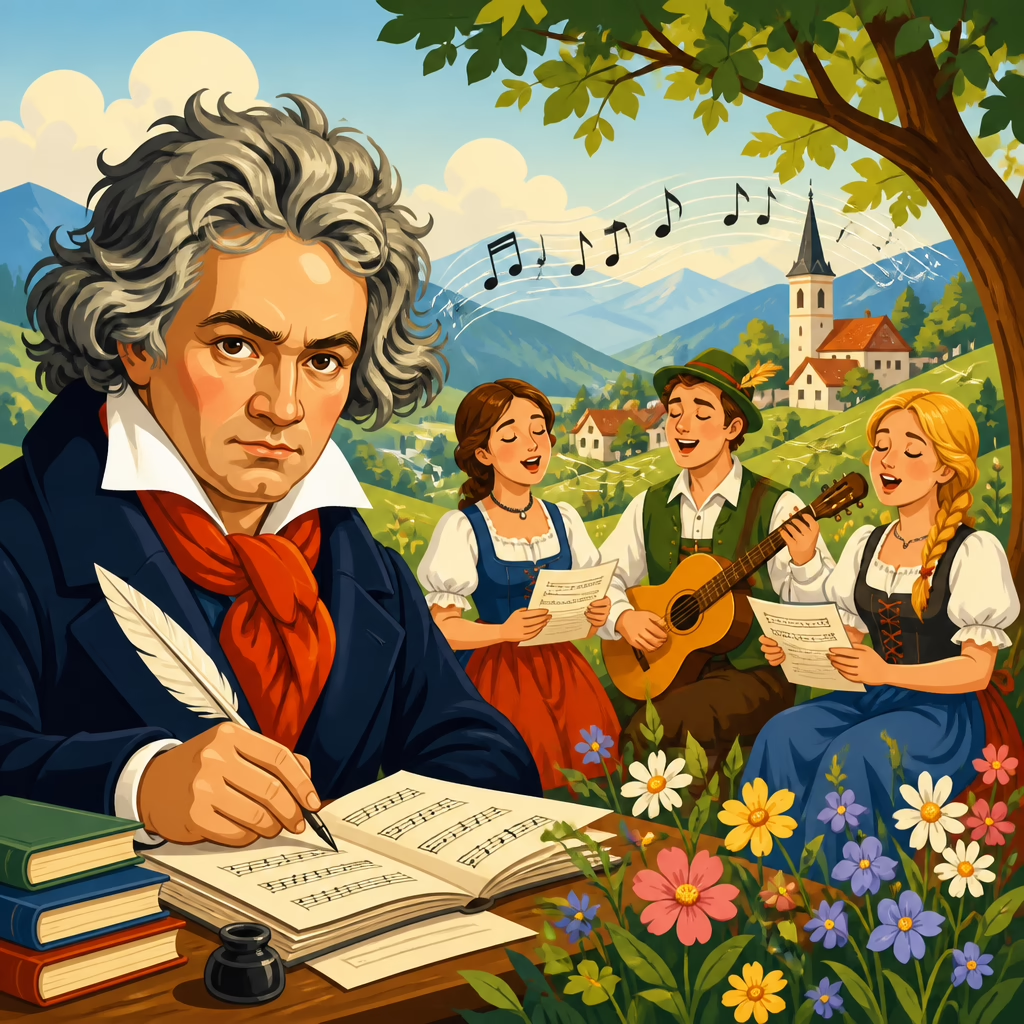
Great Recordings of Beethoven Songs and Folk Settings
Beethoven’s songs and folk settings remain one of the least explored corners of his output, yet great recordings of Beethoven songs and folk settings reveal a composer far more intimate, adaptable, and text-sensitive than the public image of the symphonist suggests. In this repertoire, “songs” usually means the original German Lieder, concert ariettas, canons, and occasional vocal works for solo voice with piano, while “folk settings” refers mainly to the hundreds of arrangements Beethoven made for British, Irish, Scottish, Welsh, Continental European, and other traditional melodies, most often for voice, piano, violin, and cello. These pieces matter because they show Beethoven working at close range: shaping diction, pacing emotional turns in a few bars, and balancing vocal line against chamber texture rather than orchestral mass. I have returned to these works repeatedly when evaluating singers, because they expose musical intelligence instantly. A performer cannot hide behind plush orchestral sonority in “Adelaide,” “An die ferne Geliebte,” or the Scottish and Irish settings. Breath control, German declamation, tonal color, and ensemble discipline are all audible. For listeners building a Beethoven collection, the best recordings of this repertoire add a necessary dimension to the familiar symphonies, sonatas, and quartets. They also answer practical questions collectors ask: which discs offer the best singing, the clearest programming, the strongest instruments, and the most persuasive stylistic approach?
What makes a Beethoven song recording great
A great Beethoven song recording begins with language. In the original songs, the singer must project consonants clearly without punching them, sustain line across Beethoven’s occasionally angular writing, and respect the rhetorical weight of the poetry. In “Adelaide,” for example, the long-breathed opening needs floated legato, but the ecstatic close requires expansion without turning sentimental. In “An die Hoffnung,” the best performances keep a firm pulse and let harmonic tension carry the plea. In the cycle “An die ferne Geliebte,” often called the first true song cycle in the standard repertory, continuity matters even more than isolated beauty. The six songs must unfold as one arc, with transitions feeling inevitable rather than merely sequential.
The folk settings ask for different strengths. These arrangements are not simple accompaniments under a tune. Beethoven often gives the violin and cello independent commentary, introduces miniature preludes and postludes, and changes texture with sharp dramatic instinct. The ensemble therefore has to think like chamber musicians. Balance is decisive: if the keyboard dominates, the settings sound square; if strings overphrase, they become faux-Romantic. The ideal performance keeps the melody direct while letting Beethoven’s craftsmanship register. I listen especially for whether the players differentiate strophic verses through articulation, dynamic shading, and text response. Without that care, even excellent melodies can blur together over a full recital.
Recorded sound is also crucial. Because this repertoire lives on nuance, over-reverberant engineering can flatten diction and smear instrumental detail. The strongest releases place the voice naturally within the chamber texture, with enough presence to hear words and enough air to preserve blend. Good annotation matters too. Beethoven’s folk settings involve unfamiliar sources, variant texts, and publication contexts linked to George Thomson and the early nineteenth-century music market. Label booklets that identify the tune, poet, arrangement type, and historical frame significantly improve the listening experience.
Essential recordings of the original songs
Among recordings of Beethoven’s original songs, Dietrich Fischer-Dieskau remains foundational, especially in recital programs that include “An die ferne Geliebte,” “Adelaide,” and the Op. 48 settings. His approach is text-led, highly inflected, and intellectually alert. Some listeners find the vocal production too interventionist by modern standards, but his command of German declamation and tonal shading makes clear how seriously this repertoire can be taken. In “Wonne der Wehmut” and “Resignation,” he finds the tension between Classical proportion and early Romantic inwardness better than almost anyone. For collectors who want a benchmark interpretation, his recordings still define the central expressive problems of the music.
Peter Schreier offers a different but equally valuable path. His tenor is lighter, more speech-attentive, and often more transparent in line. In “An die ferne Geliebte,” that transparency can be revelatory, because the cycle benefits from conversational immediacy rather than generalized lyric grandeur. Schreier’s strengths include verbal point, rhythmic discipline, and an ability to keep Beethoven’s often exposed writing moving forward. When paired with a responsive pianist, he clarifies the architecture of the cycle and the often underestimated vigor in pieces that can seem decorous if undercharacterized.
For modern listeners, Christian Gerhaher is indispensable in German song generally, and his Beethoven is especially persuasive because he combines textual intelligence with unusual control of color and line. Gerhaher does not inflate these songs into late Romantic confession. He keeps their Classical backbone intact while revealing emotional complexity through subtle accent and timbral variation. In “An die Hoffnung,” the restraint itself creates intensity. His Beethoven demonstrates that inwardness and structural clarity are not competing values but mutually reinforcing ones.
Soprano recordings deserve equal attention, particularly in songs such as “No, non turbarti,” “Soll ein Schuh nicht drücken,” and selected concert pieces where brightness and verbal agility matter. Barbara Bonney brought an appealing poise to this repertory, and more recent singers with strong Mozart credentials often succeed because they understand how to sustain elegance under pressure. The best soprano Beethoven avoids generalized prettiness. It needs backbone in the middle register, clean attack, and enough dramatic instinct to handle abrupt mood changes without distortion.
Why “An die ferne Geliebte” is the touchstone
If one work decides whether a singer truly understands Beethoven song, it is “An die ferne Geliebte,” Op. 98. Composed in 1816 to poems by Alois Jeitteles, it links six songs without break and closes by recalling the opening material, creating a circular design that influenced later composers, especially Schumann. The cycle asks for lyric ease, formal awareness, and emotional honesty free from exaggeration. The opening “Auf dem Hügel sitz ich spähend” should not sound inert; it must establish distance, longing, and motion in one gesture. “Wo die Berge so blau” needs tenderness without slackness, while “Nimm sie hin denn, diese Lieder” requires the singer and pianist to make the return of the opening feel earned rather than merely clever.
I have found that recordings succeed here when the pianist is treated as an equal architect. Beethoven’s keyboard writing is not as luxuriant as Schubert’s, but it is structurally decisive. The accompanist controls transitions, harmonic suspense, and the breathing spaces between poetic images. That is why duo chemistry matters more than individual fame. The finest accounts sound less like a singer with accompaniment and more like a chamber partnership. For readers interested in how this kind of close comparative listening sharpens judgment across Beethoven performance, the broader critical method is outlined in this guide to comparing Beethoven recordings.
| Recording focus | What to listen for | Why it matters |
|---|---|---|
| Opening song | Steady tempo, unforced legato, clear diction | Sets the cycle’s emotional and structural premise |
| Middle songs | Contrast between pastoral ease and inward tension | Prevents the cycle from sounding monochrome |
| Piano transitions | Continuity between songs, harmonic direction | Creates the sense of a unified cycle |
| Final reprise | Natural return of opening material | Confirms Beethoven’s large-scale design |
The best way into the folk settings
The folk settings can look daunting because the catalogue is large and the titles are unfamiliar. The best way in is through intelligently curated selections rather than complete editions at first. Beethoven wrote more than 170 British Isles settings alone for publisher George Thomson, plus many arrangements of other national songs. These were commercial commissions, but dismissing them as hackwork is a mistake. In the strongest examples, Beethoven transforms modest material through introductions, countermelodies, rhythmic lift, and sharply characterized instrumental writing. “O Mary, at thy window be,” “Sunset,” “The pulse of an Irishman,” and “Bonny Laddie, Highland Laddie” can become miniature dramas in the right hands.
Excellent recordings usually cast first-rate lieder or oratorio singers with alert chamber players. That combination matters because the diction requirements vary by language and dialect, and the style sits between recital intimacy and domestic music-making. Hyper-operatic singing sounds wrong, but underprojected delivery can make the texts disappear. I generally prefer singers who color the verse simply, trust the tune, and allow the violin and cello to add wit or poignancy. In these pieces, taste is everything. The best performances never condescend to the material, yet they also resist making every strophe sound consequential in the same way.
Collectors should also pay attention to editorial choices. Some labels modernize pronunciation or alter repeats; others preserve fuller sets and original sequence logic. Neither approach is automatically superior, but consistency matters. The strongest albums explain whether they are presenting Irish songs, Scottish songs, mixed-language samplers, or a representative anthology across opus numbers. That clarity helps listeners hear Beethoven’s range: martial songs, laments, love songs, drinking songs, and pastoral airs all receive distinct treatment when programming is thoughtfully done.
Recommended artists and labels for the folk settings
Among notable champions, the Hyperion series devoted to Beethoven’s folk songs set a high standard for completeness, scholarship, and performance quality. Hyperion’s engineering typically gives exactly what this music needs: a present but unforced vocal image, articulate strings, and a piano sound with definition rather than boom. The series also benefits from excellent notes, making it easier to understand tune origins and publication history. For listeners serious about the repertoire, these discs are often the safest starting point.
Thomas Allen brought warmth, verbal ease, and unshowy authority to this music, qualities that suit the directness of many settings. Felicity Lott, in turn, could lighten the line beautifully without trivializing it, especially in songs requiring elegance and charm. Anthony Rolfe Johnson contributed stylish clarity and an unaffected manner that kept narrative songs alive. Ann Murray’s musicianly steadiness and crisp text made her especially effective in ensemble tracks where quick characterization is needed. What unites these singers is not identical vocal color but a shared refusal to overinflate small forms.
The instrumental side matters just as much. Violinists and cellists in the best recordings phrase with Classical economy, avoiding thick vibrato and sentimental slides unless the tune genuinely invites them. Pianists must manage a difficult balance: they need enough profile to articulate Beethoven’s inventions, but not so much weight that the songs lose their folk core. When that balance is achieved, the listener hears why these arrangements are worth serious attention. They are not merely ethnographic curiosities or Beethoven completism. They are compact studies in adaptation, voice leading, and social function.
How to listen critically without losing pleasure
The most rewarding way to hear great recordings of Beethoven songs and folk settings is to compare three things at once: text delivery, structural pacing, and chamber balance. Start with one original song, one movement from “An die ferne Geliebte,” and two contrasting folk settings. Listen first for the words alone. Can you follow the poem without reading along? Next, focus on tempo. Does the performance move naturally, or does it sag under expressive emphasis? Finally, track the instruments. In the folk settings especially, are the violin and cello merely decorative, or are they commenting on the text and shaping the verse?
This method quickly reveals interpretive differences. A heavier baritone may bring grandeur to “Adelaide” but struggle with buoyancy in strophic songs. A lighter tenor may capture verbal spring yet lack emotional ballast in slower numbers. One pianist may uncover motivic links in “An die ferne Geliebte,” while another simply accompanies competently. In the folk songs, a slightly brisker tempo can turn a dutiful reading into a living dance. Small choices matter because the forms are small. Beethoven gives performers less space to recover from misjudgment than in a sonata movement or symphonic adagio.
There is also a practical collecting point. Because this repertoire is scattered across recital discs, complete-song editions, and themed anthologies, the ideal library often combines a benchmark cycle recording, a broad lieder survey, and a curated folk selection. That mix serves both study and enjoyment. It lets you hear Beethoven the literary miniaturist, the innovator of cyclical design, and the craftsman responding to popular melody under commission.
Great recordings of Beethoven songs and folk settings reveal a composer whose vocal imagination is subtler, more varied, and more companionable than his monumental reputation implies. The original songs show his sensitivity to text, line, and form at close range; the folk settings show his ingenuity in transforming preexisting tunes into chamber art without stripping them of their plainspoken appeal. For the listener, this repertoire offers a different Beethoven: less public, less declarative, but no less exacting. The best recordings share clear diction, disciplined phrasing, intelligent tempo, and true ensemble partnership. They also respect scale. These works collapse when treated as miniature opera, and they fade when sung too cautiously. Balance is the central virtue.
If you want the strongest starting points, begin with a distinguished account of “An die ferne Geliebte,” add a carefully selected recital of the original songs, then explore the Hyperion folk-song volumes for depth and variety. Compare singers not by vocal size alone but by how they shape language and sustain line. Compare accompanists by how they organize form and react to text. Above all, listen for Beethoven’s unmistakable fingerprints: motivic economy, harmonic purpose, and the refusal to waste a bar. Revisit these recordings with the same seriousness you would bring to the piano sonatas or string quartets, and they repay that attention richly. Start with one cycle and one folk anthology, then build outward by performer, label, and pairing.
Frequently Asked Questions
What counts as Beethoven songs and folk settings, and how are they different from his symphonies or piano works?
In this part of Beethoven’s output, “songs” usually refers to his original vocal works for solo voice and piano, including German Lieder, concert songs, shorter occasional pieces, and a few ariettas and canons that reveal his gift for compression and characterization. These works are typically more intimate than the large public statements of the symphonies, concertos, or piano sonatas. Instead of long-form development on a grand scale, Beethoven often works here through close attention to text, quick shifts of mood, harmonic nuance, and the relationship between a singer’s phrasing and the piano’s commentary. The result is a more private Beethoven: direct, witty, lyrical, reflective, and sometimes surprisingly tender.
“Folk settings,” by contrast, usually refers to the many arrangements Beethoven made of British, Irish, Scottish, Welsh, and other songs, most of them written for voice with piano trio accompaniment rather than voice and piano alone. These were often prepared for commercial publication, but that should not lead listeners to dismiss them as merely functional. At their best, they show Beethoven’s extraordinary ability to take a simple melody and frame it with inventive harmonies, instrumental introductions, codas, and companion lines that enrich rather than overwhelm the tune. Great recordings make this distinction clear: the original songs tend to showcase Beethoven the composer of text-driven miniatures, while the folk settings reveal Beethoven the arranger, collaborator, and master of refined variation within apparent simplicity.
Why are great recordings of Beethoven songs and folk settings important for understanding him as a composer?
They matter because they complicate the standard image of Beethoven as only a heroic, monumental figure. In these works, listeners encounter a composer who is highly responsive to language, accent, and character. A strong recording can show how carefully he shapes a vocal line around the natural rhythm of words, how often the accompaniment acts as an emotional subtext, and how much tonal color he can generate in a short span. This repertoire also helps bridge the gap between the Classical song tradition and the richer Lied world that would later flourish in Schubert and Schumann. Beethoven may not dominate recital programming in the same way as those later composers, but his best songs are essential to the history of German art song.
The folk settings are equally revealing. They demonstrate Beethoven’s flexibility in a context that required elegance, clarity, and charm instead of overt symphonic struggle. They also remind us that he was writing for real domestic music-making and for audiences beyond the elite concert hall. A persuasive recording brings out the sophistication hidden in these miniature arrangements: the subtle reharmonizations, the finely judged preludes and postludes, and the delicate balance between the singer and the trio instruments. Taken together, these performances expand our sense of Beethoven’s personality and craft. They show not a secondary Beethoven, but a different Beethoven—one whose expressive range becomes clearer when heard at close quarters.
What should listeners look for in a great recording of Beethoven songs and folk settings?
The first thing to listen for is textual intelligence. In Beethoven’s original songs especially, a singer must do more than produce a beautiful sound; the performance has to communicate the poem’s syntax, emotional turns, and verbal emphasis. Clear diction, sensitivity to consonants and vowels, and a natural approach to phrasing are crucial. Beethoven’s writing can seem deceptively plain on the page, but it comes alive when the singer understands where the drama lies and how the line should move with the text rather than simply over it. A great pianist is just as important, because the keyboard part often supplies atmosphere, tension, irony, or structural coherence that the voice alone cannot convey.
In the folk settings, balance and style become especially important. Since many of these arrangements involve voice, violin, cello, and piano, the best recordings avoid treating the instrumentalists as mere accompanists while also keeping the melody central. The finest performances give the tunes room to breathe and preserve their directness, but they also bring out Beethoven’s imaginative touches in the ensemble writing. Listeners should pay attention to tempo choices, articulation, and the degree of expressive freedom. If the interpretation is too heavy, the songs can sound overworked; if it is too casual, Beethoven’s craftsmanship disappears. Great recordings find the middle ground: poised, affectionate, detailed, and alive to both the popular origins of the melodies and the sophistication of the settings.
Are Beethoven’s folk settings just arrangements, or do they have real artistic value?
They absolutely have real artistic value, though it helps to approach them on their own terms. Because these pieces begin with pre-existing melodies, some listeners assume they are minor works of little interpretive interest. In fact, Beethoven’s contribution often lies precisely in how he reframes the material. He can deepen a tune through a change of harmony, sharpen its profile through rhythmic detail, or create a small dramatic world with an introduction, interlude, or coda. The apparent modesty of the task makes his ingenuity easier to overlook, but a well-chosen recording reveals how much personality and craft he invested in these settings.
They also matter historically and culturally. These arrangements sit at the intersection of art music, commerce, domestic performance, and national song traditions. Beethoven was engaging melodies associated with everyday singing and placing them in a cultivated chamber context without stripping them of accessibility. That tension is part of their charm. The best recordings respect the simplicity of the tunes while illuminating the elegance of the treatment. When performed with care, these works do not sound like curiosities from the edge of Beethoven’s catalogue. They sound like meaningful examples of his ability to adapt his voice to a different medium and audience while still leaving a recognizable artistic signature.
Where should a newcomer start if they want to explore great recordings of Beethoven songs and folk settings?
A smart place to begin is with a well-curated recital of Beethoven’s original songs alongside a separate recording or selection of the folk settings, because the contrast between the two categories is illuminating. For the songs, many listeners start with famous pieces such as “Adelaide,” “An die ferne Geliebte,” and “Ich liebe dich,” then move outward to lesser-known Lieder and occasional works. “An die ferne Geliebte” is especially important because it is one of the earliest major song cycles in the repertoire and offers a compact but profound example of Beethoven’s lyrical continuity, emotional architecture, and sensitivity to poetic sequence. Hearing it in a strong performance can immediately correct the misconception that Beethoven was somehow uncomfortable in the realm of song.
For the folk settings, it is best to choose recordings that present a generous selection rather than only one or two isolated tracks. The cumulative experience helps listeners hear the variety of Beethoven’s approach across Scottish, Irish, Welsh, and other melodies. Look for performers who understand both chamber-music balance and vocal storytelling, since these arrangements thrive when the ensemble sounds collaborative rather than hierarchical. Newcomers should also resist the urge to compare every piece to Beethoven’s biggest masterpieces. This repertoire rewards a different listening mode: closer attention, lighter scale, and appreciation for subtle craftsmanship. Once heard in that spirit, great recordings of Beethoven songs and folk settings can become not a side path, but one of the most rewarding ways into the full complexity of his art.