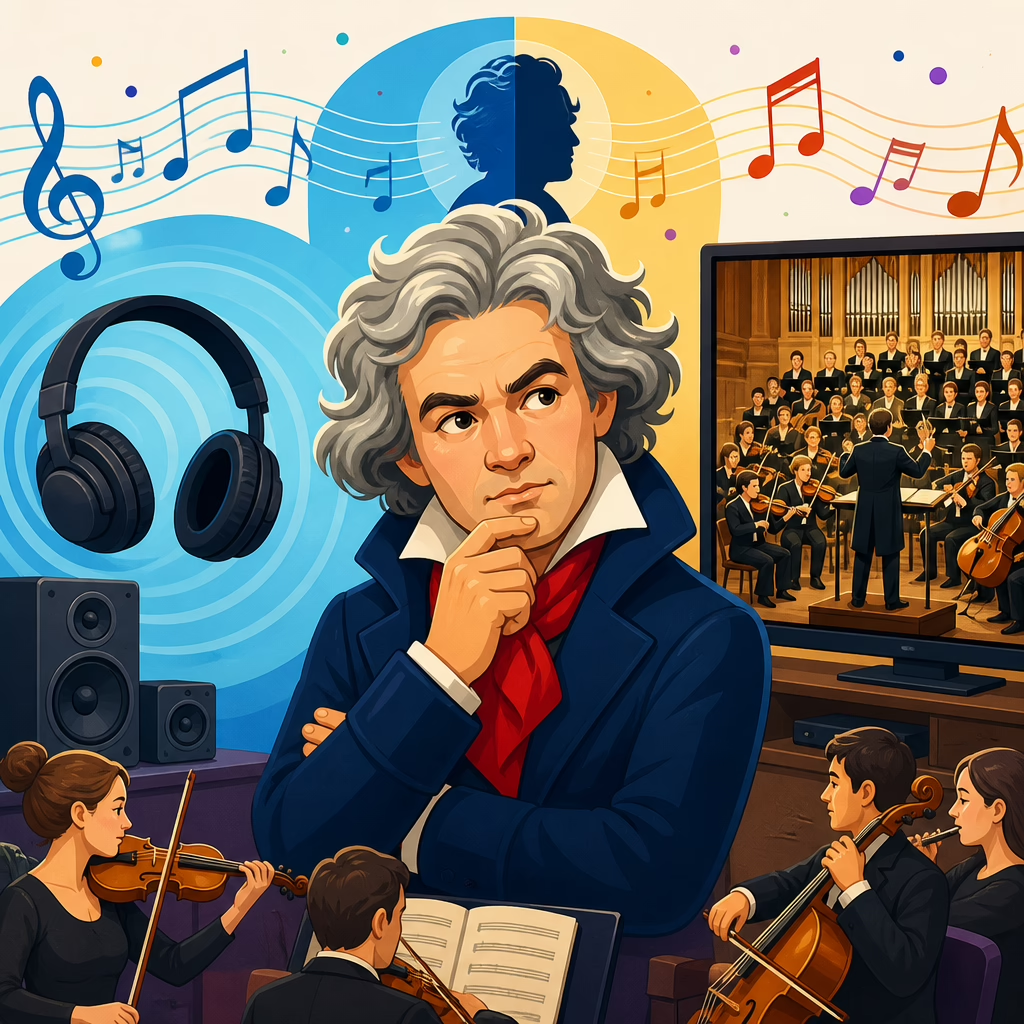
Beethoven’s Ninth on Audio and Video: What to Compare
Beethoven’s Ninth on audio and video rewards close comparison because no other symphony combines such familiar material with so many interpretive variables that alter the listener’s experience. A collector choosing among recordings quickly discovers that tempo, orchestra size, choral balance, hall acoustics, camera direction, and even subtitle style can change the work’s character as much as the performers themselves. “Audio” here means a recording heard without staged imagery, whether on LP, CD, download, or stream. “Video” means a filmed performance, concert capture, or hybrid production in which visual decisions become part of the interpretation. “Compare” does not mean picking a winner after one hearing. It means identifying the musical and technical factors that explain why one Ninth sounds stern, another ecstatic, another theatrical, and another oddly diffuse.
That matters because Beethoven’s Ninth is unusually exposed. Nearly everyone knows the Scherzo’s hammering rhythm and the finale’s “Ode to Joy,” so superficial familiarity can mask deep differences in structure, pacing, and execution. In my own listening sessions, especially when matching classic audio releases against modern Blu-ray performances, I have found that judgments formed from memory alone are unreliable. A finale that seems thrilling in isolation may feel overdriven when measured against the first three movements. A visually exciting chorus may actually be underpowered on the soundtrack. Conversely, an older mono or early stereo recording can reveal stronger architectural command than a glossy modern film. Serious comparison helps listeners spend money wisely, avoid being misled by production values, and hear how conductors solve the symphony’s biggest challenge: unifying instrumental drama and vocal proclamation into one convincing arc.
Start with the score-level questions that shape every performance
The most useful first step is to compare decisions rooted in the score rather than in sound quality. Beethoven’s Ninth raises immediate questions about edition, repeats, tempo relationships, articulation, and the size of the performing forces. Most conductors use the standard critical text, but their practical choices vary. Does the Scherzo feel driven by strict pulse or by expressive flexibility? Is the Adagio broadly spacious or flowing enough to preserve tension? In the finale, does the “terror fanfare” erupt as a break in continuity or as the inevitable release of pressure built across the symphony? These are not abstract concerns. They determine whether the work sounds monumental, classical, revolutionary, or operatic.
Watch especially how the first movement is paced. Conductors who stress the opening’s mysterious emergence often keep the first pages tightly controlled, letting the rhythmic definition sharpen as the movement develops. Others broaden early, seeking metaphysical grandeur from the first bar. Neither approach is inherently superior, but each has consequences. If the exposition is too weighty, the recapitulation can feel earthbound. If it is too quick and light, the climaxes may lack tragic force. The Scherzo then reveals whether the conductor understands Beethoven’s rhythmic engine. In the best performances, the timpani’s insistence is not merely loud; it organizes the whole texture. Compare Carlos Kleiber’s fierce propulsion, Herbert von Karajan’s polished drive, and John Eliot Gardiner’s leaner, sharper attack with period-informed articulation, and you hear three coherent but distinct solutions.
The Adagio is where many comparisons become decisive. Audio listeners often focus on string warmth and cantabile line, but the deeper issue is span. Can the conductor sustain long melodic paragraphs without slackening harmonic direction? On video, this movement can be misleading because camera cuts encourage attention to individual players instead of to cumulative phrasing. A filmed close-up of a woodwind solo may look intimate while the broader pulse subtly weakens. For that reason, compare the movement once by listening only, even if you own the video version. If the line remains compelling without pictures, the interpretation is structurally sound.
Compare orchestral sound, choral blend, and solo quartet function
Once the interpretive framework is clear, compare the performing forces as sonically distinct components. Beethoven’s Ninth is not only a conductor’s piece; it is a balance problem. The orchestra must retain symphonic authority even after the chorus enters. The chorus must project text and rhythm without sounding generalized or over-reverberant. The vocal quartet must emerge as individual personalities while still functioning as part of the larger design. In weak performances, the soloists seem imported from another event. In strong ones, they sound like the inevitable human extension of the instrumental drama.
Orchestral sound should be judged section by section. Strings need body, but also attack; a plush legato can blur Beethoven’s accents. Woodwinds must register as character voices, especially in the first movement and Adagio variations. Brass are crucial because their role shifts from structural support to public proclamation. Timpani deserve special scrutiny. On many recordings, engineers capture impact but not pitch definition, yet Beethoven’s timpani writing in the Scherzo and finale is motivically important. If the drums only thud, the symphony loses profile. Older recordings by Toscanini or Furtwängler may have limited frequency range, but they often preserve rhythmic hierarchy better than wider but softer modern engineering.
Choral comparison begins with diction. Friedrich Schiller’s text cannot merely wash over the orchestra as a noble blur. Consonants should articulate rhythm, especially in “Freude, schöner Götterfunken” and the Turkish-march episode. Listen for whether the chorus sings as one disciplined instrument or as a collection of enthusiastic individuals. The best professional choirs maintain vowel unity across dynamic extremes. Video adds another layer: physical placement. A chorus arranged too far behind the orchestra may look grand yet sound delayed or softened. Filmed performances in large cathedrals or arenas often magnify this issue. You may see thrilling scale while hearing compromised textual clarity.
The baritone’s opening recitative, “O Freunde, nicht diese Töne,” is a major comparison point because it establishes the finale’s human intervention. A commanding singer projects authority without barking. Bass-baritones such as Dietrich Fischer-Dieskau, Bryn Terfel, or Thomas Quasthoff bring very different vocal colors and degrees of rhetorical weight. The tenor’s march episode must ring out heroically but remain musical; this is harder than it looks and often exposes strain. Sopranos and mezzo-sopranos matter less as stars than as blend partners who stabilize the quartet’s ensemble. When comparing versions, note whether the quartet is recorded naturally within the orchestral space or spotlighted with close microphones. Excess spotlighting can make the soloists impressive individually while weakening the symphonic scale.
| Comparison point | What to listen or watch for | Why it matters |
|---|---|---|
| First movement pacing | Opening tension, transition control, climactic weight | Sets the symphony’s emotional architecture |
| Scherzo rhythm | Timpani definition, articulation, trio contrast | Reveals structural grip and orchestral discipline |
| Adagio span | Long phrasing, pulse stability, wind-string balance | Determines whether lyricism sustains tension |
| Finale choral entry | Diction, balance, impact after instrumental chaos | Tests integration of voices into symphonic form |
| Video direction | Camera cuts, score awareness, chorus coverage | Can clarify or distort musical priorities |
Use audio criteria for audio releases and separate video criteria for filmed performances
A common mistake is to evaluate video performances with purely musical criteria and then assume the visuals are a bonus. In practice, filmed Beethoven’s Ninth requires a second set of standards. For audio releases, ask whether the recording perspective supports the score. Is the soundstage coherent? Are bass lines audible without artificial boom? Does the hall acoustic add bloom while preserving articulation? Labels such as Deutsche Grammophon, Decca, Philips, BIS, and Pentatone developed recognizable recording signatures, and those signatures affect comparisons. A close, detailed studio balance may reveal inner parts elegantly yet underplay the work’s public scale. A distant concert-hall perspective may convey grandeur while obscuring text and rhythmic edge.
Dynamic range is particularly important in audio. Beethoven’s Ninth depends on real contrast, from hushed expectancy to choral and orchestral mass. Compression makes the symphony seem consistently exciting but actually reduces drama. If streaming, check whether the service offers lossless tiers and whether loudness normalization is altering impact between versions. Headphone listening can help with detail comparison, especially in the finale’s fugato passages, but speakers are better for judging massed sonority and bass foundation. I routinely compare the same movement both ways because some balances flatter headphones while collapsing in room playback.
Video introduces image grammar. Good concert direction respects musical form. Cameras should anticipate entries, reveal instrumental conversations, and avoid random cutting on every beat. The finest directors know when to stay wide, especially in transitions and climaxes where spatial relationships matter. Excessive close-ups can trivialize large architecture, turning Beethoven into a sequence of reaction shots. The opposite problem is static filming that never shows which section is carrying the argument. When judging a video Ninth, ask whether you learned something about the performance from watching it. If not, the filming failed even if the playing was excellent.
Subtitles and supplementary features also matter more than many collectors admit. Clear, accurate subtitles help non-German speakers follow Schiller’s poem and evaluate declamation. Poor translation can flatten irony, idealism, or shifts in register. Bonus interviews, rehearsal footage, or booklet essays can be useful if they illuminate interpretive decisions, but they should not substitute for audible results. A conductor may speak movingly about brotherhood and universality; the real test is whether the finale’s difficult transitions cohere in performance. If you want a broader framework for evaluating complete cycles and recurring interpretive patterns, consult the main guide on how to compare Beethoven symphony cycles like a critic, then return to the Ninth with these more specialized criteria.
Compare representative traditions instead of chasing a single “best” Ninth
The most revealing comparisons place recordings within performance traditions. Mid-twentieth-century Central European readings often emphasize rhetorical weight, flexible tempo, and existential drama. Furtwängler’s Bayreuth 1951 performance is indispensable not because of sonic polish, which it lacks, but because it demonstrates overwhelming long-line tension and historical presence. Karajan, especially in his Berlin versions, offers a different model: refined orchestral finish, blended choral sonority, and a consciously sculpted symphonic surface. Bernstein tends toward heightened emotional declaration, sometimes broadening the Adagio and finale to emphasize human urgency. Period-informed conductors such as Gardiner, Norrington, and Harnoncourt strip away some late-Romantic accumulation, clarifying articulation, leaner textures, and Beethoven’s disruptive energy.
Video comparisons reveal another tradition: the performance as civic event. Leonard Bernstein’s 1989 Berlin performance, with “Freiheit” replacing “Freude” in the context of the fall of the Wall, cannot be assessed purely as a neutral benchmark, yet it shows how occasion, audience, and image reshape reception. More recent high-definition releases with orchestras such as the Berlin Philharmonic or Vienna Philharmonic offer extraordinary visual access to playing technique and ensemble discipline, but they can also encourage viewers to overvalue sheen. Sometimes a less luxurious film from a festival setting communicates stronger risk, concentration, and communal force.
The practical conclusion from years of comparison is simple. Do not ask which recording is best in the abstract. Ask which performance solves Beethoven’s Ninth most convincingly on its own terms, and whether the medium helps or hinders that solution. Compare score-based decisions first, then balances, then recording or filming choices, and finally historical context. When you listen and watch this way, familiar masterpieces become newly legible. You hear why one Scherzo bites harder, why one Adagio floats but another truly sings, and why one finale sounds merely big while another feels inevitable. Choose two contrasting versions and test them movement by movement. That disciplined comparison will teach you more than any ranking ever could.
Frequently Asked Questions
What are the most important factors to compare when choosing between recordings of Beethoven’s Ninth on audio and video?
The most useful starting point is to separate the musical interpretation from the presentation format, then notice how strongly the two interact. On the musical side, compare tempo choices in all four movements, the size and playing style of the orchestra, the balance between strings, winds, brass, timpani, and chorus, the vocal character of the solo quartet, and the conductor’s overall architectural sense. Beethoven’s Ninth can sound monumental, urgent, lyrical, devotional, or sharply dramatic depending on these decisions. A broad first movement may emphasize weight and inevitability, while a swifter approach can make the music feel more volatile and driven. In the Scherzo, rhythmic articulation and timpani presence are often decisive; in the Adagio, phrasing and patience matter enormously; and in the finale, the conductor’s control of transitions can determine whether the movement feels episodic or inevitable.
On the presentation side, audio recordings ask you to focus entirely on sound: recorded perspective, dynamic range, reverberation, instrumental clarity, and the realism of the chorus and soloists in space. Video adds another layer of comparison. Camera direction can either illuminate the score or distract from it. A thoughtful video production shows who matters musically at a given moment: the bass entering with “O Freunde,” the fugue exchanges in the chorus, the timpani’s propulsion in the Scherzo, or the conductor’s cueing at critical transitions. Less sensitive direction may overuse audience shots, flashy cuts, or irrelevant close-ups that pull attention away from Beethoven’s structure. In practice, the best comparison asks not simply “Which performance is better?” but “How does this interpretation come across differently when heard alone versus when shaped by visual framing?”
How much do tempo and overall pacing change the character of Beethoven’s Ninth?
They change it profoundly. Beethoven’s Ninth is one of those works where a few minutes one way or the other can alter the emotional profile of the entire performance. Tempo is not just a matter of speed; it affects tension, articulation, phrasing, and how convincingly the symphony hangs together. A conductor who adopts taut, forward-moving tempos may highlight the work’s revolutionary energy and formal momentum. The opening movement can feel searching and unsettled rather than ceremonial. The Scherzo can become fiercely athletic, almost relentless, with sharply etched rhythms and biting accents. The finale then emerges as a culmination of accumulated pressure.
By contrast, a broader pacing can make the work sound more monumental and humane, especially in the slow movement and major choral passages. The Adagio benefits from a tempo that allows melodic lines to breathe without losing direction; too slow, and it risks stasis, too fast, and it loses its spiritual spaciousness. In the finale, pacing is especially difficult because the movement contains recitative-like interruptions, marches, lyric episodes, double fugues, and massive choral climaxes. If the conductor cannot relate these sections through intelligent tempo relationships, the movement can seem patched together. When comparing recordings, listen for whether tempo choices feel imposed from outside or organically connected to the music’s rhetoric. On video, you can often see whether a tempo is physically sustainable for the performers and how ensemble discipline supports it; on audio, you judge more purely by flow, coherence, and the sense of inevitability from start to finish.
Why do orchestra size, choral balance, and recording acoustics matter so much in this piece?
Because Beethoven’s Ninth lives at the meeting point of symphonic power, chamber-like detail, and choral proclamation. The size of the orchestra influences texture immediately. A larger modern orchestra can give the work great sonic mass and richness, especially in the brass tuttis and the culminating sections of the finale. That can be thrilling, but if the recorded balance is too dense, inner lines disappear and the music loses definition. A smaller or more transparent ensemble may reveal contrapuntal detail and rhythmic bite with unusual clarity, though some listeners may miss the sense of grand scale they associate with the piece. Neither approach is automatically right; what matters is whether the forces chosen serve the interpretation convincingly.
Choral balance is equally crucial because the finale should never sound like “symphony plus attached chorus.” The chorus must enter as a natural extension of the work’s argument. In some recordings the chorus is blended and orchestral, integrated into the texture; in others it is bright, text-forward, and dramatically projected. The soloists also need careful balancing. If they are too recessed, important text and character are lost; if they are too close-miked, the finale can feel oddly fragmented, with the quartet sitting on top of the ensemble rather than emerging from it.
Hall acoustics and engineering shape all of this. A resonant acoustic may lend grandeur to the climaxes and warmth to the Adagio, but it can blur fast choral writing and soften rhythmic attack. A drier acoustic often improves clarity and articulation, especially in the Scherzo and fugal passages, though it may make the performance seem less expansive. Video adds visual evidence of the acoustic environment: stage layout, chorus placement, soloist positioning, and hall size all help explain why a performance sounds the way it does. In a work as layered as Beethoven’s Ninth, these are not secondary technical details; they are part of the interpretation itself.
What does video reveal about a performance that audio alone cannot?
Video can reveal the mechanics and drama of ensemble music-making in a way that transforms how you understand the performance. You see how the conductor shapes transitions, how the orchestra responds physically to tempo and articulation, how the chorus enters and breathes as a collective body, and how the soloists interact with the conductor and one another. In Beethoven’s Ninth, these visual cues matter because the score depends on coordination across huge forces. Watching the conductor manage the volatile opening of the finale, prepare the choral entry, or hold together the fugues can clarify why a performance feels controlled, risky, spacious, or urgent.
Video also highlights interpretive choices in stage layout and performance style. Historically informed ensembles, for example, may use different seating plans, instrumental setups, and choral placement than large modern symphony orchestras. Seeing antiphonal violins, natural brass, harder timpani sticks, or a more compact chorus can help explain differences in articulation and balance you hear. Facial expression and physical intensity also influence reception. A chorus singing “Freude” with visible precision and engagement creates a different impression than one that sounds good but looks generalized or under-involved.
At the same time, video introduces potential distortions. Editing can manufacture emphasis that is not primarily musical. If the camera ignores the active line and lingers on reaction shots or decorative visuals, your attention may be guided away from the score. Subtitle style matters too. Clear, unobtrusive subtitles can deepen engagement with Schiller’s text, especially for listeners focusing on the finale’s humanistic message. Poorly timed or visually intrusive subtitles can break concentration. So video does not simply “add more”; it adds another interpretive layer, and part of comparing releases is deciding whether that layer deepens understanding or competes with the music.
When comparing multiple recordings, what is the best listening and viewing strategy for making fair judgments?
A good method is to compare in stages rather than trying to absorb everything at once. Start with one movement at a time, preferably in an order that isolates key variables. The first movement is excellent for judging orchestral sonority, structural grip, and the conductor’s command of long spans. The Scherzo quickly reveals rhythmic discipline, timpani profile, and recording clarity. The Adagio tests phrasing, line, tonal warmth, and patience. The finale should be saved for more focused comparison because it combines all the variables at once and can overwhelm first impressions. If you compare only complete performances straight through, you may remember broad emotional impact but miss the specific reasons one version persuaded you more than another.
It also helps to compare audio before video when possible. Listening without images lets you judge balance, pacing, dynamic control, and ensemble coherence on their own terms. Then, when you watch the video, ask whether the visuals confirm what you heard or subtly change your opinion. Sometimes a performance that sounds slightly cool on audio becomes gripping on video because the physical communication among performers is so vivid. In other cases, a powerful-sounding reading loses focus visually because awkward staging, busy editing, or uninspired camera choices interrupt concentration.
Keep practical notes on specific points: the opening tempo, the Scherzo repeat policy if relevant, the shaping of the “O Freunde” entry, how clearly the tenor march comes across, whether the fugues remain intelligible, and how overwhelming or controlled the final pages feel. Note, too, the engineering and presentation details: stereo image, bass weight, hall resonance, subtitle readability, camera pacing, and whether applause or audience noise affects the experience. Over time, patterns emerge. You may discover that you prefer leaner orchestral textures but more spacious acoustics, or that you value textual clarity in the finale more than sheer choral mass. The goal is not to find one universally “best” Beethoven Ninth, but to understand which combinations of interpretation and presentation most convincingly serve this extraordinarily variable masterpiece.