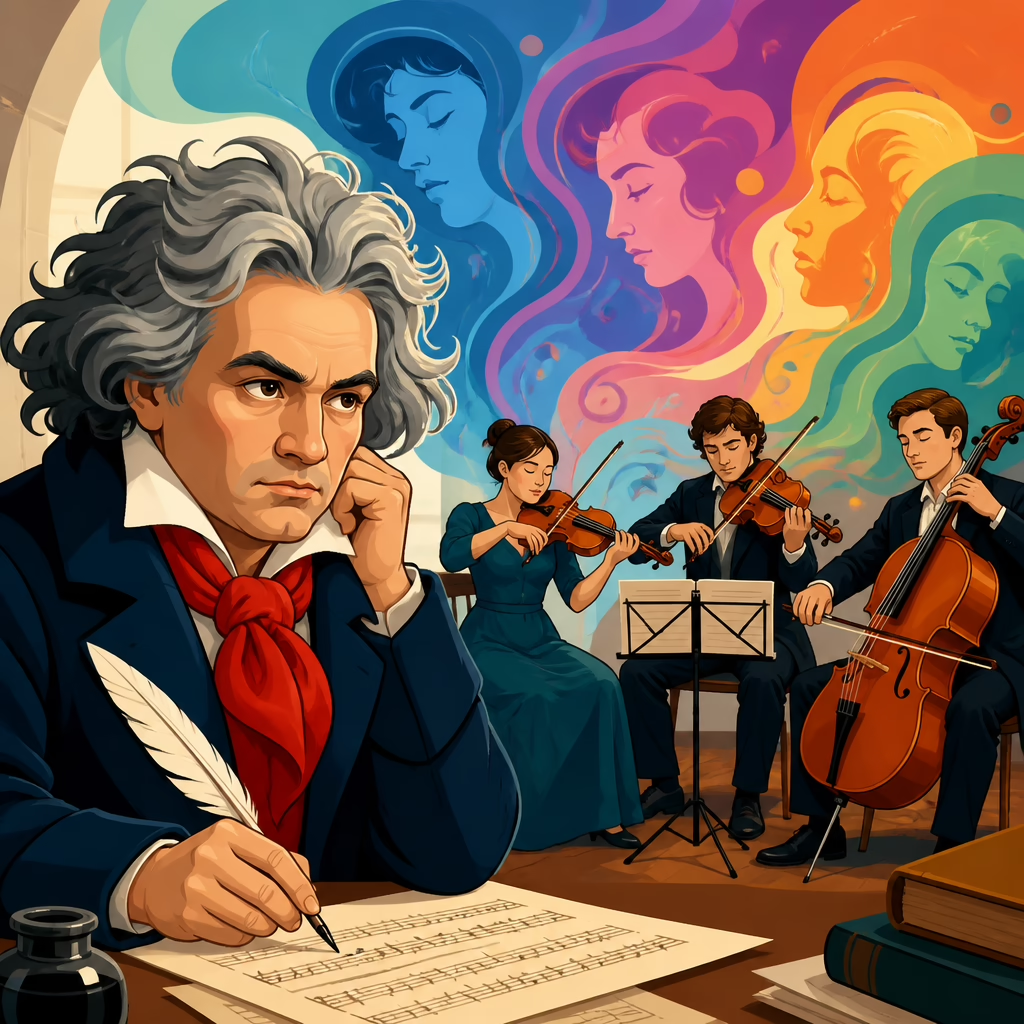
Beethoven Chamber Recordings That Reveal Inner Voices
Beethoven chamber recordings can illuminate details that even attentive listeners miss in larger-scale works, especially the inner voices that bind melody, harmony, and rhythm into a living conversation. In this context, inner voices means the parts between the obvious top line and the bass foundation: second violin figures, viola counterstatements, cello transitions, piano middle-register chords, and wind-like textures implied within string writing. When these lines are clearly projected, Beethoven’s chamber music stops sounding like a melody with accompaniment and starts revealing itself as argument, rebuttal, tension, release, and structural design. That matters because Beethoven wrote chamber music as a testing ground for ideas he later expanded elsewhere, and because the finest recordings show not only what notes are played but how musical thought travels between players.
I learned this most clearly while comparing multiple recordings of the same quartet movements in close sequence, paying less attention to big gestures than to handoffs inside the texture. A strong recording of the “Razumovsky” Quartets, for example, lets you hear when the viola quietly redirects momentum before the first violin appears to take over. In Op. 95, inner voices often carry the psychological pressure, not the melody. In the late quartets, they become the mechanism of transformation itself. The question is not simply which ensemble plays beautifully. It is which recording allows Beethoven’s middle layers to speak with intelligible shape, color, and purpose.
Several factors determine whether inner voices register. Ensemble balance is the first. Some quartets place the first violin too far forward, which flatters brilliance but suppresses Beethoven’s contrapuntal engine. Microphone placement is equally decisive. Close, dry studio sound can expose detail, but if overdone it fragments the ensemble and makes counterpoint feel diagrammed rather than organic. Reverberant church acoustics can blend timbres attractively, yet they often blur syncopations and swallow viola attacks. Tempo matters too. Fast readings can be thrilling, but if articulation is generalized, passing motifs vanish. Slower readings may reveal harmonic friction, though they risk losing line if players do not sustain tension bar by bar.
This article focuses on recordings that consistently reveal those middle layers in Beethoven’s string quartets, piano trios, and a few adjacent chamber works. The aim is not to compile every famous version, but to identify performances where phrasing, texture, and engineering let inner voices emerge naturally. These are the recordings I return to when I want to understand how Beethoven builds momentum from within rather than from surface rhetoric alone. If you care about structure, character, and the feeling that four or three players are thinking aloud together, these interpretations deserve close listening.
What makes inner voices audible in Beethoven chamber recordings
Inner voices become audible when performers treat them as speech rather than background. In Beethoven, the viola is often the hinge between harmonic support and thematic initiative. Second violin lines frequently answer, provoke, or destabilize the first violin. In piano trios, the piano’s middle register can either cushion the strings or actively reshape the phrase. The ensembles that reveal inner voices usually share four habits: terraced dynamics within a single bar, differentiated articulation between parts, clean rhythmic alignment, and a refusal to let the melody monopolize expressive weight. The result is not exaggerated balance but layered intention.
Recording practice either helps or hinders that intention. Older analogue recordings sometimes surprise modern listeners by preserving a more truthful ensemble perspective than hyper-detailed digital productions. At the same time, modern engineering can be superb when producers avoid spotlighting. I listen for whether the cello’s offbeat figure remains locatable under a violin cantilena, whether viola entries have attack and pitch center, and whether repeated inner-note patterns retain contour instead of dissolving into generalized warmth. If those things are present, the recording is telling the truth about Beethoven’s writing.
String quartet recordings that uncover Beethoven’s middle layers
The Alban Berg Quartet remains one of the safest recommendations for listeners seeking clarity without analytical coldness. In the middle-period quartets, especially Op. 59 No. 1 and Op. 59 No. 3, their balance allows the second violin and viola to articulate structural transitions with unusual clarity. The famous fugal finale of Op. 59 No. 3 benefits from their discipline: each entry speaks, but more importantly the connective tissue between entries never disappears. You hear Beethoven’s architecture assembling itself in real time. Their EMI recordings also benefit from a clean recorded image that separates lines without stripping body from the sound.
The Takács Quartet offers a different kind of revelation. Their Beethoven is more volatile, rhythmically alive, and coloristically varied. In Op. 95, that volatility helps because the work’s compressed language depends on tiny motivic cells ricocheting through all four instruments. The Takács players do not simply spotlight the tune; they make transitional fragments sound consequential. In the late quartets, especially Op. 132, the inner voices often carry the work’s spiritual unease. Takács shapes those lines with enough weight that the famous slow movement feels less like a broad hymn and more like a fragile organism supported by constantly shifting interior motion.
The Quartetto Italiano, despite a smoother and more blended sonority, remains essential. Their cycle is not the last word in forensic detail, yet in Op. 18 and several late works they achieve something rarer: inner voices emerge through perfect proportional phrasing rather than through obvious balance manipulation. I often recommend their Op. 127 to listeners who think transparency requires dryness. Here the middle lines bloom from within a luminous ensemble sound, proving that clarity and beauty are not opposites. The viola’s role in stabilizing harmonic turns becomes especially apparent.
| Ensemble | Best repertoire for inner voices | What you hear especially well | Tradeoff |
|---|---|---|---|
| Alban Berg Quartet | Op. 59, Op. 74, Op. 131 | Contrapuntal entries, structural handoffs, viola definition | Less raw edge than some newer groups |
| Takács Quartet | Op. 95, Op. 130, Op. 132 | Motivic interplay, rhythmic tension, interior drama | Sharper contrasts may feel interventionist |
| Quartetto Italiano | Op. 18, Op. 127, Op. 135 | Proportional phrasing, blended transparency, harmonic support | Less microscopic separation of lines |
| Belcea Quartet | Op. 59 No. 2, Op. 131 | Textural bite, conversational exchange, dynamic layering | Intensity can outweigh repose |
The Belcea Quartet deserves mention because their combination of modern recording quality and sharply profiled articulation can make Beethoven’s interior argument startlingly vivid. In Op. 131, where continuity across seven linked movements is everything, Belcea keeps subsidiary lines alive so that transitions feel inevitable. The listener hears not isolated themes but a chain of consequences. That is exactly what inner-voice listening is about.
Piano trio recordings where Beethoven’s texture really speaks
Beethoven piano trios present a different challenge. The danger is not only violin domination but piano overprojection. Many recordings turn the keyboard into a quasi-concerto role, flattening the interdependence that makes works like the “Ghost” Trio, Op. 70 No. 1, so unsettling. The Beaux Arts Trio, in their Philips recordings, often get the balance right by letting the piano’s central register function as a dramatic mediator. In the slow movement of the “Ghost,” the eerie atmosphere depends on murmuring interior patterns; when those are audible, the movement sounds haunted from the inside rather than merely played softly.
The Florestan Trio, using period-informed instincts on modern instruments, is also outstanding for texture. Their articulation tends to separate strands just enough to clarify Beethoven’s syntax. In Op. 97, the “Archduke,” inner voices can vanish under expansive lyricism. Florestan avoids that by giving the piano’s internal chords and the strings’ answering figures distinct profile. The result is a nobler, less upholstered “Archduke,” one in which Beethoven’s craft becomes inseparable from the music’s warmth.
The Trio Wanderer recordings are worth hearing for listeners who want a cleaner, slightly leaner sound. They do not sentimentalize transitions, which helps in Beethoven’s often underappreciated middle-register writing. In practical terms, you can follow how a piano figure seeds a later violin phrase, or how the cello’s seemingly modest line alters harmonic direction. That kind of audibility is what makes repeated listening rewarding.
For readers who also compare orchestral Beethoven, the listening habits are similar to those discussed in this guide to comparing Beethoven symphony cycles like a critic: focus on balance, articulation, recorded perspective, and how secondary material drives form. The scale changes in chamber music, but the principle does not. Beethoven’s greatness is often located in what happens underneath the headline gesture.
Late Beethoven: the recordings that best reveal transformation from within
The late works demand special attention because Beethoven increasingly embeds form inside texture. In Op. 130, Op. 131, Op. 132, and Op. 135, inner voices do not merely support themes; they generate transformation, irony, discontinuity, and reconciliation. A good late Beethoven recording therefore needs both transparency and long-line control. If a group highlights every detail equally, the music turns episodic. If it privileges surface beauty, the inner process disappears.
The Busch Quartet’s historic recordings still matter here despite obvious sonic limitations. Their value lies in rhetorical urgency and unmistakable part-writing. Even through dated sound, one can hear how lines press against one another. That is a reminder that interpretive truth can outweigh engineering perfection. Still, for most listeners building a practical library, newer recordings are easier points of entry.
The Hagen Quartet can be revelatory in late Beethoven because of their lean sonority and tensile rhythm. In Op. 131, they make internal suspensions and stepwise links register almost physically. I have used their recording when trying to show skeptical listeners that Beethoven’s late style is not abstract or diffuse. Once the middle layers become audible, the music’s continuity becomes easier to grasp.
Another strong choice is the Emerson String Quartet in selected late works. Their technical control allows difficult textures to remain legible at speed, and they articulate fugato passages with enough independence that the listener can map the counterpoint. Some hear them as cool; I hear them as exact. In Beethoven, exactness is often the gateway to emotional force because so much expression is encoded in interval, accent, and registral placement.
How to listen for inner voices without reading the score
You do not need a score to hear inner voices more clearly, but you do need a method. First, choose a single movement and listen once for the cello and viola only, ignoring the melody whenever possible. Second, replay and notice where those lines anticipate or contradict the first violin. Third, listen for repeated rhythmic cells in the middle texture; Beethoven often uses them to create pressure before a cadence or modulation. Fourth, compare two recordings of the same passage at matched volume. The version that reveals more interior logic is usually the stronger performance, even if it feels less immediately glamorous.
Headphones help, though well-positioned speakers are often better for judging blend and vertical harmony. Streaming quality also matters more than many listeners think. Lossy compression can smear attacks and reduce the separateness of instrumental timbres, especially in viola-rich textures. If a service offers lossless tiers, late Beethoven quartets are a good reason to use them. Finally, resist the urge to treat inner voices as academic details. In the best recordings, they are where wit, tenderness, dread, and propulsion actually live.
Beethoven chamber recordings that reveal inner voices change how the music is understood because they expose the composer’s thinking in motion. The best ensembles do not manufacture detail through artificial spotlighting. They project relationships already present in the score: questions answered by a viola line, rhythmic insistence transferred to the cello, harmonic doubt lodged in the piano’s middle register, and entire formal turns prepared by seemingly modest figures. Once those relationships become audible, familiar masterpieces sound newly necessary rather than merely familiar.
If you are building a focused listening shelf, start with the Alban Berg Quartet for structural clarity, the Takács Quartet for interior drama, the Quartetto Italiano for blended transparency, and the Beaux Arts or Florestan trios for piano-led textures that still breathe as chamber music. Then test your ears in late Beethoven, where inner voices stop being supportive and become transformative. Compare recordings movement by movement, not reputation by reputation. That approach reveals more than star ratings ever will.
The lasting benefit of listening this way is simple: you hear Beethoven less as monument and more as conversation. That makes the music feel closer, stranger, and more human. Choose one quartet, one trio, and one late work this week, listen for the middle layers, and let the inner voices lead you to the heart of the performance.
Frequently Asked Questions
What does “inner voices” mean in Beethoven chamber recordings?
In Beethoven chamber music, “inner voices” refers to the musical lines that sit between the most obvious outer parts: not the principal melody on top, and not the bass line anchoring everything below, but the material in the middle that gives the music its depth, logic, and momentum. These can include second violin responses, viola counterlines, cello figures that do more than simply support harmony, and in piano chamber works, the middle-register chords and passing tones that connect one idea to the next. Beethoven was exceptionally skilled at making these interior lines active rather than decorative. They often carry rhythmic tension, harmonic surprise, and emotional shading that listeners may not fully notice on a first hearing.
When a recording reveals inner voices clearly, the music feels less like a melody with accompaniment and more like a genuine conversation among equals. That is especially important in Beethoven, because his chamber writing frequently depends on interplay, interruption, echo, and argument. A viola line may challenge the violin’s statement. A second violin figure may quietly prepare a modulation before the listener consciously registers it. A cello may introduce a transition that changes the emotional weather of the phrase. These details are not incidental; they are central to how Beethoven builds drama from within the texture.
Hearing the inner voices also changes the listener’s perception of structure. Passages that may once have sounded straightforward suddenly reveal crosscurrents of rhythm and harmony. Cadences become more suspenseful. Repeated material sounds less repetitive because the middle parts keep evolving. In the best chamber recordings, these lines are neither exaggerated nor buried. They are balanced naturally, so the ear can follow them without losing the larger shape of the movement.
Why are Beethoven’s chamber recordings especially useful for hearing details that can be missed in his larger orchestral works?
Beethoven’s chamber music places every player under a microscope. With fewer instruments involved, each line has more exposure, and the transparency of the texture makes it easier to hear how the music is constructed from interacting parts. In an orchestral work, inner material may be distributed across sections and blended into a collective sonority. That can be thrilling, but it can also make certain details harder to isolate, especially in dense tuttis or in recordings where the overall orchestral image favors sweep over precision. Chamber recordings, by contrast, often let listeners hear the mechanics of Beethoven’s imagination in a more direct and intimate way.
This matters because Beethoven thinks polyphonically even when the surface sounds homophonic. He rarely treats accompaniment as passive filler. In quartets, trios, sonatas, and other chamber forms, every line can become consequential at a moment’s notice. A repeated figure in the middle register may be the engine driving a movement forward. A secondary line may anticipate a theme before the theme fully arrives. A small inner dissonance may tell you more about the emotional temperature of the passage than the main melody does. Chamber recordings expose these relationships with unusual clarity.
They also reveal Beethoven’s sense of dialogue. His larger works certainly contain dialogue, but chamber settings allow the listener to perceive it on a more human scale. You can hear one instrument lean into a phrase, another answer with resistance, and a third quietly mediate between them. That kind of close listening often deepens appreciation for Beethoven’s orchestral music as well, because once you become attuned to inner voices in chamber works, you start hearing analogous structural details in the symphonies, concertos, and overtures with greater sensitivity.
What should I listen for if I want to identify inner voices in a Beethoven chamber recording?
A useful first step is to listen beyond the obvious melody and ask what is making that melody meaningful. Often the answer lies in the middle layers. Focus on repeated rhythmic figures behind the main line, especially in the viola, second violin, cello, or piano’s inner register. These figures may seem modest at first, but they frequently create tension, propel transitions, or subtly destabilize the harmony. Also pay close attention to passing notes, suspensions, and small counter-motives that recur in supporting parts. Beethoven often plants expressive clues there.
Another effective listening strategy is to follow one inner instrument for an entire passage. In a string quartet, try tracking the viola for a few minutes rather than automatically following the first violin. You may hear how often the viola bridges phrases, intensifies harmony, or introduces a contrasting character. In piano trios or violin sonatas, listen to the piano’s middle register, where Beethoven often places crucial connective tissue. Those chords and inner runs can completely alter how the phrase breathes and where its emphasis falls.
It also helps to notice moments when the texture seems to “light up” without any obvious change in melody. That brightness or urgency often comes from an inner line gaining importance. Sometimes Beethoven implies almost orchestral or wind-like colors within string writing by distributing motion and articulation across the ensemble in a way that suggests multiple timbral planes. A great recording will make these planes intelligible. If you find yourself hearing not just a tune and accompaniment, but several simultaneous intentions moving together, you are almost certainly beginning to hear the inner voices as Beethoven intended.
What makes a chamber recording successful at projecting Beethoven’s inner voices clearly?
The most successful recordings balance clarity, blend, and interpretive purpose. Clarity alone is not enough. If every line is spotlighted equally, the performance can sound analytical rather than alive. What matters is whether the ensemble understands which inner details need presence at which moments, and whether the recording captures that hierarchy naturally. Good microphone placement and engineering help tremendously, but so do articulation, phrasing, vibrato control, dynamic gradation, and the performers’ collective sense of timing. Inner voices become audible not just because they are loud enough, but because they are shaped meaningfully.
Ensemble equality is another major factor. Beethoven’s chamber music flourishes when all players sound engaged as participants rather than as accompanists supporting a designated star. Recordings that allow the viola or second violin to speak with character, or that give the cello a full rhetorical role, tend to reveal more of the score’s internal life. In piano-involved chamber music, successful recordings avoid letting the keyboard either overwhelm the strings or recede into soft focus. The middle register of the piano is often where crucial harmonic and rhythmic information lives, so it must remain present without becoming heavy.
Tempo and texture management are equally important. If a performance is too driven, inner detail can blur. If it is too careful, the music may lose forward motion and rhetorical force. The best Beethoven recordings maintain urgency while preserving line definition. They let listeners hear transitions, counterstatements, and hidden tensions as part of a continuous argument. In other words, a successful recording does not merely document the notes; it reveals Beethoven’s layered thinking, making the inner voices feel indispensable to the drama rather than supplementary to it.
Which Beethoven chamber works are especially rewarding for listeners interested in inner voices?
The late string quartets are among the richest places to begin, because they combine radical expressive range with astonishing textural subtlety. In these works, Beethoven constantly redistributes importance across the ensemble, and inner parts often carry the music’s deepest structural and emotional messages. The middle voices do not simply support the first violin; they question, provoke, recolor, and redirect the musical narrative. Even brief figures in the second violin or viola can become the hinge on which an entire passage turns. Recordings that capture these interactions well can make familiar quartets sound startlingly new.
The middle and late piano trios are also exceptionally revealing. Here, the piano’s inner register often acts as the connective tissue between the strings, while the cello and violin exchange more than just foreground statements. Beethoven uses these textures to generate momentum from within, and attentive recordings make that process audible. Violin sonatas and cello sonatas are similarly rewarding, especially because Beethoven resists the old accompanied-sonata model and instead creates a more equal partnership. That equality allows interior lines and transitional gestures to emerge with unusual force.
Listeners should not overlook the early quartets or the string trios either. The so-called early Beethoven is full of inner activity, and hearing it clearly can change the common assumption that only the late works are texturally profound. Across these pieces, the rewards come from recognizing how often Beethoven makes the music think aloud through its inner parts. If you choose recordings known for transparent ensemble playing, natural balance, and strong contrapuntal awareness, these works can become a masterclass in how Beethoven builds expression not only through themes, but through the voices in between.