Where to See Beethoven’s Original Scores Online
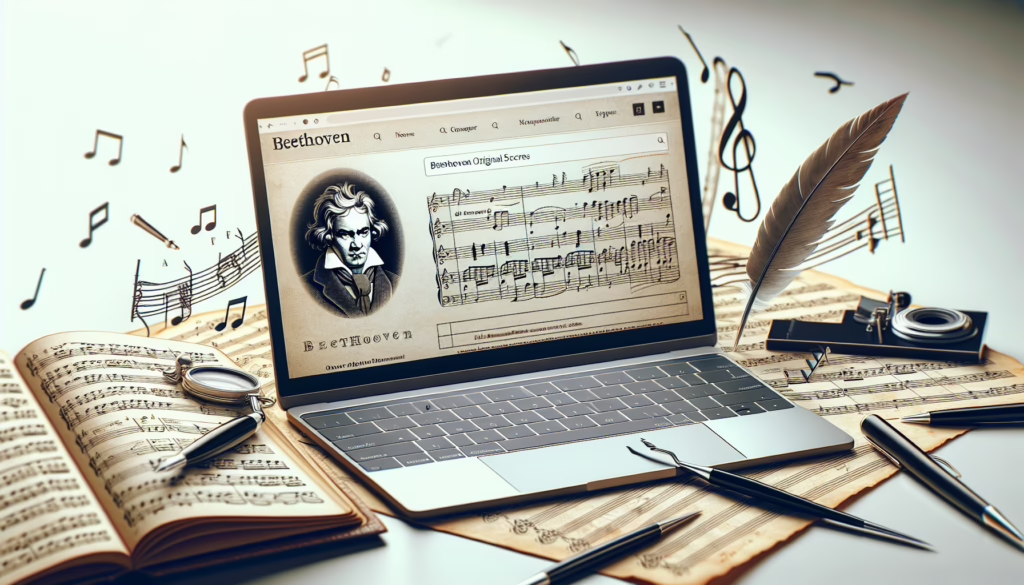
Beethoven’s original scores are no longer locked away for specialists willing to travel to rare book rooms; many can now be studied online through digitized manuscript portals, library catalogs, and scholarly archives that bring autograph pages, sketch leaves, copyists’ manuscripts, and first editions to any serious reader. In this context, “original scores” usually means sources created close to Beethoven himself: autograph manuscripts in his hand, sketchbooks and loose sketches, corrected copyist scores, and early printed editions that preserve readings from the composer’s lifetime. Knowing where to see Beethoven’s original scores online matters because these sources reveal far more than a clean modern edition ever can. You can see revisions scratched into staves, tempo words altered at the last moment, missing pages, paper types, publishers’ markings, and performance clues that shape how the music is understood. I have used these portals to trace variants in the piano sonatas, compare orchestral readings, and verify source descriptions before consulting printed critical reports. For performers, researchers, collectors, teachers, and devoted listeners, this digital landscape is the fastest route into Beethoven’s working process. It also serves as a practical hub for the broader Beethoven Collections topic, because miscellaneous source sites often hold the pieces that do not fit neatly into one archive or one genre.
The challenge is that Beethoven manuscripts are dispersed. Important leaves are in Berlin, Bonn, Vienna, New York, Washington, London, and dozens of smaller collections, while some sources survive only as scans of microfilm or legacy catalog records. A useful hub page must therefore do three things clearly: identify the best online repositories, explain what each one actually contains, and show how to search efficiently without confusing autograph manuscripts with later editions. It should also note the limits. Not every famous work is available in a full color digital facsimile, rights policies differ, and metadata can be inconsistent across institutions. Still, the situation today is remarkably strong. Major repositories now offer zoomable viewers, downloadable images, stable shelfmarks, and linked authority records. If you want to see Beethoven’s original scores online, you should start with the institutions that hold the largest manuscript concentrations, then widen the search through union catalogs and digitized music libraries that surface scattered materials under standardized names and work titles.
Start with the Beethoven-Haus Bonn digital collections
The single most important starting point is Beethoven-Haus Bonn, the leading institution devoted to Beethoven documentation, manuscripts, and research. Its digital collections include autograph manuscripts, sketchbooks, letters, early editions, and detailed catalog records tied to the house’s long-established scholarship. For anyone asking where to see Beethoven’s original scores online, Bonn is often the first answer because the institution not only owns major sources but also describes them with unusually strong contextual detail. You will often find work identifiers, dating information, provenance notes, source status, and links to related materials. In practice, that means a user can move from a sonata autograph to associated sketches or from a published score to correspondence about its preparation.
What makes Beethoven-Haus especially valuable is the combination of images and scholarly apparatus. A bare scan tells you what a page looks like; Bonn often tells you what the source is, where it fits in the genesis of the work, and whether it is complete. That distinction matters. A sketch leaf for the “Eroica” is not the same thing as a full score, and a copy with Beethoven’s corrections occupies a different position in the source hierarchy than an autograph fair copy. When I need to orient myself quickly, I use Bonn to establish shelfmark, source type, and dating before moving to external libraries. For hub-page purposes, it also acts as a bridge to related Beethoven Collections content, because users researching sketches, letters, conversation books, or first editions can all begin here and then branch into narrower articles.
Use Staatsbibliothek zu Berlin for major autograph holdings
Staatsbibliothek zu Berlin holds one of the world’s richest collections of Beethoven sources, including landmark autographs and sketch materials. Its digital platform has improved substantially, and many items can be viewed in high resolution through the library’s digitization interface. Berlin is indispensable for researchers interested in the textual history of symphonic, chamber, and piano works because the collection includes both celebrated treasures and less-publicized source fragments. Search results can be uneven if you rely only on English titles, so the most effective method is to search by uniform work title, opus number, and “Beethoven, Ludwig van” together with terms such as “Autograph,” “Partitur,” or “Skizzen.”
A practical example is the search for the Ninth Symphony or late quartets. Depending on cataloging conventions, the top result may be a manuscript description rather than the image viewer itself. Open the full record, confirm the shelfmark, then follow the digitized-object link. Berlin records often preserve the bibliographic precision scholars need: foliation, dimensions, medium, and notes on completeness. This is not just catalog trivia. If a source is missing a bifolio or consists only of score pages for one movement, that shapes how much authority you can assign to it. For performers comparing readings, Berlin’s scans can illuminate overwritten dynamics, articulation changes, and page-order issues that are flattened in printed reproductions.
Check the Austrian National Library and Vienna collections
Vienna is central to Beethoven source history, and the Austrian National Library is one of the essential places to look for digitized manuscripts and early printed editions. Beethoven lived and worked in Vienna for most of his career, and the city’s institutional collections preserve material that passed through publishers, patrons, copyists, and later collectors. The Austrian National Library’s digital platform is especially useful for score sources that circulate in the borderland between manuscript and print: presentation copies, corrected exemplars, and historically significant first editions. If your question is not only “where can I see the autograph?” but also “what did musicians in Beethoven’s time actually read?”, Vienna is crucial.
Users should also keep an eye on other Viennese institutions, including archives and museums that occasionally host digitized Beethoven manuscripts within broader cultural collections. Metadata varies, and some portals are easier to navigate in German, but the payoff is substantial. I have found Vienna records particularly useful for tracking first-edition exemplars whose title pages, plate numbers, and owner marks help date circulation and establish issue states. For a sub-pillar hub on miscellaneous Beethoven Collections, this category matters because many users arrive looking for “original scores” and really need guidance on the full source ecosystem, not just autograph pages in black ink.
Search major international libraries for dispersed manuscripts
Once you have checked Bonn, Berlin, and Vienna, widen the search to international libraries with digitized special collections. The Morgan Library & Museum, the Juilliard Manuscript Collection, the Library of Congress, the New York Public Library, the British Library, and the Bibliothèque nationale de France all hold relevant Beethoven material or related early sources. Some collections are small but significant: a single autograph leaf, a corrected copy, or an annotated first edition can answer a research question that larger repositories cannot. Because Beethoven manuscripts were bought and sold extensively in the nineteenth and twentieth centuries, dispersion is the rule rather than the exception.
The best strategy is to use authority-controlled searching. Start with the composer name in authorized form, then combine it with work number, genre, or source type. If a library supports facets, narrow by “manuscripts,” “music,” or “digital collections.” If not, use site-specific search through a web engine with the institution name and the work title. Real-world example: searching for a late piano sonata autograph fragment may fail under the nickname title but succeed under opus number alone. Likewise, “Moonlight Sonata” is less reliable than “Sonata no. 14 op. 27 no. 2.” Libraries catalog to standards; users often search colloquial titles. Bridging that gap saves time.
| Repository | Best for | What to verify in the record |
|---|---|---|
| Beethoven-Haus Bonn | Autographs, sketches, letters, early editions | Source type, shelfmark, dating, related materials |
| Staatsbibliothek zu Berlin | Major autograph manuscripts and sketch material | Digitized object link, completeness, foliation, notes |
| Austrian National Library | Vienna-based manuscript and first-edition sources | Edition state, provenance, plate number, rights |
| Library of Congress and peer libraries | Dispersed leaves, copies, rare prints | Authority heading, format, image quality, citation data |
Use union catalogs and digital music libraries to find hidden items
Many valuable Beethoven sources are not discoverable by browsing institutional homepages alone. This is where union catalogs and specialist digital music libraries become essential. RISM, WorldCat, Europeana, Gallica, HathiTrust, IMSLP, and Google Books each play a different role. RISM is particularly helpful for manuscript discovery because it standardizes source descriptions across participating institutions and often identifies music manuscripts that local library search interfaces bury. WorldCat can surface rare printed scores and facsimiles. Europeana aggregates metadata from European institutions, while Gallica is indispensable for French holdings and digitized early prints. HathiTrust and Google Books are strongest for historical editions, thematic catalogs, nineteenth-century bibliographies, and scholarship that points toward manuscript locations.
IMSLP deserves a careful, balanced mention. It is not a manuscript repository in the same sense as Bonn or Berlin, and users should never assume that a score posted there is an authoritative original source. However, it can be genuinely useful as a discovery layer, especially when it links to scans of first editions, historical complete editions, or out-of-copyright facsimiles. In my own workflow, I use IMSLP to identify whether a facsimile has circulated in print, then I trace that reproduction back to the holding institution. The key is to treat aggregator sites as pointers, not endpoints. If you need to cite, verify readings, or inspect color details, always go back to the owning library’s digitized object and catalog record.
Know the difference between autograph scores, sketches, and first editions
One of the most common user mistakes is assuming that every old Beethoven score online is an autograph. In source studies, terms matter. An autograph manuscript is written by Beethoven himself. A sketch is usually a working draft, often fragmentary, showing compositional development rather than a finished text. A copyist manuscript was prepared by another hand, sometimes with Beethoven’s corrections. A first edition is the earliest printed publication, often supervised imperfectly and sometimes containing engraver’s errors, unauthorized changes, or readings from lost sources. None of these categories is automatically “better” in every circumstance; each answers a different question.
If you want to understand Beethoven’s compositional process, sketches and sketchbooks are often more revealing than a fair-copy score. If you want a performance text close to what players first encountered, a corrected first edition may matter more than an incomplete autograph. If you want to settle an articulation dispute, a copyist score with Beethoven’s emendations can be decisive. This is why repository descriptions are so important. A strong hub page should help readers distinguish these source types before they click through to specialized articles on sketchbooks, first editions, or manuscript facsimiles elsewhere within the Beethoven Collections topic cluster.
How to search efficiently and evaluate what you find
Efficient searching depends on a few disciplined habits. Use opus numbers, genre names, and standardized titles. Try language variants when searching European libraries. Look for shelfmarks and keep them in your notes. Confirm whether the item is complete, partly digitized, or represented only by a catalog record. Check image resolution and whether the viewer allows deep zoom, rotation, or download. Read rights statements carefully, especially if you plan to publish screenshots, teach from them, or include them in an article. Good repositories make citation easy by providing persistent URLs, institutional attributions, and bibliographic export formats.
Evaluation matters just as much as discovery. Ask whether the source is primary or derivative, complete or fragmentary, corrected or uncorrected, autograph or scribal, contemporary or later. Cross-check against a critical edition when the reading seems odd; not every strange marking is Beethoven, and not every cleanly engraved phrase reflects his final intention. Named reference points help here. The New Beethoven Complete Edition and established source catalogs remain essential companions, even in a digital workflow. Digital access is powerful, but it does not eliminate philology. It simply makes careful source comparison possible for far more people than before.
What this hub covers within Beethoven Collections
As a miscellaneous hub under Beethoven Collections, this page is designed to orient readers across the scattered online ecosystem rather than confine them to one format or repository. It points toward autograph manuscripts, sketches, corrected copies, and first editions, while also preparing users for related deeper guides on specific archives, individual works, and source categories. That structure reflects how people actually search. One visitor wants the “Appassionata” autograph; another is trying to locate any digitized Beethoven sketchbooks; another needs an early edition of a string quartet for teaching. A useful hub serves all three by clarifying the landscape, naming the strongest repositories, and explaining search logic in plain terms.
The practical takeaway is simple: begin with Beethoven-Haus Bonn, move to Berlin and Vienna, then expand through major international libraries and union catalogs. Distinguish autograph from sketch, manuscript from print, and local scan from aggregator copy. Save shelfmarks, verify metadata, and compare sources before drawing conclusions. If you are building a personal research list, start today with one work you know well and inspect its surviving online sources page by page. That habit will sharpen your ear, deepen your historical understanding, and make every Beethoven score you open afterward more meaningful.
Frequently Asked Questions
What counts as Beethoven’s “original scores” when viewing them online?
In this context, “original scores” usually refers to primary musical sources created by Beethoven himself or produced very close to him during the composition and transmission process. The most sought-after materials are autograph manuscripts, meaning pages written in Beethoven’s own hand. These can include full scores, short score drafts, individual instrumental parts, and fair copies with his corrections. Closely related materials also include sketchbooks and loose sketch leaves, which are often especially valuable because they show Beethoven’s working process: false starts, revisions, thematic experiments, and structural planning before a piece reached a more finished form.
Other important source types include corrected copyists’ manuscripts, where a professional copyist prepared the music and Beethoven then added changes, annotations, or approval marks. First editions can also matter when they were issued under Beethoven’s supervision or preserve readings tied closely to early performance and publication history. When you browse online collections, it helps to distinguish between a true autograph, a contemporary copy, a later archival reproduction, and a modern scholarly edition. Library records often identify these categories explicitly, using terms such as “autograph manuscript,” “sketch,” “copyist’s manuscript,” “first edition,” or “facsimile.” Understanding that terminology makes it much easier to find the most authoritative sources rather than landing on later printed editions that are useful, but not “original” in the strict archival sense.
Where can you actually see Beethoven’s original scores online?
The best places to start are major library digitization portals, manuscript catalogs, and specialist scholarly archives maintained by institutions that hold Beethoven materials. Large national and university libraries in Europe and the United States have digitized substantial portions of their music collections, including autograph leaves, sketchbooks, early copies, and first editions. Museum-based collections and manuscript portals connected to conservatories or research institutes can also be excellent sources, especially for high-resolution images of specific works. In practice, many Beethoven sources are dispersed across multiple institutions, so there is rarely just one complete website containing everything.
A productive strategy is to search library catalogs using the work title, opus number, genre, and source type. For example, searching for a symphony by opus number alongside terms like “autograph,” “manuscript,” or “sketchbook” often yields better results than searching only by a popular title. Scholarly databases and digital thematic catalogs can also help by identifying where surviving source materials are held, even if the images themselves are hosted elsewhere. Some portals provide direct page-turning viewers and downloadable images, while others give only metadata and a call number that you can use to locate the digitized object through the institution’s image server. The strongest online research usually combines both: a bibliographic record that confirms what the source is, and a digital viewer that lets you inspect the manuscript itself.
How do you tell whether an online Beethoven manuscript is authentic and reliable?
The most reliable indicator is provenance and institutional custody. If the image comes directly from a recognized library, archive, museum, or research center with a stable catalog record, it is generally trustworthy as a digital surrogate of a real source in that collection. Good records usually include the source description, shelf mark or call number, material type, date or approximate date, physical extent, and sometimes notes on handwriting, corrections, ownership history, or watermarks. Those details matter because they help distinguish an autograph manuscript from a copyist’s score or a later facsimile.
You can also assess reliability by checking whether the source is described in established Beethoven scholarship, thematic catalogs, critical reports, or source studies. Reputable collections often link manuscripts to standardized work identifiers, opus numbers, or accepted scholarly titles. If the website provides only detached images with no catalog information, no institutional affiliation, and no shelf mark, it is much harder to evaluate what you are looking at. Another important point is that “authentic” does not always mean “complete” or “authoritative” in every musical detail. Beethoven revised extensively, and multiple early sources for the same work may preserve different readings. A sketch may be authentic but represent an early stage of the piece; a corrected copyist’s manuscript may reflect a later revision. For serious study, the safest approach is to compare the manuscript images with catalog descriptions and, when possible, with a critical edition’s source commentary.
What can you learn from Beethoven’s digitized autograph scores and sketches that you cannot get from a modern edition alone?
Digitized originals reveal Beethoven’s compositional process in a way that polished printed editions usually cannot. In an autograph score, you may see overwritten notes, erased ideas, altered dynamics, rebarred passages, changes in instrumentation, and even shifts in formal planning across a single movement. Sketch materials are even more revealing. They can show how a motif first appeared in fragmentary form, how Beethoven tested rhythmic patterns, or how he reordered sections before settling on the final version. That kind of evidence is invaluable if you want to understand not just what Beethoven wrote, but how he arrived there.
Original sources also preserve visual and material clues. Page layout, spacing, handwriting pressure, insertions, pasted slips, cue markings, and marginal notes can all provide insight into urgency, revision, and intended performance use. Copyists’ manuscripts corrected by Beethoven may expose practical issues related to rehearsal or publication, while first editions can preserve accidentals, articulation, or phrasing decisions that entered the public musical text early. None of this means a manuscript is automatically easier to read than a modern edition; in fact, the opposite is often true. But for performers, scholars, students, and dedicated readers, the manuscript offers a level of immediacy and documentary richness that a clean engraved score necessarily smooths over. It lets you encounter the music as evidence, not just as a finalized text.
Are there any limitations when using online images of Beethoven’s original scores?
Yes, and it is important to be aware of them. First, digitization is uneven. Not every surviving Beethoven source has been scanned, and even when it has, the online presentation may be incomplete. A portal might show selected pages, low-resolution reference images, or only the catalog entry without full access to the manuscript viewer. Rights restrictions, conservation concerns, or internal cataloging backlogs can all affect availability. In some cases, you may find that one institution has digitized a sketch leaf while related materials remain offline elsewhere, making it difficult to reconstruct the full source context from the web alone.
There are also interpretive limits. A digital image may not fully capture paper texture, watermark visibility, erased layers, ink color variation, stitching, or the physical relationship between bifolia and gatherings. Screen-based viewing can flatten details that matter in manuscript study. Metadata can also be inconsistent from one institution to another, especially when works are known under multiple titles or when source descriptions use older cataloging conventions. Finally, online access does not replace editorial judgment. Beethoven’s sources are often complex, fragmentary, and contradictory, so consulting a critical edition, scholarly commentary, or source catalog remains essential if you want to move from seeing the document to understanding what it means. The great advantage of digitization is access; the caution is that access still needs context.