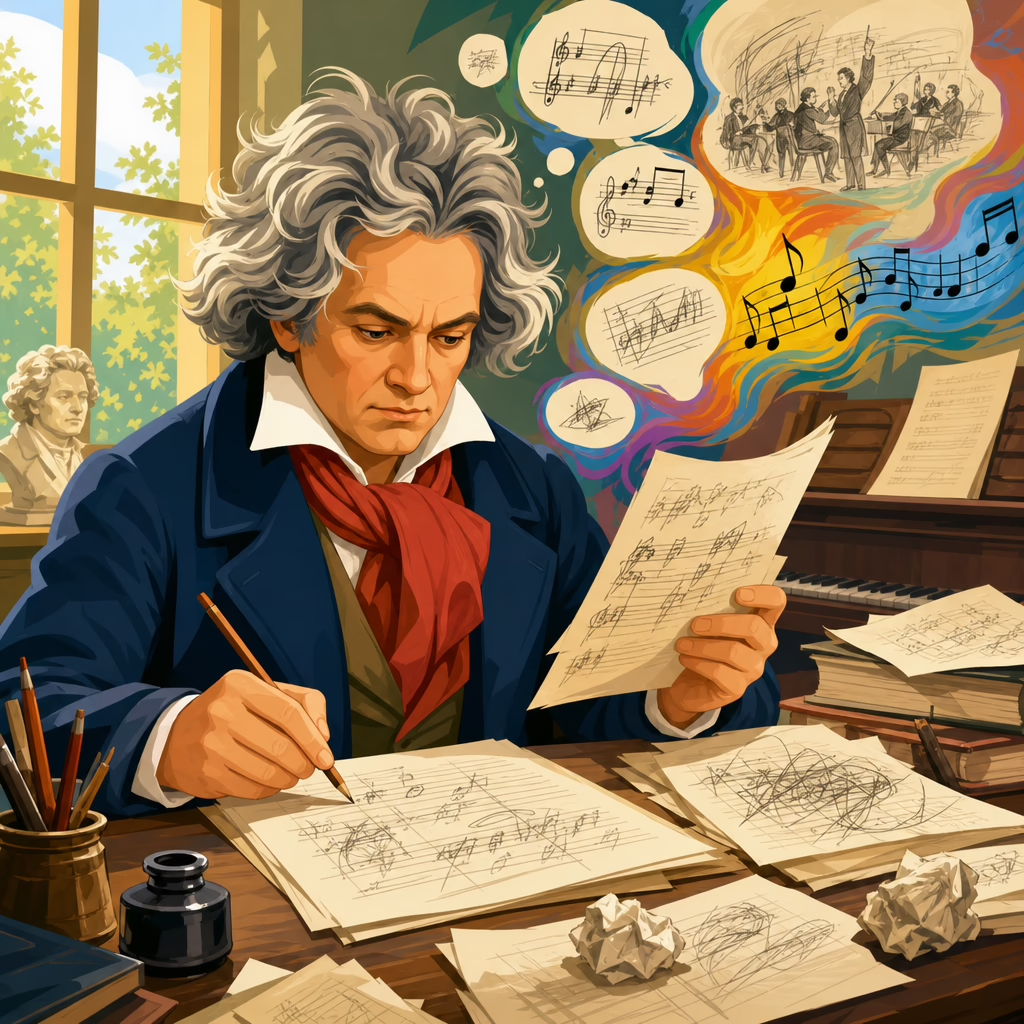
What Sketch Studies Reveal About Beethoven’s Creative Process
Beethoven’s sketch studies reveal a creative process far more deliberate, revision driven, and intellectually restless than the popular image of sudden genius suggests. In musicology, “sketch studies” means the close examination of notebooks, loose leaves, continuity drafts, and working manuscripts that preserve a composer’s intermediate thinking before a score reached copyists or print. For Beethoven, these materials are unusually abundant. He filled pocket books with motifs caught on walks, tested harmonic turns in bifolios, crossed out transitions, rewrote codas, and repeatedly rebalanced texture, rhythm, and formal proportion. Because so much survives, scholars can reconstruct not only what he wrote but how he arrived there. That matters for performers, analysts, editors, and serious listeners. The sketches show that many passages now heard as inevitable were once unstable problems. They also expose Beethoven’s habits: compression before expansion, motivic economy before surface richness, and structural planning through constant local correction. Anyone trying to understand the force of the Eroica, the volatility of the Appassionata, or the late quartets’ concentrated logic gains sharper insight from this documentary record. Sketch studies do not reduce inspiration to mechanics. Instead, they show inspiration under pressure, tested against craft until an idea could bear the weight of a whole movement.
What counts as a Beethoven sketch and why the documents matter
Not every surviving page functions the same way, and that distinction is central to interpretation. Beethoven’s working papers include brief jottings, thematic germs, continuity drafts that move through a larger stretch of music, partially texted canons, and near fair copies dense with revisions. Gustav Nottebohm, one of the foundational nineteenth century scholars of Beethoven’s manuscripts, demonstrated that these layers preserve stages of thought rather than random debris. Later editors and archivists, especially at the Beethoven-Haus in Bonn and the Berlin State Library, refined dating and source relationships by studying paper types, watermarks, handwriting, and ink. In practice, that means a two bar idea scribbled in a pocket sketchbook cannot be treated like a later draft where dynamic shading, voice leading, and phrase lengths have already solidified. The earliest stage often captures only a problem to solve: a rhythmic cell, a bass motion, or a cadence to avoid. The later stage records decisions among alternatives. I have found that performers often change their phrasing once they see this distinction, because a passage that looks merely emphatic in the final score may originate as a struggle over articulation or metric placement. Sketches matter precisely because they preserve process at different resolutions.
From fragment to form: how Beethoven developed ideas through revision
One persistent pattern across the sketches is that Beethoven rarely began with an ornamented, complete melody. More often he started with a compact cell and subjected it to transposition, rhythmic displacement, inversion, registral transfer, or sequential continuation until larger architecture emerged. The opening movement of the Third Symphony offers a classic case. Early materials show Beethoven probing how the principal idea’s triadic outline and syncopated energy might generate not only opening rhetoric but developmental friction. What sounds in the score like a broad symphonic argument grows from persistent testing of short motives against harmonic destinations. Similar evidence appears in piano sonata sketches, where he often reduced a passage to bass framework and accent pattern before rebuilding the right hand. This matters because it corrects the misconception that his forms are imposed on themes from outside. In Beethoven, form frequently unfolds from the pressure a motive exerts over time. A transition becomes necessary because the initial cell demands extension. A coda expands because the movement’s core contradiction remains unresolved. For readers interested in larger formal consequences, this focused method connects directly with his handling of exposition, development, and recapitulation in sonata writing, as explored in the broader guide at how Beethoven expands sonata form without breaking it.
What the sketchbooks show about problem solving in real time
The most revealing pages often preserve failure. Beethoven writes a promising continuation, then cancels it when the harmonic rhythm stalls. He tests one accompaniment pattern, then abandons it because it weakens metric thrust. He extends a sequence, then trims it because the arrival comes too late. These are not minor cosmetic changes. They show a composer judging proportion, energy, and intelligibility in real time. In the Waldstein Sonata sketches, for example, scholars have traced how Beethoven refined continuity by tightening transitions and clarifying registral contrast. In the Fifth Symphony materials, the famous short-short-short-long rhythm does not simply appear as destiny fulfilled; Beethoven probes its deployment, pacing, and relation to broader spans. I have always been struck by how often he removes rather than adds. The common assumption is that Beethoven’s style equals accumulation and force. The sketches show equal commitment to elimination. He cuts repeated sequence, strips decorative figuration, and hardens cadence points so a movement can carry more weight with less material. This is one reason the finished works feel inevitable. He repeatedly asks whether every bar earns its structural place.
| Work | What the sketches reveal | Why it matters analytically |
|---|---|---|
| Symphony No. 3, first movement | Motivic cells tested across transitions and development zones | Shows large form growing from compressed rhythmic and harmonic ideas |
| Piano Sonata Op. 53, first movement | Revisions tighten pacing and registral design | Explains unusual continuity and propulsion in the exposition |
| Symphony No. 5, first movement | Rhythmic motto explored as a flexible structural agent | Clarifies how a tiny pattern can govern an entire movement’s rhetoric |
| String Quartet Op. 131 | Continuity planning across linked movements | Reveals long range thinking beyond single movement boundaries |
Beethoven’s notebooks overturn the myth of effortless genius
Sketch studies matter partly because they challenge a durable cultural myth. Since the nineteenth century, Beethoven has often been presented as a heroic vessel of raw inspiration, producing masterpieces by overpowering instinct. The manuscripts tell a different story: not lesser genius, but harder won genius. Leon Plantinga, Lewis Lockwood, William Kinderman, and Alan Tyson, among others, have shown that Beethoven’s originality depended on relentless drafting. He could spend years carrying ideas from one sketch source to another before finding their final context. Themes migrated. Planned works dissolved. Rejected passages resurfaced transformed. The process was cumulative, not instantaneous. This is especially clear in cases where there is no straight line from early notation to published version. A page may contain alternative continuations that branch in incompatible directions, proving that the final form was chosen, not merely uncovered. That recognition is liberating for analysis. Instead of treating the score as a mystical object beyond explanation, we can examine decisions, constraints, and revisions with historical precision. The result is not demystification in the trivial sense. It is a fuller respect for Beethoven’s working intelligence, his capacity to hear possibilities, reject them unsentimentally, and persist until local detail aligned with overarching design.
How sketch evidence changes the reading of form, harmony, and motive
When analysts read sketches alongside finished scores, three areas become sharper: formal function, harmonic strategy, and motivic integration. First, formal function. A passage that seems obviously “transition” in the final score may begin in the sketches as thematic continuation, only later redirected toward modulation. That history explains why some Beethoven transitions retain unusual thematic weight. Second, harmony. Sketches often reveal that Beethoven discovered a destination before settling the route. He may fix a dramatic arrival in the mediant or submediant region, then repeatedly recast the approach. This shows harmony operating as teleology, not just color. Third, motive. Because Beethoven often derives wide spans from minimal cells, sketch layers can expose hidden kinships between accompaniment figures and principal themes. These links are easy to hear once pointed out, but difficult to prove without documentary support. The manuscripts provide that support. They also reveal tradeoffs. A more adventurous harmonic turn may be sacrificed for clearer motivic continuity, or vice versa. That kind of choice matters for scholarship because it resists one dimensional readings. Beethoven was not always maximizing complexity. He was optimizing tension among competing priorities: coherence, surprise, proportion, and performable texture. Sketch studies make those priorities visible rather than speculative.
Limits, cautions, and why the evidence still remains decisive
Sketch evidence is powerful, but it must be handled carefully. Not every surviving document can be dated securely, and not every absent link can be reconstructed. Beethoven sometimes returned to old notebooks, reused paper, or copied an earlier idea into a later source. Scholars therefore rely on source criticism, watermark analysis, and contextual comparison rather than intuition alone. There is also a methodological danger in overvaluing beginnings. An early sketch can tempt readers to treat the first idea as the truest one, when Beethoven himself often valued the later, more radically revised version. Another caution concerns completeness. Surviving pages are substantial, yet they do not record everything he thought. Mental hearing, keyboard improvisation, and conversation with performers all left limited traces. Even so, the documentary record remains decisive because it repeatedly confirms the same broad picture. Beethoven worked iteratively. He composed through revision. He built large forms from concentrated materials. He tested options against structural consequences. Across genres and decades, these patterns recur often enough that they cannot be dismissed as exceptional. For anyone serious about Beethoven interpretation, the lesson is practical as well as scholarly: read the score as a field of decisions, not a fixed monument. Follow the sketches where possible, compare variants, and listen for the stubborn labor beneath the finished line. That approach brings the music closer, sharper, and more human.
Frequently Asked Questions
What do musicologists mean by “sketch studies” in relation to Beethoven?
In Beethoven scholarship, “sketch studies” refers to the close analysis of the surviving materials that document how he developed a composition before it reached a final score. These sources include pocket sketchbooks, larger desk sketchbooks, loose manuscript leaves, continuity drafts, and other working papers. Rather than showing only polished results, they preserve the intermediate stages of invention: short motifs, rhythmic cells, harmonic experiments, abandoned transitions, reordered sections, and rewritten passages. For Beethoven, this evidence is especially valuable because so much of it survives compared with many earlier composers.
These documents allow scholars to reconstruct composition as an active process rather than a mysterious flash of inspiration. In Beethoven’s case, sketch studies reveal that he tested ideas repeatedly, transformed simple musical germs into large structures, and often reconsidered pacing, form, and thematic relationships over time. They also show that composing was not neatly linear. A work could begin with a tiny fragment, branch into several possibilities, stall, restart, and eventually reach coherence through revision. That is why sketch studies are central to understanding Beethoven: they show not just what he wrote, but how he thought.
Do Beethoven’s sketches disprove the myth that he composed in sudden bursts of genius?
They do not deny Beethoven’s extraordinary originality, but they strongly complicate the popular image of effortless genius. The surviving sketches show a composer who was intensely deliberate, self-critical, and revision driven. A theme that sounds inevitable in the finished work may have emerged only after many trials, substitutions, and structural adjustments. Beethoven often returned to the same material again and again, testing alternate continuations, refining motives, and rebalancing the architecture of an entire movement. In that sense, the sketches reveal genius not as instant perfection, but as sustained imaginative labor.
This matters because it changes how we understand creativity itself. Beethoven’s greatness appears not only in the brilliance of his finished music, but in his ability to recognize potential in incomplete ideas and then reshape them relentlessly. The sketchbooks show intellectual restlessness: he was rarely satisfied with the first solution and often pushed material toward greater concentration, contrast, and structural force. So the myth of sudden inspiration gives way to something more interesting and more human—a composer whose masterpieces were forged through persistence, experimentation, and unusually rigorous musical thinking.
What kinds of things do Beethoven’s sketchbooks and drafts actually reveal about his working method?
They reveal a composer constantly collecting, testing, and reworking ideas. Beethoven used pocket sketchbooks to capture motifs quickly, sometimes while away from his desk, preserving melodic fragments, rhythmic gestures, bass motions, or structural hints before they disappeared. Larger working manuscripts then show what happened next: motives are expanded, combined, transposed, interrupted, and recast in new contexts. Musicologists can often trace how a tiny cell becomes the basis of a movement, or how a passage that seems spontaneous in the final score was assembled through multiple attempts at continuity, cadence, and formal proportion.
Just as important, the drafts reveal how much Beethoven thought in terms of process and structure. He did not merely decorate finished themes; he explored how material could generate larger spans of music. Scholars see him weighing transitions between sections, revising developmental sequences, rethinking recapitulations, and sharpening dramatic timing. The sketches also expose false starts and rejected options, which are invaluable because they show what Beethoven chose not to do. In practical terms, the documents portray a mind at work on several levels at once: local detail, thematic economy, harmonic direction, and long-range formal design.
Why are Beethoven’s surviving sketches so important to music history and musicology?
Beethoven’s sketches are among the richest surviving records of compositional thought from any major composer, which makes them foundational for modern musicology. Because they preserve so many intermediate stages, they allow scholars to study creation historically rather than speculate about it abstractly. Researchers can compare a finished score with earlier versions, identify layers of revision, and examine how Beethoven’s ideas evolved across days, months, or even years. This has helped shape broader scholarly debates about authorship, creativity, revision, and the relationship between improvisation and written composition.
Their importance also extends beyond Beethoven himself. His sketch materials have become a model for how scholars approach documentary evidence in the study of creative practice. They show that masterpieces are often the result of negotiation, memory, experiment, and rethinking. For performers, the sketches can illuminate articulation of form, rhetorical emphasis, and the dramatic priorities embedded in the music. For historians, they challenge simplistic narratives of genius by grounding artistic achievement in material evidence. In short, Beethoven’s sketches matter because they let us witness composition not as legend, but as a recoverable and deeply instructive process.
How do sketch studies change the way listeners and performers understand Beethoven’s music?
Sketch studies encourage listeners and performers to hear Beethoven’s works as dynamic constructions built from active problem-solving. When you know that a movement may have grown from a small motif repeatedly revised and intensified, you begin to notice how much expressive power Beethoven draws from concentration and transformation. Passages that can seem purely monumental on the surface often become more compelling when understood as the outcome of careful choices about pacing, tension, contrast, and return. The music feels less like a fixed monument and more like the result of living, searching thought.
For performers, this perspective can be especially valuable. The sketches may clarify which ideas Beethoven treated as structurally essential, where he invested the most revision, and how he shaped momentum across a movement. That can influence decisions about phrasing, voicing, articulation, tempo relationships, and dramatic emphasis. For general readers and listeners, the larger lesson is equally powerful: Beethoven’s creative process was not diminished by revision; it was defined by it. The sketches show that his originality emerged through discipline, experimentation, and relentless refinement, offering a richer and more convincing picture of how great art comes into being.