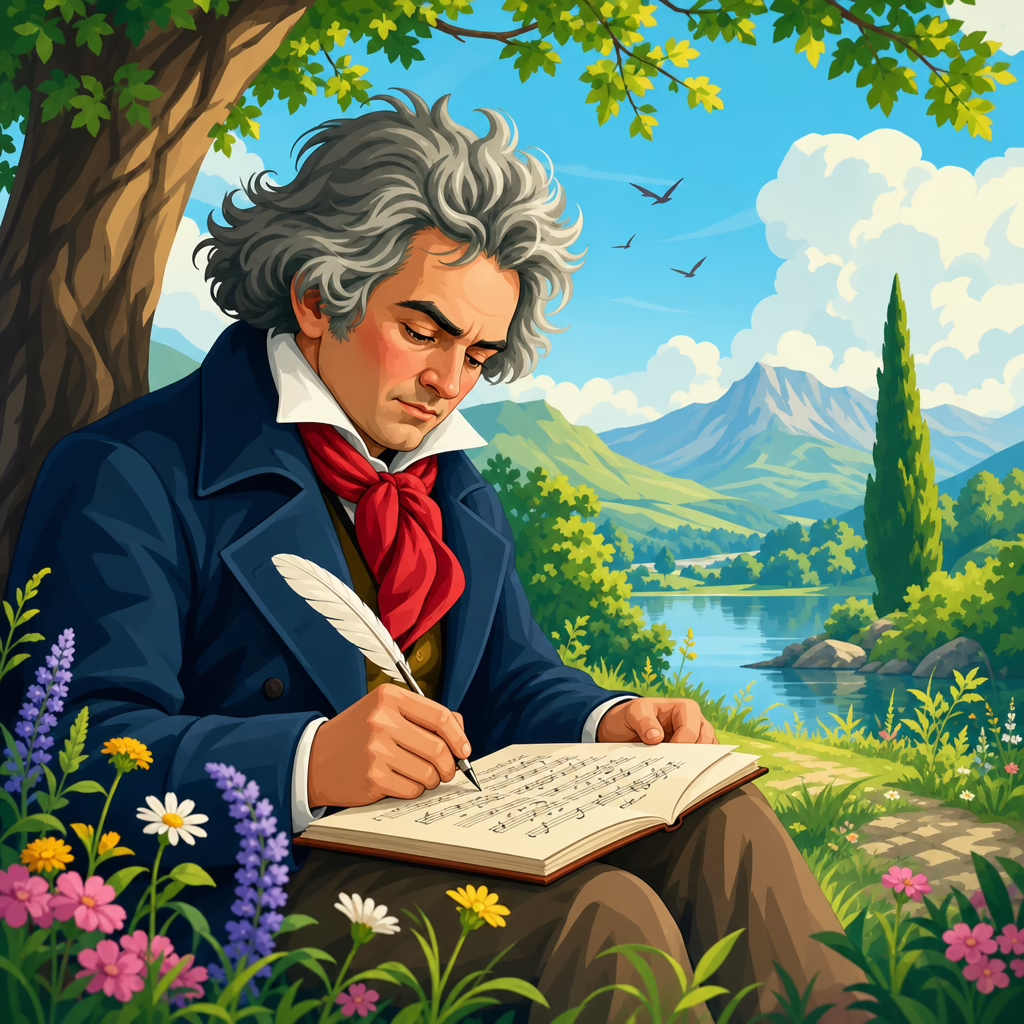
What Beethoven Wrote About Nature and Solitude
Beethoven’s writings about nature and solitude reveal a side of the composer that is as essential as his music: observant, restless, spiritually charged, and deeply dependent on walks, landscapes, and periods of aloneness. In the broader study of Beethoven’s letters and writings, this miscellaneous hub gathers the recurring themes that do not fit neatly into legal disputes, patronage, or composition history, yet they illuminate how he thought and lived. When Beethoven wrote about nature, he did not mean scenery as decoration. He meant woods, fields, streams, weather, birdsong, and the restorative force of being outdoors. When he wrote about solitude, he did not always mean loneliness. Often he meant retreat, concentration, wounded pride, self-protection, and the mental space required to endure deafness and continue working.
These themes matter because they help explain both the texture of his daily life and the expressive world of the music. Readers often know the Sixth Symphony as the “Pastoral,” or quote the Heiligenstadt Testament for its anguish, but the written record across letters, notebooks, conversation books, album inscriptions, and reported remarks shows a more continuous pattern. I have found, when working through these documents across different editions and translations, that nature and solitude are not occasional motifs. They are structural supports in Beethoven’s self-understanding. They shaped where he lived, how he walked, how he composed, whom he avoided, and what language he used for consolation. This article serves as a hub for that miscellaneous territory, defining the key ideas, tracing the main sources, and connecting the writings to the larger Beethoven archive.
How Beethoven described nature in his letters and notes
Beethoven’s most famous statement on the subject comes from a letter of 1810 to Therese Malfatti: “How happy I am to be able to wander among bushes and herbs, under trees and over rocks; no man can love the country as I love it.” The sentence is quoted so often because it is unusually direct, but it is not isolated. Across his correspondence, Beethoven returns to country air, walking routes, summer lodgings outside crowded urban centers, and the effect of landscape on his mood. He preferred rural or semi-rural surroundings during the warm months and repeatedly sought accommodations in villages around Vienna, including Heiligenstadt, Döbling, Mödling, Baden, and other outskirts where he could combine social distance with long daily walks.
In these writings, nature functions in three ways. First, it is physical medicine. Beethoven associated country life with relief from bodily strain, especially digestive trouble, headaches, and the worsening ear condition that made city noise oppressive. Second, it is emotional regulation. When letters show him irritated by copyists, publishers, family conflict, or money, references to the countryside often appear as a counterweight. Third, it is artistic stimulation. Beethoven insisted that ideas came to him while walking, and contemporaries repeatedly observed him carrying sketchbooks outdoors. The image is not romantic invention. It aligns with his working habits: short motivic cells caught quickly, then developed later with severe discipline.
His language about nature is notable for its concreteness. He writes about trees, brooks, fields, and fresh air more than abstract beauty. Even when the tone becomes elevated, he rarely sounds like a salon poet. That matters for interpretation. Beethoven was not building a literary pastoral mask detached from experience; he was reporting an actual routine. In practical terms, this subtopic connects closely to letters about residences, health, travel, and work schedules, because his love of nature was embedded in logistics.
Solitude as refuge, discipline, and social cost
Beethoven’s writings on solitude are more complicated than his nature passages because they move between chosen withdrawal and painful isolation. The clearest central document is the Heiligenstadt Testament of 1802, addressed to his brothers but not sent at the time. There he explains why he had seemed hostile or misanthropic: advancing deafness forced him away from society. He could not say, “Speak louder, shout, for I am deaf.” That admission transformed solitude from preference into necessity. Yet the Testament also shows that retreat had a productive side. He pulled back not simply because social exchange was difficult, but because artistic duty demanded endurance. In his own framing, solitude became the condition under which he would continue living and composing.
Elsewhere in the correspondence, he asks friends to understand his absences, delays, mood changes, and reluctance to appear in company. I have always been struck by how often these notes combine apology with defiance. Beethoven knew that isolation could offend patrons and companions, but he also refused to organize his life around ease of sociability. This is one reason his writings about solitude should not be reduced to biography-by-symptom. Deafness intensified seclusion, but personality mattered too. He needed uninterrupted time, disliked superficial conversation, and guarded his inner life fiercely.
At the same time, solitude carried costs visible throughout the record: miscommunication, suspicion, eruptions of temper, and idealized expectations of friendship. The same man who sought aloneness also wrote passionately to intimates and depended on a small network for practical support. Solitude in Beethoven is therefore double-edged. It preserved concentration and dignity, but it could harden into estrangement. That tension runs through this miscellaneous hub and links directly to articles on deafness, daily routine, emotional expression, and the conversation books of his late years.
Key documents for studying Beethoven on nature and solitude
The best way to study this topic is not through quotations detached from context, but through the different classes of documents in which these themes appear. Letters are the starting point because they provide dates, recipients, and immediate circumstances. The Heiligenstadt Testament is essential for solitude. The 1810 letter to Therese Malfatti is essential for nature. Summer-residence letters from Baden and other villages are also important because they place his outdoor habits in a recurring annual pattern.
Conversation books, used especially in Beethoven’s later years when deafness was profound, are another major source. Because visitors wrote their side of exchanges, these books preserve discussions of daily plans, weather, walks, health, meals, and working conditions. They are fragmentary and one-sided, but they capture the lived environment of seclusion better than many polished recollections. Sketchbooks matter as indirect evidence. They do not usually narrate nature in words, yet they confirm the connection between walking and compositional capture. Finally, reminiscences by friends and later biographers, including Anton Schindler, must be used cautiously. Some preserve useful detail, but Schindler in particular is notorious for unreliability and embellishment. Any hub article in this area should train readers to distinguish strong documentary evidence from attractive anecdote.
| Source type | What it reveals | Best use | Main limitation |
|---|---|---|---|
| Letters | Direct statements about mood, travel, landscape, and isolation | Dating ideas and identifying recipients | Selective and shaped by audience |
| Heiligenstadt Testament | Inner account of deafness and withdrawal | Understanding the moral meaning of solitude | Exceptional document, not everyday writing |
| Conversation books | Daily routine, health, weather, practical concerns | Reconstructing late-life habits | One-sided and incomplete |
| Sketchbooks | Composing process during walks and retreats | Linking environment to creative method | Mostly musical rather than descriptive |
| Memoirs and anecdotes | Vivid scenes of Beethoven outdoors or alone | Supplementing the record cautiously | Often biased or inaccurate |
For serious reading, the standard scholarly editions of Beethoven’s correspondence and the critical work on the conversation books are more reliable than quotation anthologies. Translation also matters. Slight differences in English wording can make Beethoven sound either more mystical or more abrupt than the German supports. When tracing the subject carefully, readers should compare translations where possible.
Nature in the music, and why the writings sharpen the interpretation
Beethoven’s written remarks do not “explain” the music in a simplistic way, but they do clarify how he expected listeners to think about works associated with landscape and outdoor life. The obvious example is the Sixth Symphony. Beethoven wrote that it was “more the expression of feeling than painting.” That statement is decisive. He was rejecting crude imitation while affirming that nature could be translated into states of mind: gratitude after a storm, the ease of country gathering, the serenity of a brook scene. The writings about his walks make this distinction easier to grasp. He was not composing a field recording in orchestral form. He was composing the human response to lived contact with nature.
The same perspective helps with less obvious repertoire. Many slow movements, open-air horn calls, drone textures, and rhythmic patterns associated with peasant dance acquire fuller meaning when set beside his recurrent desire for rural retreat. This does not mean every pastoral color is autobiographical. It means the writings provide a credible experiential background. As someone who has compared the letters with the sketch evidence, I find that Beethoven’s relation to nature was disciplined rather than vague. He observed, stored, transformed. A walk did not replace craft; it supplied raw material for concentrated work later.
His approach also differs from later nineteenth-century nature mysticism. Beethoven’s texts are often practical, bodily, and immediate. He speaks like a man who needs air, distance, and movement to think clearly. That is one reason nature and solitude belong together in his archive. Outdoors, he could be alone without being enclosed. The countryside solved several problems at once: noise, interruption, urban pressure, and emotional congestion.
Misconceptions, nuances, and the wider hub of related articles
Three misconceptions should be cleared away. First, Beethoven was not a permanent hermit. He maintained friendships, negotiated intensely, depended on publishers, taught pupils, quarreled with relatives, and remained entangled in public life. Solitude was recurrent, not absolute. Second, his love of nature was not merely picturesque sentiment. It was tied to health management, creative routine, and moral seriousness. Third, the documentary record is rich but uneven. Famous quotations are useful entry points, yet responsible interpretation requires attention to date, recipient, and genre.
As a hub within Beethoven’s letters and writings, this miscellaneous page should lead readers outward to more focused studies: the Heiligenstadt Testament and deafness; summer lodgings and walking routes around Vienna; the Pastoral Symphony and Beethoven’s own program notes; the conversation books as evidence of late-life isolation; album leaves and brief inscriptions that show his compressed style; and the broader issue of how his personal writings intersect with sketchbooks and compositional process. Those linked topics deepen what this overview introduces.
The lasting value of Beethoven’s writings about nature and solitude is that they correct the flat stereotypes. They show neither a saint of pure inspiration nor a bitter recluse sealed off from the world. They show a working artist who used fields, trees, weather, and chosen withdrawal as tools of survival and creation. Read together, the documents make a simple point with unusual force: Beethoven needed the natural world not as ornament, but as atmosphere for thought, and he needed solitude not because he rejected humanity outright, but because only in protected inward space could he continue to hear the music he could no longer hear with ease in ordinary life.
For readers exploring Beethoven’s letters and writings, that insight is the main benefit of this hub. It turns scattered remarks into a coherent pattern and gives context to famous passages that are too often quoted alone. Follow the related articles in this subtopic, compare the key documents, and read the letters in sequence. The more closely you trace what Beethoven wrote about nature and solitude, the more fully the person behind the works comes into view.
Frequently Asked Questions
What did Beethoven mean when he wrote about nature?
When Beethoven wrote about nature, he was not usually describing scenery in a casual or decorative way. For him, nature was a source of strength, order, consolation, and spiritual renewal. His letters and notebook entries suggest that he experienced the natural world as something emotionally and morally serious. Fields, trees, streams, hills, storms, and changing weather were not just pleasant surroundings; they were part of the inner life he depended on. Nature gave him relief from social strain, from the pressures of work, and from the profound personal suffering tied to his health and increasing deafness.
This helps explain why references to walking in the countryside appear so often in discussions of Beethoven’s habits and writings. He repeatedly sought open air and solitude because they restored his concentration and steadied his mind. In that sense, nature was not separate from his artistic life but closely bound to it. He seems to have felt that the natural world contained a truth and intensity that human society often lacked. That outlook is especially important in understanding the emotional honesty associated with his music. Even when he was not writing a specifically “pastoral” work, his way of thinking was shaped by this habit of turning outward to landscape and inward to reflection at the same time.
Why was solitude so important to Beethoven?
Solitude was important to Beethoven for several intertwined reasons: temperament, necessity, creativity, and suffering. By disposition, he appears in his writings as intensely self-directed, proud, easily wounded, and often uncomfortable with superficial social exchange. He could be warm and deeply loyal, but he also guarded his inner life. Periods of being alone gave him the freedom to think, to compose, to recover from frustration, and to maintain a sense of independence that mattered greatly to him.
There was also a practical dimension. As his hearing deteriorated, social interaction became more difficult, humiliating, and exhausting. Solitude, which may once have been a chosen condition, increasingly became part refuge and part necessity. Yet it would be misleading to treat it only as isolation or sadness. In Beethoven’s case, solitude was often productive. He used it to listen inwardly, to work through ideas, and to sustain the discipline required by composition. His writings suggest that he did not equate being alone with emptiness. On the contrary, solitude could be full: full of thought, emotional struggle, observation, memory, and artistic purpose.
At the same time, his relationship to solitude was not simple or serene. He did not become a detached hermit who no longer needed human affection. His letters show longing, disappointment, irritation, gratitude, and a strong need to be understood. That tension is crucial. Beethoven valued solitude because it protected and nourished him, but he also suffered within it. The result is a picture of a man for whom aloneness was both shelter and burden, a condition that shaped not only how he lived but also how he wrote about the world around him.
How do Beethoven’s writings about nature and solitude help us understand his music?
Beethoven’s writings about nature and solitude matter because they reveal the mental and emotional environment in which his music was conceived. They do not function as a simple code that “explains” every composition, but they do illuminate recurring habits of feeling and thought. When we see how strongly he associated walking, landscape, inward reflection, and spiritual intensity, his music can be heard with a richer sense of context. The force, patience, tension, release, and expansiveness in his works begin to seem connected to a lived experience rather than to abstract genius alone.
This is especially clear in music that openly evokes the natural world, but it also applies more broadly. Beethoven’s engagement with nature was not merely pictorial. He was less interested in imitating sounds than in conveying states of being: calm after turmoil, energy moving through stillness, gratitude, awe, freedom, and the feeling of standing within something larger than oneself. His solitude had a similar effect on his art. Because he spent so much time in intense inward concentration, his music often feels as if it has been forged through struggle rather than produced for ornament or entertainment. The emotional architecture of many works reflects a mind accustomed to wrestling alone with necessity, conviction, and hope.
His writings also remind us that Beethoven’s artistic life was inseparable from his personal endurance. Nature helped him survive. Solitude gave him room to work. Together, they formed part of the atmosphere from which his music emerged. For readers and listeners alike, this deepens the experience of Beethoven by showing that his art was not detached from daily existence. It was rooted in the repeated habits by which he made life bearable and meaningful.
Was Beethoven’s love of nature mainly spiritual, emotional, or practical?
The most accurate answer is that it was all three at once. Beethoven’s attachment to nature was practical because walking outdoors clearly supported his routine, his health, and his creative process. He needed movement, space, and relief from indoor pressures. Nature was emotional because it soothed him, energized him, and offered companionship of a kind that did not demand explanation or social performance. And it was spiritual because he often approached the natural world with reverence, as if it revealed a higher order or presence that exceeded ordinary human concerns.
What makes Beethoven especially interesting is that he did not always separate these dimensions. A country walk could at once be exercise, escape, meditation, and artistic preparation. A landscape could offer immediate pleasure while also awakening gratitude or awe. In his case, the practical never became merely mechanical, and the spiritual never floated free from bodily experience. He encountered meaning through movement, weather, terrain, and quiet observation. That integration helps explain why nature remained so central to his self-understanding.
It also distinguishes his attitude from a sentimental cliché. Beethoven did not idealize nature because it was fashionable to do so. His writings suggest dependence rather than pose. He returned to nature because he needed it. The emotional honesty of that dependence gives his remarks lasting force. They show a man who found in the nonhuman world not a decorative backdrop, but a real source of orientation when social life, health, and circumstances became hard to bear.
Why do Beethoven’s reflections on nature and solitude still resonate today?
They still resonate because they speak to enduring human needs: the need for quiet, for space to think, for contact with the natural world, and for a way to endure inner strain without losing depth or purpose. Beethoven’s writings show that these needs are not signs of withdrawal from life but often conditions for fully engaging it. Modern readers, surrounded by noise, speed, and constant communication, can recognize in Beethoven a powerful argument for the value of stepping away, walking, observing, and allowing thought to ripen in silence.
His reflections also resonate because they refuse easy simplification. Beethoven did not present solitude as purely healing or nature as a magical cure. His life remained difficult, and his writings carry that difficulty. Yet they also show resilience. He repeatedly turned to what grounded him: landscape, motion, contemplation, and the conviction that something restorative could still be found beyond immediate suffering. That combination of vulnerability and strength feels strikingly contemporary.
Finally, Beethoven’s remarks endure because they humanize a figure who is often treated only as a monumental composer. In his writings about nature and solitude, we encounter not an icon but a person: observant, restless, proud, wounded, grateful, and searching. That makes his music feel closer, not smaller. We hear more clearly that behind the public greatness was a private discipline of survival, and that this discipline was shaped in no small part by lonely walks, attentive looking, and a profound need for the sustaining presence of the natural world.