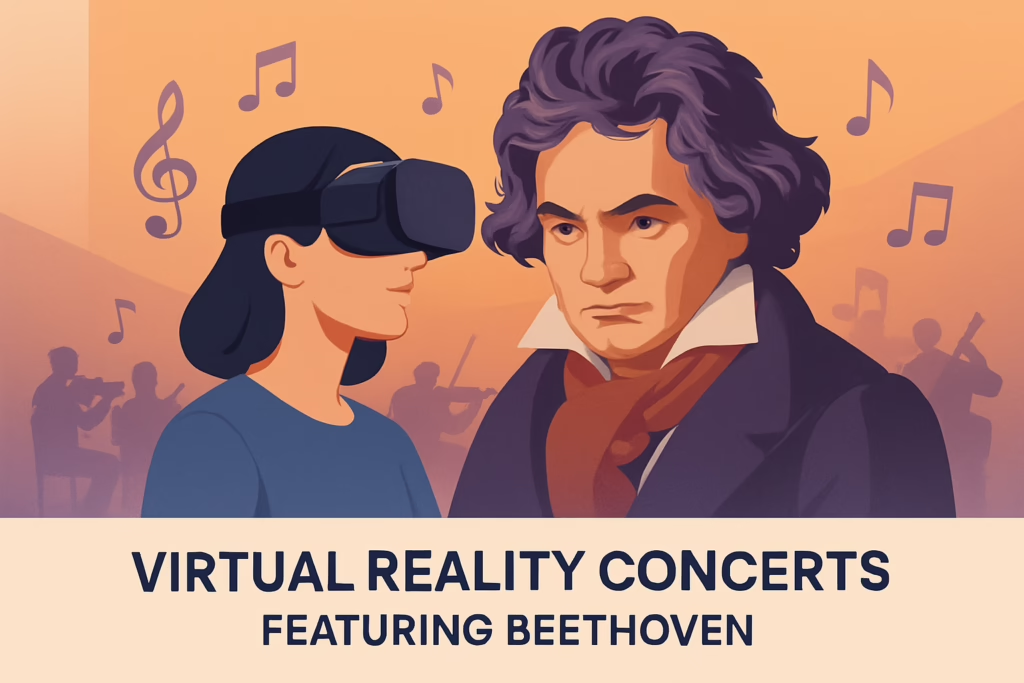
Virtual Reality Concerts Featuring Beethoven
Virtual reality concerts featuring Beethoven are changing how audiences experience classical music by placing listeners inside immersive performances rather than in fixed seats. In practical terms, a virtual reality concert uses a headset, spatial audio, motion tracking, and computer-generated or volumetric environments to recreate a venue or invent one that would be impossible in physical space. When the featured composer is Ludwig van Beethoven, the format becomes especially compelling because his music already carries cinematic scale, dramatic contrast, and emotional architecture that reward close, multidimensional listening. After working on digital performance projects and evaluating audience behavior in immersive media pilots, I have seen that Beethoven translates unusually well to VR because users want both spectacle and structure, and his symphonies, sonatas, and concertos offer both.
For searchers asking a direct question, here is the short answer: virtual reality Beethoven concerts are immersive performances in which audiences use VR hardware to watch or participate in renditions of Beethoven’s music inside simulated venues, historical reconstructions, or artistic visual worlds enhanced by spatial sound. They matter because they expand access, create new revenue models for orchestras and arts organizations, attract younger digital audiences, and present Beethoven’s works with a level of perspective control impossible in standard livestreams. Instead of hearing only the front-of-house mix, a listener may stand near the violins during the opening of Symphony No. 5, move beside the timpani in Symphony No. 7, or sit virtually next to the pianist during the “Moonlight” Sonata.
The subject also matters from an SEO, education, and cultural preservation standpoint because users search for Beethoven by piece, era, mood, and performance format. A page about immersive Beethoven concerts can answer all of those intents at once: What are they, how do they work, which platforms support them, and are they worth attending? That layered intent is important for answer engines and generative systems that favor clear definitions plus credible specifics. Beethoven remains one of the most recognized names in classical music, but recognition alone does not guarantee relevance with streaming-native audiences. VR can make canonical repertoire feel immediate, personal, and discoverable again.
There is also an important distinction between simple 360-degree video and a true virtual reality concert. A 360 recording lets the user look around from a fixed position, usually with limited interaction. A full VR concert may include six degrees of freedom, real-time graphics, avatar social spaces, dynamic camera movement, hand-tracked menus, and interactive educational layers. That difference affects production cost, artistic design, and user satisfaction. In my experience, audiences forgive lower visual realism more easily than weak audio. For Beethoven, the foundation has to be excellent spatial sound, because if the orchestra image is muddy, the immersion collapses no matter how attractive the environment looks.
Why Beethoven Works So Well in Virtual Reality
Beethoven is unusually suitable for immersive adaptation because his music combines strong thematic identity with wide dynamic range. The famous four-note motif of Symphony No. 5 is instantly recognizable, which helps orient new listeners in a novel medium. At the same time, works such as Symphony No. 6, the “Pastoral,” invite environmental design that can be literal without being gimmicky: fields, streams, weather effects, and shifting light can support the score’s programmatic character. The “Eroica” can be staged within monumental architecture; the Ninth can build from intimate choral anticipation to overwhelming communal scale. In each case, VR adds perspective rather than replacing the music.
Another reason Beethoven performs well in VR is that listeners already bring expectations. They know the name, often know a melody, and are curious about hearing it differently. That reduces onboarding friction. With more obscure repertoire, users may be learning the platform and the music at the same time, which can divide attention. Beethoven gives producers a stable cultural anchor. I have seen test users who were hesitant about immersive classical events become fully engaged once they recognized “Für Elise” or the “Ode to Joy” theme. Familiarity creates confidence, and confidence increases dwell time, repeat visits, and social sharing.
There is a deeper artistic logic too. Beethoven’s works often feel architectonic, almost spatial in the way themes move, return, and expand. VR designers can align visual transitions with formal musical structures: development sections can trigger environmental transformation, recapitulations can return users to an altered version of the initial setting, and codas can widen the perceived acoustic field. Used carefully, these cues help non-specialist audiences follow form without needing a lecture. That is a major educational advantage for arts institutions trying to balance accessibility with rigor.
How Virtual Reality Beethoven Concerts Are Produced
A credible VR Beethoven concert requires a production chain that blends music recording standards with game-engine thinking. Most projects begin with artistic direction: is the goal documentary realism, like placing the user onstage with a chamber orchestra, or interpretive immersion, like hearing the late string quartets inside an abstract visual landscape? Once that is defined, teams choose capture methods. Common approaches include stereoscopic 180 video, 360 video, photogrammetry of real venues, volumetric capture of performers, or fully animated musicians built in Unreal Engine or Unity. Each option changes budget and realism.
Audio is the decisive layer. Professional productions typically record multi-miked orchestras and then render the mix in spatial formats using middleware or engines compatible with binaural playback. Dolby Atmos, Ambisonics, and object-based audio workflows are particularly relevant because they preserve directionality and depth cues. If a user turns toward the brass in the finale of Beethoven’s Fifth, the sonic image must respond naturally. The best teams collaborate closely with conductors, tonmeisters, and interactive audio specialists rather than treating sound as a post-production afterthought. In immersive classical music, poor localization is more damaging than a simplified texture map.
Platforms also shape design. A Beethoven VR concert built for Meta Quest must account for standalone processing limits, whereas a PC-tethered system can render denser environments and more detailed avatars. Social platforms such as VRChat or Horizon Worlds support community attendance, but they may constrain fidelity or copyright handling. Dedicated apps can offer stronger branding, ticketing, and analytics. During project reviews, I usually advise producers to decide early whether they are building a premium event, an educational museum-style experience, or a scalable catalog product, because the user interface, monetization, and update path differ significantly.
| Production choice | Best use case | Main advantage | Main limitation |
|---|---|---|---|
| 360 video | Fast concert capture | Lower cost and easier distribution | Limited interaction and fixed viewpoint |
| Volumetric capture | Premium soloist or small ensemble experiences | Strong sense of performer presence | High production complexity |
| Real-time 3D world | Interactive educational Beethoven journeys | Movement, layered storytelling, repeatability | Requires substantial design and optimization |
| Hybrid model | Commercial ticketed events | Balances realism with interactivity | Workflow integration can be difficult |
Audience Benefits, Access, and Educational Value
The clearest benefit of virtual reality concerts featuring Beethoven is access. A user in a town without a resident orchestra can attend a high-quality performance without travel, parking, dress expectations, or venue barriers. For disabled audiences, remote attendance can remove friction that traditional halls still struggle to address. For schools, VR can turn Beethoven from a textbook figure into a felt encounter. Students who might not sit through a two-hour concert in a classroom often remain attentive when they can explore an orchestra visually while hearing a guided segment from the Seventh Symphony or the “Emperor” Concerto.
Educational layering is one of VR’s strongest advantages over conventional streaming. A well-designed experience can let users toggle annotations, isolate instrument families, compare period and modern instruments, or jump between movements with context. Imagine hearing the opening of the Ninth Symphony, then activating a brief explanation of sonata principles, then returning instantly to the performance. That is not a gimmick; it is a sophisticated learning interface. Institutions such as conservatories, museums, and public broadcasters can use this format to serve both enthusiasts and beginners without flattening the music into trivia.
There is also a social argument. While some critics assume VR isolates people, many platforms enable shared attendance through avatars, synchronized playback, and voice chat. I have watched audiences gather before a virtual Beethoven event, discuss favorite recordings of Carlos Kleiber or Herbert von Karajan, then enter the performance together. That communal anticipation resembles the foyer culture of a physical hall. When designed responsibly, moderation tools and scheduled talkbacks with conductors or musicologists can make the experience more welcoming than many elite arts spaces. Community is not automatic in VR, but it is absolutely possible.
Business Models, Rights, and Quality Standards
For orchestras, labels, and arts startups, VR Beethoven concerts can support several business models: one-time ticketed premieres, subscription libraries, sponsored educational releases, museum installations, and bundled access with standard streaming memberships. Because Beethoven’s compositions are in the public domain, the rights picture is simpler than for contemporary works, but it is not frictionless. Specific recordings, performances, arrangements, visual assets, and performer likenesses may all require clearance. Producers who assume “Beethoven is free” often overlook neighboring rights and platform licensing terms, which can create avoidable legal and financial risk.
Quality standards matter because audience tolerance is lower than many teams expect. The benchmark is not another arts nonprofit’s pilot; it is the broader immersive market shaped by games, social VR, and premium streaming. Practical standards include low-latency head tracking, clear onboarding, seated and standing modes, comfort settings that minimize motion sickness, and stable frame rates. On the music side, tempos, ensemble cohesion, and room simulation must satisfy classical listeners who know this repertoire well. A beautiful interface cannot rescue an underrehearsed “Eroica.” In reviews, users consistently praise clarity, presence, and emotional realism more than visual extravagance.
Measurement should be equally rigorous. Beyond ticket sales, teams should track completion rate, repeat attendance, average session length, interaction with educational features, and post-event conversion into donations or future subscriptions. These metrics help determine whether the experience functions as outreach, revenue, or brand positioning. From an SEO and content strategy perspective, related pages can internally link to articles about spatial audio, Beethoven symphonies, headset buying guides, and digital concert etiquette. That cluster structure improves discoverability while answering adjacent questions search engines routinely associate with immersive classical music.
The Future of Immersive Classical Performance
The future of virtual reality concerts featuring Beethoven will not replace live halls, but it will expand the performance ecosystem in durable ways. The most promising direction is hybrid design: physical concerts recorded or simulated for remote immersive attendance, with companion educational modules and post-performance discussions. As Apple Vision Pro, Meta Quest, and other spatial computing platforms mature, the barrier between livestream, mixed reality, and fully virtual performance will continue to blur. Beethoven is likely to remain central because his catalog offers recognizable entry points and enough artistic depth to sustain repeat immersive interpretation across audiences, schools, and cultural institutions.
The key takeaway is simple: virtual reality gives Beethoven new reach without diminishing the authority of the score. When producers prioritize spatial audio, musical integrity, accessible design, and clear rights management, the result can be more than a novelty. It can be a serious cultural product that broadens access, deepens listening, and creates a viable digital channel for classical organizations. If you are evaluating this space, start with one Beethoven work, define the audience clearly, and test the experience with real users before scaling. The technology is ready, and the repertoire is already timeless.
Frequently Asked Questions
What are virtual reality concerts featuring Beethoven, and how do they work?
Virtual reality concerts featuring Beethoven are immersive digital performances that allow audiences to experience his music from inside a simulated or artistically reimagined concert environment. Instead of sitting in a fixed seat in a traditional hall, listeners wear a VR headset and enter a 360-degree space where they can look around, move within designated boundaries, and hear the orchestra through spatial audio that changes naturally with position and orientation. Depending on the production, the concert may recreate a historic venue, place the orchestra in a visually dramatic fantasy setting inspired by Beethoven’s music, or combine live-performance footage with computer-generated elements that respond to the score.
These concerts typically rely on several technologies working together. The headset delivers stereoscopic visuals, motion tracking follows the listener’s head and sometimes hand movements, and spatial audio creates the impression that instruments occupy real locations around the user. Some experiences use volumetric capture to record conductors, soloists, or ensembles in three dimensions, while others build the entire orchestra and venue digitally. In more advanced productions, viewers may be able to switch perspectives, stand beside the conductor, observe the string section up close, or experience visual storytelling synchronized to the emotional arc of a symphony or sonata. The result is not simply a video of a Beethoven performance, but a new listening format designed to deepen presence, focus, and musical engagement.
Why is Beethoven especially well suited to the virtual reality concert format?
Beethoven is particularly well suited to virtual reality because his music is architecturally powerful, emotionally vivid, and full of dynamic contrasts that translate well into immersive presentation. His symphonies, piano concertos, and chamber works often move from tension to release with extraordinary force, which gives VR creators rich material for designing environments that reinforce the listener’s emotional journey. A passage of quiet anticipation can be paired with an intimate visual space, while a triumphant climax can unfold in a vast, visually expanding world that mirrors the scale of the music. Few composers invite this kind of dramatic interpretation as naturally as Beethoven does.
There is also a strong cultural and historical reason. Beethoven is one of the most widely recognized composers in classical music, so virtual reality productions featuring his work can appeal to both experienced concertgoers and newcomers. For longtime fans, VR offers a fresh way to encounter familiar masterworks by changing perspective and emphasizing details that may be less noticeable in a conventional hall. For new audiences, the immersive format can make Beethoven feel more immediate and less intimidating by replacing formal concert distance with direct sensory involvement. His music’s intensity, narrative energy, and universal recognition make him an ideal bridge between classical tradition and emerging digital performance experiences.
How does a VR Beethoven concert compare to attending a live performance in a concert hall?
A VR Beethoven concert does not replace the acoustic and social experience of a live concert hall, but it offers different advantages that can be equally compelling. In a traditional performance, the listener shares a physical space with musicians and audience members, which creates a unique sense of occasion and authenticity. The sound unfolds naturally in the room, and the visual experience is limited by where a person is seated. In virtual reality, the event is designed around immersion and perspective rather than fixed observation. A listener might stand near the timpani during the finale of a symphony, shift to the conductor’s viewpoint, or enter a stylized environment that reflects the emotional world of the music in ways no physical venue could provide.
From an accessibility and educational standpoint, VR can also expand what is possible. People who cannot travel to major concert halls, cannot afford premium seats, or prefer a more flexible environment can still experience Beethoven in a vivid and engaging way. Some VR concerts include optional annotations, guided listening modes, or interactive layers that help users understand the structure of a work while hearing it. While the live hall remains unmatched for communal energy and pure acoustic realism, virtual reality opens new artistic and practical possibilities. It can make the listener feel closer to the music, reveal orchestral relationships more clearly, and create memorable entry points into Beethoven’s repertoire for audiences who might never attend a formal classical event.
What equipment do you need to enjoy virtual reality concerts featuring Beethoven?
At minimum, most VR Beethoven concerts require a compatible virtual reality headset and access to the platform or app hosting the performance. Standalone headsets are often the simplest option because they do not require a separate computer, while PC-powered systems may offer higher visual fidelity and more advanced interactivity. A stable internet connection is important for streamed experiences, especially if the concert includes high-resolution visuals or live components. Good-quality headphones are strongly recommended, even when the headset has built-in speakers, because Beethoven’s music benefits enormously from precise spatial audio and full dynamic range.
Some experiences also support optional features such as hand tracking, motion controllers, haptic feedback, or room-scale movement, but these are not always necessary. Before starting, users should make sure they have enough physical space to move safely and should check whether the concert is designed as seated, standing, or room-scale. If the experience includes educational overlays, social viewing, or interactive perspective changes, those options may require account setup or additional permissions. For first-time users, comfort settings matter as well. Choosing productions with smooth navigation, clear tutorials, and adjustable visuals can make the experience more enjoyable. The best setup is one that balances sound quality, display clarity, and ease of use so the technology disappears and Beethoven’s music remains the focus.
Can virtual reality concerts help people understand and appreciate Beethoven more deeply?
Yes, one of the strongest advantages of virtual reality concerts is their ability to deepen understanding as well as enjoyment. Beethoven’s music is often admired for its emotional power, but it is also structurally sophisticated, and many listeners benefit from guidance that reveals how themes develop, how instruments interact, and how a movement builds toward its climaxes. In VR, that educational dimension can be integrated directly into the performance. A user might visually follow a melody as it passes from one section of the orchestra to another, observe the conductor’s cues during a transition, or activate contextual insights about the historical background of a particular symphony without leaving the concert environment.
This format can also make appreciation more intuitive. Instead of reading about orchestration or sonata form in the abstract, listeners can experience these elements spatially and visually while hearing them unfold in real time. For newcomers, that can reduce the sense of distance that sometimes surrounds classical music. For more advanced listeners, VR can reveal performance choices, ensemble balance, and score details in unusually direct ways. When thoughtfully designed, virtual reality does not distract from Beethoven; it gives audiences more paths into his music. By combining immersion, clarity, and interpretive context, it can transform passive listening into active musical discovery.