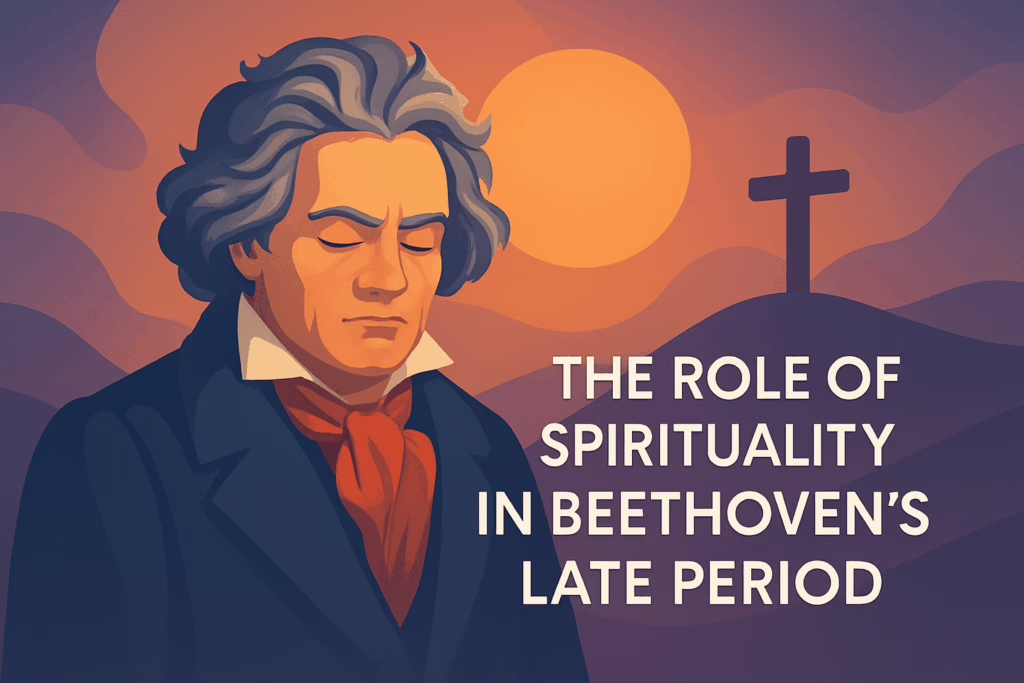
The Role of Spirituality in Beethoven’s Late Period
Ludwig van Beethoven, one of the greatest composers in Western music history, is a figure often admired for his profound musical genius. While much has been written about the technical and emotional depth of his compositions, less attention is paid to the spiritual dimensions of his works, particularly during his late period. This era of Beethoven’s composition, spanning roughly from 1815 until his death in 1827, is marked by a deep immersion in spirituality. During these years, Beethoven composed some of his most transcendent works, which continue to captivate and inspire listeners worldwide. Understanding the role of spirituality in Beethoven’s late period not only enriches our appreciation of his music but also offers insights into the broader relationship between spirituality and artistic expression. As we delve into this topic, we will explore how Beethoven’s personal struggles intertwined with his spiritual journey, influencing his musical compositions and their lasting impact.
Beethoven’s Spiritual Awakening
During the late period of Beethoven’s life, his health was declining rapidly, and he was struggling with complete deafness. Despite these formidable challenges, Beethoven seemed to experience a kind of spiritual awakening. His letters and conversation books from this time often reflect his preoccupation with philosophical and spiritual themes. It’s essential to understand that Beethoven’s notion of spirituality was not confined to any particular religious doctrine; instead, it was a broader and more personal exploration of his place in the universe and the purpose of life.
In the famous “Heiligenstadt Testament,” written in 1802, Beethoven eloquently shares the despair caused by his encroaching deafness, but he also conveys a sense of divine obligation to fulfill his artistic potential. This document is not only a glimpse into his personal suffering but also a testament to his resolve to find meaning beyond his earthly struggles. Beethoven writes of music as more than mere sound — it becomes a conduit through which he connects with something greater than himself.
- Missa Solemnis: Composed between 1819 and 1823, the “Missa Solemnis” stands as one of Beethoven’s monumental religious works. Though Beethoven did not adhere strictly to the church doctrines, this mass reflects a spiritual depth that transcends conventional religious boundaries.
- Late String Quartets: These include five quartets composed during his late period and are considered to be some of his most innovative works. The Quartets are rich in spiritual and philosophical content, especially the “Heiliger Dankgesang,” which is a song of thanksgiving for his recovery from illness.
The Influence of Nature on Beethoven’s Spirituality
Nature played a critical role in Beethoven’s spiritual life and, consequently, his compositions during the late period. Despite living in an era of industrial expansion and urban growth, Beethoven maintained a deep connection with nature, which he often associated with divine purity and inspiration. His regular retreats to the countryside were not merely for leisure but also for spiritual rejuvenation and reflection.
Beethoven’s Sixth Symphony, known as the “Pastoral Symphony,” predates his late period but provides a crucial link to his affinity for nature and its spiritual resonance. While not written during the late period, the symphony illustrates Beethoven’s lifelong appreciation for the natural world. The symphony’s movement titles, such as “Awakening of cheerful feelings upon arrival in the country,” signify his view of nature as a harmonic and spiritual force.
The Sonata Opus 110, composed in 1821, vividly illustrates Beethoven’s communion with nature in his late period. Its gentle and reflective mood is akin to a meditative conversation with nature, immersing listeners in a serene, almost spiritual experience.
| Composition | Year | Spiritual Element |
|---|---|---|
| Symphony No. 9 | 1824 | Incorporates “Ode to Joy,” symbolizing unity and brotherhood |
| Missa Solemnis | 1823 | Explores faith and devotion |
| Piano Sonata No. 32 | 1822 | Esoteric and philosophical explorations |
Beethoven’s Personal Struggles and Spiritual Growth
Personal adversity is often a significant catalyst for spiritual growth, and Beethoven’s life exemplifies this phenomenon. His late period was fraught with challenges, both external and internal, including his deteriorating health, financial instability, and strained familial relationships. However, Beethoven transformed these struggles into profound artistic and spiritual triumphs.
The Ninth Symphony, completed in 1824, is not only one of Beethoven’s most celebrated works but also an emblem of his spiritual perseverance. The inclusion of Friedrich Schiller’s “Ode to Joy” in the final movement is a powerful testament to Beethoven’s enduring belief in the unity and brotherhood of humanity. This symphony, with its grand themes and choral finale, represents Beethoven’s vision of humanity’s potential for spiritual and communal enlightenment.
In his last string quartets, especially in the “Cavatina” from the String Quartet in B-flat Major, Op. 130, listeners can hear an intimate reflection of Beethoven’s inner world. The Cavatina’s profound lyricism and poignant pauses create a spiritual space where listeners can encounter Beethoven’s vulnerability and transcendence.
The Legacy of Beethoven’s Spirituality in Music
The spiritual dimensions of Beethoven’s late works have left an indelible mark on the world of music and continue to resonate with artists and audiences today. His works are regarded not merely as entertainment but as profound experiences that invite introspection and spiritual exploration. Beethoven’s approach has influenced countless composers who followed, inspiring them to imbue their own works with spiritual and philosophical depths.
One particularly influential aspect of Beethoven’s spiritual legacy is the concept of “music as a universal language,” which transcends cultural and linguistic barriers. This idea is epitomized in the Ninth Symphony’s choral finale, which has been adopted as an anthem of unity around the world. The spiritual undercurrents of Beethoven’s compositions also paved the way for future musical movements, including Romanticism and Modernism, which often emphasize emotional and spiritual expressions.
In today’s world, where the search for meaning and connection remains a central human endeavor, Beethoven’s spiritual legacy serves as a reminder of music’s potential to inspire, heal, and unite. Performers and listeners alike continue to find solace and inspiration in Beethoven’s late works, experiencing them not only as musical masterpieces but also as profound meditations on life and beyond.
Conclusion: Embracing the Spiritual Resonance of Beethoven’s Late Works
Beethoven’s late period is a profound testament to the intersection of spirituality and artistic creation. Through his innovative compositions, Beethoven transcended the limitations of his personal struggles and crafted works that explore the deepest aspects of the human spirit. The spiritual elements embedded in his late music offer timeless messages of hope, resilience, and unity, reminding us of the universal power of music to connect and transcend. As we listen to Beethoven’s late works, we are invited to engage with our spirituality and reflect on the broader human experience.
Whether you are a musician seeking inspiration, a music enthusiast delving into Beethoven’s rich legacy, or someone on a personal spiritual journey, Beethoven’s late works offer a wellspring of insight and reflection. I encourage you to listen to these compositions with an open heart, allowing their melodies and harmonies to resonate with your own spiritual exploration. In embracing the spiritual resonance of Beethoven’s music, we honor the enduring impact of his artistic genius and celebrate the timeless connection between spirituality and music.
Take a moment to immerse yourself in one of Beethoven’s late works today and experience the transformative power of his spiritual expression. Whether through the grandeur of the Ninth Symphony or the introspective beauty of his string quartets, allow Beethoven’s music to guide you on your own spiritual voyage.
Listen, reflect, and be moved by the timeless spirituality of Beethoven’s music.
Frequently Asked Questions
1. How did spirituality influence Beethoven’s compositions during his late period?
Beethoven’s late period, which stretches from 1815 to 1827, is a fascinating era where his music took on a deeply introspective and spiritual quality. This phase came after he had already established himself as a musical genius, but it is during these years that we see him grappling more openly with existential and spiritual themes. The deaf composer found solace and expressive capacity in music, which was, for him, a means to connect with something greater than himself.
Beethoven’s late works reflect a personal dialogue with spirituality; they almost serve as a soundtrack to his inner life and struggles. As his hearing continued to deteriorate, he turned inward, exploring ideas of human suffering, peace, acceptance, and transcendence. This period includes monumental compositions like the Ninth Symphony, the late string quartets, and the Missa Solemnis, each revealing an introspective depth and ethereal beauty filled with spiritual connotations. His music from this period is often described as transcendent because it breaks conventions and reaches for the sublime, seeking to express the inexpressible.
2. What specific pieces from Beethoven’s late period reflect his spiritual exploration?
Several compositions from Beethoven’s late period stand out as being deeply influenced by spiritual themes. Among these, the ‘Missa Solemnis’ is particularly noteworthy. Written between 1819 and 1823, this mass is a reflection of Beethoven’s spiritual beliefs and struggles. It’s not just a liturgical piece; it’s a monumental work of personal faith and universal spirituality, tackling themes of redemption and divine mystery with musical intricacy and emotional depth.
Another significant piece is the ‘Ninth Symphony’, composed between 1822 and 1824. This symphony is famous for its choral finale, “Ode to Joy,” which embodies Beethoven’s vision of universal brotherhood and his deeply held humanist beliefs. The lyrics, derived from Schiller’s poem, and the music combine to express an all-encompassing message of joy and unity, tying in seamlessly with his spiritual quest for harmony beyond earthly confines.
Beethoven’s late string quartets, especially the ‘String Quartet No. 14 in C♯ minor, Op. 131’, is yet another profound reflection of his spiritual and transcendental thoughts. These quartets, complex and structurally innovative, explore vulnerabilities and contrast, leading listeners through emotional and spiritual journeys.
3. How did Beethoven’s personal life during his late period contribute to his focus on spirituality?
Beethoven’s late period was not only a time of great compositional output but also one filled with personal challenges and introspection. As his hearing loss became profound, Beethoven faced increased isolation from the world around him. This dependency on his inner resources and spiritual life grew stronger as he grappled with pain and solitude.
Despite these difficulties, or perhaps because of them, Beethoven’s spiritual outlook deepened and manifested in his compositions. This period of his life coincides with his growing preoccupation with philosophical and theological questions, greatly influencing his creativity and artistic output. The deafness effectively cut Beethoven off from social interaction, which might have driven him toward reflection and introspection, fueling a creative outpouring that sought to understand and communicate the mysteries of life and the divine.
Furthermore, Beethoven’s personal letters and diaries from this time frequently reference a belief in a higher power and the human capacity for transcending suffering through the arts. His challenging relationships, both familial and romantic, and his constant battle with ill-health also informed his spiritual explorations, creating compositions that resonate on a deeply human level.
4. What role did historical and cultural contexts play in shaping Beethoven’s late period spirituality?
The early 19th century was a period of significant social and political upheaval, which had a deep impact on Beethoven and his work. The Napoleonic Wars had shaken Europe, followed by the Congress of Vienna, which sought to restore order but also led to a period of intense reaction and conservatism. These events influenced Beethoven’s worldview, contributing to his profound hope for a more just and harmonious world—a theme that underscores much of his late-period music.
In addition to the political turmoil, the intellectual landscape was also changing rapidly. The Enlightenment, with its emphasis on reason and secularism, was giving way to Romanticism, which valued emotion and individualism, and encouraged exploration of other realms of human experience such as spirituality and mysticism. Beethoven was very much a man of his time, deeply influenced by these currents. He read widely, including philosophical and theological texts, which is reflected in the metaphysical themes of his late compositions.
In this context, Beethoven’s turn to spirituality can be seen as both a response to the external turmoil and an internal quest for meaning and transcendence. The societal push towards romantic ideals likely inflamed Beethoven’s experimentation and longing for artistic and spiritual elevation, which he achieves through his music. He stood between Classical precision and Romantic expressiveness, using his compositions as a means to transcend physical limitations and ordinary existence.
5. Was there a specific philosophy or religion that influenced Beethoven’s spirituality during his late period?
While Beethoven was raised a Roman Catholic, and elements of Catholic liturgy certainly infuse works like the ‘Missa Solemnis’, his spirituality during the late period appears to have been more personal and eclectic than dogmatic. Beethoven’s beliefs were influenced by a range of sources, including Enlightenment ideals, Eastern philosophies, Christian theology, and Romanticism.
Thanks to his voracious reading habits and broad intellectual interests, Beethoven frequently engaged with philosophical and spiritual texts that ranged widely in perspective. He was deeply influenced by writings of the German philosopher Immanuel Kant, whose ideas about ethics and metaphysics resonated with Beethoven’s quest for moral and spiritual understanding. There are also indications that he had an interest in Hindu philosophy. The concept of individual striving and personal transcendence in Hindu philosophy might have mirrored his own spiritual struggles and ambitions.
In letters and conversations during this period, Beethoven often emphasized universal humanistic themes such as brotherhood, freedom, and the pursuit of inner peace. He viewed music as an expression of the divine and believed that through it, humanity could reach a state of ultimate wisdom and fulfillment. Thus, Beethoven’s late period embodies a syncretism of beliefs rather than alignment to any single dogma, pointing to a deeply personal spiritual journey reflected in his music.