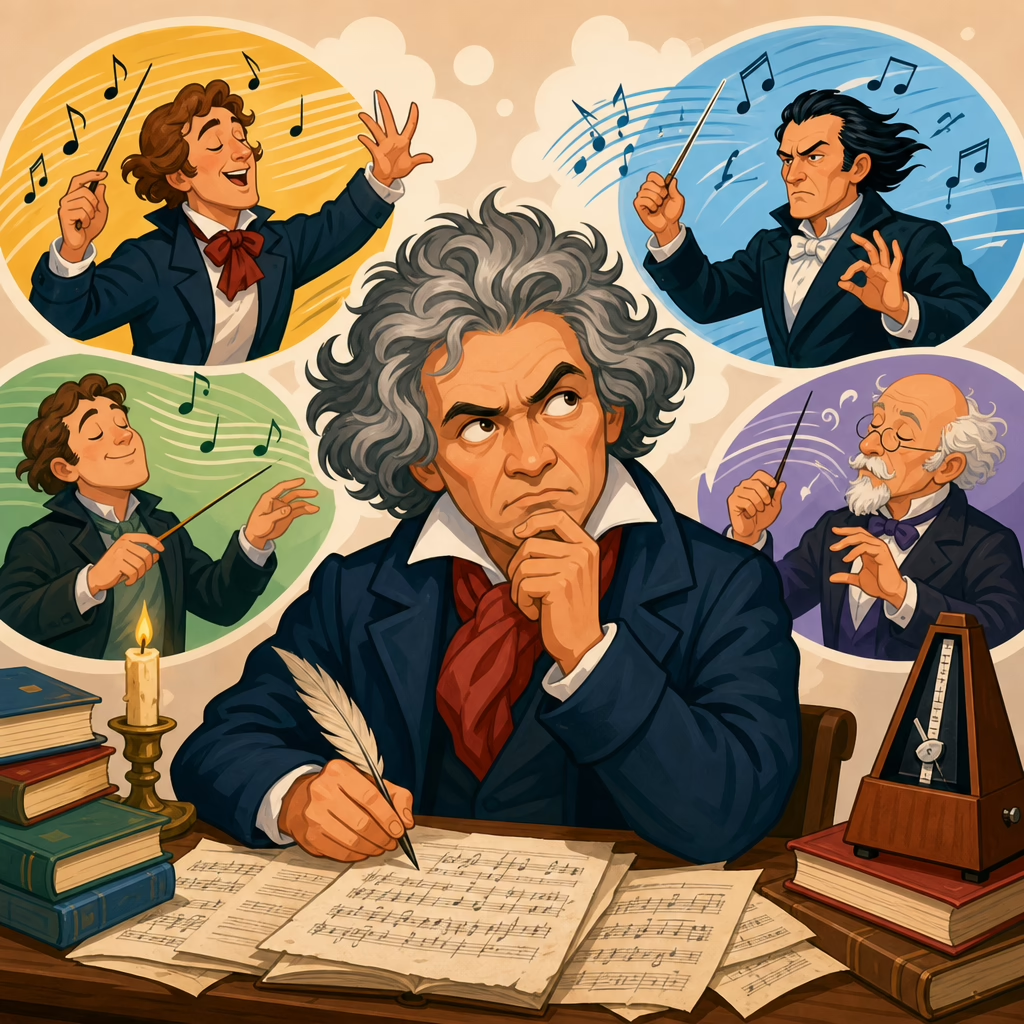
The Problem of Tempo in Beethoven Scholarship
Tempo remains one of the most stubborn problems in Beethoven scholarship because it sits at the intersection of notation, performance, instrument technology, editorial history, and listening habits. When scholars ask how fast Beethoven wanted a movement to go, they are not asking a simple practical question. They are asking how musical meaning is encoded, how authority is distributed between composer and performer, and how nineteenth-century evidence should be translated for modern ears. In my own work with scores, facsimiles, early editions, and recordings, I have found that tempo disputes almost never concern speed alone. They concern character, pulse, phrase rhythm, articulation, meter, acoustics, and the changing mechanics of the piano and orchestra.
In Beethoven studies, tempo usually refers to the practical rate of the beat as realized in performance, but scholarship also distinguishes between related concepts. “Tempo indication” means the written instruction, whether an Italian term such as Allegro or a numerical metronome mark. “Tempo relationship” refers to proportional connections between sections or movements. “Tempo flexibility” addresses local modifications such as rubato, accelerando, or rhetorical holding back. The problem arises because Beethoven left all these layers incompletely aligned. Some works have only verbal markings, some were later supplied with metronome numbers, and some survive in sources that disagree. Even when the notation is clear, performers must still decide how to project structure and drama in a hall, on a modern instrument, before listeners whose expectations differ sharply from those of 1800 or 1820.
This matters because tempo shapes Beethoven’s form more directly than many listeners realize. A first movement can feel monumental or impulsive depending on whether the beat is grounded in bar-level breadth or in kinetic subdivision. A scherzo can sound demonic, comic, or merely hectic according to accent pattern and metric hierarchy. Slow movements are especially vulnerable: played too broadly, they lose line and harmonic tension; played too quickly, they lose gravitas and songfulness. Scholarship on Beethoven’s tempo therefore influences editing, historically informed performance, conservatory teaching, recording practice, and analytical claims about motivic unity and sonata rhetoric. Any serious discussion of Beethoven’s style must confront the tempo problem rather than treating it as an afterthought.
Why Beethoven’s metronome marks remain controversial
The most famous source of controversy is Beethoven’s use of the metronome. After Johann Nepomuk Mälzel popularized the device in the 1810s, Beethoven embraced numerical tempo indications with unusual enthusiasm. He supplied metronome marks for symphonies and other works, apparently believing the tool could correct longstanding performance distortions. On paper, this seems like ideal evidence. In practice, it created a new battlefield. Many of Beethoven’s marks appear startlingly fast to modern musicians, especially in the symphonies, the Hammerklavier Sonata, and certain finales. Scholars have long asked whether the marks are authentic, miscopied, misunderstood, or simply ahead of modern habits.
Several explanations have been proposed. One line of argument points to mechanical or reading errors: perhaps the wrong side of the pendulum scale was read, perhaps copyists misplaced a number, or perhaps the metronome itself was inaccurate. Another explanation is physiological and stylistic rather than documentary. Beethoven may have conceived tempo through a lighter action, quicker decay, and sharper articulation than those of many modern instruments. A fortepiano’s sound clears rapidly, allowing brisk tempos to remain transparent. Classical bows, harder timpani sticks, and narrower vibrato also help rapid music speak. What feels reckless on a modern concert grand and in a reverberant hall can feel entirely manageable on period equipment in a dry acoustic.
Yet the evidence does not support a simple dismissal of Beethoven’s numbers. Scholars such as Clive Brown, Barry Cooper, and others have shown that many marks become musically coherent when performers respect articulation, metric stress, and phrase grouping rather than imposing later Romantic weight. Conductors influenced by historically informed practice have repeatedly demonstrated that tempos once deemed impossible can reveal contrapuntal clarity and structural sweep. The issue is not whether Beethoven’s metronome marks should be obeyed blindly. It is that they cannot be waved away without argument. They are primary evidence, and any departure from them requires a reason rooted in source criticism or performative logic, not merely inherited taste.
Source criticism: autographs, editions, and conflicting evidence
Tempo scholarship depends heavily on source evaluation. Beethoven’s autographs are indispensable, but they are not always complete, clean, or consistent. Copyists’ manuscripts, first editions, revised editions, correspondence, and conversation books all contribute evidence. Sometimes verbal tempo words vary among sources; sometimes metronome marks were added later; sometimes publication history complicates chronology. For a scholar, the first question is never “What is the tempo?” but “Which source carries authority for this reading, and how does it relate to other witnesses?” Without that discipline, discussions collapse into preference masquerading as historical fact.
A classic difficulty is that Beethoven often revised works over time, and tempo can be implicated in revision even when no new marking appears. Changes in texture, articulation, dynamic profile, or note values may imply a different practical speed. Editorial traditions sometimes regularized these details, subtly pushing performers toward heavier or steadier conceptions. Nineteenth-century editions, especially those shaped by post-Beethovenian pianism, could normalize phrasing and slurring in ways that alter the perceptual beat. Modern urtext editions improved matters, but even urtext is not interpretation-free. Editors still decide how to reconcile variant readings, how to report doubtful markings, and how prominently to present later additions.
The best scholarship therefore works comparatively. It collates sources, tests readings against instrumental realities, and asks whether a given tempo choice aligns with the notated character of the passage. This is one reason focused formal analysis remains essential. In the first movements most closely tied to Beethoven’s large-scale tonal and rhetorical planning, tempo cannot be divorced from architecture; readers interested in that broader structural context can consult the main guide on how Beethoven expands sonata form without breaking it. Tempo disputes often become clearer once one hears how exposition pacing, transition energy, and recapitulation weight function as parts of a whole rather than isolated moments.
Italian tempo words were never mere speed labels
One of the most persistent mistakes in Beethoven reception is reading Italian tempo terms as crude speed commands. In late eighteenth- and early nineteenth-century practice, Allegro, Andante, Adagio, Presto, and related modifiers conveyed affect, motion type, and articulation profile as much as metronomic pace. Beethoven inherited this semantic field from Haydn and Mozart but used it with exceptional precision. Allegro con brio is not interchangeable with Allegro ma non troppo, and Adagio sostenuto does not simply mean “very slow.” Each phrase frames a way of moving through time.
This matters because a performer can technically match a metronome number and still miss the tempo. If the articulation is legato where Beethoven writes detached quavers, the music drags despite nominal correctness. If accents are flattened, a scherzo loses spring. If long lines are chopped into small expressive units, an Adagio becomes static. I have seen this repeatedly in coaching sessions: students ask whether a movement should be “around 108,” but the real issue is whether the bar is felt in two, whether the upbeat has enough lift, and whether harmonic arrivals are driving the line. Beethoven’s notation frequently tells us how the tempo should behave from within.
Contemporary treatises reinforce this broader understanding. Johann Joachim Quantz belongs to an earlier generation, but his discussion of affect and motion remained influential. Daniel Gottlob Türk and Louis Spohr likewise show that tempo judgment involved genre, character, meter, and execution. Beethoven’s markings should therefore be interpreted within a living performance language, not by modern stopwatch logic alone. The scholarly challenge is to reconstruct that language carefully without pretending it yields a single automatic answer in every case.
Instruments, acoustics, and the difference between possible and persuasive
Modern debates often become polarized between “authentic” speed and “musical” speed, but this is a false dichotomy. What is physically possible on one instrument in one room may not be persuasive on another. Beethoven composed across a period of rapid instrumental change. Viennese pianos had shallower key dip, lighter hammers, and quicker tonal decay than modern Steinways. Woodwinds had different timbral balance. Horns and trumpets were valveless. String sections were generally smaller, and orchestral pitch standards varied. These factors influence not only balance but perceived tempo, because texture density and resonance affect how quickly musical events can be processed by listeners.
Acoustics are equally important. In a dry room, brisk tempos can sound articulate and urgent; in a resonant hall, the same tempo may blur repeated notes, bass figuration, or syncopated inner voices. Beethoven scholarship increasingly recognizes that tempo is heard relationally through attack, decay, and spatial bloom. A conductor who broadens a fast movement slightly in a large hall may not be betraying the score but compensating for reverberation. Conversely, a pianist who takes a slow movement too expansively on a sustaining modern grand can thicken textures Beethoven expected to remain transparent.
| Factor | Early nineteenth-century tendency | Typical modern tendency | Effect on tempo perception |
|---|---|---|---|
| Piano sound | Quick decay, lighter action | Long sustain, heavier action | Fast tempos remain clearer on earlier instruments |
| Orchestra size | Smaller ensembles | Larger string sections | Dense textures can feel slower today |
| Hall acoustics | Often drier spaces | More reverberant concert halls | Rapid articulation may blur in modern venues |
| Playing style | Sharper accent and less continuous vibrato | Smoother legato and fuller blend | Modern warmth can reduce rhythmic bite |
The practical lesson is not that every modern performance must imitate period conditions. It is that tempo decisions should be argued in relation to sound production. When scholars compare recordings, they must account for medium and setup, not just numbers. A metronome mark that convinces on a Graf fortepiano under a player like Ronald Brautigam may require different handling on a modern grand by Mitsuko Uchida or András Schiff to preserve equivalent intelligibility.
Case studies: why one tempo debate never fits every work
Specific works show why generalized claims about Beethovenian tempo quickly fail. The opening movement of the “Moonlight” Sonata, marked Adagio sostenuto, is frequently stretched into near immobility. But Beethoven’s texture of continuous triplets, his instruction to play delicately and without dampers as far as possible, and the movement’s underlying harmonic motion suggest sustained flow rather than funerary stagnation. On a period instrument, the line can move while preserving mystery. The scholarly point is not that there is one correct speed, but that excessive slowness contradicts the movement’s notated propulsion.
The first movement of the “Hammerklavier” poses the opposite problem. Beethoven’s metronome mark has intimidated generations of pianists. Many treat it as unplayable and adopt significantly slower tempos. Yet when the opening leaps, fanfare rhetoric, and cut-time energy are understood as parts of a large one-in-a-bar impulse, the movement gains coherence. Slower readings can sound grand, but they also risk turning tensile rhythmic writing into labor. Here scholarship has productively challenged tradition by asking whether difficulty was mistaken for disproval.
The Ninth Symphony’s Scherzo provides another revealing example. Taken near Beethoven’s indicated pace, the movement’s obsessively driven rhythm and fugal sharpness become electrifying. Broadened too much, it can feel merely heavy. But the Trio demands contrast without collapse, and conductors must judge transition proportions carefully. This is why the tempo problem is fundamentally interpretive: evidence establishes boundaries and priorities, yet artistry still lies in balancing pulse, character, and architecture within those boundaries.
What responsible Beethoven tempo scholarship should do now
The most useful current approach combines documentary rigor with performance testing. Scholars should begin with sources, trace editorial transmission, and distinguish secure evidence from conjecture. They should then examine period treatises, organology, acoustics, and historical reports of execution. Finally, they should test hypotheses in sound, ideally through comparison across instruments and spaces. Tempo is not solved at the desk alone. Some of the strongest recent insights have emerged when analytical claims are checked against rehearsal experience and recording evidence.
Just as important, scholarship should resist two temptations: fetishizing numbers and romanticizing freedom. Numerical marks matter because Beethoven provided them, but they do not cancel the semantic force of words, articulation, and form. Performers need latitude, but not the latitude to ignore primary evidence without justification. The goal is historically informed persuasion. A good tempo in Beethoven is one that makes the notation, the structure, and the sounding result mutually intelligible.
The problem of tempo in Beethoven scholarship will not disappear, because it reflects the deepest challenge in musicology: turning written traces into convincing sound across historical distance. Still, the field has moved beyond old caricatures of “literalists” versus “traditionalists.” We now know that Beethoven’s tempos must be studied through sources, language, instruments, halls, and ears together. For performers, scholars, and serious listeners, the payoff is substantial. Better tempo thinking clarifies form, sharpens character, and reveals Beethoven’s music as more dynamic, more specific, and often more radical than habit suggests. Revisit a familiar sonata or symphony with these questions in mind, and the score will start answering back.
Frequently Asked Questions
Why is tempo such a persistent problem in Beethoven scholarship?
Tempo remains a central problem in Beethoven scholarship because it cannot be reduced to a single number, a single instruction, or a single act of obedience to the score. When scholars debate tempo in Beethoven, they are really debating how musical meaning is communicated and who has the authority to realize it in performance. Beethoven’s music sits at a historically difficult crossroads: he inherited eighteenth-century practices rooted in style, rhetoric, and convention, yet he also wrote with an increasingly modern sense of precision, individuality, and control. That means his tempo indications often invite more than one kind of evidence. Musicians must consider verbal markings such as Allegro or Adagio, metronome markings where they exist, the character of the movement, the notation of rhythm and articulation, the acoustical behavior of the instruments Beethoven knew, and the performing conditions for which the works were conceived.
The difficulty is intensified by the fact that modern listeners often hear Beethoven through traditions shaped long after his death. Nineteenth- and twentieth-century performance habits, large concert halls, heavier instruments, editorial interventions, and recording culture all affect what now sounds “natural” or “convincing.” A tempo that may have made structural and expressive sense in Beethoven’s world can sound surprisingly fast or unexpectedly driven to modern ears. Conversely, a slower, broader performance that many listeners find noble or profound may owe more to later traditions than to Beethoven’s own expectations. For that reason, tempo scholarship in Beethoven is never just a practical matter of speed. It opens onto larger questions about notation, history, authority, and interpretation.
Can Beethoven’s metronome markings be trusted?
Beethoven’s metronome markings are among the most discussed and controversial pieces of evidence in all of music scholarship. On one hand, they are invaluable because they appear to offer something unusually direct: a numerical statement of intended speed from the composer himself. For scholars and performers who want to resist the weight of later performance tradition, these markings can seem like a corrective, even a lifeline. They suggest that Beethoven did not want tempo to remain entirely dependent on inherited custom or performer intuition. In at least some cases, he appears to have wanted greater exactitude than earlier composers typically demanded.
On the other hand, the markings have long raised doubts. Some seem faster than many performers find practical or musically persuasive, especially on modern instruments in modern acoustic spaces. This has led to many explanations: Beethoven may have used the metronome incorrectly; the device may have been unreliable; the published markings may contain transmission errors; the numbers may reflect idealized rather than literal performance conditions; or modern musicians may simply be conditioned by later traditions that are slower than what Beethoven expected. None of these explanations can be accepted automatically in every case, and scholars are careful not to turn any one theory into a universal solution.
The most responsible approach is neither blind faith nor outright dismissal. Beethoven’s metronome marks should be treated as serious historical evidence, but they must be interpreted alongside everything else in the score and in the broader documentary record. They often reveal a striking preference for forward motion, clarity, and structural energy. Even when performers do not follow them exactly, the markings can still challenge inherited assumptions and force a reconsideration of what Beethoven’s music is supposed to feel like in time. In that sense, the question is not simply whether the markings are “right” or “wrong,” but what they tell us about Beethoven’s conception of movement, character, and musical momentum.
How do historical instruments affect the debate over Beethoven’s tempos?
Historical instruments are crucial to the tempo debate because they shape what is physically possible, what is sonically clear, and what listeners perceive as balanced or expressive. Beethoven composed for instruments that differ in major ways from their modern descendants. Early nineteenth-century pianos had lighter actions, quicker decay, and a different tonal profile than modern concert grands. String instruments were played with different bowing conventions and often produced a lighter, more speech-like articulation. Wind and brass instruments also had distinct technical limits and coloristic possibilities. All of these factors influence how quickly musical detail can be projected without becoming blurred or overbearing.
This matters because a tempo that sounds rushed or overloaded on a modern instrument may sound vivid, transparent, and entirely manageable on a period instrument. Passagework, repeated chords, sforzandi, and sharply articulated rhythmic figures can register differently when the instrument speaks with less sustain and a more immediate attack. Likewise, balance within an ensemble changes. Inner voices may emerge more clearly, bass motion may feel more buoyant, and accents may land with greater rhetorical force rather than sheer weight. As a result, some of Beethoven’s faster indicated tempos become easier to imagine when heard through historical instruments and historically informed performance techniques.
That said, historical instruments do not automatically solve the problem. They provide an important part of the context, but tempo still depends on phrasing, room acoustics, ensemble size, articulation, and expressive judgment. Scholars therefore treat instrument technology as one essential variable rather than a complete answer. The broader point is that tempo cannot be abstracted from sound production. Beethoven’s notation was written for a material world of instruments, players, and spaces that shaped how musical time was experienced.
What role do editors and performance traditions play in shaping how Beethoven is heard today?
Editors and performance traditions have played an enormous role in shaping modern assumptions about Beethoven’s tempo, often more than listeners realize. For much of the nineteenth and twentieth centuries, Beethoven’s music was transmitted not only through original sources but also through editions that reflected changing aesthetic values. Editors sometimes added phrasing, dynamics, articulation marks, expression signs, and even interpretive suggestions that subtly encouraged broader, weightier, or more monumental readings. In some cases, these additions were made in the sincere belief that they clarified Beethoven’s intentions. In practice, however, they could shift how performers understood tempo, character, and formal pacing.
Performance tradition compounds this effect. Once a certain way of playing Beethoven becomes associated with seriousness, grandeur, or emotional depth, it can be very difficult to question. Conductors, pianists, teachers, and critics pass down expectations about what sounds authoritative. Over time, those expectations can acquire the status of common sense, even when they are historically late. A movement may come to be played more slowly because generations of influential musicians valued breadth and dramatic weight, not because the surviving evidence points clearly in that direction. Listeners then internalize these habits and may experience historically faster performances as jarring, superficial, or unmusical, even when those performances are grounded in careful scholarship.
This is why Beethoven tempo research often involves source criticism and reception history, not just score reading. Scholars compare manuscripts, first editions, later editions, correspondence, early commentary, and recorded traditions to understand how interpretations evolved. The goal is not to dismiss tradition entirely, since traditions can preserve real musical insight. Rather, it is to distinguish inherited habit from historical evidence and to ask whether long-established tempo norms illuminate Beethoven’s music or obscure important aspects of its design and energy.
Is there a single “correct” tempo for Beethoven, or is tempo ultimately a matter of interpretation?
In most cases, there is no single mechanically correct tempo for a Beethoven movement, but that does not mean tempo is arbitrary. Beethoven scholarship generally rejects both extremes: the idea that one exact speed solves every interpretive problem, and the idea that any tempo can be justified if the performer is persuasive enough. Beethoven’s scores contain a network of constraints and invitations. The tempo must make sense of the meter, note values, articulation, harmony, texture, phrasing, and expressive character. It must also allow the movement’s large-scale architecture to register. A tempo that distorts these relationships may be ineffective even if it is emotionally compelling in the moment.
At the same time, tempo is inseparable from interpretation because musical time is lived, not merely measured. Two performances at nearly the same metronomic speed can feel completely different depending on articulation, rubato, emphasis, pedaling, dynamics, and the shaping of transitions. Beethoven’s music often gains its force from tension between strictness and flexibility, propulsion and weight, drive and space. That means performers must make informed choices rather than simply submit to a number. Scholarship helps define the field of plausible choices by clarifying historical evidence and exposing modern assumptions, but performance still requires judgment.
The most productive conclusion is that Beethoven’s tempo problem is not a failure to arrive at certainty. It is a reminder that interpretation sits between evidence and imagination. Scholars can tell us a great deal about what Beethoven wrote, what instruments he knew, what tempo signs he used, and how later traditions altered his reception. Performers then translate that evidence into sound for contemporary audiences. The result is not relativism, but historically informed responsibility: a recognition that tempo in Beethoven is meaningful precisely because it connects notation, history, style, and expressive experience.