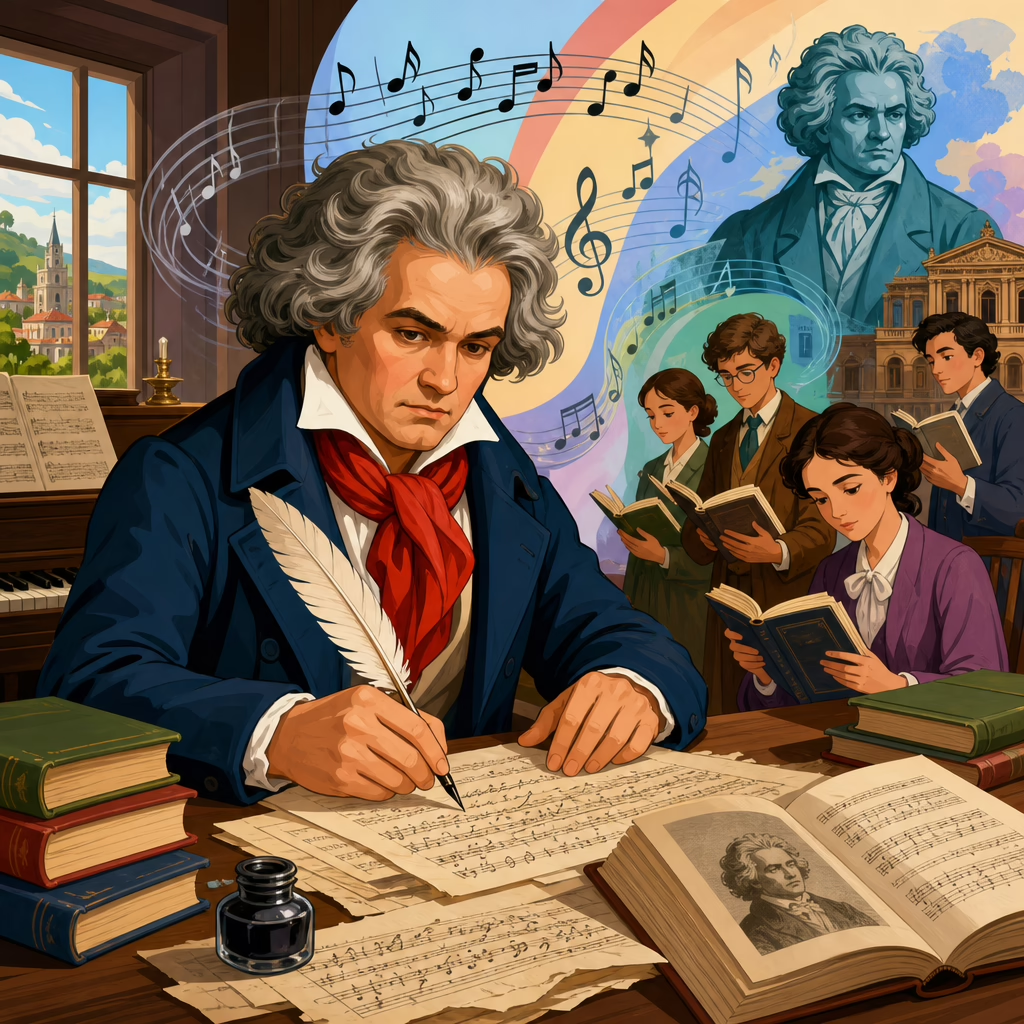
The Legacy of Beethoven’s Writings in Music Literature
The legacy of Beethoven’s writings in music literature extends far beyond biography because his letters, notebooks, dedications, legal petitions, conversation books, and marginal comments have become primary sources for understanding how a composer thought, negotiated, suffered, and shaped artistic identity. In music literature, “writings” means not only polished texts intended for publication but also everyday documents: personal correspondence, sketchbook annotations, diary-like reflections, testamentary statements, drafts to publishers, and notes preserved by friends. “Music literature” likewise reaches beyond criticism and includes biographies, editions, scholarly catalogues, performance studies, reception history, and cultural history. I have worked with these materials in editorial and research contexts, and the striking fact is that Beethoven’s written record continuously performs two jobs at once: it documents a life and generates an interpretive tradition.
That double role matters because Beethoven occupies a singular place in Western art music. His written voice helped define the image of the autonomous composer, the morally serious artist, and the creative genius wrestling with society. Later authors did not simply describe Beethoven; they built arguments on his documents. The Heiligenstadt Testament shaped narratives of inner struggle. The conversation books informed studies of deafness, sociability, and late style. His letters to publishers revealed the economics of composition, copyright anxiety, and the rise of a European music market. Even casual comments in notebooks have influenced how writers discuss form, motivation, improvisation, and revision. For readers looking for a hub on Beethoven’s miscellaneous writings, the essential point is clear: these documents are not peripheral evidence. They are foundational texts that changed how music is written about, edited, taught, and imagined.
The importance of this legacy also lies in its range. Beethoven’s writings survive in uneven, sometimes fragmentary forms, yet they touch almost every major question in music literature: authorship, authenticity, canon formation, illness, patronage, nationalism, textual editing, and the ethics of interpretation. Because the record is incomplete, scholars must balance documentary confidence with caution. Misdated letters, selective quotation, forged anecdotes, and nineteenth-century hero worship all complicate the picture. Still, compared with many earlier composers, Beethoven left an unusually rich textual footprint. That abundance has allowed generations of biographers, editors, and performers to ask not only what Beethoven composed, but how he argued, planned, remembered, and presented himself. Any serious account of Beethoven’s cultural afterlife must therefore begin with the legacy of his writings in music literature.
What Counts as Beethoven’s Miscellaneous Writings
When readers search for Beethoven’s writings, they often expect letters alone, but the miscellaneous category is where the broader literary legacy becomes visible. It includes the conversation books used mainly after severe hearing loss made spoken exchange difficult; sketchbook comments that sit between music notation and prose; personal memoranda; household notes; legal documents concerning his nephew Karl; dedications and prefaces; album leaves; reported sayings; and the famous Heiligenstadt Testament of 1802. It also includes documents not authored solely by Beethoven but inseparable from his voice, such as conversation books where visitors wrote remarks and Beethoven replied orally or occasionally in writing. These sources require careful handling because they differ in purpose, privacy, and reliability. A legal petition tells a different truth than an intimate confession or a business letter.
In practical research, these categories shape the kinds of questions scholars can answer. Letters show network and intention. Sketchbooks show process. Conversation books reveal daily routines, visitors, medical concerns, and practical artistic decisions. Memoranda expose financial pressures and domestic friction. The Heiligenstadt Testament, never sent and discovered after his death, offers a concentrated statement of despair, isolation, and ethical resolve. Taken together, these texts broaden music literature from score-centered analysis to document-based interpretation. This is why modern Beethoven studies rely on editorial projects such as the Beethoven-Haus Bonn digital archives, the New Beethoven Complete Edition context, and longstanding cataloguing traditions connected with Georg Kinsky, Hans Halm, and later archival scholars. Without this miscellaneous record, the literary Beethoven would be far flatter and far less human.
How Beethoven’s Writings Shaped the Composer Myth
One of the strongest legacies of Beethoven’s writings in music literature is the construction of the modern composer myth. Nineteenth-century authors used Beethoven’s own words to frame him as an artist of heroic suffering and spiritual vocation. The Heiligenstadt Testament became central because it reads like a moral drama: a man pushed toward despair by deafness but refusing self-destruction because art still demanded fulfillment. Biographers from Anton Schindler onward recognized the narrative power of that document, even when they distorted surrounding evidence. It supplied a ready-made plot of crisis and transcendence, and that plot profoundly shaped later books, concert essays, classroom teaching, and public memory.
This influence was not limited to one text. Letters in which Beethoven complains about aristocratic condescension or insists on artistic dignity fed the image of the independent genius. His often-quoted statement to Prince Lichnowsky, whether transmitted exactly or not, became emblematic: princes exist by accident; Beethoven exists by his own labor. Music literature repeatedly returned to such moments because they dramatized a historical shift from court servant to autonomous artist. The writings therefore did not merely preserve facts. They offered phrases, scenes, and attitudes that later writers turned into a model for discussing Romantic subjectivity. Even today, when scholars correct exaggerations, the core narrative remains influential because it emerged from documents with unmistakable emotional force.
Editorial History, Reliability, and the Problem of Mediation
Beethoven’s textual legacy is powerful partly because it has been heavily mediated. That mediation is itself a major subject in music literature. Early collectors, biographers, heirs, and publishers preserved invaluable materials, but they also introduced errors, omissions, and sometimes outright fabrication. The best-known cautionary case is Anton Schindler, once treated as an indispensable witness, now approached with skepticism because he altered conversation books and shaped anecdotes to fit his preferred Beethoven image. Modern scholarship has spent decades disentangling authentic documents from contaminated transmission. This work matters because a single suspicious quote can influence generations of interpretation.
Reliable Beethoven literature therefore depends on critical editions and archival comparison. Editors establish provenance, handwriting, dating, watermarks, recipient context, and parallel documentation before assigning authority to a text. The following comparison shows why source criticism is essential.
| Source type | What it reveals | Main limitation | Best use in music literature |
|---|---|---|---|
| Letters | Relationships, business dealings, self-presentation | Often strategic and audience-specific | Biography, patronage, publishing history |
| Conversation books | Daily life, visitors, practical decisions, late-period context | Beethoven’s spoken replies often missing | Social history, health, late works context |
| Sketchbook annotations | Compositional process, revision habits, thematic development | Fragmentary and hard to date precisely | Analytical studies, genesis of works |
| Legal and household papers | Money, custody battle, domestic reality | Narrow purpose and emotional stress | Material history, family conflict, chronology |
| Memoirs by associates | Anecdotes, reception, personality impressions | Memory distortion and self-interest | Reception studies with documentary cross-checking |
In my experience, the most responsible writing on Beethoven states clearly when a claim rests on an autograph document, an edited transcription, or a recollection published decades later. That distinction is not pedantic. It changes conclusions about temperament, politics, religion, and artistic intention. The legacy of Beethoven’s writings in music literature is therefore inseparable from the methods used to verify and interpret them.
Influence on Biography and Life Writing
No composer generated a richer documentary basis for biography before the modern age, and Beethoven’s writings transformed the standards of life writing. Early biographies leaned on anecdote, but as more letters and notebooks surfaced, biographers could reconstruct chronology, travel, commissions, friendships, illnesses, and disputes with unusual precision. Alexander Wheelock Thayer’s landmark nineteenth-century biography marked a turning point because it privileged verifiable documents over mythology. Later writers such as Maynard Solomon, Lewis Lockwood, and Jan Swafford, despite different interpretive styles, all depend on Beethoven’s writings to anchor narrative claims. The documents do not eliminate interpretation, but they constrain fantasy.
These writings also changed what readers expect from a composer biography. Instead of presenting works as isolated masterpieces, modern Beethoven literature connects compositions to lived circumstances documented in text. A letter about payment can illuminate why a commission mattered. A memorandum about lodgings can clarify a difficult period of mobility and stress. Court records from the Karl custody case expose Beethoven’s rigidity, devotion, and instability in ways no romantic anecdote could. The result is a denser, more ethically serious portrait. Beethoven appears neither as saint nor caricature, but as a working artist navigating disability, ambition, social dependence, and emotional volatility. That documentary depth became a benchmark for later music biographies beyond Beethoven himself.
Influence on Analysis, Performance, and Historical Interpretation
Beethoven’s writings matter not only to biographers but also to analysts and performers. Sketchbook studies have shown how motives evolved, how discarded possibilities shaped final structures, and how long-range planning interacted with improvisatory invention. Scholars such as Gustav Nottebohm pioneered the use of sketch materials to trace compositional genesis, creating a method that later influenced the study of many composers. This was a major development in music literature: analysis no longer had to treat the score as a finished monument detached from process. Beethoven’s notes made revision legible.
Performers likewise use the writings to make informed choices. Letters and comments about tempo, instruments, publishers’ errors, and rehearsal conditions can sharpen interpretive judgment, though they rarely provide mechanical answers. Conversation books and correspondence also help contextualize late works often described as transcendent abstractions. They show that these pieces emerged amid practical concerns, illness, visitors, jokes, and business frustrations. That ordinary context does not diminish the music; it grounds it. Historical interpretation benefits in the same way. Discussions of Beethoven’s politics, religion, and philosophical outlook rely on his written record, but careful scholars resist turning isolated remarks into total explanations. The writings support interpretation best when treated as evidence within a larger network of sources, including the music itself, contemporary testimony, and institutional history.
Why the Miscellaneous Archive Still Matters
The continuing relevance of Beethoven’s miscellaneous writings lies in their ability to connect specialized scholarship with broad cultural questions. Digital archives have made manuscripts and transcriptions more accessible, allowing students, performers, and general readers to encounter materials once limited to elite research libraries. At the same time, easier access increases the need for disciplined reading. A dramatic quotation can travel quickly without context, especially online. The most useful music literature therefore explains where a document comes from, why it was written, and what it can genuinely support.
As a hub topic, Beethoven’s letters and writings remain productive because each document type opens a different door. Some reveal creativity, others commerce, illness, friendship, law, or self-fashioning. Together they show why Beethoven has remained central not only in concert life but in the literature that surrounds music. His writings taught later generations how to narrate genius, how to edit a documentary legacy, and how to read a composer as a historical actor rather than a marble bust. If you want to understand Beethoven more completely, follow the documents: read the letters, compare the editions, and let the miscellaneous archive complicate the legend while deepening the music.
Frequently Asked Questions
What counts as Beethoven’s “writings” in music literature?
In music literature, Beethoven’s “writings” include far more than formal essays or texts prepared for publication. Scholars usually mean the full documentary record surrounding his life and work: letters to friends, patrons, publishers, and family members; sketchbook notes and compositional annotations; legal petitions and contracts; dedications and prefaces; marginal comments; and, especially in his later years, the famous conversation books used after his hearing loss became severe. These materials are crucial because they preserve Beethoven’s voice in practical, emotional, artistic, and social contexts. They show him not only as a composer of monumental works, but as a working artist managing commissions, defending his independence, coping with illness, negotiating status, and expressing deeply held ideas about art and human dignity.
This broader definition matters because Beethoven’s legacy in music literature depends on the fact that everyday documents can be as historically revealing as polished literary statements. A brief note to a publisher can illuminate his attitude toward authorship and ownership. A sketchbook annotation can reveal the tension between inspiration and revision. A legal document can expose the economic realities behind the image of the heroic genius. Taken together, these writings have become foundational primary sources for biographers, musicologists, literary scholars, and cultural historians. They help explain not just what Beethoven composed, but how he thought, struggled, communicated, and shaped the modern idea of the artist.
Why are Beethoven’s letters and notebooks so important to scholars and readers?
Beethoven’s letters and notebooks are indispensable because they bridge the gap between the finished compositions and the lived experience behind them. His music can suggest emotional force, intellectual rigor, and dramatic vision, but the writings give direct evidence of the concerns that surrounded the works: deadlines, patronage disputes, family tensions, health crises, artistic principles, and practical decisions about performance and publication. For scholars, this is invaluable. These documents help date compositions, clarify relationships, identify intended audiences, and reconstruct Beethoven’s working process. They also reveal his changing language about art, freedom, morality, and personal suffering, themes that became central to later music literature about genius and creative individuality.
For general readers, the importance is equally strong, though perhaps more immediate and human. The writings make Beethoven legible as a person rather than a distant monument of classical music. His correspondence can be affectionate, impatient, combative, witty, formal, vulnerable, and idealistic, sometimes all at once. His notebooks and conversation books can show the pressures of deafness and isolation while also preserving moments of ordinary exchange. This mixture of the exceptional and the everyday is one reason Beethoven’s documentary legacy has had such enduring literary power. It allows writers and readers alike to encounter a historical figure whose inner and outer lives feel dramatically present, and that presence has shaped centuries of interpretation in music biography, criticism, and cultural writing.
How did Beethoven’s writings shape the modern image of the composer as a heroic artistic figure?
Beethoven’s writings played a major role in establishing the enduring image of the composer as an autonomous, morally serious, and even heroic artist. Before the nineteenth century, composers were often viewed primarily as skilled professionals serving courts, churches, or urban institutions. Beethoven certainly worked within those structures, but his letters and related documents repeatedly show him asserting artistic independence, negotiating with patrons rather than simply obeying them, and presenting composition as a calling tied to inner conviction. That self-fashioning became immensely influential. Later writers drew on his words to portray him as a figure who endured hardship yet remained devoted to a higher artistic mission, an image that helped define Romantic ideas of genius.
This legacy was reinforced by the emotional and philosophical intensity found across the documentary record. His famous reflections on suffering, perseverance, and art gave biographers and critics material from which to build a powerful narrative: the artist who transforms personal struggle into universal expression. Even practical writings, such as business letters or legal statements, contributed to that image because they documented his refusal to be treated merely as a servant or craftsman. In music literature, Beethoven became a model for discussing authorship, authenticity, and the social authority of the composer. His writings did not simply record his life; they helped produce a new literary and cultural framework for understanding what a composer could represent in modern society.
What do Beethoven’s conversation books and personal documents reveal that the music alone cannot?
Beethoven’s music reveals an extraordinary artistic intelligence, but the conversation books and other personal documents expose dimensions of daily life and social experience that music cannot specify on its own. The conversation books, used largely because of his deafness, preserve written remarks from visitors, associates, and household members, sometimes alongside his own responses or related notes. They offer insight into his routines, health, finances, household management, professional contacts, and interpersonal tensions. These sources do not simply add colorful background; they reshape historical understanding by showing the practical and emotional conditions under which the late works emerged. They reveal an artist living through communication barriers, dependency, frustration, and continued intellectual engagement.
Personal documents also complicate any simplified portrait of Beethoven. They can show him as disciplined yet disorderly, idealistic yet suspicious, generous yet difficult, deeply sensitive yet fiercely argumentative. That complexity is one reason his writings have had such lasting significance in music literature. They resist hagiography while still supporting admiration. For literary and historical scholarship, these materials are especially valuable because they document the relationship between inward experience and outward circumstance. They help us see how illness, isolation, legal conflict, friendship, money, and reputation all intersected with artistic work. In other words, they allow Beethoven to be studied not just as a creator of masterpieces, but as a fully situated human being whose life documents have become a major archive of modern artistic selfhood.
Why does Beethoven’s documentary legacy still matter in contemporary music literature and scholarship?
Beethoven’s documentary legacy remains central because it continues to anchor both historical research and broader debates about interpretation, creativity, and cultural memory. His letters, notebooks, petitions, dedications, and conversation books are still mined for evidence about chronology, intention, patronage networks, publishing history, and performance practice. At the same time, modern scholarship no longer treats these writings as transparent windows into a single heroic truth. Instead, they are read critically as crafted documents shaped by audience, context, emotion, and strategy. This makes them even more important, not less, because they allow scholars to ask richer questions about self-presentation, privacy, authority, disability, and the construction of artistic identity in the early nineteenth century.
In contemporary music literature, Beethoven’s writings also matter because they keep inviting reinterpretation across disciplines. Musicologists use them to study compositional process; literary scholars examine voice, rhetoric, and narrative self-fashioning; historians analyze legal and social frameworks; disability scholars consider the meaning of deafness and communication; and cultural critics explore how archival fragments become myths. That interdisciplinary reach is part of Beethoven’s legacy. His writings are not merely supplementary documents attached to famous music; they are major texts in their own right within the literature of music. They continue to shape how biographies are written, how composers are taught, and how readers imagine the relationship between art and life. Few archives have had such a lasting influence on both scholarly method and the public understanding of what it means to be an artist.