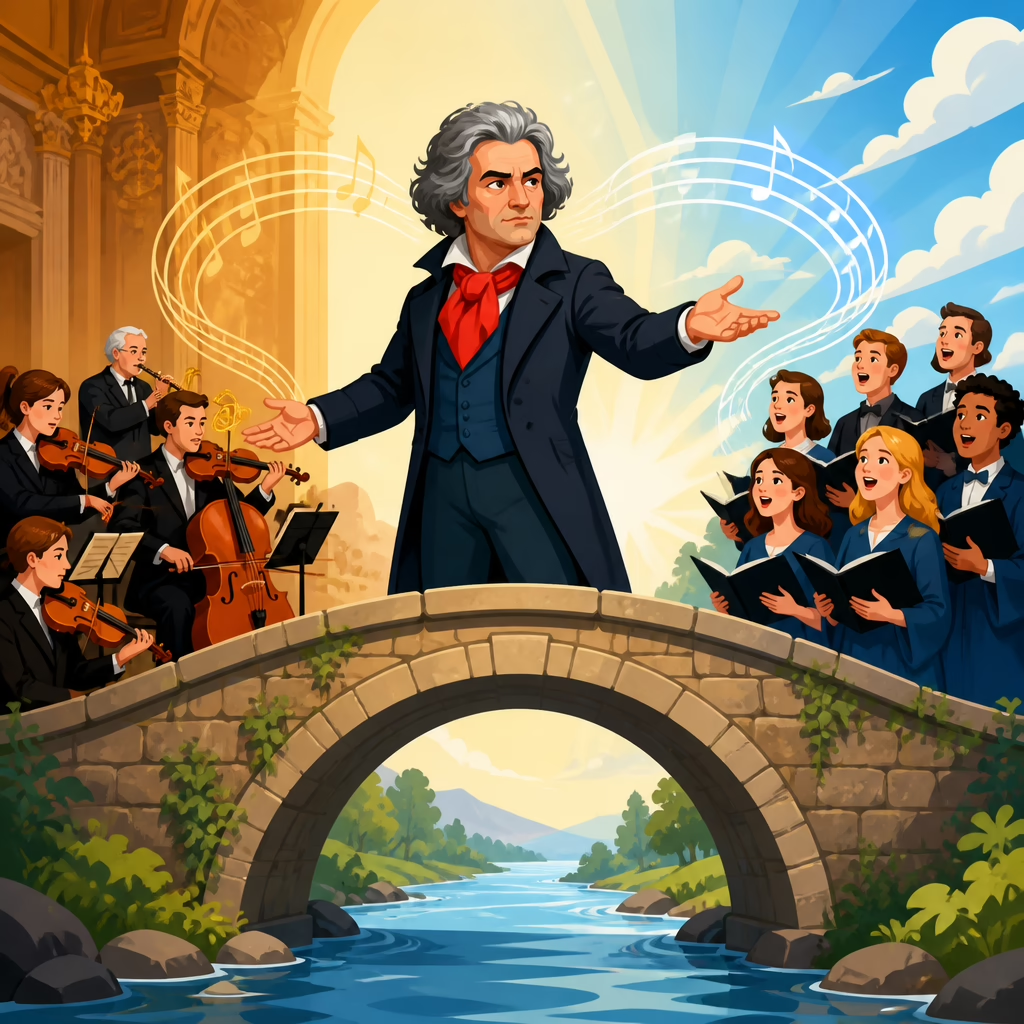
The Choral Fantasy as Beethoven’s Bridge Work
Beethoven’s Choral Fantasy, Op. 80, is often described as an oddity, yet that label misses its real value: it is a bridge work, a composition that joins the composer’s keyboard virtuosity, improvisatory instinct, orchestral thinking, and emerging public humanism in one unusually revealing score. Written for the famous Akademie concert of 22 December 1808 in Vienna, the piece stands between genres and between phases of Beethoven’s career. It begins like a piano fantasy, expands into a concerto-like dialogue, and ends with chorus and vocal soloists in a design that unmistakably anticipates the finale of the Ninth Symphony. To understand the Choral Fantasy clearly, it helps to define what “bridge work” means here: not a minor experiment, but a composition that connects earlier habits to later achievements while exposing the process of transition. In my experience studying Beethoven’s concert works alongside the sketch evidence and performance history, Op. 80 is one of the clearest examples of that function. It matters because it lets listeners hear Beethoven testing solutions he would later refine on a larger scale, and because it captures the practical realities of his music making at a critical moment in Vienna.
Why the 1808 Akademie made the Choral Fantasy necessary
The immediate reason for the Choral Fantasy was practical. Beethoven organized the massive 1808 benefit concert at the Theater an der Wien, a marathon event that also included the premieres of the Fifth and Sixth Symphonies, the Fourth Piano Concerto, parts of the C major Mass, and the concert aria “Ah! perfido.” He needed a brilliant concluding number that would reunite forces already onstage and place him at the keyboard. The result was Op. 80, assembled under pressure and by all accounts finished late. Contemporary reports and later recollections agree that the performance was underrehearsed and partly chaotic. That context matters, because the work’s hybrid shape is not an abstract aesthetic puzzle. It is a solution to a concrete concert problem: how to end an ambitious public event with something festive, inclusive, and unmistakably Beethovenian.
The opening makes that purpose audible. A long piano introduction in C minor sounds like Beethoven improvising before an audience, moving through dramatic recitative-like gestures, broken chords, abrupt pauses, and exploratory modulations. He was famous in Vienna for extemporization, and the score preserves that reputation in composed form. From there, the orchestra enters, the piano becomes both protagonist and participant, and the music gradually builds toward the simple tune that will support variations and, eventually, the choral apotheosis. This staged expansion from solitary keyboard to communal singing is the bridge concept in action. Beethoven turns the concert platform itself into a narrative, moving from individual invention toward collective affirmation.
How the piece links Beethoven the pianist to Beethoven the symphonist
One of the strongest reasons to hear the Choral Fantasy as a bridge work is that it joins two sides of Beethoven often discussed separately: the virtuoso pianist and the architect of large symphonic forms. The solo part is not merely decorative. It carries the memory of the salon, the private room, and the improvising artist who could command a Viennese audience alone. Yet the orchestral writing pushes beyond concerto convention. Instead of presenting a sharply bounded sonata-form first movement followed by a rondo or variation finale, Beethoven creates a continuous structure in which thematic growth matters more than textbook design.
The tonal plan reinforces this mediation. The piece begins in C minor, Beethoven’s key of dramatic struggle, associated with works such as the Fifth Symphony and the “Pathétique” Sonata, and moves toward the radiant C major conclusion. That move is not incidental. Across Beethoven’s middle-period music, the journey from minor conflict to major resolution becomes a central expressive strategy. In Op. 80, that journey is compressed and made public through voices. The piano initiates the process, but it cannot complete it alone. The orchestra broadens the sound world, and the chorus gives the final transformation social meaning.
This is exactly why the work should not be dismissed as a rough draft for the Ninth Symphony. Rough drafts are mainly preparatory. The Choral Fantasy is already an accomplished statement with its own profile: more intimate than the Ninth, more keyboard-centered, and more improvisatory in surface. What it shares with the later symphony is not just the idea of adding voices to an instrumental design, but the deeper conviction that instrumental music can generate a communal, text-bearing culmination without sounding arbitrary.
The theme, the text, and the road toward the Ninth Symphony
The comparison with the Ninth Symphony is inevitable, but it must be made precisely. The concluding tune of the Choral Fantasy is not the “Ode to Joy” melody, yet it belongs to the same family of Beethovenian hymn themes: diatonic, balanced, easily memorable, and suited to cumulative variation. The text, probably prepared in collaboration with Christoph Kuffner, praises art, beauty, and the unifying power of harmonious fellowship. Its sentiments are idealized, but the wording is functional in the best sense. Beethoven needed words that could crown an instrumental process already in motion. The text serves the music’s architecture by turning a singable theme into a civic statement.
What anticipates the Ninth is therefore structural and rhetorical. Both works withhold the full choral goal until late. Both rely on a melody of striking plainness after complex preparation. Both present the entry of voices as a threshold event, one that changes the meaning of everything before it. In rehearsal rooms, this is palpable: players can feel that the tune must arrive neither sentimentally nor casually, but as if the whole piece has been searching for a form of direct address. Beethoven learned in Op. 80 that a broad public tune can carry philosophical weight if it is earned through instrumental tension.
That lesson reaches beyond the Ninth. It also helps explain Beethoven’s attraction to variation as a social form. A simple melody invites participation; variation demonstrates intelligence, flexibility, and shared invention. Anyone exploring his smaller keyboard works can see the same principle in concentrated form, and a useful starting point is the broader context offered in this guide to Beethoven’s bagatelles, where brevity and motivic economy show another side of his ability to build large meaning from modest material. In the Choral Fantasy, that gift is projected onto a public canvas.
What the Choral Fantasy reveals about Beethoven’s compositional method
The work is especially revealing because its seams show. Rather than hiding transitions completely, Beethoven lets listeners hear the act of joining unlike materials. The improvisatory opening, the variation procedure, the concerto-like exchanges, the march impulses, and the choral finale do not melt into seamless classicism. They retain some friction. For analysts, that friction is evidence of method, not failure. Beethoven often thought composition through transformation: a gesture first appears in one character, then returns with expanded function. In Op. 80, the whole piece behaves that way. The opening fantasy is not abandoned when the tune arrives; its spirit of spontaneous generation remains embedded in the later unfolding.
This is where performers face the central interpretive challenge. If the opening is played as a disconnected preface and the theme as a generic anthem, the piece sounds episodic. If, however, the pianist shapes the introduction with harmonic direction and rhetorical timing, the later sections feel born from it. Conductors must then manage balances carefully, because the orchestra often supports rather than dominates, and the transition into the vocal domain can become clumsy if articulation is too heavy. The chorus, for its part, needs clarity more than mass. The text must project as the final step in a process of clarification. In successful performances, the listener senses inevitability, not patchwork.
| Element | Earlier Beethoven connection | Later Beethoven connection | Why it matters |
|---|---|---|---|
| Solo piano opening | Improvisation, keyboard fantasias, concert virtuosity | Integrated dramatic preludes in larger forms | Preserves Beethoven’s identity as performer-composer |
| C minor to C major trajectory | Middle-period struggle-to-triumph pattern | Ninth Symphony’s hard-won affirmation | Turns tonal motion into public meaning |
| Variation-based theme treatment | Keyboard variation sets and motivic economy | Finale-building through cumulative restatement | Shows how simplicity can support monumentality |
| Late vocal entry | Occasional vocal writing and cantata habits | Symphonic chorus in the Ninth | Tests how voices can crown instrumental argument |
Reception, reputation, and why the work is still misunderstood
The Choral Fantasy has long occupied an awkward place in Beethoven reception. It is not programmed as often as the piano concertos, and it is overshadowed by the Ninth whenever choral Beethoven is discussed. Some of that neglect is understandable. The piece requires solo piano, orchestra, chorus, and vocal soloists, which makes it expensive to stage for a work shorter and less famous than the major symphonies. It also resists easy classification. Audiences looking for a standard concerto encounter a choral finale; those expecting an oratorio-like experience find a highly instrumental design instead.
Yet these same features explain its importance. Music history often privileges finished monuments over transitional works, as if only the final solution deserves attention. In practice, bridge works can tell us more about a composer’s imagination because they document experimentation under pressure. With Beethoven, that pressure was artistic and personal. By 1808, his deafness was advancing, his public role as pianist was changing, and his ambitions for instrumental music were growing beyond inherited categories. Op. 80 reflects all three realities. It is the sound of a composer stretching available forms while still rooted in the concert life that had made him famous.
Modern recordings have improved the work’s standing, especially when they avoid treating it as a curiosity. Pianists who understand Beethoven’s rhetoric give the introduction flexibility without indulgence; conductors who keep tempos moving prevent the central variations from sagging; choruses that sing with clean diction rather than oratorio heaviness let the finale bloom naturally. When those choices align, the piece emerges not as a compromised hybrid but as a uniquely concentrated portrait of Beethoven in transition.
How to listen for the bridge function in a single hearing
A practical way to appreciate the Choral Fantasy is to listen for four thresholds. First, notice the opening piano solo as a record of Beethoven the improviser. The sudden contrasts and searching harmonies are not ornamental; they establish a world of possibility. Second, hear the first orchestral entrance as a change in social scale. The music leaves the individual sphere and enters a collective one. Third, focus on the arrival and repetition of the main tune. Its simplicity is strategic. Beethoven needs a melody that can be recognized, varied, and finally sung. Fourth, experience the choral entrance not as an add-on but as the completion of an argument about art’s capacity to unite distinct voices.
Listening this way clarifies why Op. 80 deserves the term “bridge work.” It connects private invention to public declaration, keyboard culture to symphonic aspiration, and middle-period drama to the universalizing tone of Beethoven’s late public style. It also shows that Beethoven’s innovations did not appear fully formed. He tested them in real performance situations, with practical constraints, uneven rehearsal conditions, and immediate audiences. That human reality makes the achievement more impressive, not less.
For anyone interested in Beethoven’s development, the Choral Fantasy offers an unusually direct window into creative transition. It is not the final word on any single genre, but it illuminates several at once. More important, it demonstrates a principle that runs through Beethoven’s art: the most powerful musical statements often arise when formal boundaries are treated as tools rather than rules. Return to Op. 80 with that in mind, and the work stops seeming marginal. It becomes essential, a vivid bridge between the Beethoven who dazzled at the keyboard and the Beethoven who imagined music speaking for humanity at large. Listen again, follow its thresholds, and its logic will reveal itself.
Frequently Asked Questions
Why is Beethoven’s Choral Fantasy often called a “bridge work”?
Beethoven’s Choral Fantasy, Op. 80, is called a bridge work because it connects several sides of his musical personality in a single composition. Rather than fitting neatly into one genre, it begins with the character of a piano fantasy, grows into something like a concerto movement, broadens into orchestral variation form, and finally culminates in a choral finale. That unusual design makes it more than a curiosity. It shows Beethoven actively linking his identity as a pianist, improviser, symphonic thinker, and public artist.
The piece also stands at an important historical moment in Beethoven’s career. Written for the celebrated Akademie concert of 22 December 1808 in Vienna, it belongs to a period when he was consolidating the heroic middle style while also reaching toward the broader humanistic ideals that would later define works such as the Ninth Symphony. In that sense, the Choral Fantasy is transitional in the best possible way: it does not merely sit between earlier and later masterpieces, but reveals Beethoven experimenting with how instrumental drama and vocal affirmation might be joined.
Calling it a bridge work also helps correct the older tendency to dismiss it as an oddity. Its very hybridity is the point. Beethoven uses the piece to unify apparently separate musical worlds: private improvisation and public celebration, keyboard brilliance and communal singing, spontaneous opening and architectonic conclusion. The result is a score that may seem unconventional on first hearing, but in fact offers an unusually direct view into Beethoven’s creative process.
How does the Choral Fantasy combine different musical genres and styles?
One of the most fascinating aspects of the Choral Fantasy is the way it moves across genres without ever entirely becoming just one of them. The opening is almost rhapsodic, with the piano entering alone in a manner that recalls Beethoven’s reputation as a formidable improviser. This introduction feels exploratory and free, as though the music is being discovered in real time. From there, the work gradually gathers momentum and shape, allowing the orchestra to enter and expand the musical argument.
As the piece unfolds, it begins to resemble a piano concerto, especially in the dialogue between soloist and orchestra. Yet Beethoven does not settle into a conventional concerto scheme. Instead, he turns toward a variation-like process in which a clear, memorable theme becomes the basis for successive transformations. These variations are not merely decorative. They steadily widen the expressive scope of the work, preparing the entrance of vocal forces as the culmination of a long musical ascent.
The final section introduces chorus and vocal soloists, transforming what began as a piano-centered fantasy into a communal statement. This is where the work most clearly anticipates Beethoven’s later interest in combining symphonic design with the human voice. The blending of fantasy, concerto, variations, and choral finale is precisely what gives the piece its significance. It is not a patchwork assembled by accident, but a deliberate synthesis that reveals Beethoven testing how far traditional boundaries could be stretched while still producing a persuasive large-scale structure.
What is the connection between the Choral Fantasy and Beethoven’s Ninth Symphony?
The connection between the Choral Fantasy and the Ninth Symphony is strong enough that listeners and scholars have long heard Op. 80 as an important precursor. Most obviously, both works culminate in a choral finale after an extended instrumental journey. In each case, Beethoven treats the entrance of voices not as an isolated effect, but as the fulfillment of ideas that have been developing all along. The basic concept of moving from instrumental discourse toward a collective vocal affirmation is already vividly present in the Choral Fantasy.
There is also a thematic and expressive resemblance. The principal melody of the Choral Fantasy is not identical to the “Ode to Joy” theme, but it shares a similarly direct, singable, hymn-like profile. Beethoven seems interested here in the kind of tune that can sustain both instrumental variation and broad public meaning. The text of the Choral Fantasy, with its emphasis on art, harmony, and shared uplift, points toward the same humanitarian dimension that would become even more powerful in the Ninth Symphony.
That said, the Choral Fantasy should not be reduced to a mere draft for the later symphony. It has its own purpose, scale, and character. The Ninth is a monumental architectural achievement, whereas Op. 80 is more experimental, more openly hybrid, and in some ways more intimate in the way it reveals Beethoven’s working methods. The value of the comparison lies in seeing how Beethoven first tried out the union of keyboard brilliance, orchestral development, and choral idealism before bringing those ambitions to their grandest realization years later.
Why was the 1808 Akademie concert important for understanding the piece?
The 22 December 1808 Akademie in Vienna is one of the most famous concerts in Beethoven’s career, and the Choral Fantasy makes the most sense when viewed within that event. This was an extraordinary benefit concert organized by Beethoven himself, featuring a daunting concentration of major works, including premieres and large-scale performances that displayed the full range of his ambition. The program was long, demanding, and logistically difficult, but it also served as a public statement of Beethoven’s artistic identity.
Within that setting, the Choral Fantasy functioned almost like a summation. It brought together the composer’s gifts as pianist, composer, and public visionary in a single finale-like statement. The prominent piano role reflected Beethoven’s continuing stature as a keyboard virtuoso, even as increasing deafness was changing the conditions of his performing life. At the same time, the orchestral and choral expansion projected him beyond the salon or solo concert platform into the realm of grand public art.
The circumstances of the premiere also help explain some of the work’s unusual character. This was not a piece written to satisfy generic purity. It was composed for a specific occasion and designed to make a cumulative impact at the end of an ambitious program. That practical origin contributes to its eclecticism, but not in a negative sense. Instead, it highlights Beethoven’s ability to turn occasion into artistic opportunity. The Choral Fantasy becomes a kind of self-portrait in performance: improviser, virtuoso, architect, and prophet of collective musical joy all at once.
Why does the Choral Fantasy deserve more attention than it usually receives?
The Choral Fantasy deserves more attention because it provides an unusually concentrated insight into Beethoven’s development, his ambitions, and his methods. Works that do not fit tidy categories are often undervalued, and Op. 80 has sometimes suffered from being measured against more conventionally unified masterpieces. Yet its importance lies precisely in its refusal to stay within one frame. It allows listeners to hear Beethoven in the act of connecting ideas that would shape some of his greatest later achievements.
It is also a rewarding piece in purely musical terms. The piano writing has flair and rhetorical freedom, the orchestral writing steadily builds momentum, and the concluding vocal section delivers genuine exhilaration. The work’s cumulative effect can be striking: what begins as something exploratory and individual gradually becomes communal and celebratory. That trajectory is central to Beethoven’s art more broadly, and the Choral Fantasy presents it in a particularly transparent way.
For modern audiences, the piece offers a valuable reminder that artistic significance does not always reside in polished neatness. Sometimes the most revealing works are those in which a composer experiments openly, takes structural risks, and allows multiple creative impulses to meet. The Choral Fantasy may be unusual, but it is unusual in a deeply illuminating way. Far from being a peripheral oddity, it stands as a key document of Beethoven’s transition from keyboard-centered brilliance to the expansive public humanism that would define his later legacy.