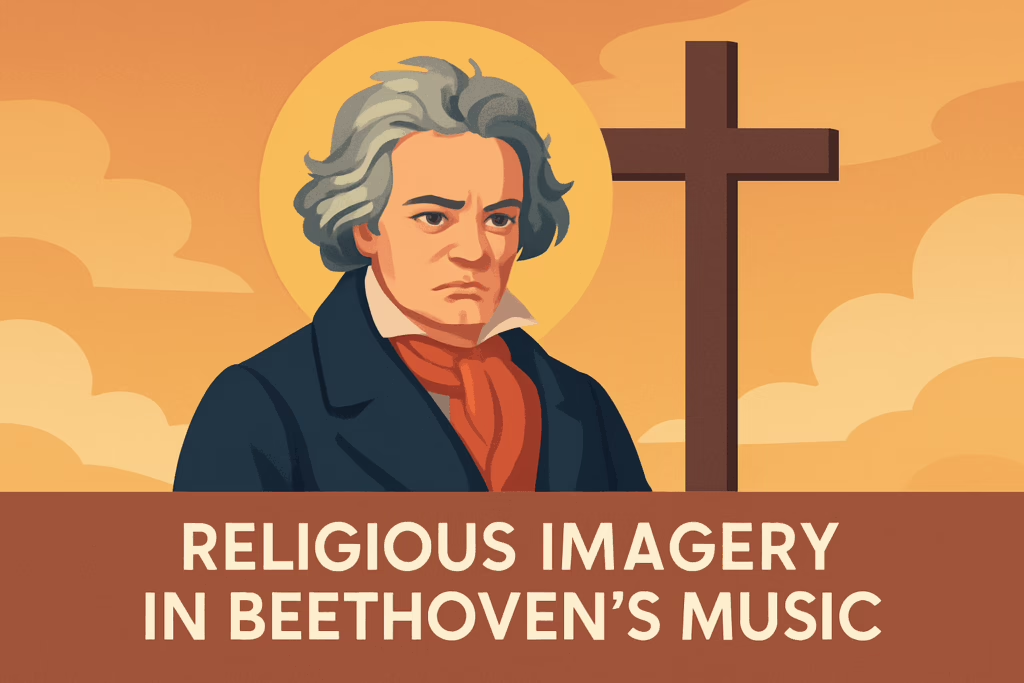
Religious Imagery in Beethoven’s Music
The music of Ludwig van Beethoven is renowned for its profound emotional depth, technical innovation, and universal appeal. Among the many elements that contribute to the power of Beethoven’s work is his use of religious imagery. This imagery is woven into some of his most influential compositions, shaping their themes and resonating deeply with audiences across the globe. Religious imagery in music involves using symbolic references, lyrics, or composition techniques that evoke religious themes or stories. For Beethoven, integrating religious elements into his music was a way to explore complex themes of life, spirituality, and humanity. This exploration reflected his personal struggles and inspirations, crafting an auditory tapestry that transcends the ordinary experience of classical music. Understanding this aspect of Beethoven’s music not only enriches our comprehension of his works but also deepens our appreciation of the broader role of religious inspiration in the arts.
Beethoven’s Use of Religious Imagery in Symphony No. 9
Perhaps the most well-known example of religious imagery in Beethoven’s work can be found in his Symphony No. 9. This symphony, particularly its final movement, is famous for its choral finale—the “Ode to Joy” with Friedrich Schiller’s poem. The sense of unity, brotherhood, and transcendence conveyed by the music is akin to religious experience. Beethoven’s “Ode to Joy” employs a celebratory and uplifting tone that mirrors themes often found in religious hymns. Utilizing a full chorus to convey the message further enhances the communal and collective experience associated with many religious ceremonies.
The effect is akin to a musical sermon, where Beethoven connects the secular joy and religious exaltation, suggesting a universality that surpasses structured belief systems. His composition invokes the ideals of enlightenment and the notion of heavenly joy, promoting an inclusive vision of spirituality.
Eroica Symphony: Allegory of Redemption
Beethoven’s Symphony No. 3, known as the “Eroica,” offers another facet of religious imagery. Originally dedicated to Napoleon Bonaparte, Beethoven redacted this dedication when Napoleon declared himself Emperor, redirecting the work’s interpretation towards broader, more universal themes. The symphony’s second movement, a funeral march, is particularly powerful. This movement explores themes of death and resurrection that align with Christian imagery of Christ’s crucifixion and subsequent resurrection.
The symphonic journey from mourning to triumph reflects ideas of redemption and overcoming adversity, which are frequent motifs in religious narratives. The work’s progress through emotional extremes and eventual arrival at a triumphant conclusion embodies a path from darkness to light, echoing spiritual salvation stories.
Fidelio: The Light of Freedom
Beethoven’s only opera, “Fidelio,” brims with religious symbolism, particularly in its exploration of themes such as truth, justice, and freedom. The opera’s storyline revolves around the rescue of a political prisoner, paralleling narratives of biblical salvation and deliverance.
Beethoven uses musical motifs to symbolize light and darkness, frequently employing tonal shifts to signify the transition from oppression to freedom akin to liberation themes in religious texts. The climactic scene in which Florestan is freed from his chains culminates in musical exaltation that feels spiritual and transcendental in nature.
Mass in C: Traditional Hymnality and Personal Expression
Although Beethoven is perhaps less known for his liturgical music than his symphonies or sonatas, his Mass in C Major remains a pivotal exploration into religious themes. Unlike the more conventional masses of his predecessors, Beethoven infused his Mass with a personal amalgam of reverence and emotional intensity. This mass captures the solemnity and worship associated with traditional liturgical music while incorporating Beethoven’s signature style of dynamic contrasts and climactic builds.
A particularly illustrative use of religious imagery is the “Agnus Dei” section, where Beethoven combines tenderness with an intense conclusion, musically praying for peace in tones both humbling and profound. The use of choir and orchestra together elevates the piece’s spiritual dimension, likening the experience to sharing in a communal prayer.
| Composition | Religious Imagery | Musical Techniques |
|---|---|---|
| Symphony No. 9 | Ode to Joy, Unity | Choral Settings, Tonal Uplift |
| Eroica Symphony | Redemption, Resurrection | Funeral March Themes, Emotional Extremes |
| Fidelio | Freedom, Light vs. Darkness | Tonal Shifts, Liberation Motifs |
| Mass in C Major | Prayers for Peace | Choir & Orchestra, Dynamic Contrasts |
Missa Solemnis: Beethoven’s Spiritual Testament
Arguably, Beethoven’s “Missa Solemnis” stands as his most explicit work driven by religious themes. Created in honor of Archduke Rudolf’s elevation to Archbishop, this composition represents a powerful, personal articulation of belief and spirituality. The Missa Solemnis is not just a reaffirmation of the traditional Latin Mass; it is Beethoven’s ambitious attempt to express genuine human emotion within the confines of religious structure.
The composition goes beyond simple religious texts to explore themes of introspection and divine connection. While adhering to the Mass’s typical parts, the “Kyrie,” “Gloria,” “Credo,” “Sanctus,” and “Agnus Dei,” Beethoven imbues each section with vivid musical imagery that reflects inner spiritual struggles and triumphs. The profound passion and tension present in this work articulate a heartfelt plea for inner and outer peace, reminiscent of universal religious aspirations across cultures and faiths.
Choral Fantasia: Bridging Humanity and Divinity
In Beethoven’s “Choral Fantasia,” we see a fascinating precursor to the epiphanic qualities of his Ninth Symphony. This unique work weaves a connection between piano, orchestra, and chorus, bridging the secular and the divine through its thematic conclusion of unity and harmony. The piece starts with a piano solo, developing into an orchestral dialogue, and culminates with a choral allegory of peace and brotherhood.
Religiously, this ensemble resonates with the joy of communal experience and shared human emotions. Its message of interconnectedness aligns with spiritual ideologies that emphasize collective goodness and divine brotherhood, conveying a vision of humanity under a harmonious order akin to religious ideals.
Conclusion: The Timeless Impact of Beethoven’s Religious Imagery
Beethoven’s music is an eloquent reminder of the power of religious imagery to enrich and elevate artistic expression. These religious elements serve not just as thematic adornments but as fundamental drivers of the emotional and structural depth in his compositions. By understanding and engaging with these pieces, listeners find themselves invited into a dialogue between the secular and the sacred, the human and the divine, just as Beethoven intended.
The pursuit of understanding Beethoven’s religious imagery offers a profound insight into how spirituality and artistry intersect to craft experiences that transcend the ordinary and touch the transcendent. As listeners or scholars, delving into this aspect of Beethoven’s work enhances our appreciation not only for his genius but also for how music can serve as a universal language bridging different aspects of human experience.
For enthusiasts and newcomers alike, exploring Beethoven’s compositions with an ear for religious imagery promises a rewarding journey. Engage with his works, attend performances, or simply reflect on their capacity to inspire—these are all ways to connect deeply with Beethoven’s genius and the timeless spirituality of his music.
Frequently Asked Questions
1. How does Beethoven incorporate religious imagery into his music?
Beethoven’s approach to weaving religious imagery into his music is multifaceted and deeply evocative. One of the most significant ways he achieves this is through his choice of themes and the narratives he chooses to depict. For instance, in his Missa Solemnis, Beethoven draws heavily on the liturgical texts of the Roman Catholic Mass, infusing his music with a profound sense of spiritual gravity. This monumental work, composed between 1819 and 1823, is a prime example of the composer’s ability to use music as a medium for expressing religious reverence and existential contemplation.
In addition to using religious texts, Beethoven often employs specific musical techniques and motifs that evoke traditional expressions of faith. For example, he uses chorales and hymnal styles that echo the grandeur of ecclesiastical music. His Symphony No. 9, particularly the final movement with the “Ode to Joy,” is another testimony to how he infuses spiritual themes, celebrating universal brotherhood in a manner that mirrors the ideals of enlightenment and divine unity.
Beethoven’s music often reflects a struggle between human suffering and the transcendence one might associate with divine intervention, which is no wonder given Beethoven’s own life hardships. This duality is evident in his later works, where themes of redemption, hope, and the power of the human spirit often prevail, resonating with religious allegories of struggle and salvation.
2. Are there specific works of Beethoven known for their religious themes?
Indeed, several of Beethoven’s works are notable for their religious overtones and themes. Among them, the aforementioned Missa Solemnis stands out as a beacon of spiritual and musical complexity. The piece is structured around the standard sections of the Mass: Kyrie, Gloria, Credo, Sanctus, and Agnus Dei. Each movement is rich with both traditional liturgical text and Beethoven’s unique musical interpretation, creating an experience that aims to transcend the typical bounds of a concert piece and enter the realm of profound spiritual encounter.
Another significant work is Beethoven’s Symphony No. 9 in D minor, Op. 125. The final movement includes a choral setting of Friedrich Schiller’s poem “An die Freude” (“Ode to Joy”), which, while not explicitly religious, carries a deeply humanistic and spiritually uplifting message. This symphony reflects ideals akin to religious salvation—a universal call to unity and peace that echoes themes found in spiritual and religious discourse.
Furthermore, Beethoven’s late string quartets, composed in the last years of his life, are imbued with introspection and seem to carry an almost sacred aura, reflecting on themes of life, death, and the eternal. The String Quartet No. 16 in F major, Op. 135, with its “Muss es sein?” (“Must it be?”) philosophical undertone, is an exploration into the deeper questions of existence, often associated with religious meditation.
3. Why was religious imagery significant to Beethoven personally?
Religion and spirituality played a complex role in Beethoven’s life. Though raised in a Catholic household, Beethoven’s personal faith evolved over time, becoming more philosophical and less bound to the structures of organized religion. He was known for his humanitarian and Enlightenment ideals, which often intersected with spiritual questions about the nature of mankind, existence, and the divine.
Beethoven’s fascination with the divine was as much about the search for universal truths as it was about personal solace. During periods of personal hardship, including his declining hearing and social isolation, religious and spiritual imagery in his music offered a form of cathartic release both for him and his listeners. This connection to higher ideals is evident in the aspirational and often triumphant character of his compositions, which seek to transcend personal suffering.
Therefore, the use of religious imagery not only provided Beethoven with a means to connect with broader existential themes but also allowed him to communicate his own inner struggles and reflections on humanity’s place in the cosmos. It became an integral part of his artistic expression and humanistic message.
4. How have audiences historically interpreted religious imagery in Beethoven’s music?
Audiences have long been captivated by the spiritual and religious implications found within Beethoven’s music, often viewing it through the dual lenses of personal and universal significance. Historically, Beethoven’s works have been interpreted as powerful narratives of struggle and redemption, mirroring the sacred journeys found in religious stories and doctrines.
In the 19th century, during and shortly after Beethoven’s life, there was a strong inclination towards Romanticism, which embraced the ideals of individualism and emotional expression. His music resonated with the listeners of the time as it so richly embodied these principles, including the exploration of spiritual and religious dimensions. The Missa Solemnis, with its bold and vibrant passages juxtaposed with moments of introspective calm, served as a touchstone for religious reflection and appreciation of the divine as a living, breathing force accessible through music.
In contemporary times, the interpretation of religious imagery in his music is no less significant. It allows modern audiences to explore themes of connection, unity, and transcendence amid fast-paced and often secular lives. The timelessness of Beethoven’s allusions to religious themes ensures his music continues to evoke profound contemplation and emotional response.
5. Did Beethoven use specific composition techniques to highlight religious themes?
Beethoven employed various composition techniques that enhanced the religious imagery in his music, thereby deepening the emotional impact and conveying a sense of the divine. One technique was the use of counterpoint, where multiple independent melodies are woven together to create intricate and harmonically rich textures. This style is evident in works like the Missa Solemnis and can evoke the complexity and unity often associated with religious experience.
He also made extensive use of dynamic contrast, employing sudden shifts between loud and soft passages to symbolize spiritual awakening and divine revelation, or to create moments of serenity and introspection. In the careful balance between powerful crescendos and delicate pianissimos, Beethoven conveyed a sense of awe that aligns with religious veneration and devotion.
Furthermore, Beethoven’s choice of key signatures and modes often played a role in highlighting the spiritual aspects of his music. For instance, he often chose D major for works with uplifting or sacred themes, as it was conventionally associated with joy and triumph. Meanwhile, through the use of minor keys, he explored more somber and introspective emotional landscapes, akin to spiritual longing and redemption.
By blending these composition techniques with religious imagery, Beethoven was able to craft music that was not only emotionally resonant but also capable of inspiring deep religious reflection and spiritual insight.