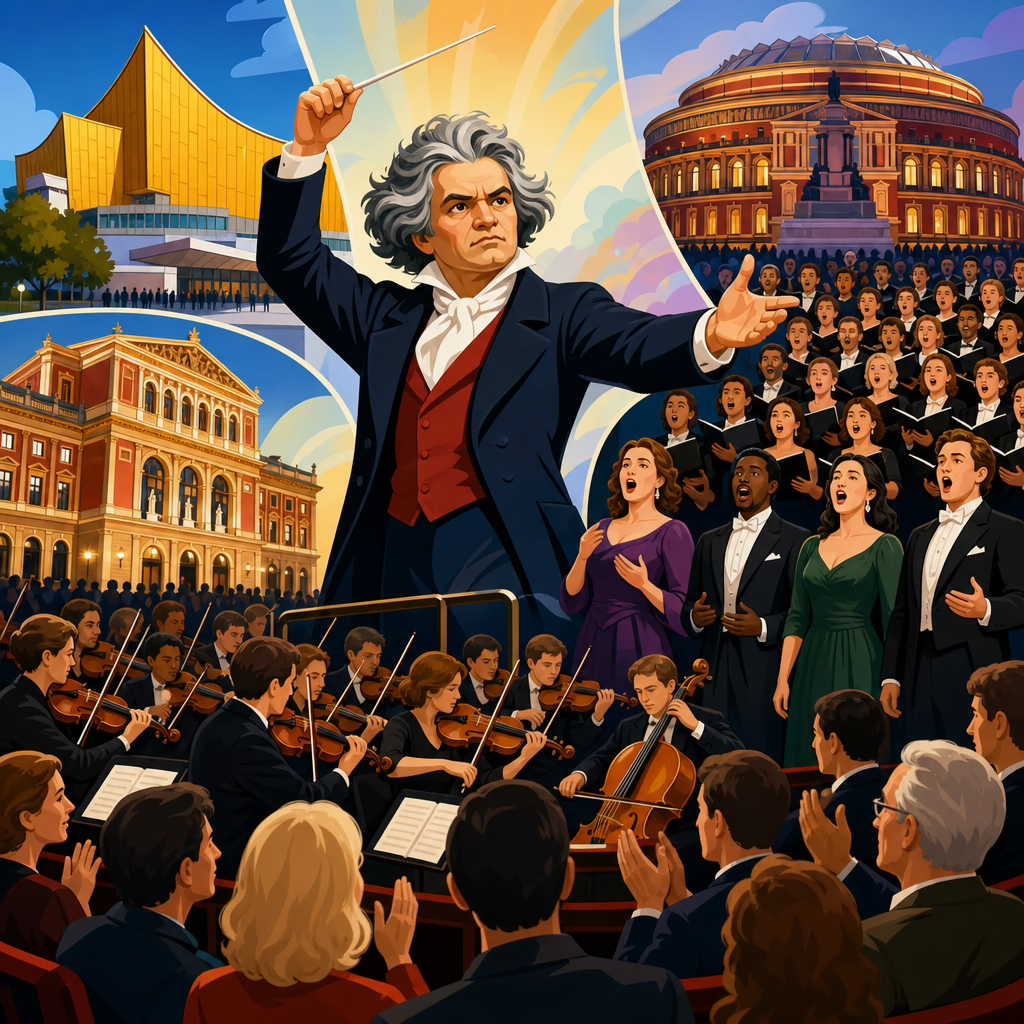
Notable Live Performances of Beethoven’s Symphony No. 9
Beethoven’s Symphony No. 9 has never belonged only to the concert hall; from its 1824 premiere onward, it has functioned as a public ritual, a political symbol, a technical test, and a measure of how conductors, orchestras, choirs, and audiences understand the idea of greatness. In the performance and recordings landscape, notable live performances of Beethoven’s Symphony No. 9 matter because this work changes meaning in front of listeners. Tempos, chorus size, tuning, hall acoustics, national context, and even the occasion itself shape what the symphony says. I have worked through many broadcast archives, concert notes, and historical recordings of the Ninth, and the same lesson keeps returning: no other major symphony leaves such a visible trail of public memory.
The term “live performance” needs a precise definition here. It includes premieres, festival appearances, benefit concerts, radio relays, wartime and postwar events, historically informed performances before audiences, and globally televised occasions in which the performance was documented in real time or essentially captured from a public event. “Notable” does not mean only “best played.” It can mean historically decisive, artistically radical, politically charged, unusually influential on later interpretation, or central to the wider performance and recordings conversation. Because this article serves as a hub within the miscellaneous branch of performance and recordings coverage, it links broad themes: premiere history, conducting traditions, major commemorations, politically symbolic performances, and the continuing tension between monumental and historically informed approaches.
Why does this matter? Beethoven’s Ninth is one of the few compositions that audiences recognize as both music and event. The final movement’s setting of Schiller’s “An die Freude” invites communities to project ideals of freedom, fraternity, resistance, mourning, or triumph onto a single score. That symbolic power has led to misuse as well as inspiration, so any serious guide must balance admiration with context. The work is also a benchmark in practical musicianship. It tests choral diction, orchestral stamina, brass control, balance between solo quartet and chorus, and the conductor’s ability to unify a vast formal design. Looking across notable live performances shows not one tradition but many, and that diversity is exactly what makes the Ninth endlessly alive.
The 1824 premiere and the birth of the Beethoven Ninth performance tradition
The first essential live performance is the premiere on 7 May 1824 at the Kärntnertortheater in Vienna. Beethoven, profoundly deaf, stood onstage and was associated with the direction, while Michael Umlauf actually managed performance coordination because the players needed a practical conductor they could follow. Every later account of the Ninth in performance begins here because the premiere established the work as an occasion beyond ordinary subscription programming. Contemporary reports stressed the audience response, including the famous moment when Beethoven had to be turned toward the hall to see the applause. That story, repeated so often because it is true to the work’s mythology, fused human struggle with artistic transcendence.
Musically, the premiere also matters because it reminds modern listeners that the Ninth did not enter the world as a polished monument. Early nineteenth-century orchestras used different instruments, smaller string sections, lighter timpani sticks, and vocal forces that produced a very different balance from later late-Romantic performances. Surviving evidence indicates that ensemble was not immaculate. Yet the event changed concert culture. It demonstrated that a symphony could include vocal soloists and chorus without becoming an oratorio, and it positioned the finale as a civic statement rather than merely a formal surprise. For anyone studying miscellaneous notable performances, this premiere is the root node from which all later branches grow.
Nineteenth-century festival culture and the rise of the monumental Ninth
After Beethoven’s death, the Ninth became a prestige work for festivals and commemorations across Europe. By the mid and late nineteenth century, conductors and institutions increasingly treated it as a ceremonial climax. Performances in Leipzig, London, Paris, and Bayreuth helped standardize a “monumental” style: larger choruses, heavier strings, broader pacing, and a heightened sense of moral uplift. This did not happen overnight, but by the time Wagner conducted the Ninth at Bayreuth in 1872 to mark the laying of the Festspielhaus foundation stone, the piece had become inseparable from cultural ambition. Wagner’s essayistic engagement with Beethoven also encouraged listeners to hear the symphony as a quasi-philosophical drama, not only a musical structure.
London’s choral traditions gave the work another dimension. Large festival choirs could generate overwhelming sonority in the “Ode to Joy” sections, and that scale appealed to audiences who wanted the Ninth to sound like civilization speaking with one voice. The tradeoff was clarity. Dense choral forces often obscured text and rhythmic detail, and some conductors accepted this because emotional mass was the goal. In practical performance history, this era matters because it created expectations that lasted well into the twentieth century. Even listeners who now prefer leaner period-informed performances often carry an inherited image of the Ninth as colossal, public, and almost architectural.
Toscanini, Furtwängler, and the twentieth-century live canon
If one asks which live performances most shaped modern perceptions of Beethoven’s Symphony No. 9, two conductors immediately dominate: Arturo Toscanini and Wilhelm Furtwängler. Toscanini’s live and broadcast performances with the NBC Symphony and earlier ensembles presented the work with fierce rhythmic drive, textual discipline, and structural tautness. He treated Beethoven not as misty metaphysics but as urgent drama. In rehearsal culture, that meant insistence on precision, accented articulation, and tight ensemble. Many later conductors who favor propulsion over grandeur still work in a space Toscanini helped define.
Furtwängler represented a different but equally influential ideal. His wartime and postwar Ninths, especially the 1942 Berlin performance and the 1951 Bayreuth reopening concert, are discussed because they reveal how live context can alter interpretation. The 1942 account is intense, elastic, and darkly driven, with huge tempo fluctuations that some hear as visionary and others as unstable. It cannot be separated from the Nazi era in which it was performed, and responsible criticism should not pretend otherwise. The 1951 Bayreuth Ninth, by contrast, carried the weight of cultural reconstruction in postwar Germany. Its opening movement emerges from near silence with exceptional tension, and the finale seeks affirmation without sounding naive. I return to these performances often because they prove that “notable” can mean morally complicated, musically transformative, and historically inseparable all at once.
Politically symbolic performances in times of conflict and change
No symphony has been used more often to mark political turning points. Beethoven’s Ninth appeared at moments of regime ceremony, liberation, rebuilding, and protest because its finale can be framed as universal brotherhood while remaining musically overwhelming. That flexibility explains both its prestige and its vulnerability to appropriation. During the twentieth century, state occasions in Europe and Asia repeatedly turned to the Ninth for symbolic legitimacy. The work’s message was never fixed; presenters shaped it through program notes, venue, audience, and broadcast framing.
The most famous late twentieth-century example is Leonard Bernstein’s 1989 performance in Berlin after the fall of the Wall. Bernstein altered the word “Freude” to “Freiheit” in the finale, turning “joy” into “freedom.” Purists objected, but the gesture captured the event’s symbolic purpose and made the concert instantly historic. The international orchestra and singers underscored reconciliation, while the televised format brought the performance into homes worldwide. Whatever one thinks of the textual alteration, it demonstrated how live Beethoven Ninth performances can become acts of public interpretation. Similar logic informs annual Japanese “Daiku” traditions, where massed choral performances reflect community identity and postwar cultural adoption. These are not footnotes; they show how the Ninth lives beyond standard European concert narratives.
Historically informed performance and the challenge to the big-symphony tradition
From the late twentieth century onward, historically informed performance transformed live Beethoven Ninth interpretation. Conductors such as Roger Norrington, John Eliot Gardiner, Nikolaus Harnoncourt, and later Philippe Herreweghe and others challenged the assumption that the symphony must sound massive and heavily sustained. Working with period instruments or historically aware modern forces, they used brisker tempos closer to Beethoven’s metronome marks, reduced vibrato, sharper timpani attack, more transparent textures, and clearer differentiation of orchestral lines. In the hall, the result was startling for audiences raised on broad, saturated sonorities.
The strongest argument for this approach is not antiquarian purity but audible structure. Inner winds emerge more clearly, the scherzo gains bite, and the finale’s Turkish march episodes stop sounding merely picturesque and instead become part of a sharply characterized drama. The limitations are real too. Leaner strings can expose choral balance problems, and very fast tempos can challenge diction in the final movement. Still, historically informed live performances permanently changed the conversation by proving that the Ninth can sound revolutionary rather than monumental. They also influenced mainstream orchestras, many of which now blend modern instruments with period-aware articulation, antiphonal violins, reduced portamento, and more disciplined brass style.
| Performance | Why it is notable | Interpretive legacy |
|---|---|---|
| Vienna premiere, 1824 | First public hearing; Beethoven present; established the work as an event | Created the mythic and civic frame around the symphony |
| Bayreuth, 1872, Wagner | Festival consecration of the Ninth as cultural monument | Strengthened large-scale ceremonial interpretation |
| Berlin, 1942, Furtwängler | Artistically extreme and historically controversial wartime performance | Defined the idea of the Ninth as existential drama |
| Bayreuth, 1951, Furtwängler | Postwar reopening with immense symbolic weight | Became a touchstone for spiritual intensity in live Beethoven |
| Berlin, 1989, Bernstein | Linked the symphony to the fall of the Berlin Wall | Confirmed the finale as a global language of political hope |
| London Revolutionary and Romantic Players, Gardiner era | High-profile period-informed challenge to traditional massiveness | Normalized faster tempos and transparent textures |
Broadcasts, recordings, and why some live Ninths endure
Not every great live performance becomes historically important, and not every famous one was flawless in the room. Survival depends on technology and institutions. Radio networks, festival archives, labels such as Deutsche Grammophon, EMI, Decca, Sony Classical, and public broadcasters preserved certain Beethoven Ninth performances and let them shape taste far beyond their original audience. Toscanini benefited from radio. Furtwängler’s reputation rests partly on airchecks and festival documentation. Bernstein’s Berlin performance became globally visible through television. In other words, a notable live performance often becomes notable because it remains accessible enough to be debated.
For listeners exploring the performance and recordings subtopic, this is the central miscellaneous lesson: recording does not merely document interpretation; it curates history. Microphone placement can favor chorus over orchestra. Live patch sessions can smooth errors while retaining event energy. Hall ambience can make a swift performance seem dry or a broad one seem majestic. I have compared multiple live Ninth releases from the same conductor and found that edition choice matters almost as much as conducting style. Serious listening therefore means asking not only who performed and when, but what source survives, who remastered it, and whether the release preserves the real dynamic and spatial profile of the event.
How to evaluate a notable live performance of Beethoven’s Ninth today
When comparing live Beethoven Ninth performances, listen first for architecture. Does the opening movement build with inevitability, or does it sprawl? In the scherzo, are timpani and lower strings rhythmically incisive? In the Adagio, does the conductor sustain long lines without sentimentality? In the finale, can you hear the cellos and basses articulate the “O Freunde” recitative-like interruptions as structural pivots rather than decorative gestures? These criteria matter more than celebrity status. A famous cast cannot rescue a finale in which chorus, soloists, and orchestra occupy separate worlds.
Then consider practical execution. The best live performances solve recurring Beethoven Ninth problems: tenor projection in the Turkish march, soprano strain above the chorus, brass fatigue near the close, and text clarity in full cry. Also weigh the event context. A commemorative concert may accept rough edges in exchange for urgency, while a festival opening may aim for polish and symbolic grandeur. This hub article is designed to orient readers toward those distinctions across miscellaneous live-performance topics. From here, the richest next step is simple: listen comparatively. Hear the premiere tradition, the monumental nineteenth century, the Toscanini-Furtwängler divide, the politically charged broadcasts, and the period-informed rethinking. Beethoven’s Symphony No. 9 rewards that effort because every notable live performance reveals not just the score, but the era that needed it.
Frequently Asked Questions
What makes a live performance of Beethoven’s Symphony No. 9 especially notable?
A notable live performance of Beethoven’s Symphony No. 9 is rarely memorable for only one reason. The most celebrated accounts usually bring together musical excellence, a strong historical or cultural setting, and a feeling that the performers are not merely reproducing a masterpiece but actively redefining it for that audience and that moment. Because the Ninth carries such symbolic weight, listeners often judge a performance not only by precision, balance, and vocal power, but also by whether it captures the work’s unusual combination of drama, philosophical ambition, and communal energy.
In practical terms, several factors can make a performance stand out. A conductor’s tempo choices can radically alter the symphony’s profile, making it sound monumental and architectural or urgent and volatile. Orchestra size, string articulation, brass style, and timpani presence can shift the sound world from dense Romantic grandeur to something leaner and more rhythmically transparent. The chorus matters just as much. In the finale, the difference between a massive choral wall of sound and a more agile ensemble affects how the “Ode to Joy” is perceived: as a civic proclamation, a spiritual appeal, or an intensely human call for solidarity.
Venue and occasion also matter enormously. A performance at a reopening concert, a political turning point, a memorial event, or an international celebration can transform the symphony into a public ritual. That is one reason the history of notable live performances of Beethoven’s Symphony No. 9 is so rich. The piece does not stay fixed on the page. It changes meaning in front of listeners, and the most important live performances are often those in which musical interpretation and public significance become inseparable.
Why is Beethoven’s Symphony No. 9 so often linked to major political and public events?
Beethoven’s Ninth has long functioned as more than a concert work because its final movement invites collective identification on a scale few pieces can match. The choral setting of Schiller’s “Ode to Joy” presents ideals of brotherhood, shared humanity, and universal fellowship, and those ideas have made the symphony available for many kinds of public use. From state ceremonies and commemorations to moments of reconciliation and celebration, the work has repeatedly been chosen because it sounds at once ceremonial, aspirational, and emotionally immediate.
That said, its political history is complex rather than simple. Different movements, governments, institutions, and communities have claimed the Ninth for very different purposes. It has been used to symbolize unity, cultural prestige, liberation, mourning, and national identity. This elasticity is part of what makes notable live performances so important to document and discuss. The same score can be heard as democratic, imperial, utopian, or deeply personal depending on who performs it, where it is performed, and what public meanings surround the event.
For audiences, this means a famous live performance of Beethoven’s Symphony No. 9 often carries interpretive layers that go far beyond musical execution. A concert given after political upheaval, at the fall or reunification of a nation, or in a setting meant to project international cooperation will inevitably be heard differently from a standard subscription performance. The Ninth’s public life is one reason it remains central to discussions of classical music in society: it is a masterpiece that repeatedly steps outside the concert hall and becomes part of civic memory.
How do conductors and ensembles differ in their approach to live performances of Beethoven’s Symphony No. 9?
The range of interpretive approaches is one of the main reasons live performances of Beethoven’s Symphony No. 9 remain so compelling. Some conductors emphasize breadth, weight, and monumental scale, treating the symphony as the summit of the nineteenth-century symphonic tradition. In those performances, the first movement can feel like a vast tragic landscape, the Adagio can unfold with devotional spaciousness, and the finale can become an overwhelming statement of collective triumph. This style often relies on a large modern orchestra, a substantial chorus, and a broad acoustic that allows the score’s grandeur to bloom.
Other conductors pursue sharper rhythmic definition, quicker tempos, lighter textures, and greater transparency, sometimes drawing on historically informed performance practice. In such readings, Beethoven’s orchestration can sound more volatile and athletic, the scherzo more biting, and the finale less like a static monument and more like a sequence of dramatic confrontations leading toward a hard-won resolution. Period instruments or historically influenced techniques can alter everything from articulation and vibrato to brass color and timpani attack, giving familiar passages a strikingly fresh profile.
Choral and vocal choices also shape the result. A massive chorus can project public grandeur, while a smaller, more text-focused ensemble may bring out urgency and clarity in Schiller’s words. Solo quartets vary in style as well: some prioritize operatic amplitude, others textual precision and chamber-like integration. Hall acoustics, rehearsal time, and even national performance traditions can influence phrasing, diction, and ensemble balance. Taken together, these variables explain why no single live performance can stand as a final version of the Ninth. Each notable interpretation reveals a different answer to the question of what Beethoven’s idea of greatness should sound like in practice.
Are there specific historical performances that are considered landmarks in the live history of Beethoven’s Ninth?
Yes, and they are considered landmarks for different reasons. The 1824 premiere in Vienna is the obvious starting point, not simply because it introduced the work, but because it established the Ninth as an event of unusual scale and ambition. Later landmark performances have often become famous because they captured a turning point in musical interpretation, recording history, or public life. Some are remembered for legendary conductors and orchestras; others for the circumstances surrounding the performance itself.
In the twentieth century, several live accounts gained near-mythic status because they combined exceptional musical execution with unmistakable historical resonance. Performances associated with wartime, postwar rebuilding, or moments of political transformation are especially prominent in the symphony’s reception history. A conductor with a strong public image can also elevate a particular concert into a reference point, especially when the interpretation is unusually intense, controversial, or revelatory. In some cases, broadcasts and live recordings preserved these events and allowed them to influence generations of listeners beyond the hall.
What matters is that landmark status does not depend only on fame. A performance may become historically important because it changed expectations about tempo, orchestral balance, or choral style. Another may matter because it demonstrated how the Ninth could function as a transnational symbol. Still another may be valued because it documented a specific performance tradition at its height. When people discuss notable live performances of Beethoven’s Symphony No. 9, they are usually talking about concerts in which interpretation, occasion, and legacy all converged.
What should listeners pay attention to when comparing famous live performances of Beethoven’s Symphony No. 9?
Listeners comparing famous live performances should start with the overall dramatic arc. The Ninth is not merely a sequence of four movements; it is a long-range argument that builds toward the unprecedented entrance of voices in the finale. A compelling performance will usually make the opening movement’s tension feel foundational, give the scherzo real kinetic force, and shape the slow movement as more than a lyrical pause. The key question is whether the finale sounds earned. In the strongest live interpretations, the choral conclusion emerges not as a prepackaged effect, but as the hard-won resolution of everything that came before.
It also helps to focus on specifics. Notice the conductor’s tempo relationships between movements, the articulation of the strings in the scherzo, the character of the woodwinds in transitional passages, and the authority of the brass at climactic points. In the finale, listen closely to the baritone’s opening intervention, the clarity of the choral diction, the balance between soloists and chorus, and whether the “Ode to Joy” theme evolves naturally through its variations. Tuning standards, instrumental style, and acoustic environment can all make a significant difference, especially when comparing older performances with modern or historically informed ones.
Finally, remember that the atmosphere of a live event is part of the interpretation. Audience presence, hall resonance, the intensity of the occasion, and the audible risks of real-time performance all affect how the Ninth communicates. A live account may be less polished than a studio recording yet far more memorable because it conveys tension, spontaneity, and a sense of shared stakes. That is precisely why notable live performances of Beethoven’s Symphony No. 9 continue to attract attention: they let listeners hear not just a masterpiece, but a masterpiece being tested, reimagined, and made meaningful in public.