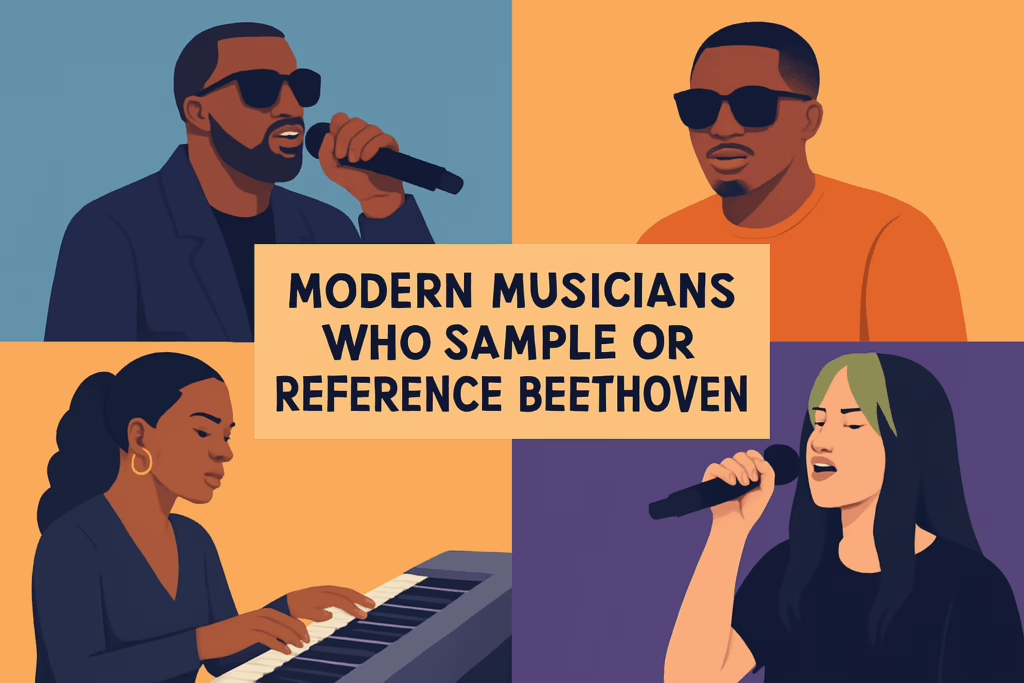
Modern Musicians Who Sample or Reference Beethoven
Modern music is a dynamic and ever-evolving art form that often incorporates elements from a diverse range of influences, including classical music. One of the most enduring classical musicians whose compositions are frequently sampled or referenced is Ludwig van Beethoven. Though he lived more than two centuries ago, Beethoven’s music continues to exert a powerful influence on contemporary artists across various genres. This phenomenon raises intriguing questions about the interrelationship between past and present music, and invites us to explore how these connections manifest in modern compositions. By delving into the ways that contemporary musicians sample or reference Beethoven’s works, we gain a deeper understanding of both the timeless quality of classical music and the creative reimagining it undergoes in the hands of today’s artists. This examination is not merely an academic exercise, but rather a meaningful exploration that reveals the universality and adaptability of Beethoven’s music. Understanding these connections can enrich our appreciation of both classical and modern music and highlight the threads that bind them together.
Beethoven’s Influence in Electronic and Hip-Hop Music
The influence of Beethoven extends beyond the classical domain, penetrating the vibrant world of electronic and hip-hop music. These genres are known for their innovative use of sampling, which involves reusing portions of existing compositions to create new works. Beethoven’s compositions, with their complex structures and emotive power, provide a rich source of material for such endeavors. Artists aim to blend the timeless depth of classical music with the modern beats of today, creating an enriched musical experience.
A notable example is the hip-hop artist Nas, who sampled a section of Beethoven’s “Fur Elise” in his song “I Can.” By incorporating the familiar piano motif, Nas not only roots his modern narrative in a classical context but also draws a connection between the aspirational themes of his lyrics and the enduring legacy of Beethoven’s music. The juxtaposition of classical elements with hip-hop rhythm in this track exemplifies how bridging these musical eras can create new meanings and emotional resonances for listeners.
Beethoven’s Presence in Rock and Pop Genres
Beethoven’s presence is also felt in rock and pop music, where his melodies and themes are often adapted and incorporated into new compositions. This cross-genre exploration reveals the versatility of Beethoven’s music, showing how its emotional depth and technical brilliance can complement a wide array of musical styles. Through referencing Beethoven, rock and pop musicians can evoke a sense of grandeur and timelessness, providing their work with added depth and resonance.
A prime example is the British rock band Electric Light Orchestra (ELO), known for integrating classical music into their work. In their song “Roll Over Beethoven,” ELO prominently features elements from Beethoven’s Fifth Symphony, merging them with rock-and-roll beats. This integration underscores the band’s commitment to blending classical passion with rock’s rebellious energy. The song acts as both a tribute to Beethoven and a statement on the evolution of music. By reimagining Beethoven’s iconic motifs within a rock framework, ELO captures the enduring vitality of his work.
Adaptations and References in Jazz
Jazz musicians have long drawn inspiration from classical music, including the works of Beethoven. The improvisational nature of jazz allows for a uniquely creative interpretation of classical pieces, transforming them into new and innovative expressions. By incorporating elements of Beethoven’s music, jazz artists engage in a dialogue with classical traditions, bridging the gap between structured compositions and freeform improvisation. This intermingling of styles underscores the idea that music is a living, evolving entity that can be continually reinterpreted.
Pianist and composer Jacques Loussier is a renowned figure in the jazz world for his ability to blend classical music with jazz improvisation. His “Play Bach” series, which includes interpretations of Beethoven, exemplifies this blend. By employing jazz rhythms and improvisational techniques, Loussier transforms Beethoven’s compositions, offering a fresh perspective while honoring the original works. This harmonious fusion provides an example of how Beethoven’s music can serve as an enduring source of inspiration across diverse genres.
The Cinematic Use of Beethoven’s Music
Beethoven’s music also finds a place in the film industry, where it is often used to underscore themes, set moods, or heighten dramatic moments. The emotive power and structural complexity of Beethoven’s compositions make them suitable for conveying a wide range of emotions and narratives within a cinematic context. The use of his music in films demonstrates the timeless appeal of Beethoven’s work and its ability to resonate across cultural and temporal boundaries.
| Film | Beethoven Composition | Scene Description |
|---|---|---|
| A Clockwork Orange | Symphony No. 9 | Features prominently in the film’s exploration of violence and redemption. |
| Immortal Beloved | Various | Uses Beethoven’s works to explore the story of his life and relationships. |
| The King’s Speech | Symphony No. 7 | Accompanies the climactic speech, adding emotional depth and urgency. |
In Stanley Kubrick’s “A Clockwork Orange,” Beethoven’s Ninth Symphony is notably used to juxtapose the film’s themes of ultraviolence and the protagonist’s search for identity. The music serves as a stark counterpoint to the chaotic imagery, imbuing the film with a sense of irony and poignancy. This example demonstrates how Beethoven’s work transcends its original context, finding new meanings in diverse narratives.
Beethoven’s Legacy in Educational and Inspirational Music Projects
Beyond traditional genres, Beethoven’s music is also utilized in various educational and inspirational music projects. These initiatives aim to make classical music more accessible and relevant to contemporary audiences, particularly younger generations. By integrating Beethoven’s compositions with modern sensibilities, educational projects can foster a greater appreciation of classical music’s significance and its potential for creative reinterpretation.
An illustrative example is the “Beethoven Rocks!” project, which reimagines Beethoven’s music within a modern context. This initiative encourages young musicians to explore and adapt Beethoven’s compositions, highlighting their continued relevance. The project not only honors Beethoven’s legacy but also empowers participants to engage with classical music in a creatively active way, demonstrating its enduring potential as a tool for innovation and inspiration.
Conclusion and Future Exploration
The exploration of modern musicians who sample or reference Beethoven provides insightful perspectives on the enduring influence of classical music in contemporary culture. By examining the ways in which artists across diverse genres incorporate elements of Beethoven’s compositions, we gain an appreciation for the timeless nature of his work and its adaptive capacity to resonate with new audiences. Whether through electronic beats, rock anthems, jazz improvisations, cinematic scores, or educational projects, Beethoven’s music continues to inspire and challenge musicians, encouraging them to explore new creative boundaries.
For readers interested in exploring these connections further, there are numerous ways to engage. Consider listening to a playlist of songs that sample Beethoven, or explore documentaries and articles detailing his influence in contemporary music. Supporting educational projects like “Beethoven Rocks!” can also provide a first-hand experience of how classical music remains relevant and innovative. By delving into the rich interconnections between Beethoven’s work and modern music, we can deepen our understanding of how the past continuously shapes and informs the present—and how this dialogue offers infinite possibilities for creative exploration.
Frequently Asked Questions
1. Why do modern musicians choose to sample or reference Beethoven in their work?
Modern musicians are drawn to Beethoven’s work for a variety of reasons. Firstly, Beethoven was a master at evoking deep emotions and creating compelling narratives through his music, which resonates strongly across diverse audiences and generations. His compositions break free from the constraints of classical structure, similar to the way modern musicians often push the boundaries of contemporary genres. This makes Beethoven’s music feel both accessible and relevant even today. Moreover, his iconic melodies and complex harmonies provide a rich tapestry for modern artists to explore, re-interpret, and blend into their music, offering a sense of timeless depth and sophistication. Additionally, referencing Beethoven can lend a sense of credibility and artistic weight to a modern artist’s work, illustrating a bridge between the old and new, and showcasing how even centuries-old music can remain influential and inspiring. Lastly, many musicians have a personal admiration for Beethoven’s resilience and passion, as his life story—overcoming adversity while creating profound art—mirrors the journey many artists experience in contemporary times.
2. How does sampling Beethoven’s music specifically enhance modern songs?
Sampling Beethoven’s music can enhance modern songs in several impactful ways. Firstly, Beethoven’s music is full of dramatic dynamics and emotional intensity which can add depth and complexity to contemporary compositions. His works often carry a certain timelessness that can invoke emotions ranging from melancholy to triumph, enhancing the listener’s experience. For instance, using one of his emotionally charged motifs can instantly elevate the emotional storyline of a song. Secondly, Beethoven’s compositions are imbued with rich textures and intricate structures that can immensely diversify the sonic palette of modern music, offering a unique contrast to repetitive or simpler beats commonly found in popular genres. Furthermore, integrating Beethoven’s well-known melodies can serve as a hook that attracts and retains listeners who have an appreciation for classical music. This kind of incorporation not only broadens a song’s audience but also introduces classical music to those who might not seek it out otherwise. Lastly, the use of Beethoven’s compositions can act as an homage, bringing historical cultural prestige to a song, creating a conversation across time between past and present musical landscapes.
3. Are there specific Beethoven pieces that are more frequently sampled or referenced by modern musicians?
Yes, there are specific Beethoven pieces that seem to resonate more prominently with modern musicians and are thus sampled or referenced more regularly. One of the most frequently sampled is “Symphony No. 5,” particularly its distinctive four-note motif. The rhythmic drive and dramatic flair of this symphony make it ripe for creative reinterpretation. Another popular choice is “Für Elise,” whose recognizable melody is often used for its soothing and somewhat nostalgic qualities. The “Moonlight Sonata” is also a favorite, especially its hauntingly beautiful first movement, which can add emotional depth and resonance to modern tracks. “Symphony No. 9,” specifically the “Ode to Joy” section, is another enduring piece, often used for its powerful message of unity and upliftment. These works not only carry musical value but also share an emotional storyline that can complement the thematic elements of modern music across various genres, from rock to hip-hop and beyond.
4. Do all modern musicians acknowledge their use of Beethoven’s music in their work?
Not all modern musicians explicitly acknowledge their use of Beethoven’s music in their work. This can vary widely depending on the intent of the sampling and the nature of the music industry practices. Some artists choose to make their influence clear as a tribute or because they wish to highlight the artistic integration of the classical and contemporary. Acknowledgement is also essential to avoid legal issues surrounding intellectual property rights. Many artists adhere to these protocols by crediting Beethoven or the public domain status of the music in their album notes or public releases. However, in certain cases, artists may use Beethoven’s work in a way that is heavily modified or part of a complex mix, making it less necessary for overt acknowledgment or simply less obvious to listeners. Moreover, classical compositions like those of Beethoven are generally not protected by copyright, given their age, but specific recordings of these works may be protected, making proper attribution a more nuanced legal issue. Despite this, many artists respect Beethoven’s legacy and acknowledge his influence, whether formally or informally, due to the immense impact his work has had on music history.
5. How do audiences typically react to the blending of Beethoven’s music with modern genres?
Audiences tend to have varied but often positive reactions to the blending of Beethoven’s music with modern genres. Many listeners appreciate the creativity and technical skill required to merge such distinct musical styles, recognizing the ingenuity involved in blending classical masterpieces with contemporary sounds. This fusion can create a unique and compelling listening experience that appeals to both classical music aficionados and fans of modern genres, fostering an appreciation across different musical communities. For some, there is a thrill in recognizing familiar Beethoven motifs within a new context, sparking interest and encouraging a re-exploration of classical music. However, there may be purists who are skeptical or critical of such integrations, feeling that the sanctity of Beethoven’s original compositions might be compromised. Nevertheless, the general trend is that this hybrid musical approach broadens musical horizons, transcending traditional genre boundaries and engaging a wide range of audiences in dialogue about the evolution and ongoing relevance of music history. Ultimately, integrating Beethoven into modern music perpetuates his legacy by keeping his compositions alive and relevant in contemporary cultural conversations.