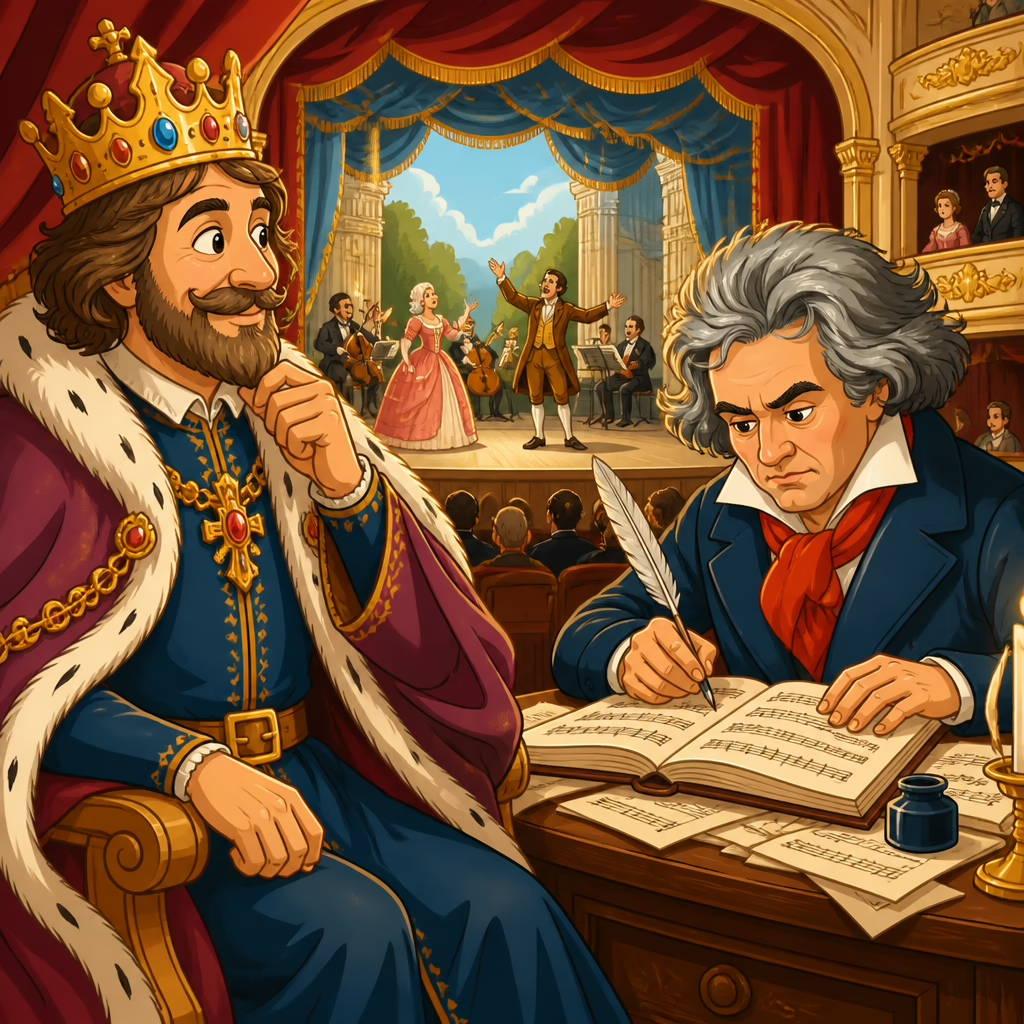
King Stephen and Beethoven’s Theater Music
King Stephen and Beethoven’s Theater Music stands at an unusual crossroads in the composer’s output: it is neither symphony nor opera, neither purely concert music nor incidental background, but a carefully designed score written to serve a staged patriotic drama. In practical terms, “theater music” means music composed for performance alongside a play, often including overtures, choruses, entr’actes, marches, and brief scene-setting numbers. Beethoven’s contribution to August von Kotzebue’s Festspiel König Stephan, cataloged as Op. 117 and first performed in 1811, belongs exactly to that tradition. Yet, like much Beethoven, it exceeds its occasion. The work was commissioned for the opening of the new German theater in Pest, then part of the Habsburg Empire, and it sought to celebrate Hungary’s founding monarch, Saint Stephen, while supporting imperial cultural policy. Understanding that context is the key to hearing the music clearly.
This score matters because it shows Beethoven operating under constraints that most listeners do not associate with him. He was writing for a civic ceremony, a political message, and a literary text by a prolific playwright he had already set in The Ruins of Athens. He had to produce music that could communicate instantly in a theater, energize spoken scenes, and flatter a multilingual audience gathered for a state occasion. I have found that when performers and listeners approach King Stephen expecting symphonic development on the scale of the Eroica, they miss the point. The strength of the work lies in its economy, color, and directness. Each number has a function: to announce, to frame, to praise, to move the drama forward. At the same time, Beethoven’s fingerprints are unmistakable in the rhythmic drive, brass writing, and sharply profiled themes.
For anyone exploring Beethoven’s stage works, King Stephen is essential because it reveals how he solved dramatic problems outside the opera house. It also helps explain why certain excerpts, especially the overture, have enjoyed a modest afterlife in the concert hall while the complete score remains less familiar. The music is tied to text, ceremony, and dramaturgy, so it can seem fragmentary when detached from its original function. But that does not make it minor. Rather, it shows Beethoven applying his craft to a specific public purpose, balancing artistic identity with commission requirements. Heard on those terms, King Stephen becomes one of the clearest examples of Beethoven’s ability to write music that is both functional and forceful.
Why Beethoven Wrote King Stephen
The immediate reason for King Stephen was political and architectural. In 1811 the authorities in Pest planned the opening of a new theater intended to strengthen German-language theatrical culture within the kingdom of Hungary. The Habsburg court wanted art to serve dynastic unity, and Kotzebue’s festival play was designed accordingly. It celebrated Stephen I, the first king of Hungary, not simply as a national hero but as a civilizing ruler whose legacy could be aligned with imperial order. Beethoven received the commission to provide music for this staged celebration, alongside music for The Ruins of Athens. That pairing is important: both scores were occasional pieces for the same opening event, and both were meant to project grandeur, legitimacy, and cultivated state power.
From a working composer’s perspective, this was a familiar kind of job but not a trivial one. Theater commissions came with deadlines, textual constraints, and practical considerations involving singers, actors, chorus, and orchestra. Beethoven had already written for the stage in Fidelio, but incidental music required a different mindset. Instead of building one sustained dramatic arc across an evening, he had to create self-contained numbers that could be inserted around spoken action. In rehearsal terms, that means cues had to be clear, tempos had to support entrances, and character had to register immediately. Beethoven understood that audiences in ceremonial theater do not wait for subtle implications; they need music to tell them where they are emotionally and politically at once.
Kotzebue’s text has never held the stage strongly on its own, and that has affected the afterlife of the score. Modern readers often find the play dutiful rather than compelling, shaped more by pageantry than by psychological drama. But dismissing the commission because of its libretto would be a mistake. Beethoven regularly elevated material through musical concentration. In King Stephen, he distilled the political message into clear sonic symbols: martial rhythm, festive brass, choral unanimity, and emphatic cadences associated with authority and public celebration. Those choices were not generic decoration. They were calculated responses to a civic event, and they explain why the work sounds so deliberately public in tone.
The Structure of the Score
King Stephen is best understood not as a single continuous composition but as a sequence of theatrical numbers serving particular moments in the play. The score includes an overture, choruses, melodramatic passages, a march, and other short sections that comment on or amplify the spoken drama. This segmented design is typical of incidental music. The overture establishes ceremonial energy before any dialogue begins. Choral movements give voice to collective identity, which is especially useful in patriotic drama because a chorus can represent a people, a court, or a ritual community. Marches and entr’actes manage transitions, signal rank, and stabilize pacing.
One reason the score can seem elusive in concert is that its numbers are purpose-built. A brief chorus may last only long enough to crown a scene with public approval. A march may exist to accompany movement on stage rather than to undergo extensive variation. Melodrama, where spoken text unfolds over instrumental accompaniment, can be particularly difficult to excerpt because its timing depends on speech. In performance preparation, this means conductors must decide whether to restore the dramatic context, use narration, or present selected orchestral and vocal numbers independently. Each choice changes how audiences perceive the work.
The overture has naturally attracted the most attention because it functions autonomously better than the other pieces. It condenses the ceremonial ethos of the whole commission into a compact orchestral statement. Still, the complete score has a logic that becomes more persuasive when heard in order. Beethoven contrasts proclamation with lyric relief, choral solidity with instrumental motion, and public grandeur with concise dramatic punctuation. That alternation is the design principle. Instead of asking whether any single number reaches the scale of a major symphonic movement, the better question is whether each number does its dramatic job. In King Stephen, the answer is consistently yes.
Musical Style: What Beethoven Emphasizes
The musical language of King Stephen is direct, extroverted, and ceremonial. Beethoven relies heavily on fanfare-like figures, firm tonic-dominant orientation, rhythmic decisiveness, and orchestral textures that project clearly in a theater. Brass and timpani carry symbolic weight. They communicate rulership, public festivity, and collective purpose faster than a more inward sonority would. Strings often provide the kinetic engine, driving phrases forward with repeated-note patterns and energized accompaniment. Woodwinds add color and occasional contrast, but the dominant impression is one of proclamation rather than introspection.
That said, the music is not merely loud or official. Beethoven’s control of contrast remains precise. He knew that pageantry without contour becomes monotonous, so he introduces dynamic terraces, registral shifts, and rhetorical pauses that sharpen attention. In the overture especially, openings of ceremonial breadth lead into more active developmental passages, then return to material that restores public poise. This pattern mirrors stage function. A festival audience needs excitement, but it also needs musical architecture that frames the occasion with dignity. Beethoven supplies both.
Harmony in this score generally serves clarity over ambiguity. Unlike late Beethoven works that thrive on remote tonal exploration and dense motivic compression, King Stephen keeps its tonal rhetoric legible. That was a practical theatrical decision. Music tied to spoken drama must not obscure the dramatic signal. A chorus praising a ruler or celebrating civic destiny needs harmonic support that reads instantly. Beethoven therefore reserves complexity for propulsion and emphasis rather than for metaphysical depth. This is one reason the piece can surprise listeners who associate him mainly with struggle narratives and monumental form: here, his discipline lies in saying exactly enough, no more, no less.
| Element | How Beethoven Uses It | Dramatic Effect |
|---|---|---|
| Overture | Compact sonata-like ceremonial opener | Establishes grandeur before the play begins |
| Chorus | Homophonic, declamatory public writing | Represents collective identity and approval |
| March rhythms | Regular pulse with brass emphasis | Signals authority, procession, and state ritual |
| Melodrama | Speech supported by instrumental underscoring | Connects music directly to plot and gesture |
| Cadential writing | Strong arrivals and emphatic closures | Makes scenes legible in the theater |
The Overture and the Best-Known Numbers
The Overture to King Stephen is the portion most often encountered today, and for good reason. It compresses the character of the entire score into a concise orchestral argument with clear ceremonial profile. The opening projects confidence immediately, using bold gestures that would have read effectively in a hall filled for an official inauguration. Beethoven then balances that broad public manner with more animated internal sections, creating momentum without losing the festive frame. The result is not a symphonic drama in miniature but a theatrical preface that knows exactly how much weight to carry.
Several choral numbers also deserve more attention than they usually receive. They demonstrate Beethoven’s skill in writing for massed voices when textual intelligibility and public impact are the main goals. The choral textures tend toward clarity rather than contrapuntal intricacy, which is entirely appropriate. In this repertory, the chorus is less an abstract musical ensemble than a civic body speaking together. That collective utterance gives the score much of its political force.
The march material in King Stephen is similarly effective because it avoids empty pomp. Beethoven’s marches almost always contain muscular rhythmic purpose; they move. On stage, that matters. Processional music must regulate physical action, from entrances to tableaux, while still sounding composed rather than utilitarian. Beethoven solved that problem better than many contemporaries. Listeners who know only the overture miss how integrated these shorter pieces are within the dramatic mechanism of the whole.
How King Stephen Fits Within Beethoven’s Works
King Stephen belongs beside The Ruins of Athens, Egmont, and Fidelio when tracing Beethoven’s relationship to theater, but it serves a narrower ceremonial function than any of them. Egmont reaches deeper into moral and psychological resistance, while Fidelio sustains full operatic conflict. King Stephen, by contrast, is a festival work, and its priorities are correspondingly compressed: legitimacy, celebration, and dramatic efficiency. That does not make it less revealing. In fact, it offers a clean view of Beethoven’s professional adaptability.
It also helps listeners understand his occasional music more broadly. Beethoven did not divide his output into “serious” masterpieces and disposable commissions as neatly as later reception history sometimes suggests. He brought craft to both. When I compare scores across his stage music, what stands out is not hierarchy but fit. He tailored methods to purpose. In King Stephen, that means memorable thematic shapes, brilliant public scoring, and formal concentration. Those qualities recur elsewhere in his catalog, including smaller forms. Readers interested in how Beethoven compresses character into short spans can also explore the piano miniatures discussed in the main guide at A Complete Guide to Beethoven’s Bagatelles, where brevity similarly demands precision.
For modern programming, King Stephen presents both opportunity and challenge. Its strongest excerpts can enrich overture-and-chorus concerts, educational programs on Beethoven’s stage music, and historically informed explorations of music for state ceremony. The challenge is context. Without explanation, audiences may hear only attractive fragments. With context, they hear a composer responding intelligently to politics, architecture, text, and public ritual. That richer hearing is what the score deserves.
Why the Work Remains Underperformed
The main reason King Stephen remains underperformed is not musical weakness but repertory fit. Full revivals require a spoken play that few companies want to stage, and excerpts outside that setting can feel incomplete unless curated carefully. There is also the overshadowing effect of Beethoven’s larger stage achievements. Presenters naturally choose Egmont or selections from Fidelio when they want dramatic Beethoven, and they choose symphonies when they want public grandeur. King Stephen sits between those categories.
Another factor is language and occasion. The work was written for a specific inauguration tied to a specific ideological moment in Habsburg Central Europe. Modern institutions are often cautious about patriotic occasional art unless they can frame it critically. Yet this very specificity makes the score valuable. It documents how major composers participated in ceremonial culture, how theaters functioned as political spaces, and how music shaped public memory. Those are not peripheral concerns; they are central to understanding nineteenth-century musical life.
Performers who approach the piece with dramaturgical intelligence can make a compelling case for it. Spoken narration, projected translations, historically informed notes, and thoughtful pairing with related Beethoven works all help. Once the audience understands that this is theater music engineered for immediate effect, the score’s strengths emerge plainly. Its concision, brilliance, and ceremonial confidence become assets rather than limitations.
King Stephen rewards close attention because it captures Beethoven in a mode that is disciplined, public, and dramatically exact. It shows him writing not for abstract posterity but for a real event, a real building, a real audience, and a real political brief. That combination produced music of striking directness: an overture that announces, choruses that unify, marches that animate, and short dramatic numbers that do their work without waste. The piece may never rival Beethoven’s most famous scores in popularity, but popularity is the wrong measure here.
Its real value lies in what it reveals. King Stephen demonstrates that Beethoven’s theatrical instincts extended beyond opera into ceremonial dramaturgy, and that he could translate ideology into sound with precision while preserving his musical identity. For listeners, the benefit of exploring it is a sharper, less simplified picture of Beethoven’s art: not just heroic and monumental, but also practical, responsive, and stage-aware. Seek out the complete score, not only the overture, and hear how effectively Beethoven turns a state commission into vivid theater.
Frequently Asked Questions
What is King Stephen, and why is it important in Beethoven’s body of work?
King Stephen is one of Beethoven’s most notable examples of theater music, a category that sits somewhat apart from the genres for which he is most famous, such as symphonies, piano sonatas, and string quartets. Rather than being conceived as a self-contained concert work, it was written to accompany a staged drama by August von Kotzebue. That makes it especially important for understanding Beethoven not only as a composer of monumental “absolute” music, but also as a practical dramatist capable of writing with specific theatrical purposes in mind.
The work belongs to a moment when music functioned as part of a larger dramatic and ceremonial experience. In this case, Beethoven’s score was designed to support a patriotic play, helping shape mood, define character, mark transitions, and intensify public themes of leadership, nationhood, and historical memory. This is what makes King Stephen so revealing: it shows Beethoven responding to text, stage action, and political context rather than creating a purely abstract musical argument.
Its importance also lies in the way it broadens our picture of Beethoven’s creative range. Listeners often encounter him through the heroic sweep of the symphonies or the inward intensity of late chamber music, but King Stephen demonstrates another side of his artistry—economical, functional, ceremonial, and dramatically direct. It confirms that Beethoven understood how music could operate in public theater as well as in the concert hall, and that he could adapt his voice to a commission without losing his distinct sense of energy, structure, and expressive purpose.
What does “theater music” mean in Beethoven’s time, and how does King Stephen fit that tradition?
In Beethoven’s era, “theater music” generally referred to music composed for use in conjunction with a stage play rather than for a standalone opera or instrumental concert. It could include an overture before the action began, entr’actes between scenes, choruses, marches, melodramatic passages, and short instrumental numbers designed to establish atmosphere or underscore important dramatic moments. Its purpose was fundamentally collaborative: the music existed to support spoken drama, ceremonial staging, and audience response.
King Stephen fits squarely within that tradition because it was not intended to function as an autonomous dramatic artwork in the operatic sense. Instead, Beethoven provided a carefully organized score made up of distinct sections that could serve the needs of Kotzebue’s patriotic drama. The music helped unify the production and elevate it beyond spoken declamation alone. It would have framed entrances, heightened emotional and political meaning, and given the work a grandeur appropriate to an official theatrical occasion.
What makes Beethoven’s contribution particularly interesting is that he treated even occasional or functional music with seriousness. He did not merely supply generic background sound. Instead, he wrote music that carries clear character and rhetorical force. The overture, choruses, and instrumental numbers have a public, ceremonial quality, but they also display Beethoven’s instinct for momentum and contrast. So while King Stephen serves a practical theatrical role, it also reflects the craftsmanship and expressive concentration that listeners associate with his larger works.
How does Beethoven’s music support the patriotic drama of King Stephen?
Beethoven’s score supports the patriotic nature of the drama by giving it ceremonial weight, emotional clarity, and a sense of public purpose. Patriotic theater in the early nineteenth century was not simply entertainment; it often aimed to instruct, commemorate, and inspire. Music was essential to that mission because it could communicate collective feeling quickly and powerfully. In King Stephen, Beethoven uses musical gestures associated with nobility, celebration, and solemn resolve to reinforce the drama’s themes of leadership, identity, and historical significance.
The overture likely would have prepared the audience for a serious and elevated subject, establishing the tone before the spoken action began. Choruses in such works often act as the voice of a community or nation, and marches or ceremonial numbers lend an unmistakably public and processional character. These elements help transform the drama from a sequence of spoken scenes into a larger civic event. Beethoven understood how to use ensemble sonority, rhythmic drive, and formal clarity to communicate ideals that an audience could immediately grasp.
Just as important, the music helps shape transitions and emotional pacing. Patriotic drama can easily become static if it relies only on speeches and historical references. Beethoven’s interludes and supporting numbers would have given the stage action momentum and variety, preventing the work from feeling merely rhetorical. His music adds color, movement, and intensity, making the patriotic message feel lived and enacted rather than simply declared. That is one reason the score remains of interest today: it shows how Beethoven could translate political and historical ideas into vivid theatrical sound.
Is King Stephen more like an opera, a symphonic work, or something else entirely?
King Stephen is best understood as something distinct from both opera and symphony, though it shares certain features with each. It is not an opera because it was written to accompany a spoken play rather than to carry a continuous sung drama. The central dramatic vehicle remained spoken text, not operatic vocal writing. At the same time, it is not simply a symphonic or orchestral composition detached from dramatic function, because each section was created to serve a particular place in a staged production.
That said, Beethoven’s instinct for structural coherence and orchestral impact means the music can sometimes feel more substantial than ordinary incidental music. The overture, in particular, often invites comparison with concert works because overtures by major composers frequently developed independent life in the repertory. Some of the choral and instrumental movements also possess enough definition and character to be appreciated outside their original dramatic setting.
So the most accurate description is that King Stephen belongs to the genre of incidental or theater music: a hybrid form in which musical pieces are linked by their service to drama rather than by the continuous architecture of a symphony or the through-composed action of an opera. This in-between quality is exactly what makes the work fascinating. It occupies a crossroads in Beethoven’s output, revealing how flexible genre boundaries could be in the early nineteenth century and how effectively Beethoven could write for a context that demanded both utility and artistic distinction.
Why does King Stephen still matter to modern listeners and readers of Beethoven?
King Stephen still matters because it expands the way we understand Beethoven as a composer and the musical culture in which he worked. Modern audiences often approach Beethoven through the idea of the solitary genius producing timeless masterpieces for the concert hall. Theater music complicates that picture in productive ways. It reminds us that Beethoven also participated in public institutions, accepted commissions, responded to literary texts, and wrote for specific events with political and ceremonial dimensions.
For listeners, the work offers a chance to hear Beethoven in a more overtly dramatic and contextual mode. Instead of building an entire world through purely instrumental development, he is shaping atmosphere in concise, purposeful numbers. That creates a different listening experience—one focused on gesture, scene, and function. It can be especially rewarding for anyone interested in how music interacts with spoken drama, nationalism, and theatrical presentation in the early nineteenth century.
For readers and scholars, King Stephen also opens a valuable window onto the relationship between art and public culture. It shows how a composer of Beethoven’s stature could contribute to patriotic theater without reducing his work to mere decoration. The score demonstrates that so-called occasional music can still carry artistic seriousness and historical importance. In that sense, King Stephen remains relevant not because it resembles Beethoven’s most famous genres, but because it reveals a lesser-known side of his imagination—adaptable, theatrical, civic-minded, and fully engaged with the demands of the stage.