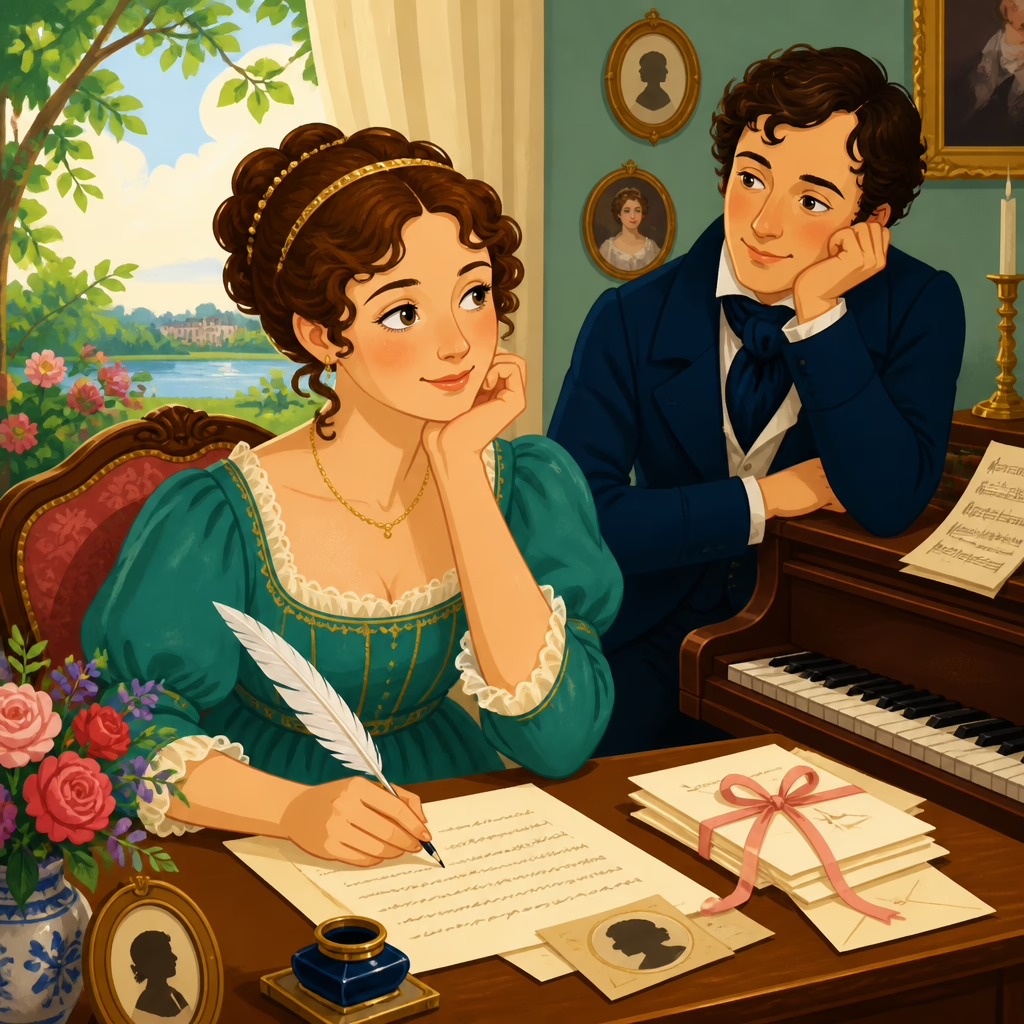
Josephine Brunsvik and the Language of Intimacy
Josephine Brunsvik occupies a singular place in Beethoven studies because her surviving letters, diary traces, and family context reveal a private vocabulary of affection that is richer, more unstable, and more historically grounded than the myths built around her. To examine Josephine Brunsvik and the language of intimacy is to ask how aristocratic convention, widowhood, property law, motherhood, and musical companionship shaped the words available to love in early nineteenth-century Vienna. The subject matters not merely because Josephine may have inspired some of Beethoven’s most personal declarations, but because the phrasing of attachment itself changes when filtered through class expectations and emotional risk. In my work with Beethoven correspondence, Josephine’s case consistently stands out: the evidence is fragmentary, yet the tone is unmistakably alive.
Josephine Brunsvik, later Countess Deym and then Baroness Stackelberg, was born into a Hungarian noble family closely connected to musical culture. She and her sister Therese studied piano with Beethoven in the late 1790s after the death of their father. Intimacy, in this context, does not mean only romance. It includes modes of address, pet names, confessional phrasing, gestures of deference, coded restraint, and the oscillation between formal and familiar language. Beethoven’s world still ran on etiquette, but letters allowed emotional experimentation. Josephine’s importance lies in how her exchanges with Beethoven show feeling pushing against social grammar. Rather than treating her simply as a candidate for the “Immortal Beloved,” a narrower and more useful approach is to read her as the woman through whom Beethoven’s intimate prose became unusually direct.
That directness emerged under pressure. Josephine’s first marriage to Count Joseph Deym placed her inside a respectable but emotionally complicated household. Deym died in 1804, leaving her a young widow with children, debts, and legal vulnerability. A noble widow could enjoy limited independence, yet any unequal marriage to a commoner threatened custody, inheritance, and social standing. Beethoven, for all his growing fame, remained socially beneath her. This imbalance is crucial. Their intimacy developed not in a vacuum of pure sentiment but in a field of consequences. Every affectionate phrase had weight. Every meeting risked interpretation. Every silence may have been strategic. When historians read their letters carefully, the language itself becomes evidence, not decoration. It shows both closeness and the barriers that closeness could not easily overcome.
Josephine Brunsvik’s social position shaped every intimate exchange
Josephine’s aristocratic birth gave her education, access, and visibility, but it also restricted her choices. Under the legal customs governing noble families in Habsburg lands, marriage was never merely personal. It affected lineage, guardianship, and estate management. After Deym’s death, Josephine’s status as a widow created a paradox. She was freer to correspond, receive visitors, and manage parts of her life than an unmarried daughter might have been, yet she was also under scrutiny because her children’s futures depended on maintaining rank. Beethoven could write passionately, but Josephine had to calculate. In practical terms, intimacy between them was never only emotional; it was administrative, legal, and reputational.
This is why scholars who reduce the relationship to a simple thwarted love affair miss the texture of the evidence. The letters suggest mutual attachment, but they also reveal asymmetry in risk. Beethoven might suffer rejection or frustration; Josephine might lose social legitimacy and maternal authority. I have found that once this imbalance is foregrounded, many disputed details become clearer. Her hesitations read less like inconsistency and more like disciplined self-protection. Even warm phrases acquire a double edge. Tenderness had to coexist with caution, and caution necessarily altered tone.
The Brunsvik family circle also mattered. Josephine’s sister Therese left memoirs that, while written later and not always reliable in chronology, preserve the atmosphere of Beethoven’s presence in the household. Musical instruction blurred into friendship, and friendship into emotional dependency. The family knew Beethoven not as a monument but as a difficult, magnetic, sometimes vulnerable man. That familiarity made intimate language possible. Yet because the relationship unfolded within a network of siblings, children, servants, and acquaintances, privacy remained porous. Josephine’s words had to survive possible discovery. That pressure helps explain the alternation between candor and reserve that marks the surviving record.
Letters reveal a private vocabulary beyond conventional politeness
The strongest case for Josephine’s significance lies in the letters. Beethoven’s notes to her include unusually ardent formulations, declarations of longing, and a habit of collapsing social distance. He writes not with the ceremonious admiration due to a noble patroness, but with urgency. Terms of endearment, references to spiritual union, and complaints about separation create a language that exceeds standard courtesy. This does not mean every phrase was unique to Josephine; letter-writing in the Romantic era often tolerated emotional intensity. But with her, intensity becomes sustained, personal, and repeatedly tied to impossible proximity. That pattern matters.
Josephine’s own surviving words are fewer and often mediated through copies or later references, which has encouraged speculation. Even so, the available evidence points to reciprocity rather than one-sided fantasy. Her phrasing suggests emotional knowledge of Beethoven’s inner life and a willingness to acknowledge mutual attachment, while stopping short of reckless declaration. This is precisely what makes the language of intimacy here so compelling. It is not blunt confession; it is negotiated closeness. The correspondence stages a relationship in which feeling seeks expression while social reality trims its edges.
One recurring feature is the movement between embodied and elevated language. Beethoven can write in a way that implies physical longing, then pivot to moral or spiritual necessity. Josephine’s situation likely encouraged that register. A love framed as soul-deep and ennobling was easier to articulate than one framed openly in sensual terms, especially for a widow guarding reputation. The result is a lexicon where transcendence is not evasive decoration but a workable form of desire. Historians should read these abstractions carefully. They often signal intensity precisely because direct naming was dangerous.
| Element in the correspondence | What it signals | Why it matters historically |
|---|---|---|
| Use of endearments | Personal bond beyond patronage | Shows collapse of formal class distance |
| References to separation | Dependence on presence and letters | Confirms an ongoing emotional relationship |
| Spiritualized language | Desire translated into morally acceptable terms | Reflects constraints on noble widowhood |
| Alternation of warmth and restraint | Mutual feeling tempered by caution | Reveals social risk embedded in style |
| Mentions of children and duty | Love entangled with practical realities | Explains why attachment did not become marriage |
Widowhood, remarriage, and maternal duty gave intimacy its limits
Josephine’s widowhood after 1804 created the period in which her connection with Beethoven appears most emotionally charged. Yet widowhood did not erase obligation. She had children to protect and financial concerns to navigate. Any marriage to Beethoven would almost certainly have been considered a mesalliance, an unequal union carrying serious consequences for aristocratic custody arrangements. This legal and familial reality gives the correspondence its tension. The lovers, if we may call them that, were not blocked by indecision alone. They were blocked by institutions.
Her later marriage to Baron Christoph von Stackelberg in 1810 is often treated as proof that Beethoven was a passing episode. The record suggests something more painful and complicated. Stackelberg offered nominal social suitability, but the marriage was troubled and ultimately unhappy. Josephine’s later diary materials indicate emotional distress, instability, and enduring conflict between desire and duty. From the perspective of intimate language, this matters because it confirms that affection was never her only criterion. She made decisions under compulsion from class logic, family pressure, and economic necessity. The words of love in her life cannot be detached from those forces.
For readers wanting broader context on Beethoven’s formative relationships and social networks, the main guide at https://lvbeethoven.com/christian-gottlob-neefe-and-beethovens-earliest-training/ helps situate how early mentorship and later patronage systems shaped his personal world. In Josephine’s case, those systems became intimate traps. Beethoven could imagine a union of hearts; Josephine had to weigh guardianship papers, noble identity, and the daily needs of children. That is why her language often feels suspended between yearning and withdrawal. It mirrors a life in which emotional truth and viable action rarely aligned.
Josephine clarifies Beethoven’s emotional prose better than legend does
Discussion of Beethoven’s private life too often gets swallowed by the “Immortal Beloved” debate, which encourages detective work at the expense of textual reading. Josephine matters even if one sets that controversy aside. Her correspondence provides the clearest sustained example of Beethoven writing from emotional exposure rather than sociable performance. When compared with letters to publishers, patrons, or casual friends, the difference is stark. Syntax loosens, impatience grows visible, and affectionate insistence replaces public self-fashioning. He does not merely report feeling; he writes as someone trying to maintain connection through language itself.
This is where Josephine becomes indispensable. She was not just a muse onto whom later generations projected sonatas and fantasies. She was a participant in a reciprocal exchange that drew out Beethoven’s most vulnerable register. The language is intimate because the relationship demanded invention. Conventional formulas were inadequate, but plain declarations were dangerous. So Beethoven developed a style of urgent compression: bursts of tenderness, appeals to destiny, reproach at absence, insistence on inward unity. Josephine’s responses, though less fully preserved, appear to have sustained that register rather than dismissing it.
Seen this way, Josephine helps interpret the emotional climate around works from Beethoven’s middle period without forcing biographical one-to-one readings. It is methodologically weak to claim that a specific phrase in a letter “explains” a specific musical theme. It is stronger to say that the correspondence documents a habit of feeling: longing intensified by interruption, devotion sharpened by impossibility, and tenderness articulated through contrast between earthly obstacles and inner certainty. Those patterns resemble the expressive world many listeners hear in Beethoven’s music, but the evidence remains strongest when kept in the realm of language.
Why historians still debate her role, and what can be stated with confidence
The debate persists because the archive is incomplete. Some letters survive only in copies, dates can be uncertain, and family memoirs were written retrospectively. Serious scholarship therefore distinguishes probability from proof. It is probable that Beethoven and Josephine experienced a deep mutual attachment. It is well supported that social inequality and her maternal responsibilities made marriage extraordinarily difficult. It remains debated how far the relationship advanced physically and whether she was definitively the addressee of the 1812 “Immortal Beloved” letter. Precision here is essential. Good history does not need absolute resolution to reach meaningful conclusions.
What can be stated firmly is that Josephine Brunsvik illuminates the language of intimacy in Beethoven’s life more clearly than almost any other figure. The evidence shows a relationship in which affection was sustained over time, shaped by legal and class constraints, and expressed through a distinctive blend of tenderness, idealization, frustration, and restraint. That blend is historically specific. It belongs to a noble widow and a bourgeois composer in Napoleonic-era Vienna, not to a timeless fairy tale. Once returned to that setting, Josephine becomes more interesting, not less.
The key takeaway is simple: Josephine Brunsvik matters because her story lets us hear how intimacy sounded when love had to pass through rank, duty, and risk. Her exchanges with Beethoven reveal not just personal feeling but the vocabulary people built when straightforward union was impossible. Read closely, the letters show affection testing the limits of decorum, and decorum reshaping affection in return. That is why Josephine remains central to any serious account of Beethoven’s emotional life. If you want to understand him beyond legend, start with the words that survived, follow their constraints as carefully as their passion, and let Josephine’s difficult clarity lead the way.
Frequently Asked Questions
Why is Josephine Brunsvik so important to understanding Beethoven’s emotional life?
Josephine Brunsvik matters because she is one of the few figures in Beethoven’s circle for whom the documentary record allows a genuinely textured view of intimacy rather than a later romantic legend. Her surviving letters, traces in family papers, and the social circumstances surrounding her life offer evidence of a relationship shaped by feeling, constraint, hesitation, and historical reality. In Beethoven studies, that is invaluable. Instead of asking only whether she fits a tidy biographical role, scholars look at how affection was expressed, concealed, negotiated, and interrupted in the world both she and Beethoven inhabited.
What makes her especially significant is that her case connects personal emotion to social structure. Josephine was not simply a beloved woman in an abstract literary sense. She was an aristocratic woman, a widow for a crucial period, a mother, and a person whose legal and financial position affected what kinds of attachment were possible. Those conditions influenced the language she could use, the risks she faced, and the meanings attached to private expressions of tenderness. For that reason, Josephine becomes central not just to the question of whether Beethoven loved deeply, but to how love itself had to be spoken in early nineteenth-century Vienna.
What does the phrase “language of intimacy” mean in the context of Josephine Brunsvik’s story?
In this context, “language of intimacy” refers to more than affectionate phrases. It includes the full range of words, tones, silences, formalities, and emotional signals through which attachment was communicated. In Josephine Brunsvik’s world, intimacy did not always appear in direct declarations that modern readers would instantly recognize. It could be embedded in forms of address, in references to shared suffering, in musical companionship, in coded emotional dependence, or in the careful balancing of propriety and longing. Reading that language requires attention to historical nuance rather than modern assumptions.
This phrase also points to instability. The vocabulary of affection available to Josephine was not fixed or transparent. Aristocratic etiquette shaped how openly one could speak. Widowhood could briefly widen emotional possibilities while also increasing practical vulnerability. Concerns about children, inheritance, and social standing could force private emotion into guarded forms. As a result, intimate language might move between warmth and caution, between candor and retreat. That shifting register is exactly what makes Josephine so compelling: her emotional world appears neither purely romantic nor purely formal, but suspended between genuine attachment and the pressures of her social position.
How did aristocratic convention and property law affect Josephine Brunsvik’s relationships?
They affected them profoundly. In Josephine’s milieu, love was never only a personal matter. Aristocratic convention governed reputation, marriageability, kinship expectations, and the acceptable limits of emotional expression. A woman of her rank did not enter relationships as a free private individual in the modern sense. Her choices were conditioned by family interests, class boundaries, and the need to preserve social legitimacy. This means that any intimate bond had to be understood alongside the public consequences it might produce.
Property law and inheritance concerns intensified those pressures. As a widow and mother, Josephine had to consider not only her own emotional life but the legal and social implications of remarriage or scandal. Questions of guardianship, control of assets, and the status of children could sharply limit her freedom. A relationship with Beethoven, however emotionally meaningful, would not have existed outside these realities. This is why the historical Josephine is more interesting than the mythic one. Her circumstances show that intimacy in her world was structured by law and class as much as by feeling. The words of affection that survive gain depth when read against those constraints, because they reveal not simply desire, but desire under pressure.
How does musical companionship fit into Josephine Brunsvik’s emotional connection with Beethoven?
Musical companionship is one of the most important dimensions of their connection because music in this period functioned as both cultural practice and emotional medium. For cultivated aristocratic circles in Vienna, music-making was woven into social life, education, refinement, and private sociability. In Josephine’s case, musical interaction with Beethoven cannot be reduced to a decorative background detail. It likely shaped the atmosphere in which intimacy developed, giving both parties a shared expressive space that did not rely entirely on straightforward verbal declaration.
That matters because music could sustain closeness where ordinary speech was constrained. A shared musical world created opportunities for admiration, influence, vulnerability, and mutual recognition. It also provided a language adjacent to words, one capable of carrying intensity without requiring every feeling to be publicly defined. For scholars, this helps explain why Josephine’s place in Beethoven studies is so distinctive. Her story is not simply about whether Beethoven loved someone; it is about how emotional life moved between letters, social ritual, domestic settings, and artistic exchange. Musical companionship becomes part of the language of intimacy itself, not merely an accompaniment to it.
Why do historians treat Josephine Brunsvik more cautiously than popular romantic narratives do?
Historians tend to be cautious because the evidence is rich but not limitless, and because Josephine’s story has often been flattened by the desire for a single dramatic conclusion. Popular narratives frequently search for a definitive muse, secret fiancée, or perfect answer to Beethoven’s emotional life. The archival record, however, points to something more complex: a relationship or set of relationships embedded in family networks, interrupted by circumstance, mediated by convention, and expressed through a historically specific vocabulary. Serious scholarship resists turning that complexity into simple certainty.
This caution is not skepticism for its own sake. It is a way of taking Josephine more seriously as a historical person. Rather than using her merely to solve a biographical puzzle about Beethoven, historians ask what her letters, family context, and life conditions reveal about gender, feeling, class, and social risk in her era. That approach produces a fuller and more convincing picture. Josephine Brunsvik emerges not as a decorative figure in a genius myth, but as a woman whose emotional language illuminates the realities of intimacy in early nineteenth-century Vienna. In that sense, caution actually makes the story more compelling, because it restores ambiguity, pressure, and human texture to a subject too often simplified.