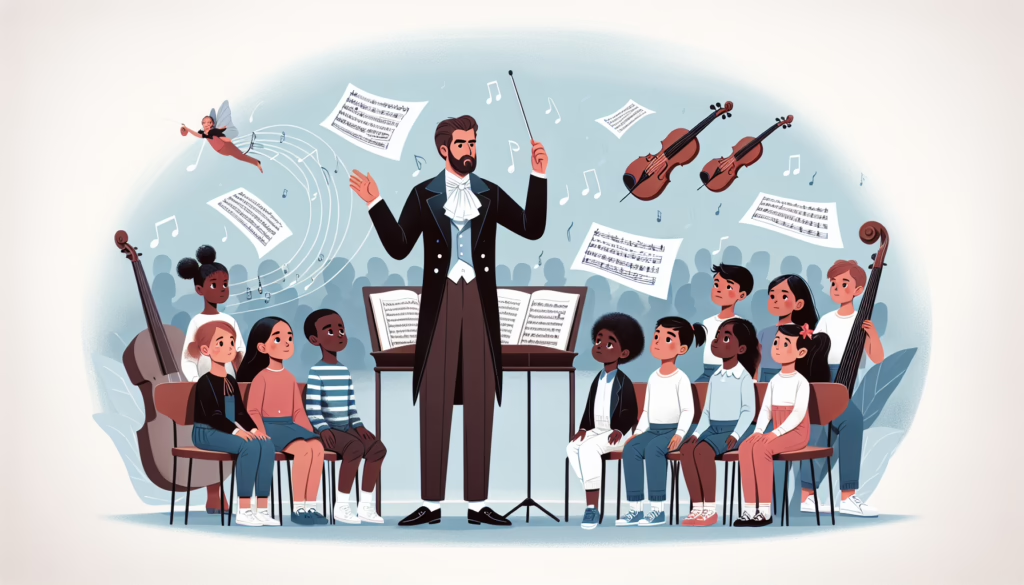
Introducing Beethoven to Children: What Works?
Introducing Beethoven to children works best when adults treat his music not as a museum object, but as a living source of rhythm, emotion, storytelling, and discovery. In classrooms, living rooms, and music studios, I have seen children respond to Beethoven most strongly when they first meet the person behind the name: a stubborn, imaginative composer who loved bold contrasts, memorable motifs, and musical jokes. For a “Beethoven in Education” hub, the key question is practical: what actually helps children listen, understand, and remember? The answer combines age-appropriate listening, movement, narrative context, creative follow-up, and repetition without pressure. Beethoven matters in children’s education because his works build listening stamina, pattern recognition, emotional vocabulary, historical awareness, and confidence with complex art. He also provides a bridge between elementary music activities and deeper study. A five-note motif from Symphony No. 5 can anchor a rhythm lesson; “Für Elise” can introduce form and familiarity; the “Ode to Joy” theme can support singing, cooperation, and cultural context. Children do not need advanced theory to connect with these works. They need entry points that feel concrete, active, and meaningful.
Before choosing activities, it helps to define the goal. Introducing Beethoven to children does not mean forcing them to admire every piece or memorize dates. It means creating repeated, positive encounters with selected works so they can identify key sounds, connect music to feeling and image, and gradually understand why Beethoven remains central in music history. “What works” is therefore broader than lesson planning. It includes repertoire selection, pacing, room setup, questioning, cross-curricular links, and how adults respond to short attention spans. It also includes knowing what does not work: long lectures, oversized biographies, and passive listening sessions with no focus task. Children are capable of serious listening, but they need structure. When teachers and parents use short excerpts, clear prompts, and hands-on reinforcement, Beethoven becomes accessible rather than intimidating. That combination makes this subject worth treating as a hub: it links listening games, composer biographies, classroom methods, family activities, concert preparation, and beginner musicianship into one coherent approach.
Start with the right Beethoven pieces
The fastest way to lose a child’s attention is to begin with a long movement that has no obvious hook. The fastest way to gain it is to choose excerpts with a clear pulse, striking contrast, or instantly recognizable theme. In practice, the most effective starting points are Symphony No. 5, first movement opening; Symphony No. 6 “Pastoral,” especially scenes that suggest nature; Symphony No. 9 “Ode to Joy”; “Für Elise”; and short passages from the “Moonlight” Sonata when the goal is mood rather than energy. These pieces work because they offer concrete listening targets. Children can hear the repeated short-short-short-long motif in the Fifth, the calm and storm imagery in the Sixth, and the singable melody in “Ode to Joy.”
Age matters. For ages four to seven, use excerpts under two minutes and focus on one idea only: loud versus soft, fast versus slow, happy versus dramatic, repeated pattern versus new pattern. For ages eight to eleven, add simple form, instrument recognition, and historical context. Middle school students can handle longer listening arcs and discussions about deafness, classical form, and how Beethoven changed expectations of what a symphony could do. When I sequence lessons, I usually start with music that invites action first, lyric singing second, and quiet concentration third. That order aligns with how most children enter unfamiliar repertoire.
Use stories, but keep them accurate
Children remember Beethoven better when his life is presented as a human story rather than a list of achievements. The useful facts are specific: he was born in Bonn in 1770, built his career in Vienna, studied earlier models such as Haydn and Mozart, began losing his hearing as a young adult, and continued composing major works despite that loss. Those points matter because they explain why his music often feels intensely driven and why his biography has become a symbol of perseverance. However, accuracy is important. Teachers should avoid turning him into a cartoon hero who “heard nothing” while writing every late masterpiece. His hearing loss was progressive and complex.
For younger children, frame biography around obstacles and choices: Beethoven had a hard childhood, worked intensely, got frustrated, loved nature, and kept creating. For older children, introduce the Heiligenstadt Testament as evidence of his emotional struggle, and explain that historians rely on letters, documented performances, and published scores rather than legend. Storytelling works best when linked directly to listening. After mentioning his love of walks outdoors, play a “Pastoral” excerpt and ask what sounds like countryside, weather, or movement. After discussing his determination, play the opening of the Fifth and ask why that rhythm feels so persistent. Biography should unlock listening, not replace it.
Turn listening into an active task
Active listening is the core method that consistently works. Children need something to do while music plays: tap a motif, raise a hand at a return, draw the shape of a melody, sort emotions, or move to changing dynamics. This is not a gimmick; it is how attention is trained. In general music classes, I have had the strongest results when every excerpt has one observable target. “Listen for the famous four-note pattern.” “Show me with your arms when the music grows louder.” “Point when the main melody returns.” These are simple tasks, but they build the habits behind close listening.
One visual organizer can help adults choose methods by age and objective:
| Age range | Recommended piece | Best entry activity | Skill developed |
|---|---|---|---|
| 4–6 | “Ode to Joy” | Sing or echo the melody with hand motions | Pitch memory and participation |
| 5–7 | Symphony No. 5 opening | Clap the motif and identify repeats | Rhythm recognition |
| 6–9 | Symphony No. 6 excerpts | Match music to weather or landscape cards | Listening for mood and imagery |
| 8–11 | “Für Elise” | Track recurring A section versus contrasting section | Basic form |
| 11–14 | Symphony No. 7, second movement | Discuss ostinato and emotional tension | Analytical listening |
Direct questions improve retention. Instead of asking, “Did you like it?” ask, “What repeated?” “What changed?” “What instrument led the melody?” “Did the ending feel finished or surprising?” These questions produce better discussion because they focus on evidence. Over time, children learn that listening is not guessing the teacher’s opinion. It is noticing, describing, and comparing what they hear. That habit supports later work in theory, performance, and music appreciation.
Connect Beethoven to movement, art, and play
Children often understand Beethoven first through the body. Movement activities are especially effective for early elementary learners because pulse, phrasing, and contrast become physical before they become verbal. Marching to the opening of Symphony No. 5, floating scarves during a lyrical phrase, freezing on cadences, or drawing broad and narrow lines to match melodic contour all make abstract musical ideas visible. Dalcroze-inspired movement methods are useful here because they translate meter, phrase length, and dynamics into space and gesture. Even a short movement task can transform a restless listening block into a focused one.
Visual art links also work well. After hearing the “Pastoral” Symphony, children can paint the difference between calm countryside and thunderstorm. After “Moonlight,” they can choose colors that match atmosphere and explain why. These responses are not about turning music into a craft project; they are about helping students externalize what they heard. In family settings, simple games are enough: “Which music sounds like sneaking, celebrating, arguing, or resting?” In school settings, pair music with vocabulary goals such as tension, release, contrast, pattern, variation, and climax. Beethoven’s writing is rich in all of them.
Teach context without overwhelming children
Historical context helps children understand why Beethoven sounds the way he does, but it must be selective. The most useful frame is that he stands between the Classical style and the Romantic expansion that followed. In plain terms, he inherited clear forms and balance, then pushed them toward stronger emotion, larger scale, and greater dramatic conflict. Children do not need a full survey of eighteenth-century Europe to grasp this. They do need a few anchors: Vienna was a major musical center; symphonies and sonatas had expected patterns; Beethoven stretched those expectations; and his influence reached composers from Schubert and Brahms to film composers who rely on motif and tension.
Named references strengthen credibility and classroom usefulness. Explain that orchestras typically perform Beethoven using modern instruments, though some ensembles use historically informed practices with period instruments and tempos shaped by scholarship. Mention that major organizations such as the Berlin Philharmonic, Vienna Philharmonic, and Cleveland Orchestra offer recordings that can serve as reliable listening sources. For classroom video, choose performances with clear camera work so children can connect sound to instruments. A conductor cueing the brass entry or a close-up of strings repeating a rhythmic cell can clarify structure more effectively than explanation alone.
Support different learners and avoid common mistakes
Not every child will respond to Beethoven in the same way, and good teaching plans for that difference. Some children connect through melody, some through narrative, some through movement, and some through instrument-focused listening. Neurodivergent learners may benefit from shorter excerpts, visual schedules, predictable transitions, and volume awareness, especially in dramatic passages. English language learners often do well with music-image matching and gesture-based prompts before abstract discussion. Beginners on piano or violin may engage more deeply when they recognize technical patterns similar to what they play in simplified repertoire.
The most common mistakes are easy to fix. First, do not overtalk. A two-minute explanation before a ninety-second excerpt is usually enough. Second, do not assign emotional meanings as if they were the only correct answer. Guide interpretation, but leave room for evidence-based difference. Third, do not begin with Beethoven’s hardest late works for general child audiences. They are profound, but they are not the best first encounter. Fourth, do not rely on worksheets alone. Paper tasks can support learning, but they cannot replace listening, singing, or movement. Finally, do not assume familiarity. Many children know “Für Elise” but cannot name it, place it, or describe it. Build from recognition toward understanding.
Make this hub a launch point for deeper Beethoven study
As a hub within Beethoven in Education, this topic should guide readers toward related articles and practical next steps. The most useful next layers are piece-specific listening guides, age-banded lesson plans, composer biography resources, classroom activities for Symphony No. 5 and “Ode to Joy,” beginner piano pathways through Beethoven themes, concert preparation checklists, and advice for talking about hearing loss in age-appropriate ways. This page matters because miscellaneous questions often bring readers in: Which Beethoven piece should I start with? How long should children listen? Is movement acceptable in classical music lessons? Can preschoolers learn Beethoven? The answer to each is yes, when the material is chosen carefully and taught actively.
Educators and parents should think in sequences rather than single exposures. Week one can introduce a motif. Week two can compare two moods. Week three can add biography. Week four can connect the music to performance, drawing, or simple composition. Repetition in new formats is what makes Beethoven stick. If this hub does its job, readers will leave with a framework: choose accessible excerpts, present accurate story context, assign focused listening tasks, use movement and art to deepen response, and scale complexity by age. Introducing Beethoven to children works when adults replace reverence with curiosity and replace passive exposure with guided discovery. Start with one strong theme, one short activity, and one thoughtful question, then build from there.
Frequently Asked Questions
What is the best way to introduce Beethoven to children for the first time?
The most effective introduction is usually not a lecture about “great music” or a long biography full of dates. Children respond much better when Beethoven is presented as a real, vivid person and his music is connected to experiences they already understand. Start with the idea that Beethoven loved strong feelings, surprises, repetition, drama, and musical storytelling. That instantly makes him more approachable. Instead of saying, “Today we are studying a famous composer,” try, “Let’s listen to music written by someone who loved turning tiny musical ideas into something exciting.” That shift matters.
It also helps to begin with short, distinctive excerpts rather than full-length works. A bold opening motif, a sudden dynamic contrast, or a passage with a clear mood gives children something to notice right away. Ask simple but meaningful questions: Does this sound brave, sneaky, stormy, funny, or peaceful? Can you tap the rhythm? Can you hear a pattern returning? Beethoven is especially effective for beginners because so much of his music is built from memorable ideas that children can recognize quickly.
Another strategy that works well is to link listening with action. Let children march, draw, conduct, clap, or invent a story while they listen. Beethoven’s music often invites movement and imagination, which makes it ideal for active engagement. When children are physically and emotionally involved, the music stops feeling distant and starts feeling alive. In practice, the best first introduction is simple, energetic, and personal: meet the man behind the name, hear a short striking example, and invite children to respond with their bodies, words, and imagination.
Which Beethoven pieces tend to work best for children?
The pieces that work best are usually those with clear character, strong rhythm, memorable motifs, and immediate emotional contrast. Children generally connect most easily with music that gives them something obvious to latch onto after a single hearing. That is why famous excerpts can be genuinely useful in education when they are used thoughtfully rather than mechanically. The opening of Symphony No. 5 is a classic example because the rhythm is unmistakable and easy to imitate. It gives children a quick sense of Beethoven’s gift for building big musical experiences from small ideas.
Other effective choices include the “Ode to Joy” theme from Symphony No. 9, which is singable, uplifting, and easy for groups to learn; the first movement of the “Moonlight” Sonata, which can open conversations about mood, atmosphere, and quiet intensity; and excerpts from the “Pastoral” Symphony, especially when exploring nature, weather, and musical scene-painting. Short passages from Für Elise also work well because many children recognize it, and its opening is accessible enough to encourage curiosity rather than intimidation. Even selections from Beethoven’s more dramatic works can be successful if they are introduced in brief, focused ways.
The key is not choosing “easy” music in a simplistic sense, but choosing music with a strong entry point. Children do not need watered-down Beethoven. They need Beethoven that has been framed well. A good excerpt should offer a rhythm to tap, a melody to remember, a mood to name, or a story to imagine. When adults choose pieces for those qualities, rather than simply for historical importance, children are much more likely to form a real connection.
How can parents and teachers make Beethoven engaging instead of intimidating?
The most reliable way is to replace passive explanation with active discovery. Beethoven becomes intimidating when adults present him as a monument to admire from a distance. He becomes engaging when children are invited to notice things for themselves. Instead of emphasizing complexity, focus on curiosity: What pattern do you hear? Where does the music get louder? Does this part sound like a joke, a storm, a celebration, or an argument? Questions like these make children participants rather than spectators.
Context also matters. Children are often intrigued by Beethoven’s personality: he was determined, unconventional, expressive, and full of big ideas. They are interested in the fact that he experimented, took risks, and sometimes surprised his listeners. Framing him as a bold creative thinker helps children see that classical music was once new, provocative, and alive. That perspective removes some of the formal stiffness that adults sometimes bring into the room. Children do not need to be told they are listening to something important before they are allowed to enjoy it. Enjoyment is often the doorway to importance.
Practical methods make a big difference as well. Use short listening windows. Repeat excerpts over several days instead of expecting instant deep concentration. Pair the music with drawing, storytelling, movement, or simple rhythm games. Let children conduct a crescendo or invent titles for contrasting sections. Compare two short passages and ask which one feels more playful or more powerful. All of these strategies help Beethoven feel like something to explore, not something to “get right.” The goal is not to force reverence. The goal is to create familiarity, confidence, and a sense of discovery.
At what age can children start appreciating Beethoven?
Children can begin appreciating Beethoven much earlier than many adults assume, but appreciation should be understood in developmentally realistic terms. A preschooler may not follow sonata form or understand Beethoven’s historical significance, but that child can absolutely respond to pulse, contrast, mood, repetition, and energy. In other words, the foundations of appreciation begin very young. A child who laughs at a musical surprise, sways to a lyrical theme, or recognizes a returning motif is already engaging meaningfully with Beethoven.
As children grow, the way they connect will change. Younger children often respond best through movement, imagery, and emotional labeling: fast or slow, loud or soft, happy or stormy. Primary-age children can begin noticing structure, character, and recurring ideas. Older children may become interested in deeper questions: Why does this music feel tense? How does Beethoven build excitement? What made his style different? Adolescents, especially, can connect strongly with Beethoven’s intensity, struggle, independence, and determination when those themes are presented honestly and without overstatement.
So the better question is not whether a child is “old enough” for Beethoven, but what kind of introduction suits that child’s stage of development. A four-year-old may need a one-minute excerpt and a movement activity. A nine-year-old may enjoy identifying motifs and drawing story scenes. A teenager may be ready for longer listening and discussion about artistic voice. Beethoven can meet children at many ages, provided adults adapt the method. Appreciation is not a single event; it is a gradual relationship built through repeated, meaningful encounters.
What practical activities help children connect with Beethoven’s music most effectively?
The most successful activities are the ones that make listening active, social, and creative. Rhythm imitation is one of the strongest starting points, especially with Beethoven, because so much of his music is driven by memorable rhythmic energy. Have children clap or tap a short motif, then listen for it inside the music. This immediately sharpens attention. Movement activities are equally powerful: marching to a steady beat, freezing when the music changes, conducting dynamics, or using scarves to trace musical shapes can help children feel structure with their whole bodies.
Story-based listening also works exceptionally well. Invite children to imagine characters, weather, landscapes, or emotional scenes while hearing an excerpt. Beethoven’s contrasts naturally support this approach. One section may sound like a hero entering, another like a storm gathering, another like a peaceful walk. Drawing while listening is another highly effective practice, especially for children who think visually. Ask them to use lines, shapes, and colors that match the music, then discuss why they made those choices. This deepens both attention and vocabulary without making the experience feel overly academic.
For classrooms and home settings alike, comparison activities are useful. Play two excerpts and ask which one sounds more energetic, more mysterious, more playful, or more determined. Singing simple themes such as “Ode to Joy” helps children internalize melody and phrasing. Older children can experiment with composing their own short motifs and “developing” them, which offers a hands-on glimpse into Beethoven’s creative method. Across all ages, the most effective activities share one principle: they turn children from passive hearers into active meaning-makers. When children get to move, imagine, predict, imitate, and create, Beethoven becomes not just understandable, but genuinely compelling.