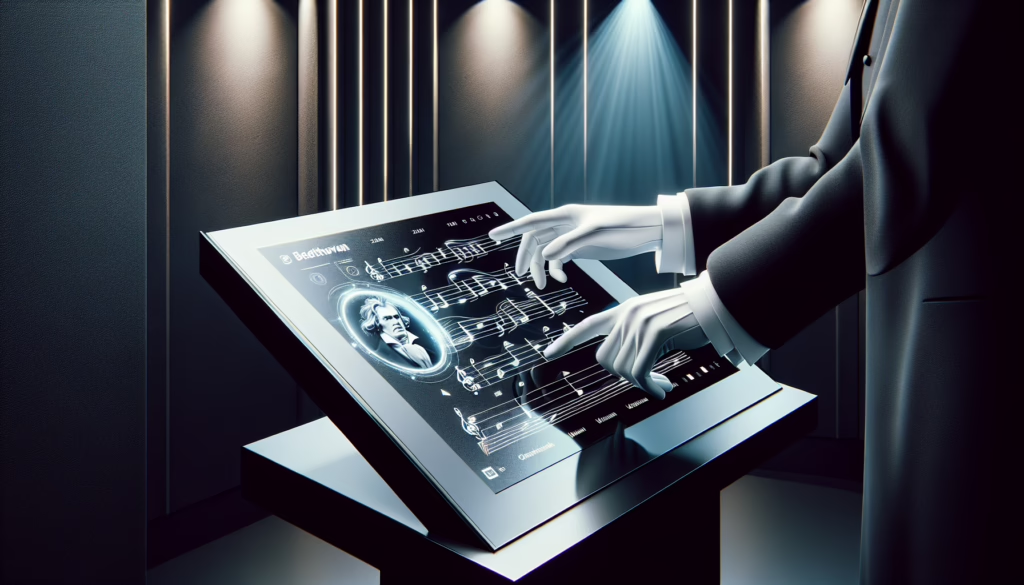
Interactive Exhibits That Bring Beethoven’s Legacy to Life
Interactive exhibits that bring Beethoven’s legacy to life do more than display manuscripts behind glass; they turn a towering composer into a vivid, approachable presence through sound, touch, movement, and story. In museum practice, an interactive exhibit is any installation that asks visitors to do something active—listen through a mixing console, compare versions of a sketch, trigger a projection, assemble an orchestral score, or explore a digital map—instead of simply reading a label. For Beethoven collections, that distinction matters. His life intersects with themes that visitors immediately recognize: artistic genius, disability, political upheaval, technological change, celebrity culture, and the ongoing afterlife of great music in film, education, and performance.
As someone who has worked with interpretation plans for music collections, I have seen a consistent pattern: visitors engage more deeply when they can connect abstract musical history to concrete actions. A facsimile score becomes meaningful when a touchscreen lets a guest isolate a motif from the Fifth Symphony and hear how Beethoven transforms it. A hearing trumpet becomes more than an object when paired with an audio station that simulates the difference between normal hearing, tinnitus, and profound hearing loss. The point is not novelty for its own sake. Effective interactivity clarifies context, lowers barriers for first-time visitors, and gives returning audiences reasons to stay longer.
This hub article covers the broad range of miscellaneous interactive approaches used across Beethoven collections. That includes digital listening stations, replica handling objects, immersive rooms, conservation-friendly facsimiles, educational family interactives, accessibility-centered design, and data-rich collection interfaces. It also addresses a practical question many institutions face: how can a museum honor the integrity of historic material while creating experiences that feel contemporary? The answer usually lies in pairing scholarly rigor with intuitive design. Beethoven’s legacy is especially suited to this treatment because his work survives in multiple forms—autograph manuscripts, first editions, instruments, portraits, letters, conversation books, and performance traditions—each capable of supporting a different kind of participation.
For readers exploring Beethoven collections as a whole, this page serves as a sub-pillar hub for the miscellaneous category: the installations, tools, and interpretive formats that do not fit neatly into manuscripts, instruments, or biography alone, yet often make those core areas accessible. If you are planning an exhibition, researching visitor engagement, or simply deciding which museums and archives offer the richest Beethoven experience, understanding these interactive models will help you assess what truly brings the composer’s world to life.
Why interactivity works so well for Beethoven collections
Beethoven is uniquely adaptable to interactive interpretation because his legacy is multisensory and process-driven. Unlike a painter, whose final canvas is the central artifact, a composer leaves traces across draft pages, corrected proofs, annotated parts, instruments, rooms, letters, and performances. Visitors often struggle with silent documents unless interpretation reveals how they functioned. Interactivity bridges that gap by showing composition as a sequence of decisions. A digital layer can highlight erased measures in a sketchbook, then immediately play the revised phrase. That simple comparison teaches visitors more about Beethoven’s craft than a wall text summarizing “he revised extensively.”
Another reason interactivity works is that Beethoven’s life invites direct questions: What did he hear as his deafness progressed? How did he compose when hearing loss became severe? Why do multiple versions of works exist? What was Vienna like during the Napoleonic era? Well-designed exhibits answer these questions in plain terms. In my experience, visitors respond especially well when museums avoid mythmaking. Rather than presenting Beethoven as a solitary genius floating above history, the strongest installations place him inside networks of publishers, patrons, instrument makers, copyists, and performers. Interactivity makes those networks visible by letting users follow routes between people, places, and objects.
It also supports a wider age range. Adults may be drawn to manuscript comparison tools, while younger visitors engage through rhythm games, conducting stations, or build-an-orchestra interactives. If those experiences are grounded in authentic collection material, they can serve both scholarship and public access. This is where miscellaneous exhibit design becomes important: the best Beethoven hubs combine serious content with flexible formats rather than assuming every visitor learns in the same way.
Core exhibit formats that make Beethoven understandable
The most effective interactive exhibits usually fall into a few repeatable formats. Listening stations remain foundational because Beethoven’s legacy is inseparable from sound. The strongest versions let visitors do more than press play. They isolate instruments, compare tempos, switch between period and modern instruments, and follow synchronized notation. Institutions using software layers inspired by digital audio workstation logic—muting tracks, highlighting themes, or looping passages—help nonmusicians understand orchestration and form without requiring music theory training.
Touchscreen manuscript explorers are equally valuable. High-resolution imaging now allows visitors to zoom into paper texture, ink color, corrections, and stitching in bound sketchbooks. When paired with short annotations, this approach makes conservation-grade detail legible to the public. The best interfaces avoid clutter and answer immediate questions: what is this document, why does it matter, and what should the visitor notice first? A strong example is a comparative display that shows a rough sketch beside a fair copy and then links both to the final performed passage.
Replica handling stations solve a major preservation challenge. Original manuscripts, instruments, and personal accessories cannot withstand repeated touching, but replicas can provide physical understanding. Visitors grasp the size of a quill, the mechanics of an early nineteenth-century keyboard, or the awkward shape of an ear trumpet in seconds. For Beethoven collections, these tactile moments are not gimmicks; they explain working conditions. Once a guest feels the weight and reach of a fortepiano action compared with a modern piano, interpretive text about articulation becomes much easier to understand.
Immersive environments have a role too, especially when carefully restrained. Projection rooms recreating Vienna streets, salon concerts, or premiere settings can be powerful if they remain anchored in documented sources. When immersive media drifts into generic “classical mood” imagery, it weakens trust. The standard I recommend is simple: every atmospheric choice should be traceable to a historical question or collection object.
Examples of interactive strategies museums and archives use
Across music museums and memorial houses, successful Beethoven interpretation often blends several media in one visitor journey. A guest might begin with a timeline wall, move to a listening console, handle a replica object, and then enter a room where projection and narration reconstruct a key event such as the 1808 marathon concert in Vienna. That sequencing matters because it gradually builds confidence. Visitors first get orientation, then evidence, then immersion.
Conversation books offer especially rich possibilities. Because Beethoven used notebooks for communication later in life, digital facsimiles can show how social exchange worked around deafness. An exhibit might present a page, transcribe the handwriting, identify speakers, and connect the discussion to a piece being composed at the time. This turns a manuscript artifact into a social document. Likewise, map-based interactives can plot Beethoven’s residences, publishers, rehearsal venues, and patron networks. Instead of memorizing dates, visitors see how geography shaped production and reputation.
Family galleries often use rhythm and motif games. These work best when they are directly tied to real compositions rather than generic music play. For example, a station can ask visitors to assemble the opening rhythm of the Fifth Symphony, then demonstrate how Beethoven develops that idea across movements. Another can compare a theme from the “Eroica” Symphony in reduced piano form versus full orchestra. Such interactives turn listening from passive reception into pattern recognition, which is exactly how many people begin to appreciate classical music.
| Interactive format | What visitors do | Why it works for Beethoven |
|---|---|---|
| Listening console | Compare recordings, isolate instruments, follow themes | Reveals structure, orchestration, and interpretation differences |
| Manuscript touchscreen | Zoom, annotate, compare draft and final versions | Shows Beethoven’s revision process clearly |
| Replica handling station | Touch quills, ear trumpets, keyboard components | Explains daily working conditions and disability history |
| Map or timeline interactive | Trace residences, premieres, patrons, publishers | Places music inside Vienna’s political and social landscape |
| Conducting or rhythm station | Lead a digital ensemble or build motifs | Makes musical form legible to beginners and families |
Accessibility, authenticity, and the challenge of interpretation
The strongest interactive exhibits about Beethoven address accessibility as a central design principle, not an afterthought. That is especially important because deafness is so prominent in his biography. Museums should resist simplistic simulations that reduce hearing loss to a sensational experience. Better practice uses layered interpretation: brief audio demonstrations, clear medical and historical context, captioned media, transcripts, induction loops, tactile elements, adjustable volume, and seating for longer listening tasks. Accessibility also means designing for visitors with limited musical background. Plain-language labels, concise definitions of terms like motif or opus, and multilingual interfaces consistently improve engagement.
Authenticity is the other critical issue. Interactive exhibits can distort history if they overdramatize uncertain events or imply more evidence than survives. I have seen installations claim to reproduce exactly what Beethoven heard, when the honest answer is that no reconstruction can be definitive. Responsible interpretation states its limits. It can say, for instance, that an audio model draws on current audiology research about sensorineural hearing loss, tinnitus, and historical descriptions, but remains an approximation. That transparency builds trust rather than diminishing impact.
There is also a conservation dimension. Original paper is light-sensitive, bindings are fragile, and instruments may be too delicate to play. This is why facsimiles, digital surrogates, and periodic rotation schedules matter. The best Beethoven collections explain these choices to visitors. When people understand that a touchscreen image protects an autograph manuscript from damage while allowing closer study than a case display ever could, they usually see digital interpretation as a gain, not a compromise.
How a hub page on miscellaneous Beethoven exhibits should guide readers
Because this article sits within a broader Beethoven collections hub, its job is not merely to describe exhibits but to orient readers toward deeper subtopics. A strong miscellaneous page should connect outward to related content on manuscripts, instruments, memorial houses, archives, portraits, and educational resources. It should help readers identify what kind of experience they want. Are they looking for family-friendly museum interactives, scholar-focused digital archives, immersive memorial house installations, or accessibility-driven interpretation? Those are different needs, and the hub should name them clearly.
It should also set expectations about quality. Not every interactive exhibit is equally useful. The best ones are tied to documented objects, answer specific visitor questions, and make interpretation easier without replacing the artifacts themselves. Weak examples rely on touchscreen novelty, oversized projections with little substance, or games disconnected from Beethoven’s actual works. Readers benefit from criteria they can apply when comparing institutions: depth of collection integration, quality of audio, clarity of scholarship, multilingual support, accessibility features, and whether the exhibit encourages genuine listening instead of hurried button pressing.
For curators and collection managers, this hub perspective has another benefit. It shows that miscellaneous interpretation is not secondary. In many Beethoven exhibitions, these tools are what unlock the rest of the collection. A first-time visitor may come for a famous name, but they stay when an interactive explains why a corrected phrase, a damaged hearing device, or a conversation-book page matters. That moment of understanding is where legacy becomes lived experience.
Interactive exhibits that bring Beethoven’s legacy to life succeed when they transform evidence into understanding without diluting historical truth. They let visitors hear revision, see networks, handle replicas, navigate places, and confront the realities of disability and artistic labor. In practical terms, the best formats are clear and repeatable: listening consoles, manuscript explorers, tactile stations, mapped biographies, and immersive rooms grounded in documented sources. Each one answers a concrete question visitors already have and connects that answer to real collection material.
For museums, archives, and memorial houses, the lesson is straightforward. Interactivity works when it serves the object, the story, and the visitor at the same time. For readers exploring Beethoven collections, this miscellaneous hub is the place to identify which institutions use those tools well and which subtopics you want to explore next. If you are building an exhibition, evaluating a museum, or planning a research trip, use these standards as your guide: authenticity, accessibility, interpretive clarity, and meaningful participation.
Beethoven’s legacy remains powerful because it is not frozen in the nineteenth century. It continues to be performed, debated, digitized, taught, and reinterpreted. The right interactive exhibit makes that continuity visible. Explore the related pages in this Beethoven collections series, compare how different institutions present the material, and use this hub to find the experiences that turn admiration into real understanding.
Frequently Asked Questions
What makes an exhibit about Beethoven “interactive” rather than traditional?
An interactive Beethoven exhibit invites visitors to participate instead of simply observe. In a traditional display, you might see a manuscript, a portrait, or a period instrument accompanied by a label. In an interactive setting, the same material becomes a starting point for action: visitors can isolate instrumental lines through a listening station, compare draft passages from a score, trigger projected annotations, explore Beethoven’s travels on a digital map, or manipulate sound to understand how a motif develops across a movement.
This matters because Beethoven’s music was built through process, experiment, revision, and performance. Interactivity helps reveal that process in ways a static display cannot. A touchscreen that layers sketches over a final score can show how an idea evolved. A conducting simulation can demonstrate tempo, balance, and emotional shape. A reconstruction of a Viennese salon with spatial audio can help visitors hear chamber music as Beethoven’s contemporaries might have experienced it. These tools make the composer’s world feel active and human rather than distant and monumental.
Just as importantly, interactivity broadens access. Not every visitor reads music fluently or arrives with deep knowledge of classical history. Hands-on stations, responsive media, tactile models, and guided listening experiences translate complex ideas into direct experience. Instead of telling visitors that Beethoven was innovative, an interactive exhibit lets them hear, test, and discover why that innovation mattered. The result is usually stronger engagement, better memory retention, and a more personal connection to Beethoven’s legacy.
How do interactive exhibits help visitors understand Beethoven’s music and creative process?
Beethoven’s reputation can sometimes make him seem intimidating, but interactive exhibits are especially effective at breaking down that barrier. They show that his masterpieces did not appear fully formed; they emerged through relentless drafting, revision, experimentation, and problem-solving. For example, a digital manuscript station can allow visitors to zoom in on crossings-out, insertions, and rewritten phrases. That kind of close comparison makes the labor of composition visible and helps audiences understand Beethoven as a working artist refining ideas over time.
Listening-based interactives are equally powerful. Many visitors know the opening of the Fifth Symphony or the “Ode to Joy” theme, but fewer understand how Beethoven builds tension, transforms motifs, or creates contrast across an entire work. A mixing console or layered audio station can let visitors mute and unmute strings, winds, brass, or voices to hear how individual parts contribute to the whole. When audiences can isolate a rhythmic pattern or melodic fragment and then hear it reappear in altered form, Beethoven’s compositional logic becomes much easier to grasp.
Some of the most memorable exhibits also combine biography with musical analysis. Visitors may trace a timeline linking major works to key moments in Beethoven’s life, including his move to Vienna, changing patronage networks, public performances, and the onset of hearing loss. When historical context is paired with participatory media, the music gains emotional and intellectual depth. Instead of receiving facts passively, visitors experience how Beethoven’s circumstances, ambitions, and artistic risks shaped the works that define his legacy today.
Can interactive exhibits address Beethoven’s hearing loss in a meaningful and respectful way?
Yes, and they should. Beethoven’s hearing loss is central to public understanding of his life, but it needs to be presented carefully, with historical accuracy and human sensitivity. Strong interactive exhibits avoid reducing him to a single dramatic fact. Instead, they use immersive tools to help visitors understand the practical, artistic, and emotional implications of progressive hearing loss while also emphasizing Beethoven’s agency, discipline, and continued creative achievement.
One effective approach is simulation-based listening. Exhibits may offer controlled audio experiences that demonstrate how certain frequencies or textures become difficult to perceive under different hearing conditions. When designed responsibly, these stations do not claim to replicate Beethoven’s exact experience with certainty. Rather, they help visitors think more concretely about what it might mean for a composer and performer to navigate sound differently over time. This can be paired with contextual materials such as letters, conversation books, and medical theories from the period to ground the experience in documented history.
Respectful interpretation also includes showing how Beethoven adapted. Interactive displays can explore the use of sketchbooks, his communication methods, the role of collaborators and copyists, and the ways he continued to imagine music internally. This shifts the narrative from tragedy alone to resilience, invention, and artistic endurance. For modern audiences, that balance is essential. It creates empathy without sensationalism and highlights why Beethoven’s late works in particular continue to inspire fascination: they are not only great compositions, but also extraordinary examples of creative persistence under profoundly challenging circumstances.
What kinds of technology are commonly used in exhibits that bring Beethoven’s legacy to life?
Museums and cultural institutions use a wide range of technologies to make Beethoven’s life and music more immediate. Touchscreens are among the most common, often used for manuscript exploration, timelines, and score comparisons. Spatial audio systems are especially valuable in music exhibitions because they let visitors hear the placement and interaction of instruments in a way that approximates live performance. Projection mapping can animate historical rooms, concert settings, or pages of notation, while motion sensors can trigger visual or sonic responses as visitors move through a gallery.
More advanced installations may include digital mixing stations, immersive sound domes, augmented reality overlays, and gesture-based interfaces. A visitor might point a device at a fortepiano and see an interpretive layer explaining how Beethoven composed or performed on similar instruments. Another exhibit may use a large-scale interactive wall where touching a city on a map reveals concerts, patrons, political events, and works associated with that place. In educational settings, game-like modules can ask visitors to assemble an orchestra, arrange sections of a score, or match sketches to finished passages.
The best technology, however, does not distract from the subject. It serves interpretation. In a successful Beethoven exhibit, digital tools clarify music, history, and creative process rather than competing with them. Good design also accounts for different visitor needs by including captions, multiple language options, adjustable volume, tactile components, and intuitive navigation. When technology is thoughtfully integrated, it deepens understanding and makes Beethoven’s world accessible to experts, students, families, and first-time museumgoers alike.
Why do interactive Beethoven exhibits matter for modern audiences, especially younger visitors?
Interactive exhibits matter because they translate Beethoven’s significance into forms people can actively experience. For many visitors, especially younger audiences, classical music history can feel remote if it is presented only through dates, portraits, and formal labels. Interactivity changes that relationship. It invites curiosity, experimentation, and discovery. A student who might not respond to a paragraph about symphonic form may become deeply engaged by building a musical texture layer by layer, comparing different interpretations of the same passage, or stepping into a projected performance environment.
These exhibits also support different learning styles. Some visitors learn best by reading, others by listening, moving, touching, or comparing visual patterns. Beethoven’s legacy is especially well suited to multi-sensory interpretation because his work spans sound, notation, performance practice, biography, politics, and cultural memory. Interactive design can connect all of those dimensions. It can show that Beethoven was not just a “great composer” frozen in history, but a person shaped by his time who still speaks powerfully to questions of struggle, ambition, innovation, and artistic freedom.
For younger visitors in particular, interactivity can be the bridge between recognition and relevance. Many already know snippets of Beethoven’s music from films, school, advertising, or popular culture, even if they do not realize it. Exhibits that let them remix themes, conduct virtual ensembles, explore animated manuscripts, or enter historically grounded story worlds help convert that familiarity into genuine understanding. In doing so, they preserve Beethoven’s legacy not as a static monument, but as a living cultural conversation that continues to evolve with each new generation.