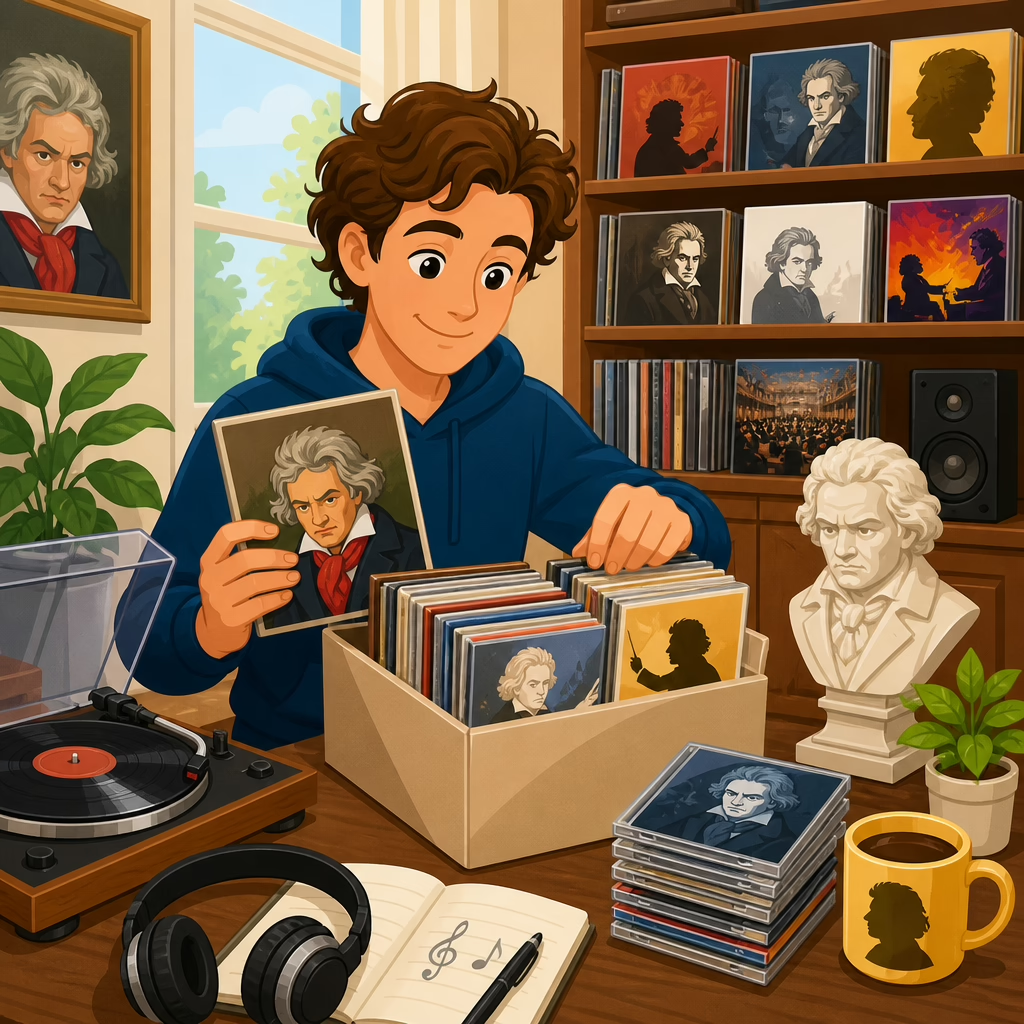
How to Build a Personal Beethoven Recording Library
Building a personal Beethoven recording library is one of the most rewarding ways to turn casual listening into informed, lasting musical understanding. A recording library is not just a pile of discs, files, or bookmarked streams. It is a deliberately chosen set of performances that lets you hear how conductors, pianists, quartets, engineers, and recording eras shape Beethoven’s music in radically different ways. In practical terms, a personal Beethoven recording library should help you answer recurring listener questions: Which performance best introduces a work? Which recording reveals inner detail? Which interpretation reflects period instruments, modern symphonic weight, or a distinctive solo voice? When chosen well, your library becomes both a listening archive and a comparative tool.
The phrase Beethoven recording library can mean several things, so it helps to define the scope at the start. First, there is repertoire coverage: symphonies, piano sonatas, string quartets, piano concertos, overtures, violin sonata cycles, cello sonatas, chamber works, sacred music, and opera. Second, there is interpretive range: historically informed performances, mainstream modern recordings, older reference versions, and idiosyncratic outliers. Third, there is format: physical media such as CD, SACD, and vinyl, or digital ownership through lossless downloads and local files, supplemented by streaming for exploration. A strong library balances all three. It gives you enough breadth to know the canon, enough variety to hear interpretive choices, and enough organization that you can actually use what you own.
This matters because Beethoven is unusually sensitive to performance decisions. Tempo, articulation, vibrato, orchestral size, observed repeats, pedal usage, bow weight, and microphone placement can transform the character of the same score. I have built and rebuilt Beethoven shelves over years of listening, ripping discs, comparing remasters, and replacing “complete” bargain boxes with better targeted versions. The lesson is simple: completeness alone does not create understanding. What creates understanding is curating a library that lets you compare like with like, hear contrasts clearly, and return to benchmark performances over time. If you build the collection methodically, you avoid duplication that adds little value, save money, and end up with a library that deepens every future listen.
Start with a framework, not a shopping spree
The best way to build a personal Beethoven recording library is to begin with a framework of listening goals. Ask what you want the collection to do for you over the next five years. If you are primarily interested in orchestral Beethoven, start with the symphonies, overtures, and concertos. If your center of gravity is keyboard music, make the piano sonatas and concertos your foundation. If you value intimacy and structural subtlety, the quartets, violin sonatas, and cello sonatas may deserve priority. A focused plan prevents the common mistake of buying a giant “complete Beethoven edition” before you know which performances actually suit your ears.
I recommend dividing the library into four tiers. Tier one is core reference recordings: dependable versions you can return to repeatedly. Tier two is contrast recordings: performances that differ in approach, such as period instrument versus modern orchestra. Tier three is historical documents: older recordings whose importance outweighs sonic limitations. Tier four is exploratory additions: single performances acquired because they illuminate a specific question, movement, or artist. This structure keeps the collection purposeful. It also makes buying decisions easier, because every new acquisition must fill a defined role instead of simply increasing volume.
Set format standards early. For serious listening, lossless audio matters more than most beginners realize. CD-quality FLAC or ALAC preserves orchestral texture, piano decay, and hall ambience better than compressed files. Streaming is excellent for discovery, but catalogs change, metadata is often inconsistent, and favorite versions can disappear. If a Beethoven performance becomes central to your listening, buy it in a stable format. Good library builders treat streaming as a testing ground and ownership as commitment.
Choose core repertoire in an order that encourages comparison
You do not need every Beethoven work at once. Build in layers that make comparisons natural. The most efficient first layer is the nine symphonies, the five piano concertos, a set of selected piano sonatas, and several late string quartets. These groups are recorded frequently, interpreted very differently, and discussed widely enough that you can cross-check your impressions with criticism and liner notes. They teach your ear quickly. The symphonies reveal orchestral style and tempo philosophy. The concertos show how soloist and conductor negotiate scale and rhetoric. The sonatas expose phrasing, touch, and pedaling. The quartets sharpen your sense of ensemble balance and structural tension.
Within each category, acquire recordings that create meaningful contrast. For the symphonies, one modern-instrument cycle and one historically informed cycle are ideal. For piano sonatas, do not begin by chasing completeness from multiple artists. Start with one complete cycle and a handful of singled-out discs by another pianist whose approach differs strongly. For quartets, one modern ensemble and one group with leaner textures or more overt rhetorical edge can teach more than three similar sets. When you later add Missa solemnis, Fidelio, the violin concerto, or the bagatelles, they will fit into a listening method you already understand.
If symphonies are your entry point, this guide on how to compare Beethoven symphony cycles like a critic gives a strong framework for hearing differences in tempo, balance, and orchestral character. Use that same comparative habit across the rest of your library. The point is not to crown one “best” recording forever. The point is to hear what each performance clarifies.
Balance modern, period, and historical interpretations
A Beethoven library should never represent only one interpretive school. Modern-instrument performances often provide tonal richness, blended orchestral sonority, and large-scale momentum. Historically informed performances usually bring sharper articulation, lighter bass weight, faster transitions, and attention to Beethoven’s metronome debates, repeat structures, and orchestral transparency. Historical recordings, especially from the mono and early stereo eras, can preserve phrasing traditions and dramatic instincts that newer performances sometimes smooth away.
In practice, this means pairing unlike with unlike. A listener who owns only a plush late twentieth-century symphony cycle may never hear how combustible the Eroica can sound with reduced vibrato and biting timpani. A collector with only period-instrument Beethoven may miss the long-breathed legato and architectural span that some modern conductors achieve magnificently. The same principle applies to piano sonatas. A brisk, texturally clear interpreter can illuminate structure, while a more granitic pianist can make Op. 111 feel monumental. Neither cancels the other.
Historical recordings deserve special protection in your budget because they are often the first items collectors neglect. Yet they frequently change how you hear the score. Wilhelm Furtwängler, Artur Schnabel, Wilhelm Kempff, and the Busch Quartet remain discussed because they project line, tension, and risk in ways that still matter. The tradeoff is sound quality. Noise reduction can also damage tone and transient detail, so seek reputable remastering labels when possible. If a transfer sounds lifeless, the problem may be the edition, not the performance.
Buy for interpretive value, not for completeness alone
Complete boxes are useful, but they are not automatically the smartest path. Their strengths are price efficiency, shelf consistency, and instant repertoire coverage. Their weaknesses are uneven performance quality, duplicated filler, minimal notes, and the tendency to lock you into one artist where Beethoven benefits from variety. I have owned several Beethoven boxes that looked ideal on paper and proved less valuable than a small stack of carefully chosen individual releases. A cheap complete sonata cycle is still a compromise if you rarely return to it.
The strongest libraries combine a few complete anchors with many selective upgrades. For example, a complete quartet cycle gives continuity across the canon, but you might still add a separate late-quartet disc by another ensemble because Op. 131 or Op. 132 opens up differently there. A symphony cycle may serve as a baseline while individual benchmark recordings of the Fifth, Seventh, or Ninth provide alternate perspectives. This approach also keeps the collection alive. Instead of “finishing” Beethoven, you keep refining your map of the repertoire.
| Category | Best first purchase | Why it works | Typical upgrade later |
|---|---|---|---|
| Symphonies | One complete cycle | Creates a consistent reference baseline | Single discs for Nos. 3, 5, 7, and 9 |
| Piano sonatas | One complete cycle | Lets you follow Beethoven’s development chronologically | Targeted late sonata recordings by a contrasting pianist |
| String quartets | One complete modern set | Establishes ensemble identity across early, middle, and late works | A second set or selected late quartets with a different sound world |
| Concertos | Complete piano concertos plus violin concerto | High musical return for relatively low cost | Alternative Emperor and Violin Concerto pairings |
Use metadata, notes, and file management like a serious listener
A Beethoven recording library becomes truly valuable when you can navigate it quickly. Poor metadata is the hidden enemy of collectors. The same work may appear as “Symphony No. 6,” “Pastoral,” “Sinfonie Nr. 6,” or simply “Beethoven: Symphony 6,” scattering files across a library browser. Standardize everything. Include composer, work title, opus number, key, ensemble, conductor or soloist, recording year, and label. For vocal works, include principal singers. If your player supports custom tags, add fields for performance style, instrument type, or edition notes.
Keep a listening log. This sounds obsessive until you try to remember, six months later, which Egmont Overture had the most incisive brass or which Op. 110 had the clearest fugue. A spreadsheet or note app is enough. Record date, setup, version, and a few observations on tempo, articulation, soundstage, and emotional effect. Over time, patterns emerge. You may discover that you prefer tighter orchestral bass, drier piano recordings, or quartets with less blended vibrato. Those insights should guide future purchases more than star ratings.
Documentation matters too. Liner notes, session details, and essays on instruments or editions often explain what you are hearing. If a conductor observes exposition repeats or uses antiphonal violins, note it. If a pianist plays a restored fortepiano copy, note the builder. These specifics turn vague preferences into informed judgments. They also make the library useful to other listeners in your household or study circle.
Budget wisely and upgrade with intention
You can build an excellent Beethoven recording library on almost any budget if you separate discovery from acquisition. First hear widely through library services, subscriptions, or borrowed discs. Then buy only versions that answer a need: a missing work, a better sound quality edition, or a genuinely different interpretation. This discipline prevents the collector trap of owning six nearly identical Pastoral Symphonies while lacking a satisfying Missa solemnis.
Prioritize labels and editions known for reliable production values. For older analog material, remastering quality varies dramatically. For newer digital releases, venue acoustics and engineering philosophy matter as much as artistic reputation. A great performance in constricted sound may still belong in your library, but recognize the compromise before you purchase. If possible, compare the same recording across a standard CD issue and a later remaster or high-resolution release. Sometimes the difference is trivial; sometimes it restores orchestral depth and instrumental color.
Upgrade in stages rather than replacing everything at once. Replace your weakest category first. If your symphony shelf is strong but your chamber shelf is thin, invest in quartets and sonatas next. Set a rule that every upgrade must displace a lesser version in active use. Storage matters as well. Back up ripped files in two locations, and keep a simple inventory of physical media. The goal is not accumulation. The goal is reliable access to the best Beethoven library you can realistically sustain.
Build a library that reflects how you actually listen
The most successful personal Beethoven recording library is one that matches your habits, equipment, and curiosity. If you compare interpretations closely, prioritize multiple versions of canonical works and maintain careful notes. If you listen in long chronological stretches, complete cycles and uniform metadata will matter more. If your system reveals fine detail, spend extra on better-mastered editions. If you mainly listen while reading scores, choose recordings with clear balances and stable tempos that support analysis. There is no virtue in collecting formats or editions you never use.
What matters is building a collection that grows your ear. Start with a framework, cover the core repertoire strategically, balance interpretive schools, and treat organization as part of listening, not clerical overhead. Buy complete sets when they establish a baseline, then refine the library with targeted alternatives that show Beethoven from another angle. Protect historical recordings, insist on dependable sound where possible, and let your own notes guide future choices. Do that, and your library will become more than a catalog of purchases. It will become a durable, personal way of hearing Beethoven more clearly, more critically, and with more pleasure. Start with one category this month, compare two versions of the same work, and build outward from there.
Frequently Asked Questions
What should be the foundation of a personal Beethoven recording library?
The best foundation is a balanced core collection built around Beethoven’s major genres rather than a random mix of famous recordings. Start with the symphonies, piano sonatas, string quartets, piano concertos, and a few key large-scale works such as the Missa Solemnis, Fidelio, the violin sonata cycle, and the cello sonatas. These categories give you a practical framework for understanding Beethoven’s development across his early, middle, and late periods. They also expose you to the widest range of interpretive questions, from orchestral scale and tempo choices to articulation, phrasing, ensemble blend, and recorded sound.
A strong library is not necessarily a large one at first. It is more useful to own or save a small number of intelligently chosen recordings that represent different interpretive approaches. For example, in the symphonies, it helps to hear at least one modern-instrument cycle and one historically informed or period-influenced cycle. In the piano sonatas, you will learn more from comparing two or three distinctive pianists than from collecting dozens of versions without a listening plan. The same principle applies to the quartets: a classic mid-20th-century ensemble, a more analytical modern group, and perhaps a historically informed or stylistically leaner approach can reveal just how flexible Beethoven’s music really is.
Think of your foundation as a working reference shelf. Each recording should answer a question: How does this conductor shape the Eroica differently? What happens when a pianist takes broader tempos in the late sonatas? How does recorded sound from the mono era alter your perception of instrumental color and balance? Once your collection begins helping you make these comparisons naturally, it has become a true library rather than a simple accumulation of recordings.
How many versions of the same Beethoven work do I really need?
For most listeners, two to four carefully chosen versions of a major work is enough to create real insight without becoming overwhelming. One recording gives you familiarity. A second gives you perspective. A third or fourth can reveal how widely interpretation can vary while still remaining convincing. Beyond that, the value depends on your level of interest, available time, and whether you enjoy close comparison listening. The goal is not to collect duplicates for their own sake, but to hear meaningful differences in style, pacing, sonority, structure, and expressive character.
A practical method is to choose versions that differ in clear and useful ways. For an orchestral work, that might mean one traditional large-scale performance, one brisker and more texturally transparent period-informed account, and one recording admired for sound quality or exceptional orchestral execution. For a piano sonata, you might pair a poetically expansive interpretation with one that is more architecturally strict and another that emphasizes rhythmic drive and clarity. These kinds of contrasts teach your ear far more effectively than buying several recordings that all occupy the same interpretive middle ground.
Some works naturally reward deeper duplication. The Fifth, Seventh, and Ninth Symphonies, the late piano sonatas, the late quartets, and the Emperor Concerto are among the pieces where multiple versions can remain fascinating over many years. Other works may need only one excellent recording until your interests deepen. A good rule is this: add another version when you have a reason for hearing it. If a new recording fills a gap in style, era, instrument type, ensemble tradition, or sonic presentation, it belongs in the library. If not, it may simply add clutter.
Should I focus on complete cycles or individual standout recordings?
The most useful answer is both, but in a deliberate order. Complete cycles are excellent for establishing continuity. A full symphony cycle from one conductor, a complete piano sonata cycle from one pianist, or a complete quartet cycle from one ensemble allows you to hear how a single artistic mind approaches Beethoven’s output as a whole. That consistency is valuable because it helps you recognize recurring habits of tempo, phrasing, dynamics, structural thinking, and emotional range. Cycles also make collecting simpler, often more affordable, and easier to organize.
However, complete cycles are rarely ideal in every work. Even legendary Beethoven interpreters often have stronger and weaker entries. That is why standout individual recordings are so important. A library becomes truly personal and musically useful when you supplement cycles with selected versions of specific works that offer something exceptional: a uniquely compelling Eroica, an especially searching Hammerklavier, a deeply humane Missa Solemnis, or a late quartet recording of unusual concentration and insight. These single-work additions often become the recordings you return to most often.
If you are starting from scratch, one sensible strategy is to buy or stream one dependable cycle in a major category and then build outward through comparison. For instance, begin with one complete set of the symphonies, then add individual recordings of Symphonies Nos. 3, 5, 6, 7, and 9 that challenge or complement that baseline. Do the same with the piano sonatas or string quartets. This approach prevents your collection from becoming fragmented while still allowing it to evolve into a nuanced library shaped by curiosity rather than by completionism.
How important are recording era, sound quality, and performance style when choosing Beethoven recordings?
They matter enormously, because they shape not only what you hear but also how you understand the music. Beethoven on record is inseparable from recording history. A mono recording from the 1930s or 1950s may offer interpretive authority, tension, and character that later digital versions do not reproduce, even if the sound is narrower or rougher. Conversely, a modern recording can reveal orchestral detail, instrumental balance, and dynamic range with striking vividness, making structural relationships easier to follow. A mature Beethoven library should include more than one recording era, because sound and interpretation are part of the same listening experience.
Performance style is just as important. Beethoven can sound monumental, volatile, lyrical, severe, elegant, dance-like, or radically modern depending on the performers. Older traditions may favor broader phrasing, weightier string tone, and a more rhetorical approach to transitions and climaxes. Historically informed and period-influenced performances often emphasize sharper articulation, leaner textures, quicker tempos, and stronger rhythmic lift. Neither approach is automatically superior. In fact, hearing both is one of the fastest ways to understand Beethoven’s complexity. What changes is not only the surface sound but the perceived character of the music itself.
Sound quality should be judged in context. A recording does not need audiophile excellence to deserve a place in your library. If a legendary performance illuminates the work in a way no cleaner modern version does, it is worth keeping. At the same time, excellent engineering can be revelatory, especially in densely scored works or chamber music where spatial detail and instrumental separation matter. The wisest approach is to avoid false choices. Do not collect only “best sound” recordings, and do not ignore sound entirely in favor of reputation alone. A well-rounded library respects historical significance, interpretive individuality, and listening pleasure equally.
How can I organize my Beethoven recording library so it actually helps me listen more intelligently?
Organization is what turns a collection into a usable library. The simplest effective structure is by genre first, then by work, then by performer. Divide your library into categories such as symphonies, concertos, piano sonatas, string quartets, chamber music, stage works, and choral works. Within each category, arrange recordings by opus number, standard numbering, or another clear sequence you will use consistently. This lets you compare versions quickly without wasting time hunting through shelves, folders, or streaming playlists.
Just as important is keeping listening notes. You do not need a scholarly database, but you should record enough information to remember why a performance matters. Note the conductor or soloist, ensemble, recording date, label or source, instrument type if relevant, and a few observations about tempo, mood, sound, strengths, and limitations. For example, you might note that one Pastoral Symphony emphasizes rustic flow and transparency while another stresses grandeur and symphonic weight. Over time, these short notes become a map of your developing taste and help you make better future choices.
If you use streaming alongside physical media or downloads, create comparison playlists for specific works rather than relying only on album-level browsing. A playlist containing three or four versions of the same sonata movement, overture, or quartet can teach you more in an hour than weeks of casual listening. It is also wise to identify “reference recordings” for each major work: not necessarily your permanent favorites, but versions you know well enough to serve as benchmarks when evaluating new ones. In the end, the best organized Beethoven library is not the biggest or most expensive. It is the one arranged in a way that helps you hear patterns, make comparisons, and return to the music with greater understanding each time.