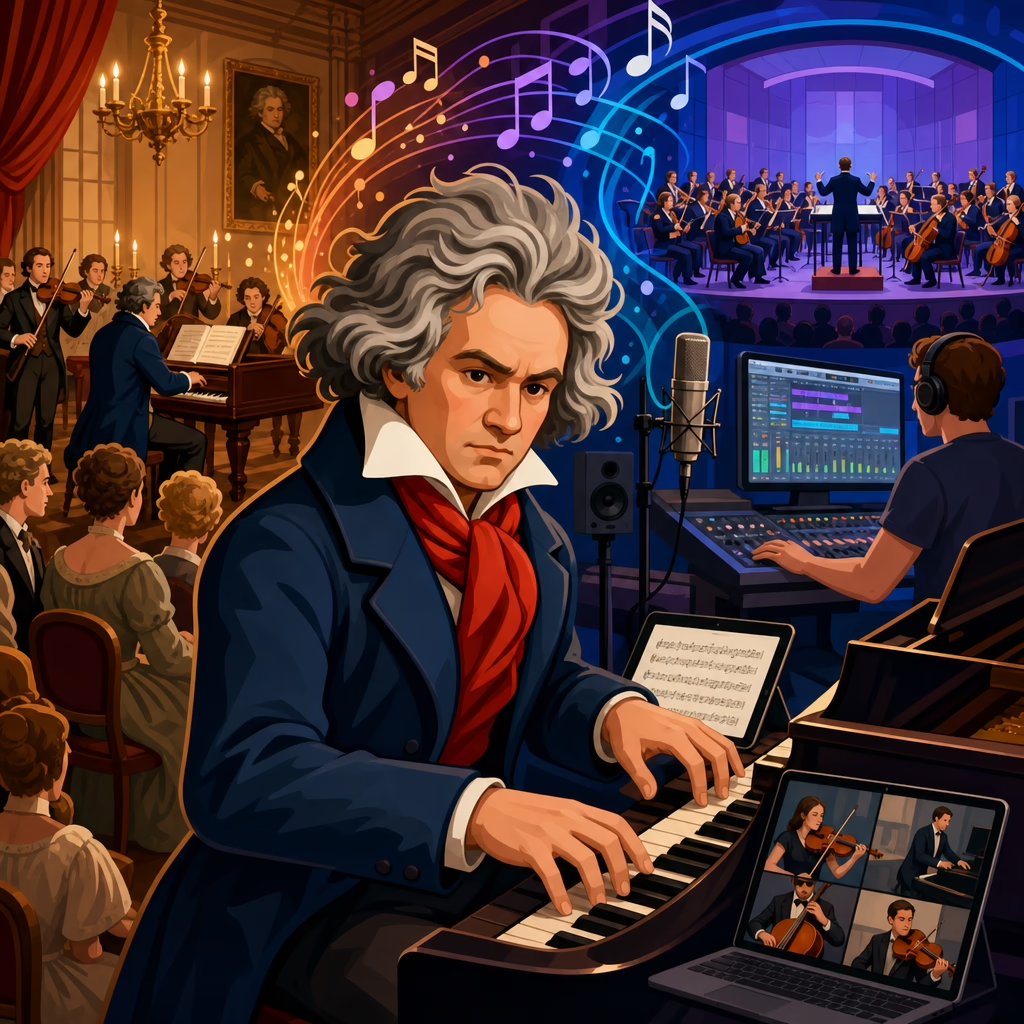
How Technology Has Changed Beethoven Performance
How technology has changed Beethoven performance is a question about instruments, recording, rehearsal, editing, distribution, and listening habits all at once. In practical terms, Beethoven performance means the choices musicians make when they play his piano sonatas, string quartets, symphonies, concertos, songs, and choral works for modern audiences. Technology includes obvious tools such as microphones, digital audio workstations, metronomes, streaming platforms, and lighting systems, but it also includes quieter advances: carbon fiber bows, improved key mechanisms, scholarly software, stage communication systems, and high resolution scans of manuscripts. Having worked with performers, concert presenters, and recording teams on Beethoven projects, I have seen that technology never acts as a neutral backdrop. It changes tempo decisions, balance, stamina, articulation, ensemble precision, audience expectations, and even which edition a player keeps open on the stand. For a repertory so central to Western concert life, that matters enormously. Beethoven sits at the intersection of historical tradition and constant reinvention. Every generation claims to return to the score, yet every generation does so through new tools. The result is not one single modern Beethoven style but a field of competing practices shaped by technical possibility. Some aim for historical sonority using period instruments and source study. Others embrace the power, projection, and polish of contemporary concert culture. Most performances combine both impulses. Understanding these changes helps listeners hear why a symphony from the 1950s sounds different from one made today, why pianists debate pedal and tempo with such intensity, and why a live performance can now reach millions beyond the hall. Technology has not replaced musicianship; it has redefined the conditions under which musicianship operates.
Instrument design changed the physical sound of Beethoven
The most direct technological change is the instrument itself. Beethoven wrote for pianos with lighter actions, shallower key dip, quicker decay, and a narrower dynamic ceiling than a modern Steinway Model D, Bösendorfer Imperial, or Fazioli F278. That difference alters everything from voicing thick left hand textures to sustaining long harmonic spans in the late sonatas. On an early nineteenth century Viennese fortepiano, accents speak quickly and repeated notes can sound sharply profiled; on a modern grand, the same passage can become orchestral, legato, and massive. Performers now choose between replicas by builders such as Paul McNulty or modern concert grands, and the technology of each instrument pushes interpretation in different directions.
String playing has changed just as profoundly. Beethoven knew gut strings and classical bows, not the steel strings and Tourte derived bow culture that later standardized nineteenth and twentieth century performance. Steel strings increase projection and pitch stability under hot stage lights, but they also encourage a denser sustained tone. Gut strings, by contrast, produce a more speech like attack and more varied color from note to note. Modern keywork on winds improves technical security in rapid passages, making exposed lines in the symphonies and chamber works cleaner and more even than they often were in Beethoven’s day. Natural horns and trumpets require hand stopping and crook changes; valved brass delivers reliability and force but changes timbral hierarchy.
These physical changes matter because Beethoven often wrote at the edge of what instruments could do. The opening of the “Waldstein” Sonata, the hammering rhetoric of the “Appassionata,” and the huge choral climaxes of the Ninth Symphony all respond differently depending on instrument technology. In rehearsal, I have watched players discover that a phrase marked sforzando means one thing on a fortepiano and another on a modern grand. Neither approach is inherently correct. What technology does is set the range of plausible solutions. That is why performance today includes both historically informed readings and unapologetically modern ones, each rooted in real material conditions rather than abstract taste alone.
Recording technology reshaped interpretation and audience expectation
Before recording, Beethoven performance was ephemeral. A concert was heard once by those present, then survived through memory, reviews, and perhaps annotated parts. The arrival of electrical recording in the 1920s, magnetic tape after World War II, and digital editing later in the century changed the artistic target. Performers now had to create versions that could withstand repeated listening. That encouraged tighter ensemble, cleaner attacks, more controlled vibrato, and a different relation to risk. In live Beethoven, a conductor may push tempo for drama; in the studio, the same choice can sound ragged when heard five times in a row through headphones.
Recording also created benchmark interpretations. Arturo Toscanini, Wilhelm Furtwängler, Herbert von Karajan, Glenn Gould, Claudio Arrau, Nikolaus Harnoncourt, John Eliot Gardiner, and many others reached listeners far beyond one city or season. Their recordings did not merely document Beethoven performance; they taught listeners what Beethoven could sound like. The modern expectation that the opening of the Fifth Symphony must have overwhelming precision, or that the slow movement of the Seventh can sustain intense long line, owes much to the microphone. Close miking reveals inner voices and balance details that are less obvious in a hall, while multi take editing can produce a level of unanimity no live event consistently matches.
Digital workstations such as Pro Tools, Pyramix, and Sequoia intensified this trend. Producers can patch together dozens of takes, align ensemble entries, manage page turn noise, and build a coherent tempo arc across sessions. Used well, this allows a recording to represent a musical ideal rather than a single accident of time and fatigue. Used badly, it can smooth away spontaneity and rhetorical danger that are central to Beethoven. I have sat in sessions where a quartet debated whether to keep a slightly raw take because its phrasing had narrative urgency. That debate exists because technology makes perfection available. Beethoven performance today is shaped by that availability even before the first note is played.
Historical research tools changed what performers think the score means
Technology has also transformed scholarship, and scholarship feeds performance directly. High resolution digitization by institutions such as the Beethoven-Haus Bonn and major libraries allows performers to inspect autograph manuscripts, first editions, sketch material, and corrected proofs from anywhere. That matters because Beethoven’s notation can be inconsistent, revised, or damaged, and editorial decisions affect articulation, slur length, accents, dynamics, and even pitches. When a pianist compares urtext editions from Bärenreiter and Henle against manuscript images, that is a technological act shaping sound.
Software and online databases make source comparison faster and more precise. Tempo relationships, recurring motives, and variant readings can be studied across an entire work cycle in ways that once required travel and weeks of archival labor. As a result, musicians are less dependent on inherited tradition alone. They can test whether a famous rubato is grounded in the notation, whether a crescendo extends across a barline in the sources, or whether later editors normalized an awkward but expressive reading. This has sharpened articulation in Beethoven, especially in chamber music and early symphonies, where slurs and accents carry structural meaning.
The metronome question shows the value and limitation of these tools. Beethoven’s metronome marks, many of them strikingly fast, have been contested for generations. Modern scholarship can examine early metronomes, copyist errors, and source transmission in detail, yet no technology can settle the issue entirely. Some conductors adopt the marks to restore propulsion; others argue that they are unreliable or context dependent. What has changed is the quality of the argument. It is now based less on vague custom and more on measurable evidence, acoustics, and instrument response. Technology therefore has not ended interpretive disagreement; it has made that disagreement more informed, more transparent, and often more musically productive.
Rehearsal, measurement, and stage systems improved precision
Much modern Beethoven performance is shaped before the audience arrives. Electronic tuners, drone apps, click capable metronomes, rehearsal recording, and spectrographic analysis help musicians diagnose intonation, rhythm, blend, and timing. Orchestras routinely record rehearsals and review them immediately. A conductor can hear whether the scherzo trio in the Ninth lost bass definition, whether timpani attacks are speaking clearly, or whether a woodwind line is covered by strings in a particular seat configuration. Chamber groups use simple stereo rigs or multitrack setups to evaluate unanimity of articulation. This feedback loop shortens the time between action and correction.
Stage technology matters too. Adjustable risers improve line of sight and balance. LED stand lights reduce heat compared with older lamps, which helps with tuning stability. Quiet page turning tablets such as forScore on iPad are now common in some contexts, especially for large scale projects with revisions and cuts, though many Beethoven specialists still prefer paper for reliability and annotation. Backstage communication systems coordinate chorus entries, offstage players, and complex concert logistics in works such as the Missa solemnis or Ninth Symphony. None of this is glamorous, yet it raises the baseline competence audiences now expect.
Precision, however, is not the same as meaning. Beethoven relies on controlled instability: sudden accents, dangerous transitions, and long spans of cumulative tension. Over measured rehearsal can make the music efficient but emotionally generic. The best ensembles use technology diagnostically, not dictatorially. They fix what obscures the score, then leave room for rhetorical timing, dynamic surprise, and human risk. That balance is easier to describe than to achieve, but it defines the strongest current Beethoven practice.
Distribution technology expanded who hears Beethoven and how
The shift from the concert hall to radio, LP, compact disc, download, stream, and video platform has changed Beethoven performance as surely as any new instrument. A local orchestra can now livestream a complete symphony cycle, and a conservatory student can compare twenty recordings of Opus 111 in an afternoon. That access broadens education and democratizes listening, but it also standardizes taste by making certain recorded norms globally familiar. A listener in São Paulo, Seoul, or Stockholm may come to a first live Beethoven concert already conditioned by carefully edited studio sound and close camera storytelling.
| Technology | What changed in performance | Concrete Beethoven example |
|---|---|---|
| Modern concert instruments | Greater volume, sustain, and technical security | Heavier sonority in the “Emperor” Concerto |
| Digital editing | Higher expectation of precision and polish | Seamless ensemble in late string quartet recordings |
| Online archives | Direct access to manuscripts and first editions | Reconsidered articulation in the Eroica Symphony |
| Streaming and video | Global reach and visual influence on interpretation | Livestreamed Ninth Symphony with worldwide audience |
Video has had a special impact because Beethoven is now consumed visually as well as aurally. Camera direction highlights bow strokes, breathing, conductor cueing, and keyboard choreography. Performers know that facial expression and stage movement may shape audience response online, where viewers often encounter excerpts rather than entire works. Presentation choices such as hall lighting, shot selection, and subtitle design in vocal works affect perceived intensity and accessibility. This has helped bring Beethoven to new audiences, including younger listeners who discover the music through clips, documentaries, and educational channels rather than formal concert attendance.
The tradeoff is compression of context. Algorithmic platforms reward recognizable openings and dramatic peaks, not necessarily whole sonata forms or complete variation sets. In response, many presenters package Beethoven with commentary, score graphics, podcasts, and companion essays. That hub style presentation can deepen engagement when done well. It treats performance not as an isolated event but as part of a broader ecosystem of recordings, notes, interviews, and linked repertory. For Beethoven, whose works reward repeated listening and structural awareness, that ecosystem is increasingly central.
Technology widened access while raising new artistic questions
One of the best outcomes of modern technology is accessibility. High quality hearing assistance, captions, streamed archives, and on demand educational content allow more people to engage with Beethoven than ever before. Musicians with geographically dispersed collaborators can coach, annotate, and plan projects remotely. Students can slow recordings without changing pitch, compare editions instantly, and practice with orchestral reductions generated from notation software. For institutions, digital ticketing and audience analytics help identify what programming reaches first time listeners versus specialists. These are practical gains, not abstractions.
Yet every gain introduces a question. If recordings are endlessly editable, what should count as authenticity? If period instrument performance is amplified or closely miked, is the listener hearing historical balance or modern mediation? If a competition performance circulates online forever, does that encourage caution in a repertory that needs boldness? I have seen younger musicians absorb enormous amounts of Beethoven through recordings before they ever play in an acoustically responsive room. They arrive technically informed but sometimes uncertain about scale, resonance, and how silence behaves in live space. Technology can train the ear brilliantly, but it can also flatten the difference between heard sound and screen sound.
The healthiest approach is plural. Beethoven performance now thrives because artists can choose among tools rather than submit to one model. They can combine urtext rigor with modern projection, use rehearsal analytics without losing spontaneity, and release both studio and live versions of the same work to show different truths. Listeners benefit when they understand these variables. Hearing Beethoven historically, digitally, and live is not redundant; each mode reveals something the others miss. Technology has changed Beethoven performance by making interpretation more informed, more exact, more widely shared, and more self conscious. It has not solved the essential challenge of the music, which is to turn notation into urgency, architecture, and human speech. That challenge remains where it has always been: in the performer’s ear, body, judgment, and courage. Listen across formats, compare approaches, and return to the score with sharper questions.
Frequently Asked Questions
How have modern instruments changed the way musicians perform Beethoven?
Modern instruments have had a major impact on Beethoven performance because they differ significantly from the instruments he knew. Today’s pianos are larger, more stable, and far more powerful than early nineteenth-century fortepianos, which means pianists can produce a broader dynamic range, longer singing lines, and greater volume in large concert halls. At the same time, that extra power can easily blur textures or make Beethoven sound heavier than intended if players are not careful with pedaling, articulation, and tempo. String instruments also use modern setups, including metal or synthetic strings, higher tension, and modern bows, all of which affect projection, phrasing, and tone color. Wind and brass instruments are more mechanically reliable and more consistent in tuning, which changes both ensemble balance and the character of orchestral sound.
Because of these developments, performers constantly make interpretive decisions about whether to lean into the strengths of modern instruments or to compensate for them in pursuit of clarity and historical awareness. Some artists try to recreate the sharp accents, transparent textures, and rhetorical contrasts associated with Beethoven’s era, even on modern instruments. Others embrace the symphonic breadth and sustained tone that modern technology allows. Historically informed performance practice has also been shaped by research tools, instrument reconstruction, and wider access to scholarship, so even musicians using modern instruments often perform Beethoven differently than they did a century ago. In short, technology has not simply made instruments “better”; it has changed the entire expressive framework within which Beethoven is played.
What role has recording technology played in shaping Beethoven interpretation?
Recording technology has transformed Beethoven performance from something primarily experienced live into something preserved, repeatable, and endlessly comparable. Early recordings already influenced interpretation by encouraging performers to think about duration, clarity, and what could be captured by limited equipment. As recording improved, musicians became increasingly aware that every detail of tempo, balance, phrasing, and attack might be heard repeatedly by critics, students, and global audiences. This created a feedback loop: recordings documented influential interpretations, and those interpretations then became models that later performers studied, imitated, challenged, or refined.
In the modern era, high-resolution microphones, multi-track sessions, and digital editing have raised expectations of precision. A Beethoven symphony or sonata can now be assembled from multiple takes, allowing ensembles and soloists to correct slips, refine ensemble timing, and shape a polished final product that may exceed what is possible in a single live performance. That has both benefits and drawbacks. On the positive side, recordings can reveal inner voices, structural logic, and interpretive nuance with extraordinary detail. On the negative side, they can encourage overly controlled performances or unrealistic standards of perfection. Recording technology has also broadened stylistic awareness by making performances from different traditions instantly accessible. A pianist today can compare dozens of recordings of the same Beethoven sonata and absorb a century of interpretive history in a matter of hours. That level of access has profoundly changed how musicians prepare, perform, and even imagine Beethoven’s music.
How has digital technology changed rehearsal and preparation for Beethoven performances?
Digital technology has made rehearsal and preparation far more analytical, efficient, and collaborative. Musicians now use digital scores, rehearsal apps, tuners, metronomes, slow-down software, and annotation tools to study Beethoven in ways that were previously impossible or far more time-consuming. A string quartet can mark bowings in shared digital parts and instantly update everyone’s copy. An orchestra conductor can distribute revised articulations and balance instructions before rehearsal begins. Pianists can listen back to trial runs immediately, compare tempos against Beethoven’s controversial metronome markings, and examine whether their voicing brings out structural lines clearly enough.
Video conferencing and file sharing have also changed collaborative preparation, especially for chamber music and vocal repertoire. Performers can exchange annotated scores, discuss interpretation remotely, and arrive at in-person rehearsals with a more unified concept already in place. Digital archives have made manuscripts, first editions, scholarly commentary, and historically informed research much easier to access, giving performers better tools for making interpretive choices. This does not mean technology replaces musical instinct or ensemble chemistry. Beethoven still demands listening, risk-taking, and deep structural understanding. But digital tools have made performers more informed and more self-aware. They can diagnose rhythmic instability, articulation inconsistency, pacing issues, or balance problems with far greater precision than earlier generations, which inevitably affects the final performance audiences hear.
Has audio editing and amplification changed what audiences expect from Beethoven performances?
Yes, significantly. Audio editing and amplification have altered listener expectations in ways that reach far beyond the studio. Because audiences regularly hear polished recordings with flawless ensemble, ideal balance, and highly controlled dynamics, they may unconsciously expect live Beethoven performances to sound equally clean and exact. This can put pressure on performers to minimize spontaneity in favor of security, especially in technically exposed works such as the late piano sonatas, the violin concerto, or the late string quartets. The more people consume perfected audio, the more live performance is judged against a standard shaped by technology rather than by the natural risks of real-time music-making.
Amplification and sound reinforcement have also affected certain venues and presentation formats. While traditional classical concerts often avoid heavy amplification, microphones are frequently used for broadcasts, outdoor concerts, educational events, and hybrid media productions. The use of microphones can change how balance is perceived, how singers project in Beethoven’s choral works, and how orchestral detail reaches the audience. Even when amplification is subtle, it can influence performance choices because musicians know that close miking may capture details differently from what a concert hall naturally projects. In addition, film, livestreams, and high-quality headphones have trained listeners to focus on sonic detail in a more intimate way. As a result, Beethoven performance today is shaped not only by what sounds convincing in a hall, but also by what translates well through speakers, screens, and recordings.
How have streaming platforms and changing listening habits influenced Beethoven performance today?
Streaming platforms have changed Beethoven performance by changing how people discover, compare, and consume his music. Instead of encountering Beethoven mainly in formal concert settings or through a small personal recording collection, listeners now move easily between complete symphony cycles, historical recordings, period-instrument performances, piano sonata playlists, and algorithmically recommended excerpts. That has expanded access tremendously. A listener can hear radically different approaches to the same work in minutes, which has made audiences more stylistically aware and often more opinionated. Performers, in turn, know they are reaching listeners who may compare their interpretation immediately with many others from around the world.
These platforms also influence programming and presentation. Short-form clips, curated playlists, and digital promotion tend to favor memorable moments, strong identities, and accessible framing. That does not diminish Beethoven’s depth, but it does encourage musicians and institutions to think carefully about how they present his music to modern audiences. A concert performance may now be planned with live streaming, video excerpts, social media distribution, and replay value in mind. Listening habits have become more fragmented as well: many people hear Beethoven while commuting, studying, or using headphones rather than sitting attentively in a concert hall. That shift affects how performers and producers think about pacing, sound detail, and communication. At the same time, streaming has helped revive interest in both mainstream and specialist Beethoven traditions, from large-scale symphonic interpretations to historically informed chamber performances. In that sense, technology has not narrowed Beethoven performance; it has multiplied the contexts in which his music is heard and the strategies performers use to make it speak powerfully today.