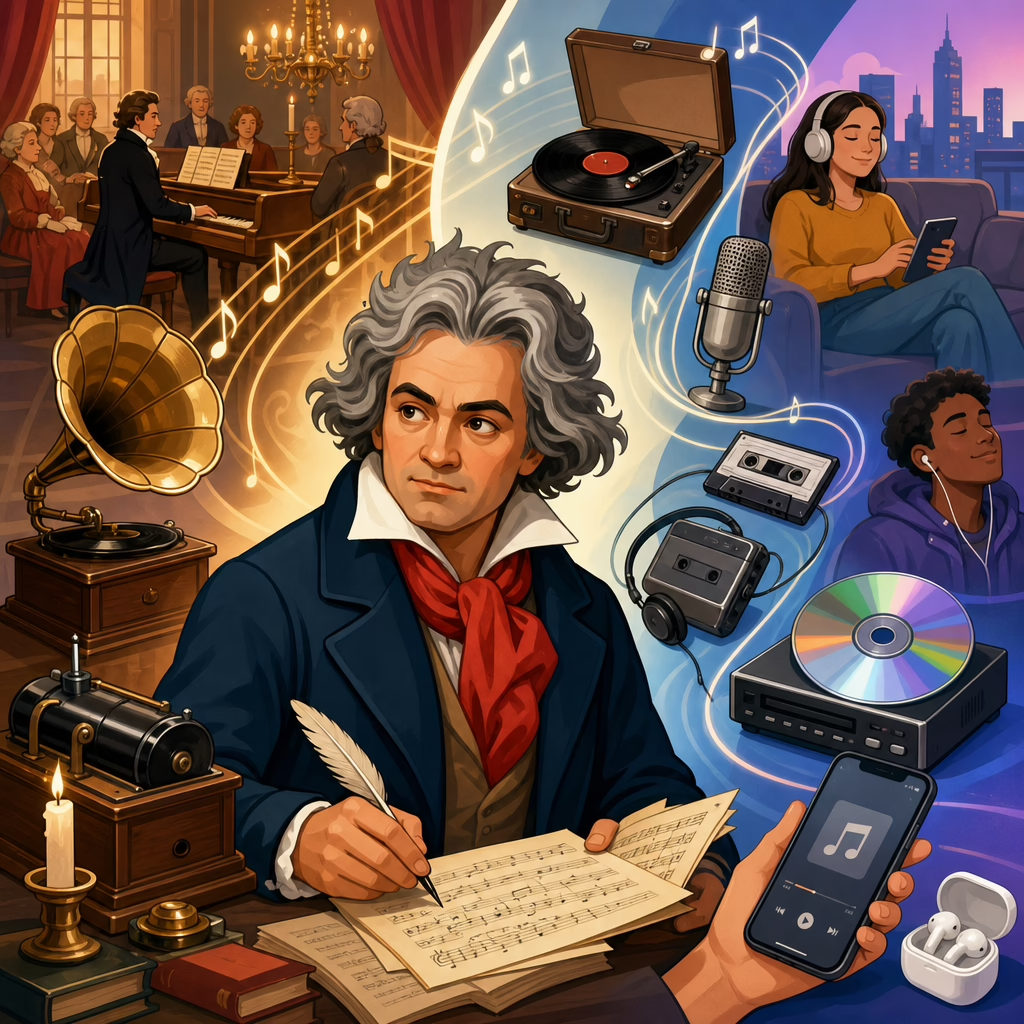
How Recording Technology Changed the Way We Hear Beethoven
How recording technology changed the way we hear Beethoven is one of the most important stories in classical music because it reshaped performance practice, listening habits, criticism, and even the public image of the composer. Recording technology means the tools and processes used to capture, store, edit, reproduce, and distribute sound, from acoustic horns and shellac discs to magnetic tape, stereo LPs, compact discs, and today’s high resolution streaming platforms. In practical terms, each technical shift altered what listeners could hear, what performers aimed to produce, and which interpretations became influential. I have worked through Beethoven discographies, compared transfers from early 78s, and heard how identical passages change character across formats. That experience makes one point clear: recordings did not merely preserve Beethoven performances. They actively taught generations what Beethoven should sound like, which is why any discussion of performance and recordings must begin here.
Before recording, Beethoven was largely encountered in live spaces shaped by local orchestras, domestic pianos, church acoustics, and the uneven availability of scores. A listener in Vienna, Boston, or Tokyo might know the Fifth Symphony through arrangements, partial performances, or a teacher’s description rather than through repeated exposure to a stable version. Recording changed that instability. Once performances could be replayed, compared, bought, broadcast, and archived, Beethoven became both more accessible and more standardized. Tempos once heard once could be measured. Phrasing became discussable in concrete detail. Conductors developed reputations not only through concerts but through discs that circulated far beyond the hall. This hub article covers that broad miscellaneous territory: the move from rarity to repeatability, the rise of recorded authority, the tension between documentation and studio construction, and the modern listener’s ability to move instantly between historically informed and modern symphonic Beethoven.
From one time event to repeatable object
The first major change recording brought to Beethoven listening was repeatability. Acoustic era discs in the early twentieth century captured only limited frequency range and short durations, yet even those primitive records transformed listening by making a performance into an object that could be owned and revisited. Beethoven’s music, especially short piano works, overtures, and excerpted symphonic movements, entered homes in a way earlier audiences could not have imagined. The famous constraints of the 78 rpm disc, often four to five minutes per side, forced cuts and side breaks, but they also encouraged close attention. Listeners learned Beethoven in fragments, replaying the opening of the Fifth Symphony or the “Moonlight” Sonata movement until those passages became culturally fixed.
That fixity mattered. In a concert, details vanish into memory; on a record, they can be checked again. A held fermata, a portamento in a string section, or a pianist’s use of arpeggiation became evidence. Critics could compare two Eroica recordings bar by bar. Students could imitate Artur Schnabel’s Beethoven sonata style from discs, not just from teacher lineage. This was revolutionary because Beethoven interpretation had long relied on oral tradition, local habits, and the prestige of live testimony. Recordings turned those habits into audible documents. They also expanded access. Someone far from a major conservatory could hear leading Beethoven performers, building taste through repetition rather than occasional exposure. For a sub-pillar on performance and recordings, that shift from event to repeatable artifact is the foundational miscellaneous topic tying every later development together.
How recording formats shaped Beethoven interpretation
Recording formats did not passively transmit Beethoven; they pushed musicians toward certain choices. Acoustic recording before microphones favored direct, loud, midrange sound. Large orchestral textures were difficult to balance, so ensemble placement around the horn affected what reached the disc. Early Beethoven recordings therefore often emphasize bold articulation and clear rhythmic profiles. With electrical recording after the mid-1920s, microphones improved dynamic nuance and orchestral depth. Suddenly the slow introduction to the Seventh Symphony or the mysterious opening of the Fourth Piano Concerto could be captured with greater subtlety. Tape then changed everything again by permitting edits, retakes, and long form continuity. LPs removed many of the brutal side-change interruptions that had chopped symphonies into awkward units, allowing broader architecture and more patient pacing.
Later stereo recording widened spatial imagination. Beethoven’s antiphonal effects, woodwind color, and the relationship between timpani and strings became part of everyday listening. By the compact disc era, low noise floors and extended timing encouraged complete sonata cycles, quartet sets, and scholarly editions. Digital recording also exposed new issues: close miking could exaggerate detail while flattening concert hall perspective, and editing could create technically immaculate yet slightly airless performances. Streaming has added another layer. Listeners now move instantly between Furtwängler, Toscanini, Karajan, Gardiner, Chailly, and dozens more, often hearing Beethoven history as a playlist rather than a sequence of major purchases. The medium changes expectation. If a format highlights impact and clarity, performers lean into those qualities. If it rewards long spans and repeated comparison, structural coherence becomes central.
Recorded authority and the rise of the Beethoven canon
Recording technology also intensified the canon around a relatively small group of Beethoven works and interpretations. The Fifth and Ninth Symphonies, the “Emperor” Concerto, the “Moonlight,” “Pathétique,” and “Appassionata” sonatas, and selected string quartets became recording staples because labels knew they would sell. Repetition in the marketplace reinforced repetition in culture. As a result, many listeners came to know Beethoven through a predictable gateway repertoire, sometimes at the expense of less recorded works such as the op. 54 Sonata, the op. 86 Mass, or many folksong arrangements. This pattern still influences recommendation engines and search behavior today.
At the same time, repeated recording cycles created authority figures. Schnabel’s complete Beethoven sonatas, recorded between 1932 and 1935, were technically imperfect by modern standards, yet they established a benchmark for intellectual seriousness and structural understanding. Wilhelm Furtwängler’s live Beethoven symphony recordings projected volatility and architectural sweep, while Toscanini’s Beethoven emphasized discipline, drive, and textual control. Herbert von Karajan’s multiple Beethoven cycles showed how the same conductor adapted the canon to changing technology, from mono and stereo to digital. These recorded identities mattered because listeners increasingly judged live performances against them. In my own listening, I have repeatedly seen how a student who first learns the Seventh from Carlos Kleiber hears propulsion as essential, whereas one raised on Klemperer often values weight and granite-like stability. Recordings create listening defaults, and those defaults shape the canon as powerfully as printed criticism.
Editing, authenticity, and the question of what is real
One of the most misunderstood effects of recording on Beethoven is the tension between authenticity and construction. Many listeners assume a recording documents what happened. In practice, especially from the tape era onward, a Beethoven recording often represents an edited ideal assembled from multiple takes. That process can clarify ensemble, intonation, and balance, but it can also remove risk. Beethoven’s music thrives on tension between discipline and danger. The first movement of the “Waldstein” Sonata, the scherzo of the Ninth, or the coda of the Fifth gains electricity when the performance feels slightly on the edge. Excessive editing may smooth that edge away.
There is no simple answer here, and serious listeners should avoid false binaries. Live recordings are not automatically truthful; microphone placement, patch sessions, and postproduction can affect them too. Studio recordings are not automatically artificial; some capture extraordinary concentration impossible in routine concerts. What matters is understanding what kind of artifact one is hearing. A historically important example is Glenn Gould’s resistance to the concert model and embrace of the studio as a creative space, even though he is not primarily a Beethoven reference point. His philosophy influenced broader attitudes toward recorded performance. In Beethoven, the authenticity debate became especially visible with historically informed performance. Conductors such as John Eliot Gardiner, Roger Norrington, and Nikolaus Harnoncourt used period instruments, smaller forces, and source-based articulation partly in response to long established recording norms that had made Beethoven sound uniformly monumental. Recordings enabled that challenge and spread it worldwide.
How different technologies changed what listeners noticed
As playback improved, listeners began hearing different layers of Beethoven’s writing. Early records highlighted rhythm and contour more than inner detail. Better microphones and quieter surfaces later revealed wind counterpoint, articulation marks, pedal effects, and orchestral balances that were previously obscured. Headphones intensified this change. A listener hearing the opening of the Eighth Symphony through modern headphones may notice bassoon attacks, offbeat accents, and string articulation in ways impossible on worn shellac through acoustic reproducers. Technology therefore changed not only quality but attention.
| Era | Main format | What listeners heard best | Typical effect on Beethoven listening |
|---|---|---|---|
| 1900s–1920s | Acoustic 78 | Strong midrange, direct attacks | Focus on rhythm, melody, and declamatory gesture |
| 1925–1940s | Electrical 78 | Greater dynamic and timbral range | More attention to orchestral color and pianistic nuance |
| 1950s–1960s | LP and tape | Longer spans, cleaner continuity | Better grasp of large scale structure in symphonies and sonatas |
| 1960s–1980s | Stereo LP | Spatial separation and depth | Heightened awareness of instrumental dialogue and hall sound |
| 1980s–2000s | CD and digital | Low noise, precision, wide dynamics | Comparative listening and complete cycles became normal |
| 2000s–today | Streaming and hi-res audio | Instant access across eras | Interpretive comparison is continuous and global |
This progression also influenced scholarship and criticism. Analysts could test claims about tempo relationships or orchestral balance using accessible recordings rather than relying entirely on scores and concert memory. Consumers, meanwhile, became more technically literate. They learned terms like mono, stereo, remaster, transfer, dynamic range, and historically informed. In Beethoven listening, that literacy matters because medium and message are tightly linked. A heavily noise reduced remaster may erase air around a violin section. A bright digital transfer can overemphasize attacks in late quartets. Hearing Beethoven well now means evaluating both interpretation and audio presentation.
Broadcast, film, streaming, and the global Beethoven ear
Recording technology reached beyond records themselves through radio, film, television, and now algorithmic streaming. Radio made Beethoven part of everyday civic and domestic life. During the mid twentieth century, symphonies and concertos entered households as scheduled public culture, not only as luxury purchases. Film then attached Beethoven to visual narratives, sometimes deepening understanding, sometimes reducing works to shorthand for fate, heroism, or genius. Television broadened access again, especially through filmed concerts and educational programs that showed conducting gestures, orchestral seating, and instrumental interaction. Visual media changed the way people heard because seeing a conductor shape a crescendo or a pianist manage a trill reframed sonic expectations.
Streaming has produced the biggest expansion since the LP, but it comes with tradeoffs. The benefit is obvious: anyone can compare complete Beethoven cycles in minutes, read digital booklets, and follow score videos alongside audio. The downside is fragmentation. Movements become tracks, tracks become background, and major interpretive arguments can disappear inside endless choice. Metadata quality also matters. If a platform mislabels an edition, omits performers, or splits a work badly, it harms understanding. Still, for this miscellaneous hub, streaming is essential because it connects every other subtopic. It links historical recordings, remastering, period performance, collector culture, and listener education into one searchable ecosystem. The way we hear Beethoven today is global, comparative, and permanently mediated by recommendation systems as well as musicians.
What this means for listeners, performers, and the wider hub
The central lesson is that recording technology changed Beethoven by changing us. It trained listeners to expect repeatability, comparison, and interpretive identity. It trained performers to think in terms of permanence, microphone detail, and marketable cycles. It trained critics to write with recordings in mind, often treating the score, the concert, and the disc as three related but distinct realities. For listeners, the best approach is active comparison. Hear a prewar sonata set beside a modern period instrument version. Compare a live Furtwängler Ninth with a studio Karajan cycle and a Gardiner performance using period forces. Notice how technology affects tempo perception, bass weight, vocal blend, and dramatic tension. That practice turns passive consumption into informed listening.
As the hub page for miscellaneous topics within performance and recordings, this subject opens the door to everything else: historic Beethoven discography, remastering methods, mono versus stereo listening, live versus studio debate, period instruments on record, famous conductors and pianists, broadcast history, and the economics of complete cycles. The key takeaway is simple. We do not hear Beethoven in a vacuum. We hear him through devices, formats, editing choices, institutions, and inherited recorded models. Understanding those layers makes every sonata, quartet, concerto, and symphony richer. If you want to hear Beethoven more clearly, start comparing recordings across eras and ask not only who is performing, but what technology is teaching your ear.
Frequently Asked Questions
How did early recording technology first change the way audiences heard Beethoven?
Early recording technology transformed Beethoven from something most people experienced only in concert halls and salons into something that could be heard repeatedly at home. In the acoustic recording era, musicians played into large recording horns that funneled sound directly to the cutting mechanism, and that process imposed severe limitations. Orchestras had to be rearranged unnaturally around the horn, dynamics were compressed, low frequencies were often weak, and large forms had to be squeezed onto short sides of shellac discs. Even so, this was revolutionary. Listeners who might never attend a major symphony performance could suddenly hear excerpts from Beethoven’s symphonies, piano sonatas, string quartets, and overtures in their own living rooms.
That change mattered because it shifted Beethoven from an event to a repeatable object of listening. Before recordings, memory played a much larger role in how people judged a performance. With records, listeners could replay a movement, compare one artist to another, and begin forming opinions about tempo, phrasing, articulation, and emotional character with much greater precision. Beethoven’s music became not only more accessible but also more standardized in public consciousness, since certain recorded interpretations gained authority and circulated widely. In that sense, even technically primitive recordings helped create the modern idea of Beethoven as a composer known through a recorded canon as much as through live performance.
In what ways did recording technology influence Beethoven performance practice?
Recording technology had a profound effect on performance practice because it changed how musicians prepared, presented, and evaluated Beethoven. Once performances could be preserved, artists knew their choices would no longer vanish after the last note. Conductors, pianists, quartets, and orchestras began to think more self-consciously about details that recordings exposed mercilessly: ensemble precision, balance, rhythmic discipline, continuity across movements, and consistency of interpretation. The ability to hear oneself back was especially important. Musicians could study their own recordings, identify weaknesses, and refine approaches in ways that earlier generations could not.
Different recording eras also encouraged different performance values. In the shellac era, shorter side lengths sometimes encouraged brisk tempos and cuts. With electrical recording, magnetic tape, and LPs, longer spans became easier to preserve, which supported broader architectural thinking in Beethoven’s large-scale works. Editing technology further raised expectations for technical polish. As recording became more sophisticated, audiences grew accustomed to performances with fewer wrong notes, tighter ensemble, and more controlled balances than were always achievable in live settings. That, in turn, influenced performers on stage.
Recordings also played a major role in historical performance debates. As scholars and musicians gained access to older instruments, treatises, and archival ideas, recordings became the main vehicle through which “new” approaches to Beethoven spread internationally. Faster tempos based on metronome markings, lighter articulation, reduced vibrato, smaller orchestral forces, and more transparent textures reached broad audiences largely because they were recorded and distributed. So recording technology did not simply document Beethoven performance practice; it actively shaped it by rewarding certain aesthetics, circulating them globally, and turning interpretive choices into subjects of public comparison and debate.
Why do recorded Beethoven performances from different eras sound so different?
Recorded Beethoven performances sound different across eras for two big reasons: changing technology and changing musical taste. On the technological side, the differences are dramatic. Acoustic recordings before the microphone captured sound mechanically and could not reproduce the full range of orchestral color or dynamic contrast. Electrical recording introduced microphones and improved fidelity, making Beethoven’s orchestral and piano textures more vivid. Magnetic tape allowed easier editing and cleaner sound. Stereo LPs gave listeners a more spacious, directional image of ensembles. Compact discs reduced surface noise and encouraged a highly detailed, sometimes clinical listening style. Today’s high-resolution digital and streaming formats can reveal minute details of articulation, pedaling, and room acoustics that earlier listeners could never hear at home.
But technology is only part of the story. Musical styles changed too. Early twentieth-century Beethoven often featured more flexible tempo, portamento in string playing, weightier phrasing, and a stronger sense of rhetorical freedom. Mid-century interpretations often emphasized monumentality, power, and long structural lines, especially in the symphonies. Later historically informed performances pushed toward leaner textures, sharper rhythmic profile, brisker tempos, and an attempt to recover aspects of Beethoven’s original sound world. Because recordings preserve these styles, they allow us to hear interpretation as history, not as a single timeless truth.
As a result, when listeners compare Beethoven recordings from different decades, they are hearing more than different conductors or soloists. They are hearing different recording tools, different production methods, different concert spaces, different editorial standards, and different cultural assumptions about what Beethoven should sound like. Each recording is a document of both the music and the era that produced it.
How did recordings change the way critics, scholars, and ordinary listeners judged Beethoven?
Recordings fundamentally changed Beethoven criticism because they made comparison easier, more precise, and far more public. In a purely live culture, a reviewer described a performance that most readers had not heard and would never hear again. Once recordings entered the picture, critics could revisit a performance multiple times and compare it directly with rival versions. That encouraged more detailed analysis of tempo relationships, structural pacing, dynamics, phrasing, orchestral balance, and fidelity to the score. Beethoven interpretation became something people could debate with evidence close at hand.
For scholars, recordings opened an entirely new field of study. They made it possible to trace changes in style over time, document traditions passed through teachers and ensembles, and examine how ideas about authenticity evolved. A recorded history of Beethoven revealed that interpretation is never fixed. Even canonical works such as the Fifth Symphony, the “Appassionata” Sonata, or the late quartets have been performed in strikingly different ways depending on the period, performer, and medium.
For ordinary listeners, recordings created a new kind of expertise. People no longer needed to rely only on a local orchestra or a single teacher’s opinion. They could build personal libraries, compare famous conductors, follow favorite pianists, and develop strong preferences. This democratized access to Beethoven while also raising expectations. Listeners became more alert to details and more likely to judge one version against another. In many ways, the modern culture of ranking, recommending, and canonizing Beethoven performances is inseparable from recording technology, because recording made interpretation portable, repeatable, and open to broad scrutiny.
What is the impact of modern digital recording and streaming on how we hear Beethoven today?
Modern digital recording and streaming have made Beethoven more available, more searchable, and more fragmented than ever before. On the positive side, listeners now have access to an extraordinary range of performances: legendary mono documents, classic stereo cycles, historically informed interpretations, live concert recordings, and newly released high-resolution audio from around the world. Someone curious about the “Eroica” Symphony or the late piano sonatas can hear dozens of approaches in a single afternoon. That level of access has expanded musical literacy and made it easier to understand Beethoven as a living interpretive tradition rather than a fixed monument.
Digital technology has also improved sound quality and production flexibility. Engineers can capture greater dynamic range, finer detail, and more natural hall ambience than many earlier formats allowed. That matters especially in Beethoven, where contrasts of texture, register, rhythm, and volume are central to the music’s expressive force. A modern listener can hear inner voices in a string quartet, orchestral articulation in a symphony, or pedaling nuance in a piano sonata with remarkable clarity.
At the same time, streaming has changed listening habits. Beethoven’s music is now often encountered through playlists, algorithmic recommendations, isolated movements, or mood-based curation rather than full-concert concentration. That can bring new audiences to the music, but it can also weaken attention to the long-range architecture that is so essential to Beethoven’s style. His works often depend on cumulative tension, thematic transformation, and large-scale dramatic design, all of which are best appreciated when heard as complete wholes.
Even so, the overall impact is enormous and lasting. Digital recording and streaming have made Beethoven globally present in a way earlier generations could hardly imagine. They allow listeners to move instantly between centuries of interpretation, compare traditions, and hear details once available only to those in the best seats of the best halls. In that sense, modern technology has not diminished Beethoven’s significance. It has multiplied the ways we encounter him, debate him, and ultimately hear him.