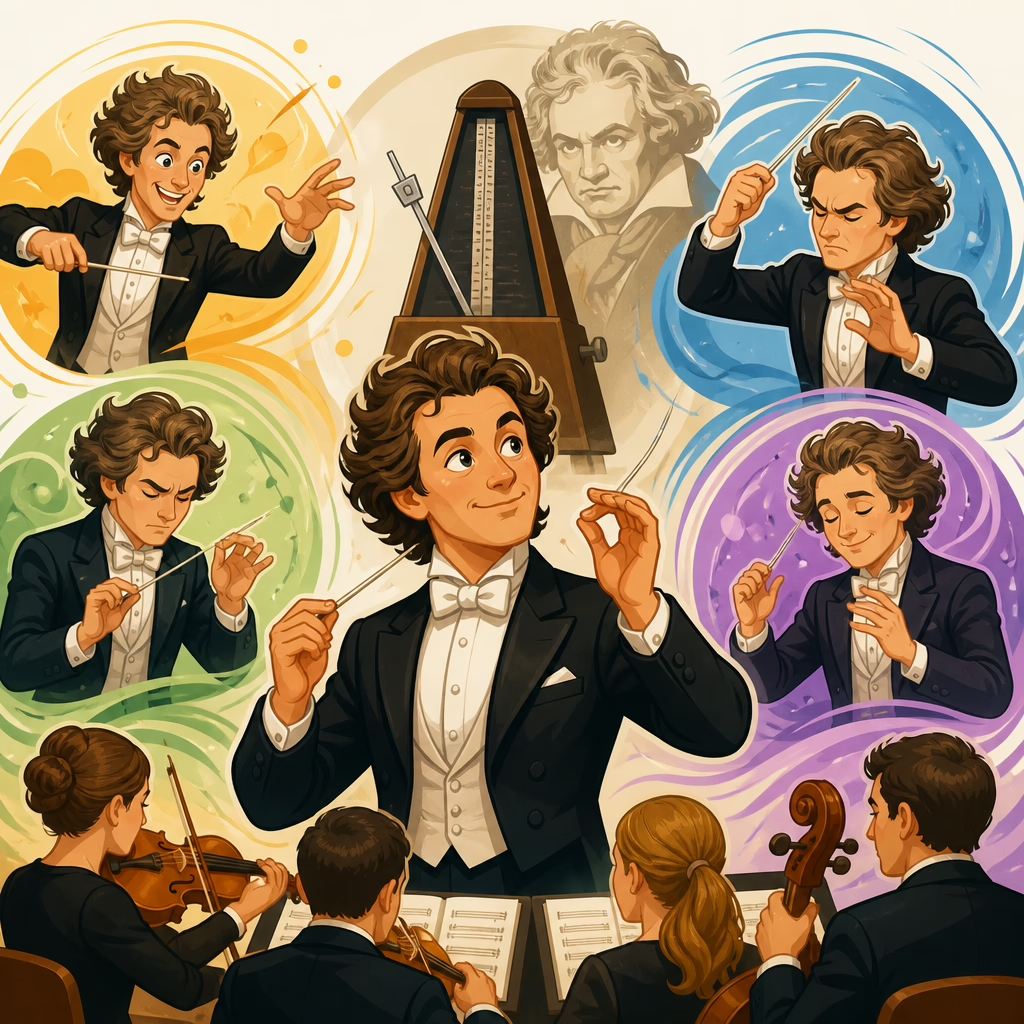
How Conductors Handle Beethoven’s Metronome Marks
Beethoven’s metronome marks remain one of the most debated instructions in classical performance because they sit at the crossroads of notation, technology, orchestral practice, and artistic judgment. A metronome mark is the numerical tempo indication a composer assigns to a movement or section, usually by linking a note value to beats per minute, and Beethoven was the first major composer to provide them systematically across symphonies, sonatas, quartets, and overtures. Conductors handle these markings carefully because they appear precise yet generate practical questions the numbers alone cannot solve: Which metronome did Beethoven use, how reliable was it, what did he mean by beat hierarchy, how do acoustics affect perception, and when should a conductor prioritize character over arithmetic? In rehearsal rooms and listening comparisons, I have found that these questions matter less as abstract musicology than as audible choices shaping tension, articulation, and form. A fast first movement can sound electric or breathless; a slower scherzo can sound weighty or merely cautious. The issue matters especially in Beethoven because pulse is structural, not decorative. Tempo governs the bite of accents, the weight of sforzandi, the buoyancy of accompaniment figures, and the span of long crescendos. Understanding how conductors handle Beethoven’s metronome marks helps listeners assess recordings more intelligently and explains why performances by Toscanini, Norrington, Harnoncourt, Gardiner, Chailly, and Karajan can all claim seriousness while sounding fundamentally different.
Why Beethoven’s numbers became controversial
Beethoven embraced Johann Nepomuk Maelzel’s metronome in the 1810s and supplied numerical markings after many works had already circulated without them. That history alone created friction. The marks often arrived after performers had formed habits from manuscript copies, parts, or oral tradition, and some of the published values seemed surprisingly swift. In the symphonies, the most notorious examples include the opening movement of the “Hammerklavier” Sonata and several symphonic scherzos and finales whose indicated tempos test ensemble clarity even for elite players. Conductors therefore confront not just a number but a historical layer added to an evolving performance tradition.
The controversy persists because the marks are neither obviously wrong nor effortlessly practical. Some can be realized convincingly on period instruments with light articulation and reduced vibrato; others remain awkward even under historically informed conditions. Scholars have proposed mechanical error, misreading of the metronome scale, confusion about note values, and later engraving mistakes. None of these theories solves every case. The more persuasive view, and the one many conductors effectively adopt, is that Beethoven’s marks convey a genuine preference for kinetic urgency, but they still require interpretation through the work’s rhetoric, phrasing, and instrumental means.
This is why debates over Beethoven’s metronome marks never reduce to “follow the text” versus “ignore the text.” Conductors are always interpreting several texts at once: autograph, first edition, parts, dynamic markings, articulation, phrase structure, and the acoustical reality of a modern concert hall. A literalist reading can distort the music if it compresses articulation beyond audibility. A relaxed reading can betray the thrust Beethoven clearly wanted. The best conductors understand that the numbers are evidence of intention, not a substitute for musicianship.
What conductors actually mean by “taking” a metronome mark
When conductors say they are taking Beethoven’s metronome mark, they rarely mean enforcing one invariant pulse from first bar to last. In practice, “taking the mark” usually means using Beethoven’s number as the governing center of gravity for a movement. Within that framework, conductors may allow brief elastic adjustments at cadences, before major transitions, or to clarify orchestral attacks. The result is not romantic tempo rubato in the late nineteenth-century sense, but neither is it machine regularity.
Another practical issue is tactus, the felt beat level. A written marking might attach to the half note, dotted half, quarter, or eighth, but performers perceive speed through larger groupings. In Beethoven, phrase rhythm often matters more than the smallest pulse. A conductor can technically match the printed number while shaping bars in two rather than four, creating spaciousness without slowing. Conversely, a conductor can choose a lower number yet subdivide aggressively and produce a restless impression. That is why two recordings that differ by several metronome points may sound closer than stopwatch timing suggests.
Rehearsal technique also affects whether a printed tempo works. At Beethoven’s faster markings, string bow distribution, off-the-string articulation, timpani stick choice, and wind breathing become decisive. I have watched conductors solve “impossible” tempos by changing articulation syllables, reducing legato weight, asking basses for more vertical attacks, or balancing brass so inner rhythm remains audible. Tempo is never isolated from execution. Conductors who succeed with Beethoven’s marks usually build a whole style around them.
Historically informed conductors and the case for faster Beethoven
Historically informed performance changed the terms of the debate by demonstrating that many of Beethoven’s fast tempos become plausible when orchestral sound is leaner, articulation shorter, and vibrato less continuous. Conductors such as Roger Norrington, John Eliot Gardiner, Frans Brüggen, and Nikolaus Harnoncourt did not simply accelerate familiar readings; they reconfigured the orchestral language around the tempos. Natural trumpets cut through textures differently, hard sticks on timpani sharpen rhythmic profile, and classical bows help string players articulate repeated notes with less drag.
The strongest argument from this camp is musical rather than ideological. Faster tempos often make Beethoven’s textures cohere. Accompaniment figures that sound busy at moderate speeds can become propulsive when aligned with the composer’s indicated pulse. Harmonic rhythm also clarifies: sequences drive forward, transitions feel inevitable, and large sonata forms stop sagging under accumulated emphasis. The finale of the Seventh Symphony, for example, can sound heavy if treated as monumental; nearer Beethoven’s mark, it becomes a controlled blaze of rhythmic obsession.
That said, historically informed conductors do not all make the same choices. Gardiner often combines taut tempos with fierce rhythmic discipline and sharply profiled accents. Harnoncourt, by contrast, may adopt similarly urgent basic speeds while introducing more rhetorical inflection and greater contrast of gesture. Chailly, working with a modern orchestra but drawing on historical research, often seeks a middle path: brisk, text-aware, and polished without sounding academically constrained. If you want a structured way to compare these decisions across complete sets, the best companion resource is this guide to comparing Beethoven symphony cycles like a critic.
Why traditional conductors often broaden the pulse
Conductors from the central twentieth-century tradition frequently treat Beethoven’s metronome marks as advisory rather than binding because they prioritize line, sonority, and architectural breadth in large halls with modern instruments. Wilhelm Furtwängler is the classic example. His Beethoven often departs radically from printed numbers, yet the tempo relationships within movements can feel deeply argued. He broadens transitions, stretches climaxes, and allows thematic material to breathe in ways that produce overwhelming cumulative force. For listeners who value spiritual drama over textual exactitude, this approach can sound truer to Beethoven’s expressive ambition than numerical fidelity.
Herbert von Karajan, though steadier than Furtwängler, also demonstrates why conductors may resist strict observance. Modern string sections sustain with more mass, valved brass blend more smoothly than natural brass, and large symphony halls reward longer lines. Under these conditions, some of Beethoven’s swiftest marks can blur harmonic bass lines or reduce the impact of dynamic contrasts because the sound itself carries more inertia. Slower choices can restore grandeur and transparency, particularly in acoustically resonant spaces.
The danger, of course, is that broadening can turn Beethoven into post-Wagnerian rhetoric. Scherzos lose wit, finales lose dangerous edge, and repeated rhythmic cells become dutiful. Experienced conductors know this and often compensate by tightening articulation even when the basic pulse is slower than marked. A successful traditional reading therefore does not merely reject Beethoven’s numbers. It proposes an alternative equilibrium among weight, clarity, and momentum.
How specific musical factors influence tempo decisions
Conductors handling Beethoven’s metronome marks weigh several recurring factors at once:
| Factor | Why it matters | Typical conducting response |
|---|---|---|
| Articulation density | Rapid repeated notes can clog if played heavily | Lighten bow stroke, shorten note lengths, or slightly ease pulse |
| Hall acoustics | Resonant venues smear attacks and bass lines | Choose a leaner sound or temper extreme speeds |
| Instrument type | Period and modern instruments speak differently | Adjust tempo to match attack, sustain, and blend |
| Beat hierarchy | Music may feel in two, four, or one despite notation | Conduct larger units to preserve flow at fast marks |
| Orchestral size | Larger sections create more sonic weight and latency | Reduce forces, refine articulation, or broaden slightly |
| Character markings | Allegro con brio and vivace imply affect beyond speed | Balance metronome number with rhetorical character |
These factors explain why the same conductor may honor one metronome mark closely and modify another. The slow movement of a symphony poses different problems from a finale built on perpetual motion. In lyrical movements, conductors often ask whether the marked pulse permits singing wind phrases and harmonic suspense. In scherzos, they ask whether the tempo preserves humor, lift, and sharply sprung rhythm. Beethoven’s numbers therefore function less like speed limits than like coordinates around which conductors map a workable performance.
Listening examples: what changes when the tempo changes
Tempo decisions alter Beethoven at every level. In the first movement of the Fifth Symphony, a conductor close to Beethoven’s mark tends to emphasize propulsion, the continuity of the accompaniment, and the forward pull from one phrase to the next. The famous four-note motto becomes less a hammering emblem and more a kinetic cell driving the whole structure. At a broader tempo, the same material gains mass and rhetorical gravity, but transitions can feel segmented unless the conductor sustains long-range tension expertly.
In the Seventh Symphony’s second movement, the issue is different. If taken too slowly, the repeated rhythmic tread can become solemn to the point of stasis. Closer to Beethoven’s indication, the movement often sounds not funereal but processional, with a steady current beneath the surface melancholy. Conductors who understand this distinction avoid sentimental drag. They let the variations accumulate intensity through layering rather than through simple broadening.
The Ninth Symphony offers perhaps the clearest demonstration that tempo is inseparable from choral and orchestral practicality. Fast scherzo tempos can electrify rhythmic design, yet if the timpani and fugato strings lose unanimity, brilliance turns into noise. In the finale, conductors must reconcile Beethoven’s propulsion with the diction of soloists and chorus. Some tighten orchestral episodes while giving vocal lines slightly more room. Others maintain relentless continuity and rely on crisp German consonants and agile chorus training. Both strategies can work when grounded in a coherent view of the whole movement.
How to judge a conductor’s choice fairly
The best way to judge how conductors handle Beethoven’s metronome marks is to ask not “Is this exact?” but “What musical result does this tempo produce, and is that result consistent with Beethoven’s notation and character?” Start with the opening pulse, then listen for collateral evidence. Do accents speak clearly? Are inner voices audible? Does phrase rhythm feel natural? Can the orchestra maintain unanimity under pressure? Does the chosen tempo support the movement’s large form, especially in transitions, codas, and developmental sequences?
It also helps to compare a conductor’s tempo relationships within the same work. A first movement that is only moderately fast may still feel convincing if the scherzo, slow movement, and finale are proportioned intelligently. Beethoven’s architecture depends on contrast as much as on absolute speed. Conductors who miss this may produce individually attractive movements that fail to cohere as a symphonic argument.
Finally, allow for plural solutions. Some Beethoven metronome marks can be realized persuasively only within a historically informed sound world; others translate successfully to modern orchestra practice. The most convincing conductors neither fetishize the numbers nor dismiss them. They treat Beethoven’s marks as urgent testimony from the composer, then test that testimony against instruments, acoustics, ensemble response, and the expressive logic of the score. For listeners and collectors, that balanced perspective brings the richest rewards. The next time you compare recordings, follow the pulse, notice how it shapes articulation and form, and decide whether the conductor has made Beethoven’s numbers speak rather than merely count.
Frequently Asked Questions
Why are Beethoven’s metronome marks so controversial among conductors?
Beethoven’s metronome marks are controversial because they appear unusually fast, unusually strict, or both when compared with the performance traditions that developed in the nineteenth and twentieth centuries. At first glance, a metronome mark seems objective: it gives a numerical tempo, so it looks like the composer has settled the matter. But in Beethoven’s case, those numbers raise immediate practical and musical questions. Some of them feel breathtakingly quick in large orchestral works, especially when played in big modern concert halls with modern instruments, heavier strings, more sustained wind tone, and larger ensembles than Beethoven knew. Others can sound driven if followed literally without regard to phrasing, articulation, acoustics, and the character of the movement.
Conductors also debate whether the marks reflect Beethoven’s exact final intention, the limitations of early metronomes, copying or publication errors, or a different baseline of orchestral style. Early nineteenth-century players often used lighter articulation, less continuous vibrato, and a more speech-like approach to rhythm, which can make a quick tempo sound clearer and less congested than it does in a modern symphonic style. On top of that, Beethoven’s own music often depends on tension between pulse and expression. Conductors therefore have to decide whether the mark is best understood as a fixed rule, an idealized target, or a clue to the music’s energy. That is why the debate never stays purely technical: it quickly becomes a question of how literally to read notation, how much to trust historical context, and how much room artistic judgment should have in performance.
Do conductors usually follow Beethoven’s metronome marks exactly?
Some do, some do not, and most fall somewhere in between. In practice, conductors rarely treat Beethoven’s metronome marks as simple on-off commands. Even those who are deeply committed to historical fidelity often distinguish between respecting the underlying pulse and obeying every number with mechanical exactness. A conductor may aim to preserve the urgency, forward motion, and proportion implied by Beethoven’s indication while still making subtle adjustments for orchestral balance, hall resonance, ensemble size, and the technical demands of a particular passage.
Modern performances show a wide spectrum. Historically informed conductors are often more willing to take Beethoven at his word, especially when using smaller forces and period-style articulation that support greater clarity at brisk tempos. Traditional symphonic conductors may choose broader tempos, arguing that the structure, grandeur, and sonority of the music benefit from more breadth. Even then, many are careful not to ignore the marks entirely. They may use them as a corrective against inherited habits that have become too slow, too monumental, or too romanticized. In other words, the marks still exert pressure even when they are not followed to the exact beat per minute. For most conductors, the real task is not blind obedience but informed negotiation between text and sound.
What factors do conductors consider when deciding whether to adjust Beethoven’s written tempos?
Conductors weigh a surprisingly large number of factors before settling on a tempo. First is the internal character of the music itself: articulation, note values, dynamic profile, phrase length, and harmonic rhythm all affect whether a tempo feels natural or forced. A fast metronome mark may work beautifully if the articulation remains buoyant and the texture transparent, but the same number can become muddy if the orchestra is large or the string section uses a sustained legato approach. Conductors also listen for whether the music speaks clearly at that speed. In Beethoven, tempo is inseparable from rhetoric; the pulse has to support the drama, not just satisfy the number.
They also consider external conditions. A dry hall can accommodate speed differently from a reverberant one. A chamber-sized orchestra can turn corners more easily than a large modern ensemble. Wind and brass instruments have changed dramatically since Beethoven’s time, and those differences affect blend, attack, and endurance. Conductors may also think about the relationship between movements, because Beethoven’s formal architecture often depends on proportion across an entire work, not just within one movement. Then there is the interpretive question: is the mark a command, a benchmark, or a provocation? Some conductors believe Beethoven was intentionally pushing performers toward greater vitality than was customary. Others think a few numbers may be unreliable in transmission. The final decision usually emerges from a combination of score study, historical research, rehearsal experience, and artistic conviction.
How does historical performance practice influence the way conductors approach Beethoven’s metronome marks?
Historical performance practice has had a major impact on how conductors think about Beethoven’s tempos. Once scholars and performers began studying early nineteenth-century instruments, treatises, ensemble habits, and notation conventions more closely, many assumptions inherited from later romantic performance started to look less inevitable. Conductors discovered that lighter bows, quicker decay, cleaner articulation, narrower vibrato, and smaller orchestral forces could make rapid tempos far more playable and far more intelligible than they seemed in older large-scale symphonic traditions. In that context, Beethoven’s metronome marks no longer appeared merely eccentric; they began to sound like part of a coherent musical language built around propulsion, contrast, and sharply profiled rhythm.
That said, historical performance practice does not produce one single answer. It broadens the conversation rather than closing it. Even specialists disagree about what Beethoven would have expected in terms of flexibility, accentuation, and local tempo nuance. Some argue that if the instruments and style are historically grounded, the marks become much more persuasive. Others maintain that even with period-aware playing, certain numbers still require interpretation rather than literal acceptance. What historical practice has changed most decisively is the burden of proof. It is now harder for conductors to dismiss Beethoven’s marks simply because they conflict with later tradition. Instead, they must engage seriously with the possibility that the composer intended a leaner, more urgent, and more rhythmically alive sound world than audiences once took for granted.
What is the best way to understand a conductor’s tempo choice in Beethoven today?
The best way is to hear it as an interpretive argument rather than just a numerical decision. A conductor choosing a tempo in Beethoven is making a statement about style, structure, energy, and even the meaning of the work. A brisk tempo may suggest that the music’s drama lies in momentum, tension, and rhythmic bite. A broader tempo may emphasize weight, architecture, and singing line. Neither choice is automatically right or wrong; what matters is whether the tempo creates coherence across the movement and allows the musical details to speak convincingly. In a strong performance, the chosen speed will clarify phrasing, sharpen contrasts, and make the piece feel inevitable from within.
It also helps to listen beyond the stopwatch. Two performances at nearly the same metronome speed can feel completely different depending on articulation, accent placement, orchestral transparency, and the conductor’s handling of transitions. Beethoven’s metronome marks matter, but they are only one layer of the score. The most persuasive conductors do not merely defend or reject the numbers; they absorb them into a larger understanding of Beethoven’s language. That is why the debate remains so fertile. It is not only about whether Beethoven was “right” in a technical sense. It is about how performers today can honor a revolutionary composer’s written instructions while still making the music sound vivid, playable, and deeply human in the present moment.