How Beethoven Uses Variation as Narrative
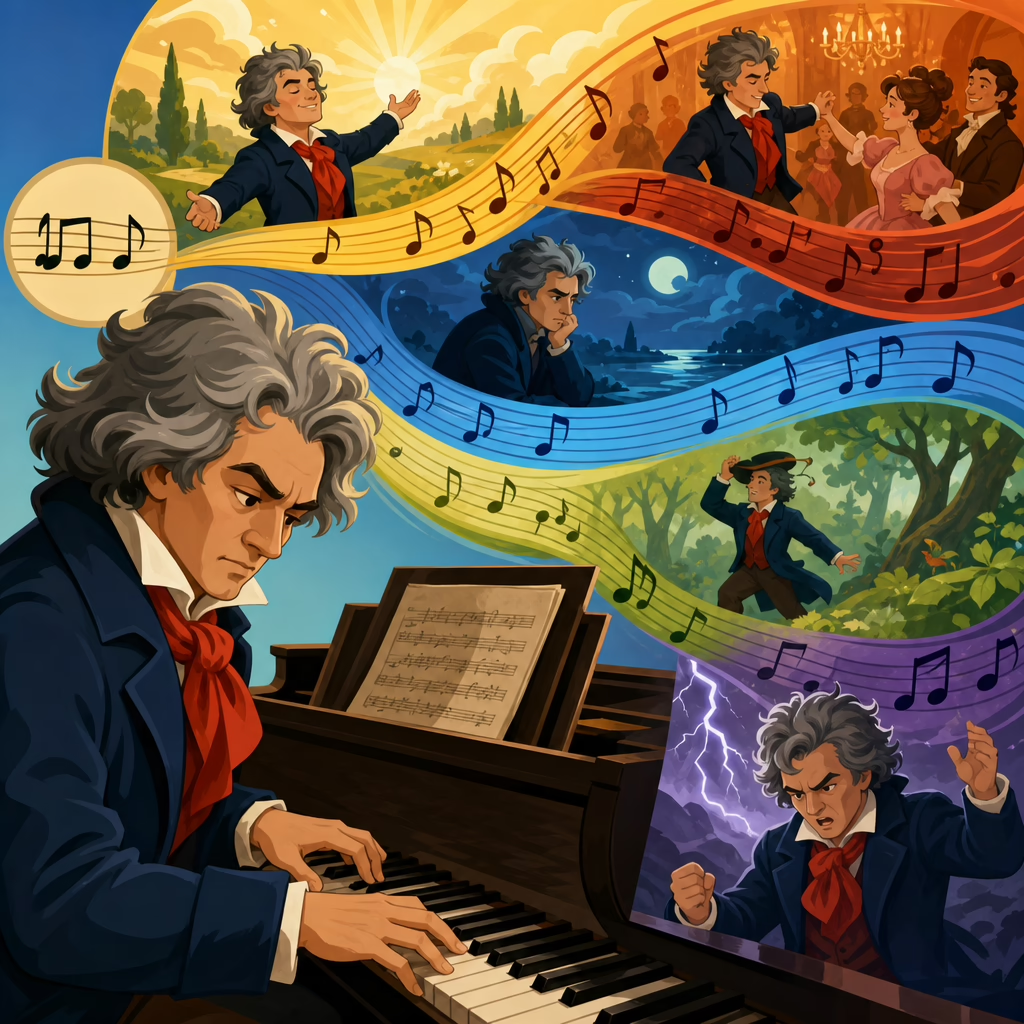
Variation in Beethoven is never mere decoration; it is a narrative device that turns repetition into action, memory into conflict, and return into transformation. In practical analysis, “variation” means the deliberate alteration of a theme’s melody, harmony, rhythm, texture, register, phrase structure, or character while preserving enough identity for listeners to recognize continuity. “Narrative” in instrumental music does not mean a hidden plot with named characters. It means a felt sequence of events: presentation, disturbance, intensification, delay, reversal, recognition, and resolution. Beethoven’s music is one of the clearest places to study this process because he treats thematic material less as a finished object than as dramatic matter under pressure.
I have found, both in score study and rehearsal work, that performers often underestimate how plainly Beethoven signals narrative through variation. He does not simply embellish a tune, as many eighteenth-century composers might in a salon set. He asks what happens when a musical idea is forced to survive in a new environment. A march theme becomes fragile in minor; a hymn becomes urgent through rhythmic compression; a dance becomes visionary when the bass line changes its ground. These are not cosmetic changes. They alter the listener’s sense of time, causality, and expectation.
This matters because Beethoven’s large forms depend on small transformations. If a movement feels inevitable, that effect usually comes from local acts of variation that accumulate dramatic meaning. The same principle links his independent variation sets, slow movements built on repeated patterns, and development sections in sonata form. To understand how Beethoven expands continuity without monotony, variation must be heard as a storytelling engine. The essential question is not “How many notes changed?” but “What new role does the theme play now?” Once that question guides analysis, Beethoven’s procedures become unusually concrete and audible.
Variation as event, not ornament
Beethoven inherited a rich eighteenth-century variation tradition, but he changed its center of gravity. In many earlier sets, the theme functions as a stable platform for increasingly brilliant surface treatment. In Beethoven, the theme often becomes a protagonist whose identity is tested. That is why analysts distinguish between ornamental variation and character variation. Ornamental variation preserves the theme’s expressive stance while altering detail. Character variation changes the theme’s emotional and rhetorical function. Beethoven relies heavily on the second type, and that shift is central to his narrative power.
A clear example appears in the finale of the Piano Sonata in A-flat major, Op. 26, a theme and variations movement placed where a sonata-form finale might otherwise stand. The theme begins with unusual reserve: balanced phrases, modest harmonic motion, and a nearly detached poise. The early variations do not simply decorate this surface. They successively sharpen rhythmic profile, redistribute emphasis among registers, and tighten motion so that the theme’s social demeanor begins to feel unstable. By the time Beethoven reaches the minor-mode variation, the same structural outline supports a markedly different world. Listeners do not hear “the same tune with extra notes.” They hear a familiar identity passing through changed circumstances.
This is one reason Beethoven’s variation writing often feels developmental even when the formal label says “variation set.” He creates directional pressure by controlling what remains constant and what becomes vulnerable. A bass line may stay fixed while texture dissolves around it. Phrase lengths may remain recognizable while harmony darkens. A cadence may recur at the expected point but arrive with entirely different weight. In performance, these details matter because they shape how much memory the listener carries forward. Narrative depends on recognition, and recognition depends on continuity across change.
How Beethoven chooses what to vary
Beethoven’s narrative control begins with selection. He rarely varies everything at once. Instead, he isolates a few parameters and manipulates them with strategic consistency. The most common are rhythm, accompaniment pattern, mode, contrapuntal density, register, and harmonic timing. By limiting the field, he ensures that each variation reads as a meaningful event rather than a generalized makeover. In rehearsing Beethoven, I have often marked the “nonnegotiable identity markers” of a theme: perhaps an intervallic outline, a cadential rhythm, or a recurring bass progression. Those markers let him transform almost everything else without losing the thread.
Consider the Andante con moto from the Fourth Piano Concerto. The movement is not a formal variation set, yet it behaves like one through repeated restatement under changing expressive pressure. The stark, unison strings present terse phrases; the piano answers with harmonized, rhythmically softened versions. What varies first is not melody alone but rhetorical stance. Each recurrence alters articulation, harmonic shading, and registral warmth, gradually changing the relationship between the opposing materials. The narrative emerges from repeated encounters in which the same basic idea acquires new implications.
The table below summarizes several recurring Beethovenian strategies and the narrative effect they typically produce.
| Variation strategy | What changes | What stays recognizable | Typical narrative effect |
|---|---|---|---|
| Mode shift | Major to minor or minor to major | Phrase outline, bass plan, motif shape | Recasts memory as loss, menace, or release |
| Rhythmic compression | Shorter note values, denser motion | Harmonic skeleton, cadence points | Creates urgency and forward drive |
| Textural thinning | Fewer voices, exposed lines | Underlying progression, melodic contour | Signals vulnerability, distance, or suspension |
| Contrapuntal intensification | Imitation, inner voices, invertible lines | Motivic cells, tonal anchors | Turns statement into argument or struggle |
| Register transfer | Theme moved higher or lower | Intervals, rhythm, phrase lengths | Changes perspective and emotional scale |
| Accompaniment redefinition | New figuration beneath the theme | Melody or bass pattern | Alters social setting, motion, and character |
These techniques are audible because Beethoven does not randomize them. He stages them. One variation may intensify rhythm while preserving texture; the next may strip texture after rhythmic excitement, producing the sense of aftermath. This sequencing gives variation the logic of scenes rather than illustrations. The theme is not repainted; it is recontextualized.
The Diabelli Variations and the drama of revaluation
No Beethoven work demonstrates narrative variation more comprehensively than the Diabelli Variations, Op. 120. Diabelli’s theme is intentionally ordinary: square phrasing, obvious harmonic punctuation, even a slightly smug rhythmic bounce. Beethoven’s genius lies in refusing either to reject or merely prettify it. Instead, he repeatedly revalues it. He treats trivial material as something capable of wit, violence, lyric introspection, learned counterpoint, and transcendence. The narrative is therefore not only within the sequence of variations; it is about the changing status of the theme itself.
Variation 1 announces the method immediately. Rather than offering elegant embellishment, Beethoven detonates the opening with heavy accents and expanded sonority, exposing latent force in the source. Later variations caricature Diabelli’s gestures, especially the repeated-note rhetoric and cadential swagger. Others abstract the theme to intervallic or harmonic essentials. Variation 13 turns inward with extraordinary delicacy; Variation 20 introduces severe contrapuntal concentration; Variation 31 unfolds as a slow, deeply reflective Largo that seems to suspend the entire project in philosophical time. The final minuet does not “win” by overpowering what came before. It reframes the whole cycle through poise, making the theme’s journey feel earned rather than erased.
What makes this narrative convincing is proportion. Beethoven places comic, destructive, analytical, and contemplative variations in a long-range architecture of contrast and return. The result resembles a novel more than a string of episodes. If you want a related view of large-scale continuity, see this guide to how Beethoven expands sonata form without breaking it. The same compositional instinct is at work: identity persists because Beethoven controls recurrence at multiple structural levels.
Variation inside sonata thinking
Beethoven’s most important innovation may be that variation and sonata logic are not separate domains in his mature style. Development sections often operate through highly focused variation of tiny cells, while recapitulations return not as duplicates but as narratively altered restatements. This is why the old opposition between “theme and variations” and “sonata form” can be misleading in Beethoven. He thinks variationally inside sonata structures and dramatically inside variation sets.
The first movement of the Eroica Symphony offers a powerful case. Its opening triadic theme seems straightforward, but Beethoven subjects its motives to relentless redefinition: displaced accents, fragmentation, sequence, harmonic destabilization, and contrapuntal recombination. When the recapitulation arrives, listeners recognize the material, yet it now carries the memory of struggle. The theme’s identity has expanded through experience. That is a narrative outcome achieved by variation, even though the movement is not formally a variation set.
The same principle appears in the Waldstein Sonata, Op. 53. The opening idea depends less on singable melody than on a kinetic pattern and harmonic trajectory. Beethoven varies spacing, figuration, registral balance, and harmonic delay so continuously that the movement’s drama arises from changing states of the same impulse. This procedure matters analytically because it explains why Beethoven can sustain large spans without introducing many new themes. Variation allows one idea to generate a whole field of events.
Slow movements, memory, and transformed return
Beethoven’s slow movements show another side of narrative variation: the management of memory. In these movements, repeated material often returns altered in ways that make listeners hear the past differently. The effect is less about conflict than about recollection, endurance, or spiritual deepening. The slow movement of the String Quartet in A minor, Op. 132, headed “Heiliger Dankgesang,” is exemplary. Its alternating sections contrast a chorale-like, archaic texture with episodes marked “feeling new strength.” The returning hymn is not identical each time; changes in scoring, registral placement, and surrounding context make it sound progressively more hard-won.
This kind of variation creates narrative by assigning time a moral quality. A simple restatement would imply stasis. Beethoven instead composes return as changed remembrance. In the Arietta of the Piano Sonata Op. 111, the theme’s successive transformations move from stillness to rhythmic animation, then into textures that seem to transcend bar-line gravity. The famous syncopated variation is often described in stylistic shorthand, but its real function is structural: it breaks open the theme’s temporal surface, allowing the listener to experience continuity in a newly elastic way. The later return to quiet simplicity is moving because variation has enlarged what that simplicity can mean.
From a performer’s perspective, these movements demand disciplined pacing. If every variation is played as an isolated mood piece, the narrative collapses. The player must preserve the theme’s lineage across changes in touch, tempo relationship, voicing, and pedaling. Beethoven writes enough continuity into the score to support this reading, but he also relies on the interpreter to project long memory.
Why Beethoven’s variation narratives still feel modern
Beethoven’s use of variation as narrative still feels modern because it mirrors how people actually process identity. We do not experience continuity as sameness. We recognize persons, institutions, and ideas through change, stress, contradiction, and adaptation. Beethoven composes with that psychological realism. A theme is credible not when it survives untouched, but when it remains itself while becoming more than it was. That is why his variation movements can feel dramatic without any external story and philosophical without any text.
For analysts, the practical lesson is direct. Start by locating the theme’s durable markers, then track which parameters Beethoven changes, in what order, and with what consequences for tension, perspective, and memory. For performers, the lesson is equally concrete: shape each variation as a new situation for a continuing identity. For listeners, the reward is hearing repetition not as redundancy but as meaning unfolding in time.
Beethoven uses variation as narrative because variation lets music think aloud. It tests ideas, revises first impressions, and turns return into revelation. Listen again to Op. 26, the Fourth Concerto, Op. 111, or the Diabelli Variations with that premise in mind. The thread you will hear is not decoration on a theme. It is the theme becoming a history. Follow that history closely, and Beethoven’s deepest dramatic logic comes into focus.
Frequently Asked Questions
What does it mean to say that Beethoven uses variation as narrative rather than decoration?
In Beethoven, variation is rarely just a matter of making a melody sound prettier, more virtuosic, or more elaborate. When analysts say he uses variation as narrative, they mean that each return of an idea feels like an event with consequences. A theme does not simply come back in different clothes. It comes back changed by what has happened around it. A shift in rhythm can make the same material sound urgent instead of stable. A change in harmony can turn confidence into uncertainty. A move into a different register or texture can make a familiar phrase sound distant, intimate, fragmented, or newly defiant. The listener recognizes continuity, but also senses development, pressure, interruption, and response.
This is where the narrative dimension enters. In instrumental music, narrative does not require a literal storyline or named characters. It refers to a felt sequence of states and transformations over time. Beethoven is especially powerful at making repetition feel active rather than static. He often presents a motive or theme in a clear form, then subjects it to stress: compression, expansion, rhythmic displacement, contrapuntal complication, harmonic destabilization, or dramatic recontextualization. Because the material remains recognizable, the listener hears not random contrast but the ongoing life of the same idea. In that sense, variation becomes the mechanism through which memory, struggle, and transformation are made audible.
This is one reason Beethoven’s music can seem so dramatic even without words. He understands that recurrence creates expectation, and expectation creates the conditions for meaningful change. A return that confirms what came before feels different from a return that unsettles it. A variation that intensifies can feel like escalation; one that strips texture away can feel like reflection or aftermath. Beethoven turns these distinctions into large-scale form. Variation becomes a way to generate action, not just surface diversity.
How does Beethoven preserve a theme’s identity while changing it so dramatically?
Beethoven’s skill lies in knowing how much of a theme must remain intact for listeners to perceive sameness, even when many details have changed. Identity in a musical theme does not depend on one parameter alone. It can be preserved through interval pattern, contour, bass support, phrase rhythm, harmonic trajectory, cadential shape, or a distinctive rhythmic cell. Beethoven often keeps one or two of these anchors firmly in place while transforming others with remarkable freedom. That is why a listener can still hear continuity even when the music sounds forcefully different on the surface.
For example, he may preserve the harmonic skeleton of a theme while recomposing the melody above it, or retain the melodic outline while changing accompaniment, articulation, register, and tempo character. Sometimes the phrase proportions remain recognizable even as the inner details become more restless. At other times, a tiny motive functions as the real source of identity: a repeated note pattern, a turn figure, a short-short-short-long rhythm, or a characteristic leap followed by stepwise resolution. Because Beethoven often works motivically, even a very small musical cell can carry the memory of the whole. When he manipulates that cell across changing contexts, the listener experiences both recognition and growth.
This balance is crucial to the narrative effect. If the material changed too completely, it would no longer feel like transformation; it would feel like replacement. If it stayed too similar, the music would risk sounding static. Beethoven occupies the expressive middle ground where continuity and alteration interact. He gives the ear enough evidence to say, “I know this,” while also giving it enough difference to feel, “This is no longer what it was.” That tension between identity and change is the engine of variation as narrative.
Which musical elements does Beethoven vary to create a sense of conflict, memory, and transformation?
Beethoven can vary virtually every element of a theme, and the specific choice matters because each type of change carries a different expressive implication. Melody is the most obvious parameter: notes may be ornamented, reordered, compressed, expanded, fragmented, or redistributed across voices. Harmony can be stabilized or destabilized, making the same idea feel grounded, questioning, tragic, or triumphant. Rhythm is especially important in Beethoven. By accelerating motion, inserting syncopation, displacing accents, or breaking regular phrasing, he can turn a calm idea into one charged with tension and forward drive.
Texture is another major narrative tool. A simple chordal theme may reappear as contrapuntal dialogue, as a dense accompaniment pattern, or as an exposed single line. Each version changes the listener’s relationship to the material. Thick textures can suggest pressure, conflict, or public force; thin textures can suggest vulnerability, memory, suspension, or concentration. Register also matters. A theme in the middle range may seem balanced and present, while the same material moved upward can feel luminous, strained, or remote, and moved downward can feel weightier, darker, or more ominous.
Phrase structure and formal placement are equally significant. Beethoven may truncate an expected cadence, extend a phrase beyond its normal boundary, or interrupt a return before it fully settles. These are not neutral alterations. They affect how the listener perceives time, control, and consequence. Character, too, is variable: the same thematic identity can be recast as lyrical, martial, intimate, comic, severe, or ecstatic. When Beethoven changes several of these dimensions at once, he creates the impression that the theme has undergone experience. It is no longer merely repeated; it has been tested, remembered, resisted, and remade.
Why is variation so important to Beethoven’s larger forms, not just to isolated variation sets?
One of the most important things to understand about Beethoven is that variation is not confined to works explicitly labeled “Variations.” It is a deep compositional principle that shapes sonata movements, slow movements, scherzos, finales, and even transitions and codas. In other words, Beethoven thinks variationally. He often builds entire structures by taking a small amount of material and continuously reinterpreting it. This allows large forms to feel unified without becoming repetitive, because the same ideas generate new situations across the span of a movement.
In sonata form, for instance, the development section can be understood as a high-pressure laboratory of variation. Themes and motives are broken apart, recombined, sequenced, displaced, and harmonically destabilized. Yet the recapitulation is not always a simple return to the opening state. Because the material has passed through conflict, its return can feel altered in function and meaning, even if many notes are similar. Beethoven often intensifies this effect in codas, where previously heard material undergoes one more transformation that reframes the entire movement. The result is a powerful sense that musical ideas have history.
This is why variation is so central to the narrative quality of Beethoven’s music. It supports coherence across time by linking moments through memory, while also producing drama through change. Rather than relying only on contrast between unrelated themes, Beethoven frequently creates contrast within identity itself. A single motive can become tender, obsessive, disruptive, ceremonial, or explosive depending on context. That capacity lets him build forms that feel both tightly integrated and dramatically alive. Variation is therefore not an ornament added to form; it is one of the main ways form acquires expressive direction.
How can a listener hear Beethoven’s variations as narrative when there is no literal story to follow?
The key is to listen for relationships over time rather than for a hidden plot. You do not need to assign characters or invent scenes in order to hear narrative in Beethoven. Instead, pay attention to how a musical idea returns and what has changed when it does. Ask simple but revealing questions: Is the theme more stable or less stable than before? Has its rhythm become more driven? Has the harmony darkened or brightened? Is the texture more exposed, more crowded, more fragmented? Does a return feel like confirmation, resistance, interruption, recovery, or culmination? These kinds of perceptions are the basis of musical narrative.
It also helps to listen for memory. Narrative depends on recollection, and Beethoven composes with the listener’s memory in mind. A motive heard early in a movement can take on new force later because the ear remembers its earlier state. When it reappears transformed, the comparison happens almost automatically. That comparison is what turns repetition into meaning. The listener senses distance traveled: not a literal journey through external events, but a sequence of tensions, setbacks, intensifications, and renewals within the musical argument itself.
Finally, it is useful to think of Beethoven’s music as dramatizing processes rather than depicting stories. A process can be highly narrative: something is stated, challenged, broken apart, reassembled, and returned in changed form. That sequence already carries the logic of beginning, disturbance, development, and outcome. Beethoven’s genius is that he can create this effect with purely musical means. By varying melody, harmony, rhythm, texture, register, phrase structure, and character while preserving identity, he makes the listener hear continuity under pressure. That is why his variations so often feel like action unfolding rather than decoration repeated.