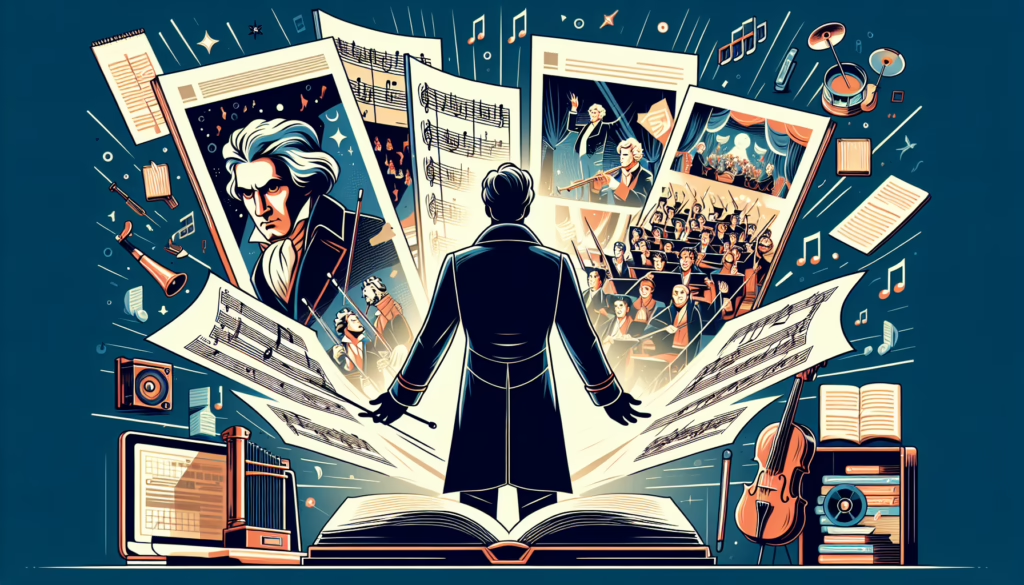
Graphic Novels About Beethoven Worth Exploring
Graphic novels about Beethoven worth exploring occupy a fascinating corner of music publishing, where biography, visual storytelling, and cultural history meet. In the broader world of Beethoven books, this miscellaneous hub matters because many readers want something different from standard scholarly lives, piano analyses, or collections of letters. They want to see the composer’s world interpreted through panels, pacing, color, and character design. A graphic novel, in this context, is not simply an illustrated biography. It is a narrative work that uses sequential art to convey mood, conflict, historical setting, and inner life. When the subject is Ludwig van Beethoven, that format can illuminate his deafness, volatility, ambition, and creative process in ways prose alone often cannot.
I have worked through Beethoven shelves in public libraries, conservatory collections, used bookstores, and publisher catalogs for years, and I have learned that readers often search for “graphic novels about Beethoven” when they actually mean several related things at once. They may be looking for a true full-length graphic biography, a manga adaptation, a comic-format introduction for younger readers, a fictionalized story in which Beethoven appears as a character, or an illustrated history that sits somewhere between art book and comic. That ambiguity is exactly why a hub page is useful. The miscellaneous label is not a catchall for leftovers. It is the practical map for a niche category that spans age ranges, artistic traditions, and degrees of historical fidelity.
Why does this category deserve attention? Because Beethoven is unusually well suited to visual narrative. His image is instantly recognizable: the wild hair, stern gaze, and nineteenth-century dress create strong iconography. His life also contains natural dramatic arcs: early talent in Bonn, artistic struggle in Vienna, hearing loss, difficult patrons, complex friendships, family conflict, and the late-period transformation that produced some of the most challenging music in Western art. For readers intimidated by a dense prose biography, a graphic treatment can provide a high-access entry point without reducing the stakes of his life. For established Beethoven readers, these books offer interpretation rather than mere summary.
This article serves as the hub for miscellaneous Beethoven graphic literature under the Beethoven Books topic. It explains what qualifies, which formats readers are likely to encounter, how to judge quality, where graphic treatments are strongest and weakest, and what related pages this hub should point toward as the subtopic grows. If you want a practical guide to finding, evaluating, and enjoying visual books about Beethoven, start here.
What Counts as a Graphic Novel About Beethoven?
A graphic novel about Beethoven can take several forms, and separating them helps readers choose well. The most straightforward category is the graphic biography: a book-length comic that narrates Beethoven’s life from childhood to death, usually with some historical notes. These works often emphasize milestones such as his move to Vienna, studies with Haydn, the onset of deafness, the Heiligenstadt Testament, and the composition of the Ninth Symphony. Their strength is narrative clarity. Their weakness is compression; a life this large can become simplified if the artist rushes from event to event.
The second category is manga and international comic adaptations. Japanese educational manga series, for example, have often treated major composers as approachable historical figures. These editions can be excellent for younger readers or adults who prefer visual momentum over footnotes. They typically use expressive character acting and clear plotting, though translation quality matters. In my experience, the best of them balance emotional readability with accurate chronology, while weaker versions lean into melodrama and flatten the music into a list of famous works.
A third category includes illustrated educational comics for children and middle grades. These are not always marketed as graphic novels, but they belong in this hub because readers discover them through the same search path. They may explain sonata form, the role of patrons, or why Beethoven’s deafness mattered. Good examples respect the reader’s intelligence and avoid cartoonish myths, such as the false idea that Beethoven composed entirely in silence from youth onward. Strong educational comics make distinctions: progressive hearing loss, adaptation through sketchbooks, and the importance of tactile and mental hearing.
Finally, there are fictional or semi-fictional works in which Beethoven appears as a central or supporting figure. Some historical comics imagine conversations with patrons or students; others weave his music into larger plots about Vienna, Romanticism, or artistic genius. These books can be rewarding if they clearly signal where invention begins. If a comic uses the “Immortal Beloved” mystery or Beethoven’s custody battle over Karl, for instance, readers should know whether they are getting documentary reconstruction or dramatized speculation.
Why Beethoven Works So Well in Sequential Art
Beethoven’s life translates unusually well into comics because it combines visible drama with invisible art. Music cannot literally be shown on a page, yet graphic storytelling can represent rhythm, density, interruption, and emotional force through panel size, line weight, recurring motifs, and page turns. I have seen effective artists depict the opening of the Fifth Symphony not by drawing notes floating in the air, but by using repeated visual shapes, abrupt black fields, and compressed panel timing. That is a smart solution: it translates structure rather than pretending to reproduce sound.
His personal story also contains high visual contrast. Bonn and Vienna offer distinct settings; aristocratic salons differ from cramped workrooms; public triumph sits beside private illness. Deafness, especially, can be conveyed powerfully in comics. Sudden silent panels, muffled dialogue balloons, fragmented text, or crowded visual textures can suggest auditory distress better than a descriptive paragraph. This is one reason many readers who struggle to connect with prose biography immediately respond to illustrated treatments of Beethoven’s middle years.
Another advantage is that comics can hold contradiction without losing pace. Beethoven was disciplined and disorderly, affectionate and abrasive, idealistic and suspicious. A skilled cartoonist can place these qualities side by side in expression, posture, and scene construction. In prose, contradictions often require explanation. In comics, they can coexist in a single page. That makes the format especially suited to a composer who resists simplistic hero narratives.
How to Evaluate Graphic Novels About Beethoven
Not every visually attractive Beethoven book is worth buying. The best way to evaluate graphic novels about Beethoven is to ask five practical questions: Is the history accurate? Does the art support the music? Is the intended audience clear? Are sources acknowledged? Does the book add insight rather than recycling clichés? Accuracy comes first. A reliable book should place major events in the correct order, identify key figures properly, and avoid familiar myths unless it explicitly challenges them.
Art matters just as much. A good Beethoven comic does not merely illustrate a textbook summary. It uses visual language to convey pressure, form, social hierarchy, and creative labor. When I review these books, I look closely at scenes of composition. Does the artist show notebooks, drafts, revisions, pianos, conversation books, and performance settings with some care? Or does the book simply present Beethoven as a generic “tormented genius” staring into space? The former reflects research. The latter usually signals a shallow treatment.
Audience fit is another essential criterion. Some books are ideal for children aged eight to twelve. Others assume familiarity with the Eroica Symphony, late quartets, or Napoleonic politics. Problems arise when publishers market a simplified educational comic as a definitive adult biography, or when a dense art-comic offers little entry support for newcomers. The strongest titles know exactly whom they serve.
| Evaluation Criterion | What Strong Books Do | Common Weakness |
|---|---|---|
| Historical accuracy | Get chronology, relationships, and major works right | Repeat myths or compress events misleadingly |
| Visual storytelling | Translate musical tension through panels, pacing, and design | Rely on decorative portraits only |
| Audience targeting | Match language, notes, and complexity to readers | Confuse children, or oversimplify for adults |
| Documentation | Include back matter, timelines, or source notes | No indication of research basis |
| Interpretive value | Add perspective on deafness, creativity, or context | Recycle the angry-genius stereotype |
Documentation should not be overlooked. Even a concise graphic biography benefits from an afterword, bibliography, glossary, or timeline. In children’s publishing, series from educational imprints often include these aids, and they significantly improve trust. For adult readers, back matter helps separate artistic license from established record. That distinction is crucial in Beethoven studies, where letters, conversation books, and later recollections do not always align neatly.
Types of Readers and the Best Entry Points
Different readers need different Beethoven graphic books, and this hub exists partly to prevent mismatches. For children and families, the best entry point is usually an educational comic that explains who Beethoven was, why his music matters, and how his hearing loss shaped his career without turning the subject into a moral lesson. These books work best when read alongside a listening session. Pair a short comic chapter on the Fifth Symphony with an actual performance, and the story becomes anchored in sound.
For teens and classroom use, manga-style biographies are often the most effective. They move quickly, humanize historical figures, and create enough emotional identification to sustain interest. Teachers often tell me these editions help reluctant readers approach music history units more confidently than traditional survey textbooks do. A good classroom comic can also introduce terms like sonata, symphony, patronage, and premiere in usable context.
Adult general readers usually benefit from a hybrid path: start with a graphic or illustrated overview, then move to a fuller prose biography or thematic Beethoven book. This sub-pillar hub should therefore connect naturally to related pages on Beethoven biographies, Beethoven for beginners, books about the Ninth Symphony, and titles focused on deafness and creativity. Graphic books are often gateways, not endpoints, and that is a strength rather than a limitation.
Collectors and serious Beethoven enthusiasts form a smaller but important audience. They tend to value unusual editions, art-driven interpretations, and out-of-print educational comics that capture how Beethoven has been represented across decades and cultures. For them, the appeal is not just information but reception history. A Beethoven comic published in postwar Europe, for example, may frame genius, struggle, and freedom differently from a twenty-first-century manga produced for students. Those differences are worth noticing.
Common Themes You Will See Again and Again
Most graphic novels about Beethoven return to a core set of scenes, and recognizing them helps readers judge originality. The first is the difficult childhood under Johann van Beethoven, usually framed as a story of discipline mixed with instability. The second is Vienna as proving ground, where Beethoven confronts teachers, patrons, and competitors. The third is hearing loss, often depicted as both physical crisis and artistic turning point. The fourth is heroic creation: the Eroica, Fifth Symphony, Missa solemnis, late sonatas, and Ninth Symphony dominate visual retellings because they offer obvious dramatic peaks.
Some themes are handled better than others. Hearing loss is often portrayed with care today, especially when creators avoid simplistic triumphalism. The best books show adaptation, frustration, social isolation, and practical changes in communication. Family conflict is harder. Many comics reduce Beethoven’s custody struggle over Karl to melodrama, when it was also a legal and social story involving class, guardianship, and reputation. Likewise, the “Immortal Beloved” letter is irresistible to storytellers, but speculative romance can crowd out more solidly documented aspects of his life.
One theme I always hope to see treated more deeply is work. Beethoven did not produce masterpieces by accident or raw emotion alone. He revised intensely, filled sketchbooks, tested ideas, negotiated payments, and responded to performers and venues. Graphic storytelling can show labor beautifully, yet many books still jump from inspiration to finished triumph. Readers should seek titles that make composition look like craft.
How This Miscellaneous Hub Supports the Wider Beethoven Books Topic
Within a broader Beethoven Books structure, this page functions as a hub because the graphic category touches multiple neighboring subjects without fitting neatly into only one of them. It overlaps with children’s Beethoven books, illustrated music history, composer manga, classroom resources, and fictional Beethoven retellings. A reader who lands here may eventually want a standard life of Beethoven, a book on the late quartets, or an accessible guide to listening. This hub should help that journey by clarifying pathways.
In practical terms, this means future supporting articles under the miscellaneous subtopic could include focused pages on Beethoven manga, Beethoven comics for kids, fictional graphic portrayals of Beethoven, and illustrated introductions to classical composers that feature Beethoven prominently. Each of those pages would serve a narrower query, while this one remains the orientation point. That hub role matters for discovery. Readers rarely know the exact publishing category they need, but they do know they want something visual and Beethoven-related.
It also matters for quality control. Because the market is scattered, some worthwhile titles come from educational presses, some from international publishers, and some from museum or specialty imprints. A strong hub can identify patterns, explain differences, and direct readers toward the best fit rather than pretending there is one definitive graphic novel everyone must read. In a niche field, clarity is more helpful than hype.
Graphic novels about Beethoven are worth exploring because they make a famously complex composer more immediate without stripping away depth. The best ones do three things at once: they tell a compelling story, respect the historical record, and use visual language to communicate what prose often struggles to capture about music, deafness, and creative work. That combination makes them valuable for beginners, students, teachers, collectors, and long-time Beethoven readers who want a different angle on familiar material.
This miscellaneous hub is the starting point for that search. Use it to distinguish graphic biography from educational comics, manga from fictionalized retellings, and visually appealing books from genuinely useful ones. Prioritize accuracy, audience fit, strong back matter, and artwork that interprets rather than decorates. When you do, graphic books stop being novelty items and become meaningful entries in the larger landscape of Beethoven books.
If you are building a Beethoven reading list, add at least one visual title to it, then follow that experience into related pages on biography, listening guides, and specialized studies. Exploring Beethoven through comics and graphic storytelling is not a detour from serious reading. For many readers, it is the most vivid way in.
Frequently Asked Questions
What makes a graphic novel about Beethoven different from a standard biography?
A graphic novel about Beethoven offers a very different reading experience from a conventional prose biography because it communicates through both words and images at the same time. Instead of explaining Beethoven’s world solely through chronology, footnotes, and analysis, a graphic narrative can show the atmosphere of late eighteenth- and early nineteenth-century Europe through facial expression, architecture, costume, page layout, and visual pacing. That matters with a figure like Beethoven, whose life is often described in highly intellectual or scholarly terms. In graphic form, readers can feel the emotional force of his struggles, ambitions, relationships, and artistic breakthroughs in a more immediate way.
Another important distinction is that graphic novels are especially good at representing tension, silence, and subjectivity. Beethoven’s hearing loss, for example, is not just a biographical fact; in visual storytelling, it can be rendered through panel fragmentation, muted color palettes, distorted lettering, or strategic use of empty space. Those techniques can make readers experience something closer to the emotional reality of the story rather than simply reading a summary of it. For many people, that makes the material more memorable and accessible without necessarily making it less serious.
That said, a graphic novel is not automatically a simplified version of Beethoven’s life. Some works are highly researched and carefully grounded in historical detail, while others lean more heavily into interpretation, symbolism, or dramatic reconstruction. The best examples do both well: they respect the historical record while using the visual medium to illuminate aspects of Beethoven that prose alone may leave abstract. If you are exploring Beethoven books and want something beyond traditional academic lives, the graphic novel format can be one of the most engaging and surprisingly insightful places to start.
Are graphic novels about Beethoven historically accurate, or are they mostly fictionalized?
The answer depends on the specific book, but in general, graphic novels about Beethoven exist on a spectrum between documented biography and imaginative interpretation. Some titles are built around established facts from letters, memoirs, published scholarship, and known events in Beethoven’s career. These works may recreate important episodes such as his education in Bonn, his arrival in Vienna, the evolution of his reputation, his hearing loss, and the difficult final years of his life with close attention to what historians can verify. In those cases, the visuals serve as a way of making history vivid rather than replacing it.
Other graphic works use Beethoven more loosely as a character, symbol, or cultural presence. They may dramatize internal thoughts no one could truly know, compress timelines, merge minor figures, or invent dialogue to create narrative momentum. That is not necessarily a flaw. Every biographical work, even a prose biography, makes interpretive choices. The key question is whether the book is honest about its method and whether it captures the broader truth of Beethoven’s personality, environment, and artistic significance. A responsible graphic novel may include an afterword, notes, bibliography, or creator commentary that helps readers understand what is drawn from evidence and what is artistically imagined.
If historical reliability matters to you, it is worth checking the author’s background, the publisher’s framing, and whether the book includes documentation or recommended reading. Readers who want a visually rich entry point can use graphic novels as a gateway, then follow up with traditional Beethoven biographies for deeper context. In practice, the strongest graphic novels tend to succeed not because they reproduce every detail with documentary precision, but because they combine research with compelling storytelling in a way that encourages readers to take Beethoven seriously and keep exploring.
Who should read graphic novels about Beethoven?
Graphic novels about Beethoven can appeal to a much wider audience than many people assume. They are an excellent choice for readers who are curious about classical music history but feel intimidated by large scholarly biographies or highly technical books on composition. Because the format is visual and narrative-driven, it often lowers the barrier to entry without sacrificing substance. Someone who has heard Beethoven’s name all their life but never learned much about him may find a graphic interpretation far more inviting than a traditional academic study.
They are also valuable for dedicated music lovers and even experienced Beethoven readers. A well-made graphic novel does not merely repeat facts in illustrated form; it can reveal how Beethoven’s life has been remembered, dramatized, and culturally reimagined. That makes these books useful not only for beginners but also for readers interested in reception history, visual culture, adaptation, and the continuing life of classical music in contemporary publishing. Teachers, librarians, and parents may also find them especially helpful when introducing younger readers or visually oriented learners to Beethoven’s era and legacy.
At the same time, these books are not limited to children or students. Many graphic biographies are written for adults and can handle complex themes such as illness, class ambition, political upheaval, family conflict, artistic frustration, and public mythmaking. If you enjoy biography, illustrated nonfiction, historical storytelling, or creative approaches to major cultural figures, graphic novels about Beethoven are well worth your attention. They occupy a useful middle ground: approachable enough for newcomers, but rich enough to reward serious readers looking for a fresh angle.
What should readers look for when choosing a Beethoven graphic novel?
One of the first things to consider is the book’s overall purpose. Some graphic novels aim to provide a relatively broad biographical overview, while others focus on a single period of Beethoven’s life, a particular relationship, or an interpretation of his inner world. If you are new to the subject, a book with a clear chronological structure may be the best starting point. If you already know the basics, you may prefer a more experimental work that concentrates on a defining struggle, such as deafness, creative isolation, or the social and political world of Vienna.
Art style matters more than many readers expect. Beethoven’s life can be rendered in many visual modes: realistic, expressive, symbolic, darkly dramatic, or even stylized and contemporary. The right choice depends on what kind of reading experience you want. A detailed historical style may help you feel anchored in the period, while a more abstract or emotionally charged style may better convey the intensity of Beethoven’s personality and music. It is also worth paying attention to how the book handles music itself. Since sound cannot literally be heard on the page, skilled creators often use visual rhythm, layout, recurring motifs, and typography to suggest musical force and structure.
Finally, look for signs of thoughtful authorship. An introduction, notes section, bibliography, or historical commentary can be a strong indicator that the creators have engaged seriously with the subject. Reviews from reputable sources, library recommendations, and publisher descriptions can also help clarify whether a book is intended as biography, historical fiction, educational nonfiction, or artistic homage. The most rewarding Beethoven graphic novels usually combine three things: solid research, compelling visual storytelling, and a clear sense of why Beethoven still matters to readers now.
Can graphic novels really help readers understand Beethoven’s music and legacy?
Yes, especially when they are crafted with an awareness that Beethoven was not just a historical personality but a revolutionary musical thinker whose legacy extends far beyond the facts of his life. A graphic novel cannot replace listening to the symphonies, sonatas, quartets, or concertos, and it cannot provide the same analytical depth as a specialized music study. What it can do is create a strong interpretive bridge between Beethoven the human being and Beethoven the cultural force. By dramatizing the circumstances in which he worked, the pressures he faced, and the meanings later generations attached to him, the format can make his music feel more connected to lived experience.
This is particularly effective when the book uses visual storytelling to suggest musical energy. Crescendos, rhythmic momentum, silence, contrast, and emotional shock can all be translated into sequential art in surprisingly powerful ways. Readers may come away with a better intuitive grasp of why Beethoven’s work has long been associated with struggle, breakthrough, heroism, intimacy, and innovation. Even when the book does not analyze the music in formal terms, it can deepen appreciation by showing the personal and historical context out of which the music emerged.
Graphic novels also help readers understand Beethoven’s legacy by showing how he has been mythologized across generations. He is not only a composer from the past; he is a symbol of genius, perseverance, rebellion, and artistic seriousness. A thoughtful graphic work can explore both the historical Beethoven and the legend built around him. That dual perspective is useful because it reminds readers that legacy is never static. It is continually reshaped by artists, scholars, publishers, and audiences. In that sense, graphic novels about Beethoven are not merely side curiosities within music publishing; they are part of the ongoing conversation about how one of Western music’s most influential figures is seen, remembered, and reinterpreted.