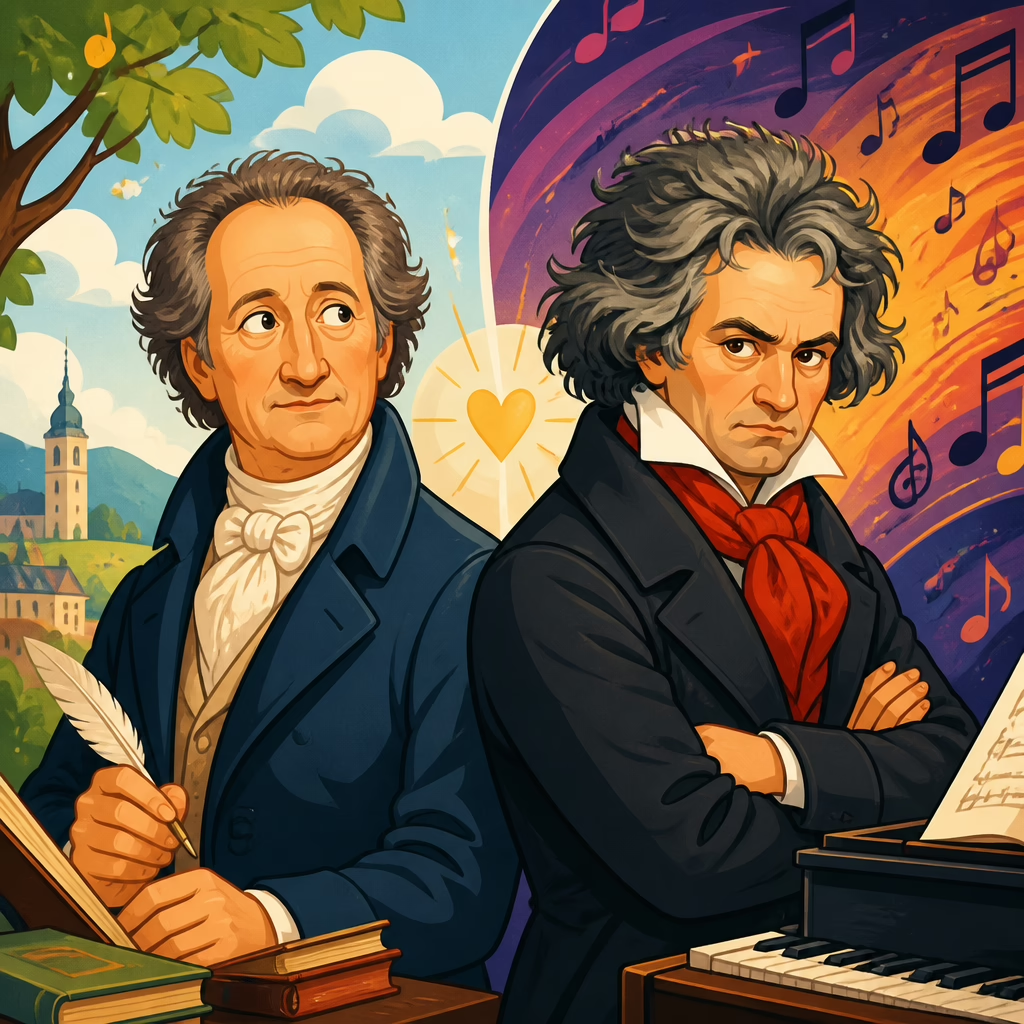
Goethe and Beethoven: Admiration Without Harmony
Goethe and Beethoven met only a handful of times, yet their brief relationship has become one of the most revealing cultural encounters of the early nineteenth century. Each man stood near the summit of his art: Johann Wolfgang von Goethe as the dominant German writer of his age, Ludwig van Beethoven as the composer who reshaped the language of instrumental music. Admiration flowed strongly in one direction and cautiously in the other. Beethoven revered Goethe’s poetry, set his texts, and longed for artistic kinship. Goethe recognized Beethoven’s extraordinary gifts, but he also found him difficult, excessive, and socially unruly. “Admiration without harmony” captures the paradox exactly. They valued each other’s greatness while failing to achieve genuine personal accord. That tension matters because it illuminates larger conflicts between courtly culture and artistic independence, classical restraint and Romantic intensity, social diplomacy and uncompromising genius. Their story is not a sentimental friendship narrative. It is a case study in why two towering creators, sharing language, fame, and historical moment, could still misunderstand one another at the deepest level.
Why Beethoven sought Goethe so intensely
Beethoven’s attraction to Goethe was neither casual nor fashionable. From his Bonn years onward, he absorbed German literature as part of his intellectual formation, and Goethe occupied a central place in that world. The young Beethoven moved among readers shaped by Enlightenment thought, civic reform, and the new prestige of German letters. In that environment, Goethe represented more than a successful author. He embodied cultural authority. Beethoven’s early training also placed him inside a network where literary seriousness mattered alongside musical craft; the background outlined in the main guide on Christian Gottlob Neefe and Beethoven’s earliest training helps explain why he approached poets as artistic equals rather than decorative sources of lyrics.
What drew Beethoven especially was Goethe’s breadth. He was not merely the author of love lyrics suitable for songs. He had written drama, philosophical verse, novels, and works that wrestled with freedom, fate, and inward struggle. Those themes aligned naturally with Beethoven’s mature artistic concerns. When Beethoven composed settings such as “Wonne der Wehmut,” “Neue Liebe, neues Leben,” “Sehnsucht,” and the incidental music to Egmont, he was not using prestigious text as ornament. He was entering into dialogue with a mind he considered profound. In practical terms, Goethe gave Beethoven verbal situations rich in contrast: tenderness against turbulence, introspection against heroic action, private feeling against public duty. Beethoven responded with music that sharpened those oppositions rather than smoothing them away.
This explains why the prospect of meeting Goethe carried unusual weight for Beethoven. He did not seek mere celebrity contact. He wanted recognition from the preeminent German man of letters. Beethoven had already conquered Vienna as a pianist and composer, yet literary endorsement promised something different: confirmation that instrumental music could stand beside poetry as a vehicle of the highest thought. I have always found this crucial when reading Beethoven’s comments about writers and statesmen. He expected art to speak with moral seriousness. Goethe, at least from a distance, appeared to share that expectation.
The 1812 meeting at Teplitz and its immediate promise
Their main encounter took place in 1812 at Teplitz, the Bohemian spa town where aristocrats, officials, artists, and invalids mingled during the season. Beethoven was there for health reasons and social opportunity; Goethe arrived with established fame and ease in elite circles. The setting encouraged introductions, conversation, and display. For Beethoven, this was the long-awaited chance to stand before the poet whose words had already entered his compositional imagination. For Goethe, it was an opportunity to observe the celebrated composer whose reputation had become impossible to ignore.
At first, the meeting seemed promising. They spent time together, exchanged views, and evidently found enough common ground to continue seeing one another during the stay. Beethoven later wrote with warmth about Goethe, calling him too fond of court atmosphere but still speaking from clear admiration. Goethe, in letters to his wife Christiane and others, acknowledged Beethoven’s immense talent. One often quoted remark describes Beethoven’s personality as “uncontrolled,” but the statement is more nuanced than a simple dismissal. Goethe heard authentic greatness in him while also sensing that the force of that greatness disrupted social equilibrium.
Their conversations likely touched on theater, song, and current politics, though surviving evidence is fragmentary. What we can say firmly is that both men arrived with expectations shaped by very different habits of life. Beethoven had built an identity around artistic autonomy. He resisted hierarchy, despised empty ceremony, and believed rank should yield before genius. Goethe, despite his youthful Sturm und Drang associations, had spent decades in Weimar’s administrative and courtly world. He valued form, mediation, and social tact. Those differences did not instantly destroy mutual respect, but they made sustained harmony unlikely from the start.
The famous walk: court etiquette versus artistic sovereignty
No episode reveals the divide more vividly than the oft-retold incident involving the imperial family. During a walk in Teplitz, Goethe and Beethoven encountered members of the court. According to Beethoven’s later account, Goethe stepped aside respectfully, removed his hat, and bowed, while Beethoven kept his course and expected nobles to make way. The story may have been polished in recollection, as such anecdotes often are, but historians broadly accept its core truth because it matches both men’s documented attitudes.
The incident matters not because it proves Beethoven was heroic and Goethe servile, but because it dramatizes incompatible codes of conduct. Beethoven saw deference to rank as a compromise of artistic dignity. He had already broken with patrons, quarreled with princes, and insisted that nobility depended on character rather than title. His famous sentiment to Prince Lichnowsky—there are many princes but only one Beethoven—captures the same posture. Goethe thought differently. He had spent years navigating power structures in Weimar, where influence, patronage, and reform all required etiquette. To him, civility before royalty did not necessarily negate inner independence.
The clash therefore reached beyond personality into political culture. Beethoven belonged emotionally to the age of rights, merit, and heroic individuality, even after Napoleon’s imperial turn had complicated revolutionary ideals. Goethe belonged to a world that prized order, continuity, and disciplined self-command. Neither position was simple. Beethoven’s defiance could become abrasive self-dramatization. Goethe’s composure could shade into accommodation. Yet the Teplitz walk condensed their disagreement into a memorable image: the composer refusing to bend, the poet bending because social reality demanded it.
How Goethe judged Beethoven’s music and temperament
Goethe’s response to Beethoven was respectful but reserved. He clearly perceived extraordinary power. He was not deaf to innovation, nor was he incapable of recognizing force beyond his own aesthetic preferences. Still, Beethoven’s musical language often pressed beyond Goethe’s ideal balance. By 1812 Beethoven had already written works that expanded form, intensified contrast, and treated emotional disruption as structurally meaningful. Goethe, formed by classical proportion and measured articulation, did not always find such intensity congenial.
Temperament complicated the artistic judgment. Goethe repeatedly linked Beethoven’s genius with a lack of self-mastery. That was not casual criticism in Goethe’s vocabulary. Self-command, for him, was a cardinal virtue of both art and life. He distrusted excess, however brilliant its source. Beethoven, by contrast, tended to regard strong feeling and uncompromising expression as signs of authenticity. In practice, this meant that qualities Beethoven considered morally serious could appear to Goethe as undisciplined. Their disagreement was less about whether Beethoven was great than about what greatness should look like when embodied in a person.
It is also telling that Goethe did not become a champion of Beethoven in the way later admirers hoped he might. He offered praise, but not deep advocacy. He did not provide the validating literary embrace Beethoven wanted. From years spent comparing their correspondence, I think this disappointed Beethoven more than he openly admitted. He had expected affinity and encountered appraisal.
How Beethoven read Goethe through music
Beethoven’s most enduring reply to Goethe was musical, and it reveals a richer understanding than the failed personal relationship might suggest. His settings of Goethe’s texts are not uniform in style because he responded to different poetic problems with different compositional tools. In the songs, he often sharpened psychological instability through rhythm, harmony, and abrupt register changes. In Egmont, he translated Goethe’s political tragedy into a musical argument about oppression, resistance, and moral victory.
The overture to Egmont is especially important. Goethe’s play centers on the Dutch nobleman resisting Spanish tyranny, and Beethoven heard in it the language of liberation. The work moves from dark tension toward a concluding “Siegessymphonie,” a victory music that transcends the hero’s death. This is not incidental accompaniment. It is interpretive reading in orchestral form. Beethoven seizes the ethical core of the drama and amplifies it with unmistakable urgency. If Goethe approached power through reflective complexity, Beethoven approached the same subject through struggle made audible.
Even in the smaller songs, Beethoven’s engagement is active rather than obedient. He does not simply mirror poetic mood. He interrogates it. “Neue Liebe, neues Leben,” for example, captures emotional disorientation through restless accompaniment and volatile pacing. “Wonne der Wehmut” balances sweetness with ache instead of resolving the contradiction. These are not polite salon miniatures. They are evidence that Beethoven understood Goethe as a poet of inner conflict, not just polished expression.
Where they aligned, and why that alignment still failed
For all the friction, Goethe and Beethoven did share important ground. Both believed art had serious human purpose. Both resisted trivial entertainment. Both sought forms capable of carrying inner truth. Both also worked with extraordinary discipline, despite the myth that Beethoven created in pure tempest while Goethe floated in Olympian ease. Anyone who studies their manuscripts knows how laborious their achievements were.
Yet shared seriousness did not produce friendship because they differed on the relation between art and life. Beethoven treated the artist’s independence as sacred and public. Goethe treated inward freedom as compatible with outward form. Beethoven dramatized conviction. Goethe moderated it. Beethoven moved toward confrontation; Goethe toward management. In modern terms, they agreed on the value of authenticity but not on its social expression.
| Issue | Beethoven | Goethe |
|---|---|---|
| Relation to rank | Merit above title; often openly defiant | Courtesy within hierarchy; pragmatic adaptation |
| Ideal artistic effect | Transformative intensity and struggle | Balance, clarity, and controlled expression |
| View of genius | Exceptional force justifies independence | Exceptional force requires self-mastery |
| Public behavior | Blunt, impatient, sometimes confrontational | Diplomatic, composed, socially calibrated |
This contrast explains why the relationship remains so instructive. It was not a simple failure of manners or chemistry. It exposed a fault line in German culture at the moment Romantic values were pressing against older classical and courtly norms. Their mutual admiration was real. So was the mismatch.
The afterlife of the encounter in biography and criticism
Later generations turned Goethe and Beethoven into symbols, often oversimplifying both. Nineteenth-century Beethoven worship encouraged readings in which the composer appears as pure democratic hero and Goethe as timid courtier. Other accounts, more sympathetic to Goethe, portray Beethoven as socially impossible and emotionally theatrical. Neither caricature is adequate. The evidence shows two mature artists whose values genuinely diverged.
Biographers return constantly to Teplitz because the meeting seems to promise unity between Germany’s greatest poet and greatest composer, then denies it. That denied expectation gives the story enduring force. Critics have also used the episode to debate classicism versus Romanticism, patronage versus autonomy, and the artist’s role in public life. Those debates persist because the underlying questions remain current. How should creators engage institutions? When does civility become compromise? When does principled independence become vanity? Goethe and Beethoven do not supply a neat answer, but they sharpen the questions magnificently.
The healthiest interpretation, in my view, holds admiration and incompatibility together. Beethoven was right to expect art to command respect beyond rank. Goethe was right to suspect that genius without discipline can consume itself. Their inability to harmonize does not diminish either man. It clarifies them.
Goethe and Beethoven never became the allied titans posterity imagined, and that is precisely why their encounter matters. Beethoven found in Goethe a poet worthy of musical engagement but not a companion in temperament or public principle. Goethe found in Beethoven a composer of overwhelming power but not a model of cultivated balance. Their relationship remained suspended between esteem and unease. That unresolved tension gives us a clearer view of both men than an easier friendship ever could.
The key takeaway is simple: admiration does not guarantee harmony, especially when two creators attach different moral meanings to art, status, and self-command. Beethoven’s settings of Goethe, above all Egmont, prove that artistic understanding can run deeper than personal rapport. At the same time, the Teplitz episode shows how quickly shared greatness can fracture over conduct and values. Read their meeting not as gossip, but as a concentrated lesson in cultural history.
If you want to understand Beethoven’s world more fully, follow this thread backward into his intellectual formation, his literary interests, and the mentors who shaped his seriousness before fame. That wider context makes the Goethe encounter sharper, stranger, and far more human.
Frequently Asked Questions
Why is the relationship between Goethe and Beethoven so historically important if they met only a few times?
The importance of the Goethe-Beethoven relationship lies less in the number of their meetings and more in what those meetings revealed about two towering figures of German culture. Goethe represented literary classicism at its most refined: disciplined, socially graceful, and deeply invested in order, proportion, and cultivated form. Beethoven, by contrast, embodied a more disruptive artistic force. He admired inherited ideals, but he expressed them through a fierce individuality that often challenged social convention, musical tradition, and expectations of decorum. When these two men encountered one another, historians and readers have naturally seen more than a personal acquaintance; they have seen a symbolic meeting between literature and music, classicism and emerging romantic intensity, courtly restraint and artistic independence.
Their brief connection also matters because admiration did exist, especially on Beethoven’s side. Beethoven held Goethe in exceptionally high esteem, setting his texts and regarding him as a poet of rare stature. He wanted recognition not merely from a famous author, but from a cultural authority whose approval carried enormous meaning. Goethe, meanwhile, recognized Beethoven’s talent, yet seems to have remained cautious about the composer’s temperament and manner. That imbalance gives the relationship its enduring fascination. It was not a story of easy friendship or mutual artistic fusion, but of respect complicated by difference. Because both men became cultural giants, even their limited interactions have invited generations of interpretation about art, status, personality, and the changing values of the early nineteenth century.
Did Beethoven truly admire Goethe more than Goethe admired Beethoven?
In broad terms, yes. The evidence strongly suggests that Beethoven’s admiration for Goethe was more intense, emotionally charged, and artistically invested than Goethe’s admiration for Beethoven. Beethoven had long engaged with Goethe’s work before they met. He set Goethe’s poetry to music, most famously in songs such as “Mignon” and “Neue Liebe, neues Leben,” and he was drawn to the emotional and philosophical depth of Goethe’s writing. For Beethoven, Goethe was not simply a successful man of letters; he was a poetic voice capable of matching the seriousness and inward force Beethoven sought in music. Beethoven clearly hoped for a meaningful intellectual and artistic bond.
Goethe’s regard for Beethoven was real, but more measured. He understood that Beethoven possessed extraordinary gifts, and he did not dismiss him. Yet Goethe seems to have been unsettled by the composer’s intensity, irregular manners, and unwillingness to adapt himself to social expectations. Goethe moved comfortably within aristocratic and courtly circles, even when maintaining a degree of inner independence. Beethoven, on the other hand, often insisted on the dignity of the artist in ways that could appear confrontational. This difference affected Goethe’s response. He could appreciate Beethoven’s genius while hesitating before the man himself. So the relationship was not one of indifference on Goethe’s part, but neither was it a meeting of equal warmth. That asymmetry is central to understanding why the phrase “admiration without harmony” fits so well.
What happened during the famous meeting in Teplitz, and why is it remembered so vividly?
The most famous episode associated with Goethe and Beethoven took place in 1812 in the spa town of Teplitz, where both were staying. The story has become legendary because it seems to dramatize their different attitudes toward rank, etiquette, and personal dignity. According to the traditional account, the two men were walking together when they encountered members of the imperial court. Goethe, accustomed to courtly behavior and respectful of established protocol, stepped aside and bowed. Beethoven, by contrast, kept his hat on and walked through the assembled nobility with defiant self-possession, expecting the nobles to acknowledge him as an equal in human worth, if not in formal station.
Whether every detail of the anecdote has been polished by retelling, its symbolic power is undeniable. It captures the contrast between Goethe’s comfort with social order and Beethoven’s insistence on artistic sovereignty. Beethoven reportedly felt disappointed, even pained, by Goethe’s deference to aristocratic authority. Goethe, in turn, likely saw Beethoven’s conduct as needlessly abrasive or socially improper. This moment is remembered so vividly because it condenses a larger historical tension into a single scene: the older world of hierarchy and cultivated civility confronted by a newer idea of genius that refused to bow automatically before inherited status. The Teplitz encounter has endured because it feels larger than biography. It reads almost like a parable about what art meant in a rapidly changing Europe.
How did their artistic values differ, even though both were considered geniuses?
Goethe and Beethoven shared greatness, but they did not define artistic greatness in the same way. Goethe’s mature outlook emphasized balance, clarity, control, and the disciplined shaping of feeling into form. Even when he addressed passion, suffering, or inward conflict, he often valued composure and artistic measure. His classicism was not coldness; it was a belief that art should transform raw emotion into something lucid, durable, and humanly intelligible. Beethoven, while also deeply committed to structure and craft, often projected struggle more openly. His music can feel driven by conflict, rupture, resistance, and triumph hard won. He expanded musical form not by rejecting discipline, but by charging it with unprecedented intensity.
These differences help explain why each may have admired the other without fully entering the other’s world. Beethoven found in Goethe’s texts emotional richness and philosophical seriousness that he could translate into music. Goethe, however, may have found Beethoven’s expressive force overwhelming, especially in comparison with his own ideals of moderation and social poise. The divergence was not simply aesthetic; it was temperamental. Goethe tended toward equilibrium, mediation, and cultivated distance. Beethoven tended toward confrontation, inward necessity, and uncompromising self-assertion. Both pursued truth in art, but they approached it through different emotional climates. That is why their connection remains so revealing: it shows that genius does not automatically produce sympathy, and that artistic excellence can coexist with deep differences in sensibility.
What does the phrase “admiration without harmony” really mean in the case of Goethe and Beethoven?
“Admiration without harmony” captures the central paradox of their relationship. There was admiration, especially Beethoven’s reverence for Goethe’s literary achievement and Goethe’s acknowledgment of Beethoven’s extraordinary musical power. Yet there was no full harmony of temperament, values, or social instinct. They respected one another from across a divide they could never quite bridge. Beethoven wanted a stronger bond than circumstances and personality allowed. Goethe seems to have appreciated Beethoven more from a distance than in intimate companionship. In other words, the obstacle was not lack of talent, intelligence, or cultural significance. The obstacle was incompatibility in the ways they moved through the world and understood the role of the artist within it.
The phrase also points to a broader truth about cultural history. We often imagine great creators naturally recognizing one another and falling into profound alliance. The Goethe-Beethoven case reminds us that admiration can remain partial, cautious, or unresolved. Shared greatness does not erase differences in character. Beethoven saw the artist as a figure who could claim dignity against social hierarchy with uncompromising force. Goethe, though hardly servile, remained more willing to work within established structures of civility and rank. Their relationship therefore becomes a powerful example of how two masters can stand near the summit of their age, recognize each other’s brilliance, and still fail to achieve personal or spiritual accord. That tension is precisely what makes the story so compelling for modern readers.