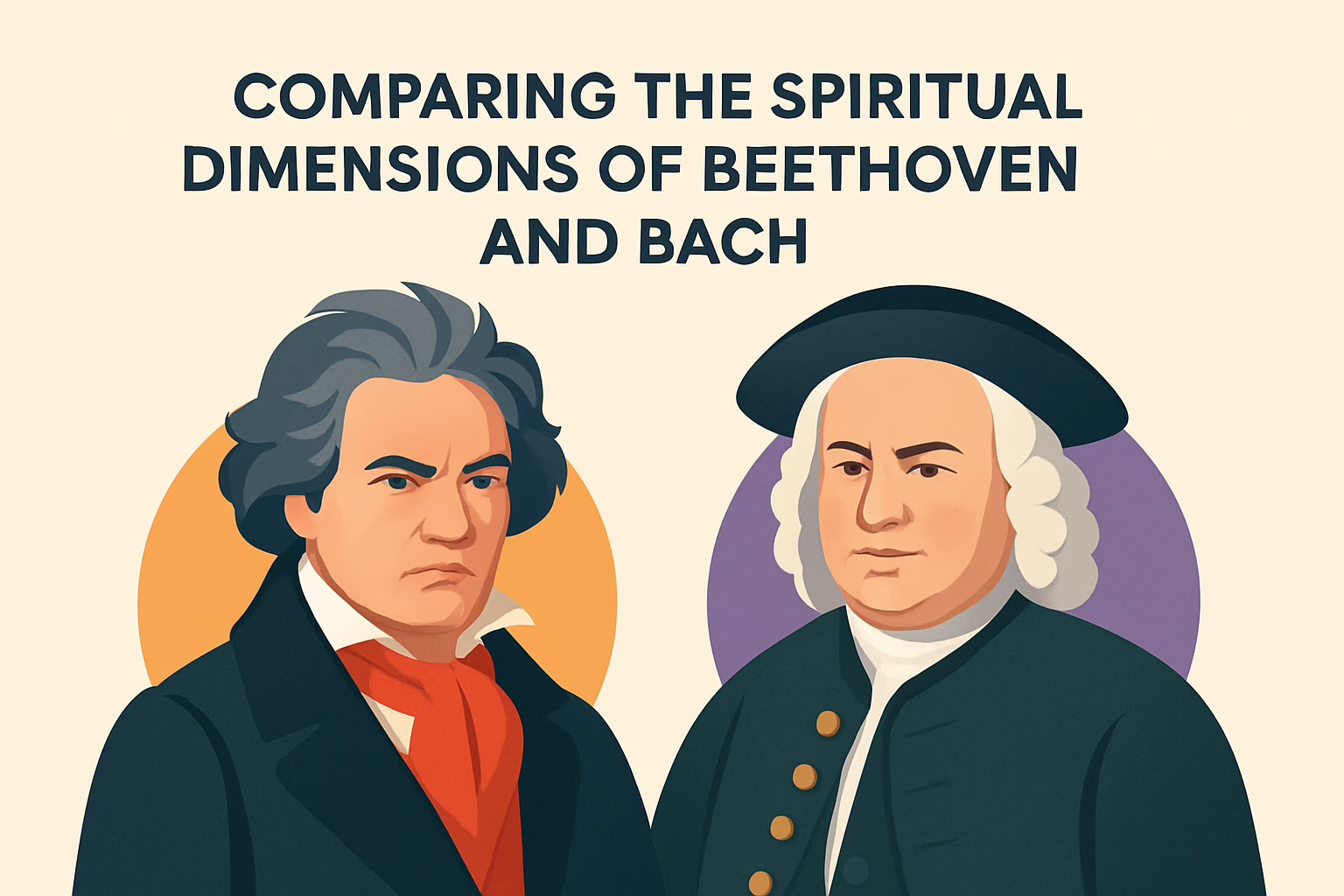
Comparing the Spiritual Dimensions of Beethoven and Bach
The world of classical music is a treasure trove of exceptional artistry, woven with the intricate layers of human emotion and spiritual exploration. Among this pantheon of musical titans, Ludwig van Beethoven and Johann Sebastian Bach stand out for their uniquely profound spiritual dimensions. Each composer offered a transcendent experience through their compositions, embodying their understanding and representation of spirituality, which reflects in the unique tonal architecture of their works. This article strives to understand the spiritual depth inherent in their music, examining how each composer’s spiritual environment shaped their compositions, and why this exploration remains crucial even today.
To delve into the spiritual dimensions of Beethoven and Bach, it’s essential to define what we mean by “spirituality” in musical composition. In this context, spirituality extends beyond religious themes to include the broader quest for meaning, transcendence, and connection with a higher reality that can pervade musical art. Understanding how spirituality is woven throughout the works of these composers not only enriches our appreciation of their music but also offers modern listeners a pathway to engage with their own spiritual journeys. Musicians and listeners alike can gain awareness of how historical spiritual themes can find a modern context, leading to greater cultural and personal enrichment. By exploring how Beethoven and Bach built spiritual narratives within their music, we can appreciate their visionary ability to translate the ineffable into sound, creating universal expressions of the spiritual experience that continue to resonate across centuries.
The Early Years and Formative Spiritual Influences
Both Beethoven and Bach were profoundly influenced by the religious and spiritual traditions of their times, which shaped their musical and spiritual outlook. Johann Sebastian Bach, born in 1685 in Eisenach, Germany, was raised in a deeply Lutheran family. The Lutheran Church’s teachings were integral to his life and provided a consistent source of spiritual and professional inspiration. Bach’s role as a church organist and composer inevitably entwined his music with religious themes, translating his devout faith into some of the most eloquent sacred music ever written. His famous “St. Matthew Passion,” for example, epitomizes the integration of his Lutheran beliefs with his profound musical language, offering a deeply moving narrative of Christ’s crucifixion.
In contrast, Ludwig van Beethoven, born in 1770 in Bonn, Germany, grew up in an environment influenced by the Enlightenment and the age’s evolving religious philosophies. While Beethoven was initially rooted in Catholic traditions, he increasingly distanced himself from organized religion, developing a more personal and philosophical spirituality. Unlike Bach’s explicitly liturgical compositions, Beethoven’s works explore broader themes of human struggle, heroism, and transcendence. His Symphony No. 9, particularly its choral finale “Ode to Joy,” embodies this transition, celebrating universal brotherhood and joy as spiritual ideals.
- Beethoven’s Enlightenment Influence: Marked by rationalism and human-centric spirituality.
- Bach’s Lutheran Devotion: His compositions reflect doctrinal themes and biblical narratives.
Musical Techniques and Expression of Spirituality
The spiritual expressions in the works of Beethoven and Bach often lie in their innovative use of musical forms and techniques. Bach’s mastery of counterpoint and structure allows his music to convey complex theological and spiritual narratives, transcending mere religious adherence to achieve a deeply personal and mystical dimension. His work “The Art of Fugue” exemplifies this, transforming a straightforward musical form into a metaphor for the infinite complexity of divine wisdom. Bach’s use of intricate fugues not only showcased his technical prowess but also underscored the transcendent spiritual journey, inviting listeners to contemplate deeper truths beyond the notes.
Beethoven, on the other hand, is celebrated for his revolutionary approach to form and harmony, which he used to evoke profound emotional and spiritual experiences. His compositions often incorporate dramatic shifts and contrasts that reflect inner struggles and resolutions, akin to spiritual enlightenment. In the “Missa Solemnis,” Beethoven’s treatment of the mass text reveals an intense personal quest for spiritual understanding, characterized by its powerful expressiveness and monumental scope.
Real-World Applications: The Impact and Legacy
The spiritual dimensions present in Beethoven’s and Bach’s music continue to impact musicians, scholars, and audiences around the world. Their compositions serve as a bridge between the sacred and the secular, providing insight into the human condition and our timeless quest for meaning. For instance, Bach’s “Mass in B minor,” although written in an era dominated by religious institutions, is performed today in contexts emphasizing its artistic universality rather than its liturgical function. This shift illustrates the timeless capability of Bach’s music to speak to a broad spectrum of spiritual seekers, regardless of specific religious affiliation.
Similarly, Beethoven’s compositions, particularly his symphonies and late quartets, are frequently interpreted through the lens of philosophical and existential exploration. His Symphony No. 7, renowned for its intense rhythmic vitality and euphoric finale, is often used in modern media and cultural events to signify triumph over adversity, blending artistic brilliance with spiritual aspiration.
| Aspect | Bach | Beethoven |
|---|---|---|
| Spiritual Influence | Lutheran Theology | Enlightenment Philosophy |
| Musical Expression | Complex Counterpoint | Dramatic Contrast |
| Modern Relevance | Universal Spiritual Themes | Existential and Humanist Ideals |
Musical Legacy as Spiritual Heritage
The spiritual legacies of Beethoven and Bach extend far beyond their immediate influence as composers. Their music has become integral to Western culture, shaping not only the evolution of classical music but also inspiring countless individuals in personal reflection and spiritual growth. In contemporary settings, their works are celebrated not merely as historical artifacts but as living art forms that continue to provide comfort, inspiration, and enlightenment to new generations.
Educationally, music conservatories around the globe integrate their works into curricula not only to teach technical proficiency but also to impart lessons in artistic depth and spiritual understanding. Concerts featuring their compositions often aspire to evoke powerful spiritual experiences, engaging audiences in moments of reflection and unity that transcend cultural and temporal boundaries.
Conclusion: The Enduring Spiritual Resonance of Beethoven and Bach
The exploration of the spiritual dimensions in the music of Beethoven and Bach reveals a rich tapestry of ideas, emotions, and transcendent experiences. Their unique approaches to spirituality within their compositions not only created profound musical legacies but also offered tools for personal and collective reflection. By translating visions of transcendence into sound, these composers crafted works that speak directly to the human soul, continuing to offer solace and inspiration in a complex world.
The study of their music encourages us to explore our own spiritual dimensions, prompting reflection on our connections to the past, each other, and the broader universe. As we listen to Beethoven’s stirring symphonies or immerse ourselves in Bach’s intricate fugues, we are invited to journey beyond the notes and discover a deeper understanding of ourselves. To truly appreciate their music, we should actively engage with it, explore its themes, and allow it to enrich our spiritual lives. By doing so, we not only honor their legacy but also participate in an ongoing dialogue about the role of music in both personal and universal human experience.
As you delve deeper into their musical oeuvres, consider attending live performances or exploring in-depth studies of specific works. Allow the spiritual depth within their music to guide you in discovering new realms of introspection and appreciation, ensuring that the spiritual legacies of Beethoven and Bach remain ever vibrant and relevant.
Their music continues to serve not only as a testament to artistic genius but also as a timeless beacon for those on a spiritual quest, affirming that the pursuit of the divine through art is as relevant today as it was in their time.
Frequently Asked Questions
1. How do Ludwig van Beethoven and Johann Sebastian Bach differ in their approach to spirituality in music?
When comparing the spiritual dimensions of Beethoven and Bach, it’s critical to consider the historical and personal contexts that shaped their approaches to music. Johann Sebastian Bach, living and composing during the Baroque period, was heavily influenced by his deep Lutheran faith. His compositions are often seen as acts of devotion, crafted with the intention of glorifying God. This intention is palpably evident in works like the “Mass in B Minor” and his multitude of sacred cantatas. Bach’s music often reflects a structured spiritual order, with intricate counterpoints and harmonies symbolizing divine perfection.
In contrast, Ludwig van Beethoven, composing during the ensuing Classical and Romantic periods, had a more personal and, at times, tumultuous relationship with spirituality. His approach was deeply introspective, often reflecting his struggles with deafness and personal turmoil. Beethoven saw music as a bridge to the divine, a medium of personal and universal transcendence rather than strict religious devotion. This perspective is notably present in his later works like the “Missa Solemnis” and the final movements of his Ninth Symphony, where music becomes a celebration of human dignity and divine joy.
2. Can you explain the role of personal adversity in shaping the spiritual dimensions of Beethoven’s music?
Beethoven’s life was fraught with personal challenges and adversities, which profoundly influenced the spiritual depth of his music. Perhaps one of the most significant adversities he faced was his progression towards complete deafness. This personal struggle forced Beethoven to grapple with feelings of isolation and despair, yet he channeled these emotions into a source of creative and spiritual strength. His music from this period reflects a heroic struggle against fate, embodying a dynamic range from profound suffering to ultimate triumph.
This sense of overcoming hardship is powerfully expressed in works such as the “Heiligenstadt Testament,” a letter he wrote reflecting on his despair over his encroaching deafness, and his pivotal Symphony No. 9. This symphony, with its choral setting of “Ode to Joy,” transforms personal adversity into a universal message of unity and hope, thus displaying the profound spiritual perseverance that characterized Beethoven’s later life and compositions.
3. In what ways does Johann Sebastian Bach’s music reflect his spiritual beliefs?
Bach’s spirituality is deeply embedded in the fabric of his music, most prominently through his use of religious texts and themes. Being a devout Lutheran, Bach always saw his music as an expression of worship and faith. His works frequently use biblical texts and liturgical themes, which are elaborated upon in the form of sacred cantatas, oratorios, and motets. The “St. Matthew Passion” and “St. John Passion,” for instance, are monumental works that recount the Passion of Christ with profound emotional and spiritual depth, portraying a complex, yet deeply personal faith.
Moreover, Bach’s use of complex counterpoint and fugues can be seen as a reflection of divine order and perfection – characteristics that are in line with his belief in God as the ultimate creator of harmony and structure. The meticulous craft of his compositions mirrors an orderly universe where every note and rest is purposeful, symbolizing a divine attention to detail.
4. What are some key compositions that highlight Beethoven’s spiritual explorations?
Beethoven’s spiritual explorations are vividly captured through a variety of his works, each reflecting different stages of his personal and philosophical evolution. One of his most revered compositions, the “Missa Solemnis,” was designed to accompany the installation of his patron, Archduke Rudolph, as Archbishop of Olomouc. However, the piece transcended its initial ceremonial purpose to become a profound spiritual statement. This masterwork embodies Beethoven’s exploration of the sacred, blurring the lines between religious observance and personal introspection.
Additionally, his late string quartets, such as Opus 132 featuring the “Heiliger Dankgesang” movement, reflect a deep introspection and appreciation for divine healing – a poignant reflection against his personal health struggles. His Ninth Symphony, with its final choral movement based on Schiller’s “Ode to Joy,” represents an apex of Beethoven’s spiritual vision: a utopian vision of humanity united, speaking to both individual and collective transcendence.
5. How do historical contexts play a role in shaping Bach and Beethoven’s spiritual music?
The historical and cultural contexts in which Bach and Beethoven composed their music greatly influenced their spiritual dimensions. Bach’s compositions were deeply rooted in the Baroque tradition, a period characterized by intricate musical structures and a strong association with the church. Living in a time where music was often interwoven with religious services, Bach’s work largely served liturgical purposes. His role as Kapellmeister and Cantor in Leipzig also meant that much of his output was dedicated to church music, thus heavily integrating his spiritual beliefs into his musical legacy.
On the other hand, Beethoven composed in the Classical period transitioning into Romanticism, a time when music began to express individualism and emotional expression. This era allowed Beethoven the freedom to explore and expand the expressive capacity of music beyond strict forms and religious themes. These broader cultural shifts enabled him to explore deeper philosophical and existential questions, reflecting an inner spirituality often tied to humanistic ideals, personal resilience, and universal connection, rather than mere religious ritual.