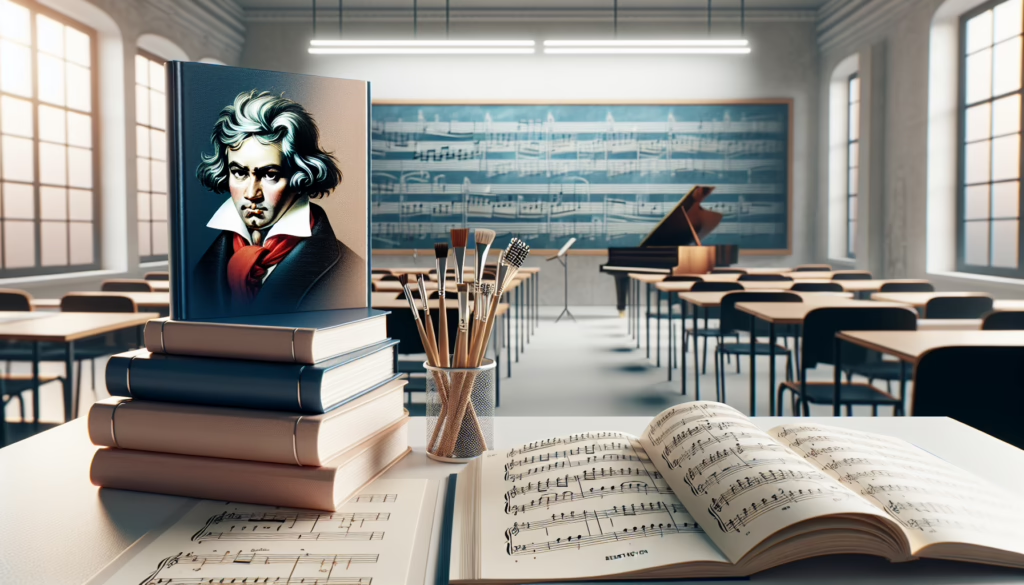
Classical Music in the Classroom: The Beethoven Model
Classical music in the classroom is no longer a niche enrichment idea; it is a practical teaching strategy that can support attention, structure, historical understanding, emotional literacy, and creative thinking when used with purpose. In this context, the Beethoven model means using Ludwig van Beethoven’s music, biography, working methods, and cultural legacy as a flexible framework for instruction across subjects. I have seen this approach work best when teachers stop treating Beethoven as a distant monument and start presenting him as a case study in discipline, experimentation, adversity, and artistic problem solving. That matters because schools need interdisciplinary tools that are memorable, academically defensible, and adaptable from elementary classrooms to university seminars. Beethoven offers exactly that combination: recognizable music, rich historical documentation, clear links to social studies and language arts, and a body of work that lets students hear change, contrast, and intention. A well-designed Beethoven-centered classroom approach can turn classical music from background sound into a meaningful, teachable resource.
What the Beethoven model means in education
The Beethoven model is a teaching framework built around four usable elements: listening, context, analysis, and creation. Listening gives students direct contact with the music. Context places the music inside the political, cultural, and personal realities of late eighteenth- and early nineteenth-century Europe. Analysis helps students identify patterns such as motif, form, instrumentation, tempo, and dynamics. Creation asks them to respond by writing, performing, debating, composing, or making connections to other disciplines. In practice, this model is more effective than passive exposure. Simply playing a symphony during independent work rarely produces measurable learning. Guided listening with a clear objective does.
Beethoven is especially useful because his catalog includes short, teachable examples and large works with obvious structural landmarks. The opening four-note motif of Symphony No. 5 is one of the most accessible examples of thematic development in Western music. “Ode to Joy” from Symphony No. 9 is widely known, easy to sing in simplified arrangements, and linked to ideas of unity and citizenship. The “Moonlight” Sonata invites discussion about mood, interpretation, and the mismatch that can occur between popular nicknames and composer intent. These pieces allow teachers to scale complexity without abandoning rigor.
Another reason this model matters is that it supports transfer. When students learn to hear repetition and variation in Beethoven, they become better at noticing structure in poetry, rhetoric, and even mathematical reasoning. When they study patronage, publishing, and public concerts, they gain a clearer view of how creative work circulates in society. When they examine Beethoven’s sketchbooks, they learn that excellence usually comes from revision rather than instant inspiration. That lesson lands with students because it is concrete. They can see drafts, changes, crossings-out, and persistent refinement.
Why Beethoven works across subjects
In cross-curricular planning, Beethoven is unusually versatile. In music classes, he anchors instruction on sonata form, symphonic writing, chamber music, piano literature, orchestration, and the transition from Classical to Romantic style. In history classes, he opens discussions about Vienna, the Napoleonic era, Enlightenment ideals, aristocratic patronage, and the rise of the public concert economy. In English language arts, his letters and accounts from contemporaries support close reading, tone analysis, and argument writing. In social-emotional learning, his hearing loss and persistence provide a grounded entry point into resilience, identity, frustration, and adaptation.
I have found that teachers get the strongest results when they frame Beethoven not as “great because experts say so,” but as “important because his work changed expectations.” Before Beethoven, many composers operated more clearly within courtly or church structures. Beethoven still depended on patrons, yet he also expanded the model of the composer as an independent artistic force whose personal vision could reshape form, scale, and audience expectations. Students can grasp that change. It parallels shifts they see in technology, media, and entrepreneurship, where established rules are often reworked by people who understand the system deeply enough to challenge it.
The relevance also extends to classroom culture. Beethoven’s music makes high-level concepts audible. Tension and release, balance and disruption, unity and contrast, struggle and resolution are not abstract phrases when students can hear them. That sensory quality helps mixed-ability classrooms. A student who struggles with technical vocabulary may still recognize a sudden dynamic change, a repeated rhythm, or a dramatic silence. From there, language can be built around direct perception.
Core classroom uses: listening, discussion, and project design
The most successful classroom use of classical music begins with intentional listening tasks. Ask students to track one element: rhythm, mood shifts, instrument families, recurring motifs, or dynamic contrast. For younger learners, a movement map works well; they draw or label what changes when the music changes. For older students, compare two recordings of the same work and ask which interpretive choices alter the emotional effect. This turns listening into evidence-based analysis rather than opinion alone.
Discussion should connect sound to meaning. A productive sequence is simple: what did you hear, how did the composer create that effect, and why might that effect matter in its historical or dramatic context? For example, with Symphony No. 3, “Eroica,” students can hear expanded scale and intensity, then connect those traits to changing political ideals and Beethoven’s complex response to Napoleon. With Symphony No. 6, the “Pastoral,” they can discuss how instrumental music can suggest scenes without becoming literal sound design. Those are foundational questions in arts education and literary interpretation alike.
Projects work best when they ask students to make something from evidence. A middle school class might create a “Beethoven survival guide” explaining his era, major works, and challenges in student-friendly language. A high school humanities class might stage a mock salon debate on whether music without words can communicate moral or political ideas. A college survey course might analyze a sketchbook page alongside the finished passage to study revision. Each version uses the same hub idea: Beethoven is not just content to memorize; he is a lens for inquiry.
| Classroom goal | Beethoven resource | Practical activity | Learning outcome |
|---|---|---|---|
| Focused listening | Symphony No. 5, first movement | Track the four-note motif across the movement | Students identify repetition, variation, and structure |
| Historical context | Symphony No. 3, “Eroica” | Discuss Beethoven, Napoleon, and changing political ideals | Students connect art to historical events |
| Emotional literacy | Piano Sonata No. 14, “Moonlight” | Write a response comparing mood and musical choices | Students support interpretation with evidence |
| Revision and process | Beethoven sketchbooks | Compare draft ideas with final passages | Students see creativity as iterative work |
| Performance and community | Symphony No. 9, “Ode to Joy” | Sing or analyze a classroom arrangement | Students explore ensemble, text, and civic themes |
Common misconceptions and how teachers should handle them
One common mistake is using classical music only as a productivity soundtrack and then claiming broad academic benefits. Research on background music is mixed and highly dependent on task type, familiarity, volume, and learner preference. Quiet instrumental music may help some students during routine work, but it can also distract others, especially during reading-heavy or language-intensive tasks. The stronger educational case is not “Beethoven makes students smarter.” It is “Beethoven, taught deliberately, strengthens listening, analysis, cultural literacy, and expressive capacity.” That claim is more accurate and more defensible.
A second misconception is that Beethoven is automatically inaccessible because the music is old or complex. In reality, access depends on framing. If students enter through one vivid question, the barrier drops. Why does the opening of Symphony No. 5 feel so urgent? How can a piece without words tell a story? What does it mean that Beethoven continued composing while losing his hearing? These are human questions before they are specialist questions. Once curiosity is active, technical learning becomes easier.
A third issue is hero worship. Beethoven was extraordinary, but classroom teaching should avoid flattening him into a myth of solitary genius. He was shaped by teachers, performers, patrons, publishers, copyists, instrument makers, and audiences. He also lived within social hierarchies and economic realities that matter historically. Presenting that fuller picture does not reduce his achievement. It improves historical accuracy and gives students a better model of how creative ecosystems actually function.
Resources, standards, and teaching methods that strengthen results
Teachers who want a reliable Beethoven in education plan should combine strong source material with recognized instructional methods. Primary sources include letters, documented conversations, early editions, and surviving sketchbooks. Reputable secondary support comes from conservatory archives, major orchestras, university music departments, and critical biographies. For recordings, compare interpretations from conductors and performers with distinct approaches rather than relying on a single version. Students learn quickly that tempo, phrasing, articulation, and balance change what they hear.
From a pedagogy standpoint, backward design is highly effective. Start with the desired outcome, such as “students will explain how a musical motif creates coherence,” then choose the Beethoven excerpt that best demonstrates it. Universal Design for Learning also fits this topic well. Offer multiple means of engagement by pairing audio with score excerpts, timelines, images, movement, or discussion. Offer multiple means of expression by allowing essays, presentations, annotations, or performances. This makes a Beethoven-centered lesson more inclusive without lowering standards.
Assessment should measure specific understanding. Useful options include short listening quizzes on motif recognition, reflection prompts tied to historical evidence, comparative analysis of recordings, and project rubrics that reward accurate terminology and clear reasoning. In my experience, the most revealing assessments ask students to transfer a concept. If they can explain thematic development in Beethoven and then identify a similar pattern in a film score or speech, the learning has moved beyond recall.
Building a hub around miscellaneous Beethoven classroom topics
As a hub page within Beethoven in Education, miscellaneous coverage should organize the many questions teachers and curriculum planners actually ask. That includes age-appropriate repertoire, classroom management during listening, interdisciplinary lesson ideas, accommodations for diverse learners, performance options for non-specialists, digital resources, copyright considerations for modern editions and recordings, and guidance on discussing disability responsibly. A strong hub does not bury these issues. It surfaces them clearly so users can move to deeper articles on each subtopic.
For example, one linked article might focus on Beethoven and social-emotional learning, using the Heiligenstadt Testament to examine frustration, identity, and perseverance without reducing disability to inspiration alone. Another might cover Beethoven and history, tracing Vienna, Napoleon, and the Congress of Vienna. Another could explain how to teach sonata form using short excerpts before expanding to full movements. Another could address ensemble adaptations, including simplified “Ode to Joy” arrangements for recorder, keyboard, choir, or mixed classroom instruments. This hub’s role is to define the landscape and help educators choose an entry point that matches their goals.
Miscellaneous does not mean unfocused. It means broad but navigable. The best hub pages answer immediate questions, establish trustworthy scope, and point readers toward specialized resources. For Beethoven in the classroom, that breadth is a strength. One teacher may need a five-minute listening routine for general music, while another needs a semester-long interdisciplinary unit. Both should be able to start here and find a clear next step.
Conclusion
The Beethoven model works because it turns classical music into an active teaching tool rather than a decorative extra. At its strongest, it combines guided listening, historical context, close analysis, and student creation. Beethoven’s music offers memorable motifs, dramatic contrasts, and widely documented creative processes, while his life opens serious conversations about resilience, revision, patronage, politics, and culture. Used carefully, this approach supports music education, humanities teaching, and broader classroom goals such as attention, interpretation, and evidence-based discussion. It also avoids the weakest claims often made about classical music by focusing on teachable outcomes instead of vague promises.
For educators building a Beethoven in Education curriculum, this hub should serve as the practical starting point. Use it to identify the classroom purpose first, then select the Beethoven work, source material, and activity that match that purpose. Keep the listening intentional, the context accurate, and the assignments concrete. When you do, Beethoven stops being a symbol of elite culture and becomes what teachers need most: a durable, flexible resource for deep learning. Choose one piece, one question, and one classroom application, and build from there.
Frequently Asked Questions
What does “the Beethoven model” mean in a classroom setting?
The Beethoven model is an instructional approach that uses Ludwig van Beethoven as more than a composer to be briefly mentioned in a music unit. Instead, it treats his music, life story, creative process, historical context, and long-term cultural influence as a flexible teaching framework that can support learning across subjects. In practice, that means teachers might use a Beethoven symphony to shape focused listening routines, his biography to explore perseverance and identity, his sketchbooks to discuss revision and the writing process, and the political climate of his era to strengthen history instruction. The model works especially well when Beethoven is presented not as a distant genius on a pedestal, but as a complex human being who experimented, struggled, adapted, and produced work that still invites interpretation.
This approach is effective because it gives teachers a coherent anchor point. Rather than bringing classical music into the classroom as background sound with no clear purpose, the Beethoven model links listening and discussion to specific learning goals. A teacher might use short excerpts to train attention and pattern recognition, compare different performances to develop analytical language, or connect Beethoven’s compositions to broader themes such as change, conflict, emotion, discipline, and innovation. The result is a classroom strategy that is culturally rich but also practical: it supports content knowledge, close observation, discussion skills, and creative thinking in ways that feel integrated rather than decorative.
How can Beethoven’s music improve attention and classroom structure without becoming a distraction?
Beethoven’s music can support attention and structure when it is used intentionally, with clear routines and a defined purpose. The key is not to assume that any classical music automatically improves concentration. Instead, teachers should match the music to the task. For example, a calm, familiar instrumental excerpt can be used as a predictable signal for entry, journaling, silent reading, reflection, or transition time. More dramatic passages can be used in short bursts for analysis, movement, or emotional interpretation, but they are usually less effective as continuous background during cognitively demanding tasks that require heavy language processing. The value comes from consistency and design: students learn to associate certain musical cues with certain behaviors, which helps create structure and reduces wasted time.
Beethoven is particularly useful because his music offers strong contrasts, memorable motifs, and recognizable architecture. Teachers can use those qualities to help students notice patterns, anticipate shifts, and discuss how structure works in art and in thinking. A short opening motif, a repeated rhythmic figure, or a gradual build in intensity can become a practical way to train listening stamina and self-regulation. To avoid distraction, teachers should keep selections brief at first, set expectations before playing, and give students something specific to listen for, such as dynamics, repetition, mood, or instrumentation. When students know why the music is being used and what they are expected to do with it, Beethoven’s work becomes a tool for focus rather than just classroom atmosphere.
In what ways can the Beethoven model support subjects beyond music?
One of the strongest arguments for the Beethoven model is that it naturally crosses disciplinary boundaries. In history or social studies, Beethoven opens the door to discussions about the Enlightenment, revolution, nationalism, patronage, social class, and the shifting role of the artist in European society. Students can study the historical forces that shaped his world and examine how artistic work reflects political and cultural change. In language arts, his letters, reported conversations, and biographical episodes can be used to teach narrative voice, argument, tone, point of view, and revision. His sketchbooks are especially valuable because they show that powerful creative work often comes from drafting, reworking, and refining ideas rather than producing perfection on the first attempt.
In science and health, Beethoven’s hearing loss invites age-appropriate conversations about sound, the ear, disability, adaptation, and the relationship between physical limitations and human creativity. In social-emotional learning, students can reflect on frustration, resilience, identity, isolation, discipline, and expression through both his biography and his music. In art or creative projects, students can translate musical ideas into visual design, movement, poetry, or storytelling. Even mathematics can be included through rhythm, pattern, sequence, proportion, and formal structure. The point is not to force Beethoven into every lesson, but to use him as an organizing lens when it helps students make meaningful connections. When done well, the model shows students that knowledge is interconnected and that music can be a serious way of thinking, not just an extracurricular add-on.
How do teachers use Beethoven in a way that feels engaging and modern rather than old-fashioned or elitist?
The most important shift is to stop presenting Beethoven as a symbol of cultural prestige and start presenting him as a case study in creativity, struggle, experimentation, and influence. Students are much more likely to engage when they are invited to ask real questions: How does someone keep working under pressure? What does revision look like in any field? Why does some art survive across centuries? How do performance choices change meaning? How can one short musical idea become something much larger? These questions immediately make Beethoven relevant because they connect to processes students already know from writing, problem-solving, teamwork, and self-expression.
Teachers can also make the material feel current by using comparison, interpretation, and student voice. Rather than simply announcing that a piece is important, they can let students compare two recordings, describe emotional differences, map a listening journey, debate whether a passage sounds defiant or hopeful, or connect a Beethoven motif to modern film music and contemporary storytelling. It also helps to acknowledge complexity. Beethoven should not be flattened into a flawless hero; he was a brilliant and difficult person living in a specific historical moment. That honesty builds credibility. When students encounter him as a real artist whose work can still be argued over, reinterpreted, and connected to modern questions, the classroom experience becomes more dynamic, inclusive, and intellectually alive.
What are the best practices for introducing the Beethoven model to students who have little or no background in classical music?
Start small, stay concrete, and build familiarity over time. Students do not need prior knowledge of classical music to respond thoughtfully to Beethoven, but they do need guidance in how to listen and what to notice. A strong entry point is a short, striking excerpt paired with a simple prompt: What do you hear repeating? Where does the music change? What mood does it suggest? What kind of scene could this accompany? From there, teachers can introduce basic vocabulary such as tempo, dynamics, motif, contrast, and form in direct, usable ways. It is usually more effective to revisit a few excerpts several times than to rush through many pieces with little depth. Repetition builds confidence, and confidence makes interpretation possible.
It is also important to connect the listening experience to visible and relatable evidence. Students can examine a timeline of Beethoven’s life, look at images of manuscripts and sketchbooks, read a short quotation, or track how a musical idea evolves within a piece. Structured discussion, quick writes, drawing responses, and collaborative analysis all help make the experience active rather than passive. Teachers should avoid assuming that students will automatically value the material because of Beethoven’s reputation. Instead, they should create value through good pedagogy: clear questions, accessible entry points, frequent opportunities for response, and explicit links to larger learning goals. When introduced this way, the Beethoven model becomes approachable even for beginners, and students often discover that classical music is not remote at all—it is organized emotion, pattern, decision-making, and storytelling that they can learn to hear.