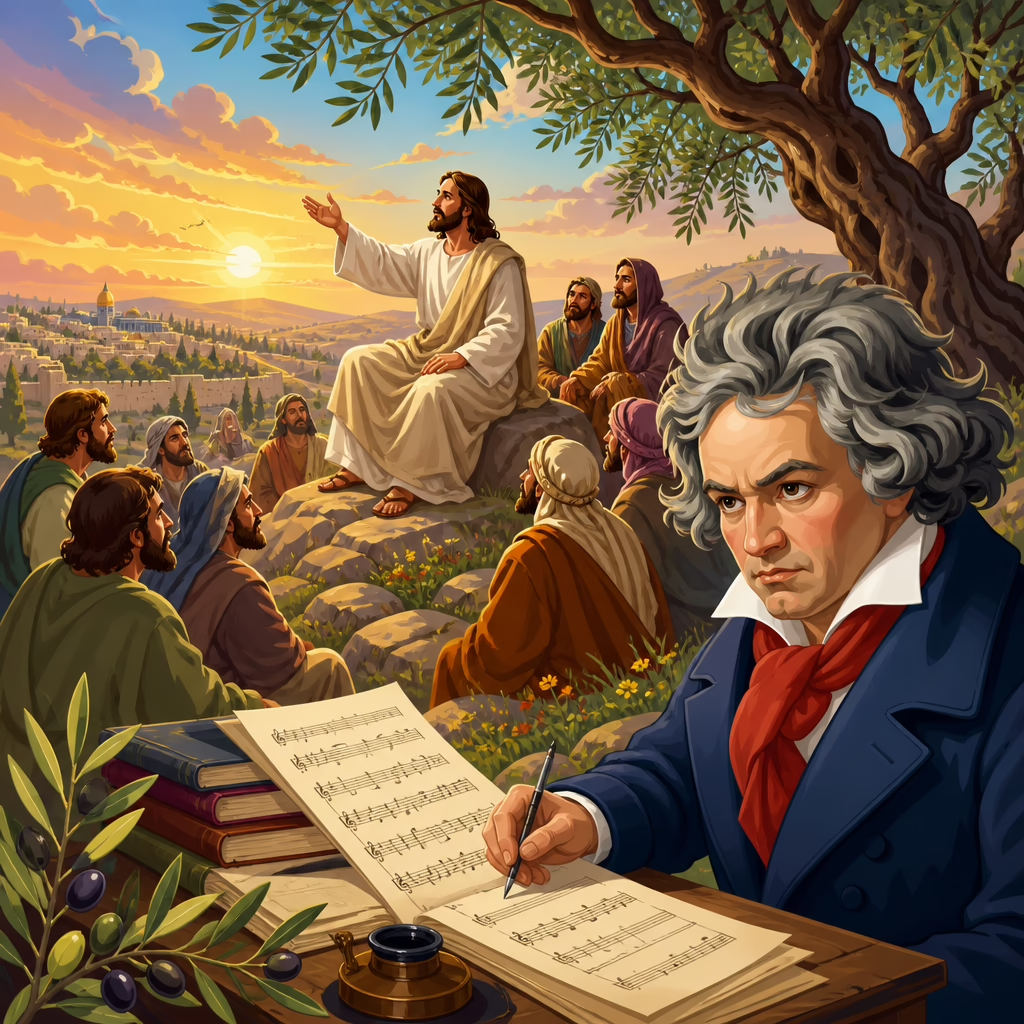
Christ on the Mount of Olives: Beethoven’s Other Sacred Drama
Christ on the Mount of Olives is one of Beethoven’s least discussed major vocal works, yet it reveals a great deal about his religious imagination, dramatic instincts, and ambitions as a composer at a turning point in his career. Known in German as Christus am Ölberge, Op. 85, the work is an oratorio-like sacred drama premiered in Vienna in 1803, the same extraordinary period that also produced the “Eroica” Symphony and the first sketches for several middle-period masterpieces. In practical terms, it sits uneasily between genres: not a liturgical church piece, not an opera, and not a full-scale Handelian oratorio in the English sense. That in-between identity helps explain both its historical neglect and its fascination. When I return to the score, what stands out is how directly Beethoven treats the emotional crisis in Gethsemane. Instead of presenting a broad biblical panorama, he narrows the lens to anguish, prayer, temptation, angelic consolation, and eventual triumph. For listeners who know Beethoven primarily through symphonies, piano sonatas, or even the late Mass in D, this work matters because it captures him experimenting with sacred theater in a concentrated, highly personal way.
The key terms are worth defining clearly. A sacred drama is a religious work designed for concert presentation rather than staged worship or grand opera, though it may use operatic devices such as recitative, aria, chorus, and sharply contrasted characters. In this case, the principal solo roles are Jesus, the Seraph, and Peter, while the chorus alternates functions, representing angels, soldiers, and disciples. The text, by Franz Xaver Huber, does not simply reproduce scripture; it paraphrases and expands the Gospel scene of Christ on the Mount of Olives before the arrest. That choice gives Beethoven room for psychological intensity, but it also introduces the central critical issue surrounding the work: the libretto has often been judged conventional, even weak, while the music frequently exceeds it. Understanding that tension is essential if we want to hear the piece on its own terms rather than dismiss it as a flawed precursor to later sacred masterpieces.
Historical moment and Beethoven’s purpose
Beethoven composed Christ on the Mount of Olives quickly for a benefit concert at the Theater an der Wien on 5 April 1803, one of the most significant self-curated events of his early Viennese career. The same concert also included the premieres of the Second Symphony and the Third Piano Concerto. That context matters because the work was not an isolated devotional exercise; it was part of Beethoven’s public artistic positioning. He wanted to demonstrate range: symphonic command, pianistic virtuosity, and the ability to handle a large vocal-dramatic canvas. In Vienna at the time, sacred subjects in concert halls were entirely viable, especially during Lent, when opera houses were restricted and audiences welcomed morally elevated dramatic music. Beethoven therefore had a practical opportunity to write something spiritually serious while also theatrically compelling.
Biographically, the timing is impossible to separate from the Heiligenstadt period. In 1802 Beethoven had written the Heiligenstadt Testament, confronting his increasing deafness and despair. While it would be simplistic to read the work as autobiography in disguise, the subject of solitary struggle before suffering was one he could hardly have approached impersonally. I hear that personal pressure in the tenor writing for Jesus, which demands not detached sanctity but human agitation, pleading, and resolve. Beethoven emphasizes the emotional extremity of the scene far more than static reverence. That approach aligns with his broader middle-period tendency to dramatize crisis as the precondition for victory.
Huber’s libretto follows an 18th-century devotional style rather than strict biblical language, and that has long limited the work’s reputation. Critics from the 19th century onward often complained about sentimentality and generalized expression. Those criticisms are not baseless, but they can obscure what Beethoven was trying to do. He selected a single scriptural episode and reshaped it into a conflict narrative with immediate stage energy. The result may not satisfy listeners seeking theological depth comparable to Bach’s Passions, yet it succeeds on dramatic concentration. The work lasts roughly fifty minutes, depending on cuts and tempi, and never loses sight of its core question: how does fear transform into willing sacrifice?
What happens in the work
The drama unfolds in one continuous arc rather than in the vast, episodic structure of a full oratorio. Jesus begins in anxiety, wrestling with the suffering ahead and asking the Father whether the cup might pass from him. The Seraph enters as a consoling messenger, affirming divine purpose and strengthening him. Peter appears with an impulse toward action and defense, embodying the disciple’s earthly misunderstanding of spiritual necessity. Meanwhile, the chorus shifts perspective repeatedly. At times it offers heavenly reassurance; at others it embodies hostile forces approaching to seize Christ; later it voices the disciples’ confused loyalty. Beethoven uses these transitions to create rapid changes in color without expanding the cast.
One reason the work can surprise modern listeners is its almost operatic profile. Jesus is written for heroic tenor, not bass, and the vocal line frequently rises into exposed, urgent declamation. This is not the older convention of assigning Christ a grave, unshakable sonority. Beethoven instead presents vulnerability in sound. The Seraph, usually sung by soprano, brings lyrical radiance and smoother line, acting as both comforter and theological interpreter. Peter, typically a bass, introduces firmness and muscular rhythm. In performance, those contrasting timbres clarify the emotional architecture even when audiences do not follow every word of the German text. Beethoven understood characterization through voice type in a deeply theatrical way, and that instinct gives the score immediate accessibility.
The chorus deserves equal attention because it is the engine of scale. Beethoven writes forcefully for collective voices, often in sharply etched blocks that anticipate his later instinct for public utterance. Even in this relatively early score, he knows how to make a chorus sound like more than accompaniment. The angels do not merely decorate; they stabilize the work’s moral horizon. The soldiers do not simply enter; they disturb the texture with real dramatic threat. The closing music, with its emphasis on victory through submission, can sound stylistically closer to Beethoven’s civic ceremonial mode than to inward church music. That is one reason some listeners find the ending exhilarating and others find it mismatched to Gethsemane. Both reactions are understandable, and both arise from Beethoven’s determination to convert private agony into universal proclamation.
Musical language, structure, and style
From a structural standpoint, Christ on the Mount of Olives is built from recitative, aria, ensemble, and chorus, but Beethoven treats these inherited forms with unusual urgency. The opening orchestral writing establishes tension immediately rather than providing a neutral introduction. Recitative often spills toward arioso, and arias are shaped less as decorative set pieces than as emotional pressure zones. Beethoven’s instinct is always directional: he pushes phrases forward, thickens harmony at moments of spiritual conflict, and uses orchestral punctuation to intensify every rhetorical turn. This is why the music can remain compelling even when the text feels generalized.
In practical musical terms, the score shows Beethoven testing how sacred subject matter can coexist with the high-voltage dramatic rhetoric associated with his concert and theatrical writing. The orchestration is not as radical as in the later symphonies, but it is far from routine. Strings carry nervous motion in Jesus’s scenes, winds often color moments of consolation, and brass help mark collective declarations. Harmonic contrast is one of the work’s chief strengths. Beethoven moves quickly between darkness and reassurance, often using tonal shifts to frame Christ’s inward transformation. The effect is not mystical suspension; it is conflict in motion.
| Element | How Beethoven uses it | Dramatic effect |
|---|---|---|
| Recitative | Heightened, orchestral, often driving toward aria | Creates immediacy and psychological tension |
| Aria | Focused on crisis or consolation rather than ornament | Lets each character define a distinct emotional stance |
| Chorus | Alternates between angels, disciples, and soldiers | Expands the scene from private prayer to public conflict |
| Orchestra | Uses contrast in texture, dynamics, and tonal color | Turns a scriptural episode into living drama |
Listeners familiar with Beethoven’s later sacred music will notice what is absent as much as what is present. There is little of the contrapuntal depth or liturgical grandeur of the Missa solemnis. Instead, the style is closer to the expressive world of early 19th-century Viennese stage music, though with a stronger symphonic backbone than most occasional sacred works of the day. Some numbers can sound conventionally Italianate in contour, especially in the solo writing, and this has sometimes been held against the piece. I think that criticism misses a central fact: Beethoven was not trying to write archaic church music. He was trying to speak to a contemporary public in a language they recognized, then intensify that language through his own sense of struggle and release.
Reception, criticism, and why the work faded
The work was initially successful enough to remain in circulation during Beethoven’s lifetime, and the composer revised it after the premiere. Yet it never achieved secure canonical status. There are several reasons. First, the libretto was repeatedly criticized for lacking poetic distinction. Second, Beethoven himself later produced sacred works of much greater perceived profundity, inviting comparison the earlier score could not easily win. Third, the piece falls between institutional settings. It is not indispensable in church repertory, not a standard staged opera, and not a festival oratorio on the scale that choral societies often prefer. Programming economics matter in repertory history, and this work has always occupied an awkward niche.
There is also a stylistic issue. Modern audiences often approach Passion subjects through Bach, expecting theological gravity articulated through chorales, biblical narration, and monumental architecture. Beethoven offers something else: compressed sacred melodrama. If a conductor tries to make it pious and static, the work can sag. If approached as a concentrated spiritual drama with operatic truthfulness, it comes alive. The performances I have found most convincing treat it neither apologetically nor as a curiosity, but as a genuine statement from 1803 Beethoven. Strong casting is decisive. The tenor singing Jesus must combine lyric line, stamina, and an almost theatrical vulnerability; without that, the emotional core disappears.
For readers exploring Beethoven’s vocal catalog, this score also usefully complicates the standard story that he was uncomfortable with voices until late in life. The work certainly has awkward moments, and Beethoven sometimes pushes declamation hard, but he also shows real flair in pacing scenes and distinguishing character. If you are tracing his development across genres, it helps to place this sacred drama alongside his other less frequently discussed works rather than viewing only the famous landmarks. A broader works-based listening path can start elsewhere, but it benefits from a central orientation point such as the main guide at https://lvbeethoven.com/a-complete-guide-to-beethovens-bagatelles/, then return to pieces like Op. 85 with a sharper sense of how experimental Beethoven could be outside the standard canon.
How to listen today and what to notice
The best way to hear Christ on the Mount of Olives is to set aside the expectation of late Beethoven spirituality and instead listen for transition. This is Beethoven in the act of expanding his public voice. Notice first how he dramatizes isolation. The opening does not present Christ as remote or icon-like; it presents him as a figure under pressure. Then notice how the Seraph’s music alters the emotional temperature. Beethoven uses register, orchestral brightness, and smoother phrasing to create relief without removing seriousness. When Peter enters, listen for grounded, more martial energy. Those shifts are the score’s backbone.
It also helps to follow the chorus closely. In many recordings the chorus can blur into generalized grandeur, but on the page its function is sharply defined. The collective voice changes role as the dramatic situation changes, and those transformations are what elevate the work above a sequence of solo numbers. Finally, attend to the ending with open ears. If you expect resignation, you may be surprised by its assertiveness. Beethoven chooses victory language over contemplation. That choice may not align with every modern taste, but it is artistically revealing. It shows a composer who instinctively understood redemption not as passive stillness but as hard-won triumph.
Christ on the Mount of Olives deserves to be heard not as an embarrassment before the “real” sacred masterpieces, but as Beethoven’s other sacred drama: concise, uneven, sincere, and often powerfully alive. Its importance lies in the way it concentrates several defining traits of his middle-period imagination: struggle rendered as action, faith expressed through conflict, and music driven toward resolution. The libretto has limitations, and no honest assessment should ignore them. Yet the score repeatedly transcends those limits through vocal characterization, orchestral urgency, and a remarkably focused sense of scene. That is why the work continues to reward close listening.
For anyone interested in Beethoven beyond the familiar canon, this piece offers a valuable corrective. It reveals a composer willing to test sacred subject matter against theatrical form, and willing to portray Christ’s humanity with unusual directness. That combination makes the work historically distinctive and emotionally immediate. Listen to a strong modern performance, follow the text, and pay attention to how Beethoven shapes fear into resolve. You will hear not a minor footnote, but a revealing chapter in his artistic development. Add it to your Beethoven listening list and revisit it after the major symphonies; its voice becomes clearer every time.
Frequently Asked Questions
What is Christ on the Mount of Olives, and why is it important in Beethoven’s output?
Christ on the Mount of Olives, or Christus am Ölberge, Op. 85, is Beethoven’s sacred drama centered on Christ’s agony in the Garden of Gethsemane just before the Passion. Premiered in Vienna in 1803, it stands apart within Beethoven’s catalog because it occupies a space between opera, oratorio, and devotional concert work. Although it has never enjoyed the broad popularity of the symphonies, piano sonatas, or the later Missa solemnis, it is important because it captures Beethoven at a moment of artistic transition, when his style was expanding dramatically in scale, emotional ambition, and expressive boldness.
The work matters historically as well. It emerged during the same fertile period that produced the “Eroica” Symphony and other central works of Beethoven’s middle years. That timing makes it especially revealing. Listeners can hear a composer experimenting with musical heroism, psychological conflict, and heightened theatricality in a sacred setting. Rather than presenting religion as static ceremony, Beethoven dramatizes inner struggle, fear, consolation, and victory. In that sense, the piece offers a rare window into how he translated spiritual subject matter into living drama.
It is also significant because Beethoven wrote relatively little large-scale sacred vocal music compared with some of his predecessors and contemporaries. That gives this work unusual weight in understanding his religious imagination. Even if it is not universally considered one of his supreme masterpieces, it remains invaluable for showing how he approached biblical narrative, how he shaped voices and chorus for dramatic effect, and how he tested the expressive boundaries of sacred music early in his middle period.
How does this work differ from a traditional oratorio or from Beethoven’s later sacred music?
While Christ on the Mount of Olives is often described as an oratorio-like work, it does not fit neatly into the most formal, traditional model of the genre. A conventional oratorio often places stronger emphasis on extended narration, broad choral architecture, and a certain liturgical or scriptural gravity shaped by established precedents such as Handel and Haydn. Beethoven’s piece, by contrast, is more concentrated and overtly theatrical. It focuses intensely on a single dramatic episode rather than unfolding a large biblical panorama, and it treats that episode with a vivid sense of immediacy.
One of the most striking differences is its operatic impulse. The solo writing is emotionally direct, often urgent, and strongly characterized. Christ is not presented as a distant icon but as a suffering, humanly expressive figure confronting dread and submission. The angelic and military elements heighten contrast, and the chorus functions at key points not only as a sacred collective voice but as a dramatic force. The result is a sacred drama that often feels closer to stage action than to purely devotional meditation.
Compared with Beethoven’s later sacred music, especially the monumental Missa solemnis, this earlier work sounds more immediate, less architecturally vast, and more rooted in theatrical expression than in liturgical transcendence. The Missa solemnis aims for spiritual universality and immense structural complexity. Christ on the Mount of Olives is narrower in scope but more concentrated in emotional narrative. That difference does not make it lesser in purpose; rather, it shows Beethoven trying out a different sacred language, one built around conflict, empathy, and dramatic momentum.
Why is Christ on the Mount of Olives considered one of Beethoven’s lesser-known works today?
There are several reasons this piece remains less discussed than Beethoven’s most famous compositions. First, it has always lived somewhat in the shadow of the towering works surrounding it in his career. When a composition is situated near the “Eroica,” the “Waldstein,” the “Appassionata,” the Razumovsky Quartets, and eventually the Ninth Symphony and Missa solemnis, it can easily be overlooked, even if it is historically and musically fascinating in its own right.
Second, the work occupies an awkward category in modern performance culture. It is not a standard liturgical piece, not a full opera, and not among the most frequently programmed oratorios. Because of that, it can fall between institutional niches. Opera companies are less likely to stage it, orchestras may prioritize more familiar Beethoven, and choral societies often turn to Handel, Bach, Haydn, Mendelssohn, or the Beethoven mass settings instead. Practical programming habits play a major role in shaping what stays in the repertory.
There has also been a longstanding critical hesitation about the libretto and overall dramatic conception. Some commentators have admired the score’s intensity while questioning whether the text always reaches the highest poetic level. Beethoven himself was often exacting about literary quality, and this issue has affected the work’s reputation. Yet modern listeners sometimes find that the music’s sincerity, energy, and emotional directness outweigh older reservations. As performance practice broadens and curiosity grows about Beethoven’s less familiar vocal works, the piece is increasingly appreciated not as an obscure footnote, but as an illuminating part of his development.
What does the work reveal about Beethoven’s religious imagination and dramatic instincts?
This sacred drama reveals that Beethoven approached religious subject matter not merely as doctrine or ceremony, but as lived emotional experience. He is drawn to the psychological intensity of Gethsemane: fear, loneliness, resolve, and ultimate acceptance. That choice alone is revealing. Rather than focusing on public triumph or abstract sacred grandeur, he turns to a moment of inward crisis. This tells us a great deal about the kind of spirituality that interested him as a composer: one rooted in struggle, moral seriousness, and the transformation of suffering into strength.
His dramatic instincts are equally evident. Beethoven was deeply responsive to conflict, contrast, and the shaping of musical character, and those instincts animate the entire work. He writes with urgency for the soloists, creates clear oppositions of mood and force, and uses the chorus to magnify spiritual and theatrical stakes. Even in a concert setting, he seems to think in scenes. The music presses forward with a sense of action, not just contemplation, and that gives the work a distinctive dramatic pulse.
At the same time, the score shows Beethoven searching for a specifically sacred kind of heroism. Christ’s ordeal is treated not only as religious narrative but as a trial of will and faith. That perspective aligns strongly with Beethoven’s broader artistic world, where adversity and transcendence often stand in dynamic relationship. In this work, religious feeling is inseparable from moral struggle. That synthesis helps explain why Christ on the Mount of Olives remains so interesting: it lets us hear Beethoven applying the same intensity of purpose that drives his instrumental music to a deeply human sacred drama.
How should modern listeners approach Christ on the Mount of Olives if they are hearing it for the first time?
A helpful way to approach the piece is to set aside expectations shaped by Beethoven’s most famous symphonic or keyboard works and listen instead for character, tension, and sacred theater. This is not the Beethoven of purely instrumental argument at its grandest, nor is it the vast liturgical world of the Missa solemnis. It is a more concentrated and dramatically focused work. If listeners hear it as an intense meditation on a single biblical crisis, its strengths become much clearer.
It also helps to pay close attention to the relationship between the solo voices, the chorus, and the orchestra. Beethoven is not simply accompanying text; he is creating an unfolding dramatic environment. Notice how emotional states change, how orchestral writing supports spiritual conflict, and how the chorus broadens private anguish into communal significance. The work gains force when heard as a sequence of dramatic transformations rather than as a collection of isolated numbers.
Finally, first-time listeners should hear it as a document of Beethoven’s artistic ambition at a crucial turning point. Even where the work may feel unconventional or hybrid, that very quality is part of its fascination. It shows a composer pushing against inherited forms, trying to fuse sacred subject matter with heightened immediacy and emotional truth. Approached on those terms, Christ on the Mount of Olives becomes far more than a rarity. It becomes a compelling testimony to Beethoven’s willingness to experiment, to dramatize faith, and to bring spiritual conflict into the center of musical expression.