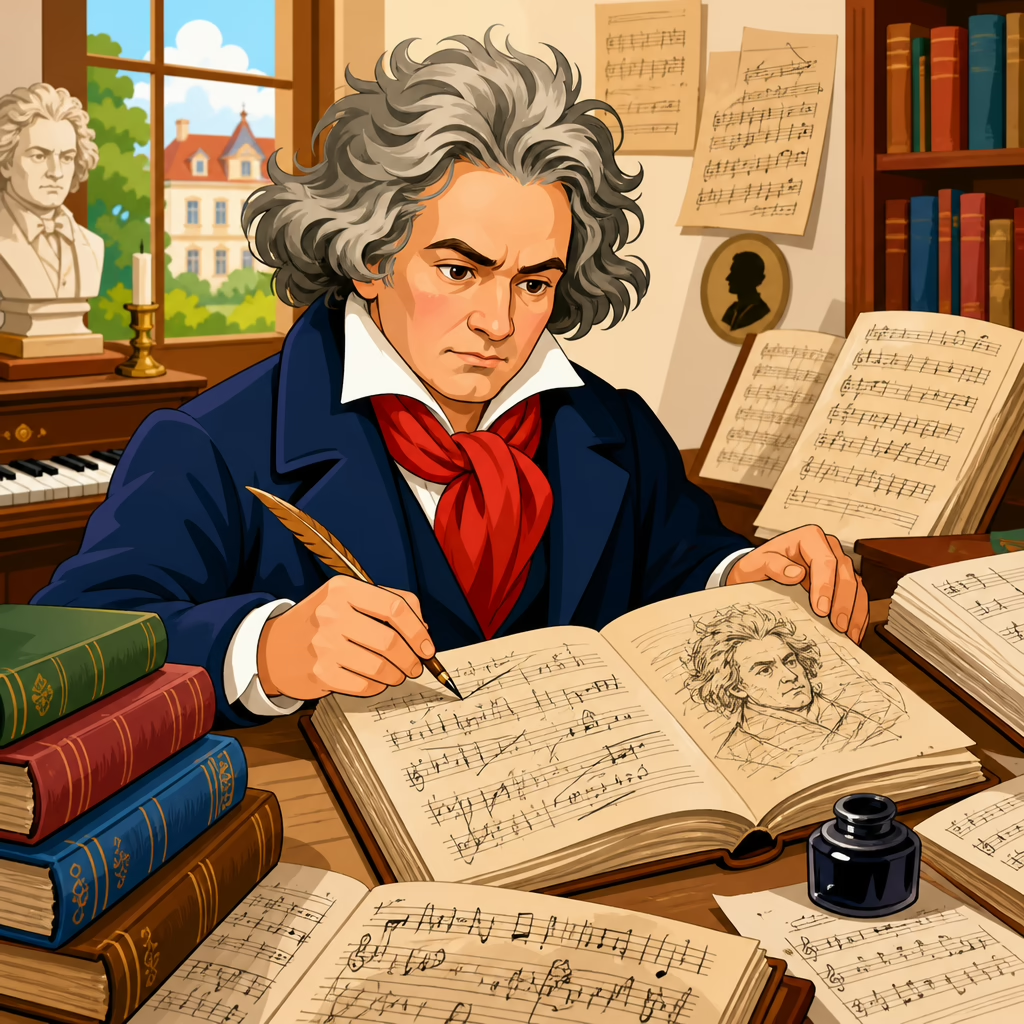
Best Books on Beethoven Manuscripts and Sketchbooks
Anyone serious about Beethoven’s creative process eventually arrives at the manuscripts and sketchbooks, because no other source shows so clearly how themes were tested, rejected, expanded, and transformed before reaching their final form. In Beethoven studies, a manuscript usually means an autograph score, draft leaf, corrected copy, or related document in the composer’s hand, while a sketchbook refers to the bound or assembled notebooks in which he jotted motives, contrapuntal plans, harmonic experiments, and structural reminders. These materials matter because Beethoven was not a composer who simply heard complete works inwardly and wrote them down unchanged. The surviving paper record proves the opposite: he revised relentlessly, worked in layers, and often used sketches as a laboratory where small cells became symphonic arguments. Readers looking for the best books on Beethoven manuscripts and sketchbooks therefore need more than coffee-table reproductions. They need studies that explain dating, paper types, scribal habits, watermarks, catalog references, and the editorial logic scholars use when reconstructing chronology from scattered leaves.
I learned that lesson the hard way while working through facsimiles alongside modern editions. At first, the pages looked like chaos: cramped notation, overwritten bars, verbal reminders, crossings-out, and ideas apparently abandoned midstream. But with the right books, the disorder starts to reveal method. Good scholarship teaches you how Beethoven grouped ideas, how he carried a rhythmic cell from one project into another, and how a sketchbook can illuminate not only a finished sonata or quartet but also the choices that never reached publication. That is why this niche matters to performers, musicologists, collectors, librarians, and advanced listeners alike. If you want to understand why the Eroica expands its opening material so aggressively, or how the Diabelli Variations emerged from fragmentary plans, books on the manuscript record are indispensable. The titles below are the most useful starting points and, in several cases, the core references that remain standard in serious Beethoven research.
Why manuscript and sketchbook studies matter for Beethoven research
Beethoven manuscript studies answer a direct question: how do we know what he composed, when he composed it, and how his ideas changed during composition? Printed first editions tell only part of that story. They preserve one published state, often with engraver errors, publisher interventions, or changes made under pressure. Manuscripts and sketchbooks preserve process. From them, scholars can track the evolution of a motive, establish relative chronology, identify periods of intense revision, and distinguish between conceptual planning and notation prepared for performance or publication.
This field became especially important because Beethoven’s working papers survive in uneven but substantial quantity. Unlike Mozart, whose autograph legacy is different in character, Beethoven left behind a remarkably rich sketch tradition. Yet those materials are dispersed across institutions such as the Staatsbibliothek zu Berlin, the British Library, the Bibliothèque nationale de France, the Beethoven-Haus in Bonn, and collections in the United States. Books that synthesize this evidence save readers years of archival orientation. They also teach crucial technical habits: reading autograph notation, understanding bifolios and gatherings, recognizing when a leaf has been disbound, and using thematic catalogs alongside manuscript descriptions. Without that foundation, it is easy to misread a sketch as a direct draft when it may be a later recollection or a side experiment.
For readers new to specialist Beethoven studies, the best path is to pair manuscript books with a broader orientation to the composer’s life and reception. A useful starting point for that wider context is this guide to Beethoven biographies for first-time readers, then return to the sources below for concentrated work on sketches and autographs. The two approaches reinforce each other: biography gives chronology and circumstances, while manuscripts show decisions in motion.
The essential books every serious reader should start with
The first indispensable title is Douglas Johnson, Alan Tyson, and Robert Winter’s The Beethoven Sketchbooks: History, Reconstruction, Inventory. Among specialists, this is the foundational modern reference because it does three demanding jobs at once. It explains the history of the surviving sketch materials, reconstructs dismembered books where possible, and inventories the contents with a level of precision that lets readers move from general curiosity to document-based study. Tyson’s expertise in paper studies and watermarks is especially important here. Dating Beethoven manuscripts is not guesswork; it often depends on the physical evidence of paper stocks, formats, and their use across known periods. This book shows how material bibliography and musicology work together.
The second major title is Gustav Nottebohm’s Beethoveniana and his related studies of Beethoven’s sketches. Nottebohm, writing in the nineteenth century, effectively founded Beethoven sketch study as a discipline. Some of his conclusions have been revised by later scholarship, and his methods do not always match current documentary standards, but dismissing him would be a mistake. He had access to sources closer to their original state than many later scholars did, and he understood before most writers that the sketches were not peripheral curiosities but central evidence for Beethoven’s compositional thought. Reading Nottebohm today is still rewarding because he notices patterns that remain valid: motivic persistence, the layered development of themes, and the complex route from fragment to final form.
A third essential resource is the body of facsimile publications produced by major institutions, especially the Beethoven-Haus Bonn. Facsimiles matter because manuscript study depends on visual evidence. Descriptions alone cannot fully convey page layout, cancellations, marginal insertions, ink changes, or the density of work on a single opening. If you can compare a scholarly discussion with a high-quality facsimile, your understanding improves immediately. For that reason, the best “books” in this area often include both analytical commentary and reproduced leaves, even when they focus on a single source.
Best books by purpose: reference, analysis, and facsimile use
Different readers need different kinds of books on Beethoven manuscripts and sketchbooks. A performer preparing Op. 111 may want insight into revision and articulation habits. A graduate student may need source descriptions and shelf marks. A collector or librarian may want provenance and physical reconstruction. The strongest titles can be grouped by function.
| Book or Resource | Best For | Why It Matters |
|---|---|---|
| The Beethoven Sketchbooks: History, Reconstruction, Inventory by Johnson, Tyson, and Winter | Core reference work | Maps surviving sketchbooks, reconstructs broken sources, and provides a dependable scholarly framework. |
| Gustav Nottebohm’s sketch studies and Beethoveniana | Historiography and early analytical insight | Established the field and still offers valuable observations on compositional development. |
| Beethoven-Haus facsimile editions | Direct source reading | Lets readers inspect handwriting, revisions, and page design instead of relying only on summary. |
| Alan Tyson’s work on paper studies | Dating and source criticism | Shows how watermark and paper analysis can resolve chronology and source relationships. |
| Critical commentaries in modern scholarly editions | Work-specific source comparison | Connects autographs, copies, and prints to editorial decisions performers actually encounter. |
If you buy only one major scholarly volume, make it the Johnson-Tyson-Winter book. If you want to understand how the discipline was built, add Nottebohm. If your main goal is to see Beethoven’s hand at work, prioritize facsimile editions tied to specific works you already know well, such as late piano sonatas, quartets, or symphonic materials. Familiar repertoire makes manuscript reading less intimidating because you can relate unfinished notation to a sound world already in your ear.
Specialized studies that reward close reading
After the standard references, the next tier consists of specialized books and edition commentaries focused on particular periods, genres, or source problems. Lewis Lockwood’s scholarship is especially valuable here. Although he is better known for broader Beethoven studies, his source-based work consistently models how to connect manuscript evidence to stylistic interpretation. Lockwood does not treat sketches as isolated artifacts; he shows how they illuminate genre decisions, formal pacing, and the expansion of motivic material. That balance is ideal for readers who want more than archival description.
Alan Tyson also deserves separate emphasis beyond the coauthored sketchbook volume. His research on paper types, especially in the study of eighteenth- and nineteenth-century music manuscripts, changed Beethoven scholarship by making chronology more exact. In practical terms, Tyson’s methods help answer questions that once remained speculative. Was a leaf really connected to a certain sonata project? Does the paper match a known working period? Could a sketch belong to a revision campaign rather than the initial drafting stage? These are not minor technicalities. They affect how we narrate Beethoven’s development and how confidently we attribute compositional sequence.
Robert Winter’s contributions likewise matter because he brings analytical sharpness to source study. In Beethoven manuscript work, physical evidence and musical reasoning must check each other. A watermark can suggest date range, but voice-leading, orchestration habits, or formal context can confirm or complicate that picture. The best books in this field never rely on only one type of evidence. They integrate codicology, bibliography, and analysis.
Readers interested in the late style should seek studies and facsimiles tied to the late piano sonatas, Missa solemnis, Ninth Symphony, and late quartets. These sources reveal Beethoven at his most layered and self-critical. You see compressed motivic notation, alternate contrapuntal solutions, reminders about large spans of form, and moments where a small scribble unlocks a monumental passage. The late sketchbooks are demanding, but they repay patience because they expose how abstraction and rigor coexist in Beethoven’s final decade.
How to choose the right Beethoven manuscript book for your needs
The right choice depends on your purpose, your tolerance for technical detail, and whether you plan to read manuscripts directly. If you are a newcomer, start with a source guide that explains terminology and reconstruction. Do not begin with a random facsimile volume unless you already know the work intimately. Raw manuscript images without commentary can be fascinating, but they are easy to misread. You need orientation on abbreviations, continuity between leaves, and the difference between a sketch, a draft score, and a fair copy.
If you are a performer, choose books that connect sources to interpretive questions. Critical reports and commentaries in scholarly editions from publishers such as Bärenreiter or Henle are often more useful than broad historical surveys because they address articulation, dynamics, slurring, pedal indications, and variant readings. Manuscript scholarship becomes musically urgent when it explains why one accent is doubtful, why a phrase mark may be incomplete, or why a printed reading reflects an engraver’s simplification rather than Beethoven’s final intention.
If you are a researcher, prioritize inventory-based books and studies grounded in physical description. Look for exact shelf marks, provenance notes, bibliography, and discussions of disbound leaves. Beethoven sources have often been separated, sold, rebound, or cataloged under changing systems. Reliable books help you navigate that complexity. They also signal scholarly credibility by showing where uncertainty remains. In this field, a trustworthy author does not force false certainty from incomplete evidence.
Price and format matter too. Older scholarly books can be expensive in print, but many are available through university libraries, interlibrary loan, HathiTrust, Internet Archive, or institutional digital collections. The Beethoven-Haus digital archive is especially valuable because it increasingly allows readers to compare published scholarship with online manuscript images. For many readers today, the best “book” is a combination: one standard reference in print, one facsimile edition, and a digital archive open beside them.
Common mistakes readers make when using sketchbook scholarship
The most common mistake is expecting a neat linear path from first idea to finished masterpiece. Beethoven did not always compose that way. He often returned to older ideas, transplanted motives, explored multiple solutions in parallel, and kept conceptual notes that make sense only when compared with later drafts. A sketchbook page can contain unrelated projects or material at different stages of development. Good books teach readers to resist simplistic narratives.
Another mistake is treating every surviving mark as equally intentional. Manuscripts contain corrections, shorthand, abandoned attempts, and practical reminders. Some notations are exploratory rather than declarative. That is why editorial judgment matters. The best authors explain what the source can prove and what remains an inference. They do not inflate ambiguous evidence into biographical drama.
A third mistake is ignoring the physical object. In Beethoven studies, paper format, ink, stitching, and leaf order are not peripheral details. They are evidence. When a scholar reconstructs a sketchbook, the argument may depend on conjugate leaves, watermark pairs, or traces left by rebinding. Readers who skip those sections often miss the basis for the dating and attribution that follows.
The best books on Beethoven manuscripts and sketchbooks are the ones that turn difficult source material into intelligible evidence without flattening its complexity. Start with Johnson, Tyson, and Winter for the indispensable map of the terrain. Read Nottebohm to understand the origins of sketch study and to sharpen your eye for compositional process. Add facsimile editions and work-specific critical commentaries so that scholarship remains tied to the actual appearance of Beethoven’s pages. Together, these resources show a composer not as a monument but as a worker on paper, constantly testing, revising, and refining.
That is the main benefit of reading deeply in this subfield: you hear the music differently because you see how hard Beethoven fought for it. Manuscripts and sketchbooks reveal discipline, experimentation, and structural imagination in their raw state. If you want to move beyond admiration into understanding, choose one core reference, one facsimile, and one edition commentary, then study them side by side with a familiar work. That simple next step will give you a far clearer view of Beethoven’s mind than any summary ever could.
Frequently Asked Questions
What are the best books to start with if I want to understand Beethoven’s manuscripts and sketchbooks?
If you are just beginning, the best approach is to look for books that explain both the documents themselves and the larger scholarly methods used to interpret them. A strong starting point is Lewis Lockwood’s work, especially Beethoven: The Music and the Life and Beethoven: Studies in the Creative Process, because Lockwood consistently shows how autograph scores, draft materials, and sketch sources reveal Beethoven’s compositional thinking. His writing is especially valuable for readers who want clear explanations without losing the depth of serious scholarship.
Another essential name is Alan Tyson, whose research changed the way scholars date Beethoven sources. Tyson’s studies are indispensable because he treated manuscripts not simply as relics, but as evidence that can be tested through paper types, watermarks, handwriting, and chronology. That kind of documentary work matters enormously when reading about sketchbooks, since the order of entries often affects how we understand the birth of a theme or the development of an entire movement.
For readers who want a more specialized entry into sketch studies, Joseph Kerman’s writings and the scholarship of Sieghard Brandenburg are also important. These authors help bridge the gap between source study and musical interpretation. In other words, they do not just catalog pages; they explain why a deleted passage, a rewritten cadence, or a compressed contrapuntal note matters artistically. If your goal is to see Beethoven’s creative process in action, books by these scholars are among the most rewarding places to begin.
What is the difference between a Beethoven manuscript and a Beethoven sketchbook?
In Beethoven scholarship, the distinction is important because the two kinds of sources serve different purposes. A manuscript usually refers to a document in Beethoven’s hand connected to a composition at a more advanced or more formal stage. That can include autograph scores, draft leaves, corrected copies, and other written materials that preserve music close to its finished state. These sources often show revisions, performance-related adjustments, and decisions made late in the compositional process.
A sketchbook, by contrast, is generally a bound notebook or assembled gathering of leaves in which Beethoven jotted ideas at much earlier stages. These can include motives, harmonic plans, contrapuntal experiments, thematic fragments, rhythmic cells, structural outlines, and even abrupt reworkings of an idea that would later appear in a very different form. Sketchbooks are often messier, less linear, and more exploratory than full manuscripts, which is precisely why they are so valuable. They let readers watch Beethoven think.
This difference also affects how books on the subject are written. A study focused on manuscripts may concentrate on textual authority, chronology, editions, and the relationship between autograph scores and printed versions. A book centered on sketchbooks usually asks how Beethoven invented, tested, rejected, and transformed his materials over time. For anyone interested in creative process, sketchbooks are often the most vivid evidence; for anyone interested in textual history and final compositional decisions, manuscripts are equally crucial.
Why are Beethoven’s sketchbooks so important to understanding his creative process?
Beethoven’s sketchbooks matter because they reveal composition as a process of searching rather than instant inspiration. They show that many of his greatest ideas did not emerge fully formed. Instead, themes were often built through repeated trial, compression, expansion, transposition, recombination, and structural rethinking. A motive that seems inevitable in the finished work may look uncertain, awkward, or radically different in an early sketch. That contrast is one of the most illuminating aspects of studying these sources.
They are also important because they expose how Beethoven thought across multiple musical dimensions at once. In a single cluster of sketches, you may find thematic fragments beside harmonic progressions, contrapuntal notes, rhythmic variants, and formal markers. This tells us that Beethoven was not simply inventing tunes and later “filling in” the rest. He was often shaping motive, harmony, texture, and architecture in an interconnected way. Good books on the sketchbooks help readers see that these pages are not random scraps; they are records of compositional problem-solving.
Perhaps most importantly, sketchbooks challenge simplistic myths about genius. They make Beethoven seem more formidable, not less, because they reveal the discipline behind the imagination. The pages show persistence, self-criticism, and technical control. Scholars and serious readers value books on these materials because they teach us not only what Beethoven wrote, but how he arrived there, what alternatives he rejected, and how his music became structurally powerful through revision.
Are books on Beethoven manuscripts and sketchbooks only useful for specialists and musicologists?
Not at all. While some titles are undeniably technical, many of the best books are rewarding for performers, conductors, composers, advanced students, and dedicated general readers. The key is choosing books that balance documentary detail with musical explanation. A specialist might focus on source layers, watermark evidence, and textual reconstruction, but a broader reader can still gain a great deal from understanding how a familiar sonata, quartet, or symphony evolved from rough notation into a finished masterpiece.
For performers, these books can be especially practical. Manuscripts may preserve articulation, dynamics, phrasing decisions, or revisions that deepen interpretive choices. Sketch studies can illuminate pacing, tension, thematic emphasis, and long-range structure. For composers and theorists, the sketchbooks are invaluable models of development, showing how a tiny cell can generate a large movement. For listeners, the reward is often a heightened sense of drama: hearing the final piece becomes more meaningful when you know how much experimentation lies behind it.
That said, some books are highly specialized and assume familiarity with source criticism, German terminology, or Beethoven catalog references. Readers new to the subject should start with narrative-oriented studies by major Beethoven scholars, then move into more technical works if they want deeper archival detail. The field is broad enough that there is truly something useful at every level of interest.
What should I look for in a high-quality book about Beethoven manuscripts and sketchbooks?
The best books do more than reproduce fascinating images or list archival facts. First, they should explain why the sources matter. A high-quality study connects manuscript evidence to musical meaning, showing how revisions affect form, expression, texture, or thematic development. If a book merely inventories pages without helping you hear or understand the consequences of those pages, it may be useful as a reference but less satisfying as a reading experience.
Second, look for strong source methodology. Serious books should discuss dating, provenance, paper types, handwriting, or relationships among different documents when those issues matter. Beethoven source study can be complicated, and responsible authors make clear when a conclusion is secure and when it remains debated. This is one reason scholars like Alan Tyson remain so influential: they demonstrated how careful documentary analysis can reshape larger interpretations of Beethoven’s music.
Third, pay attention to whether the book situates the manuscripts and sketchbooks within Beethoven’s broader creative life. The strongest studies do not isolate the documents from the works, the historical moment, or the composer’s artistic habits. They show how these written traces fit into Beethoven’s long-term methods of invention and revision. Ideally, a great book on this subject leaves you with both a clearer understanding of the physical sources and a deeper appreciation of the music itself.