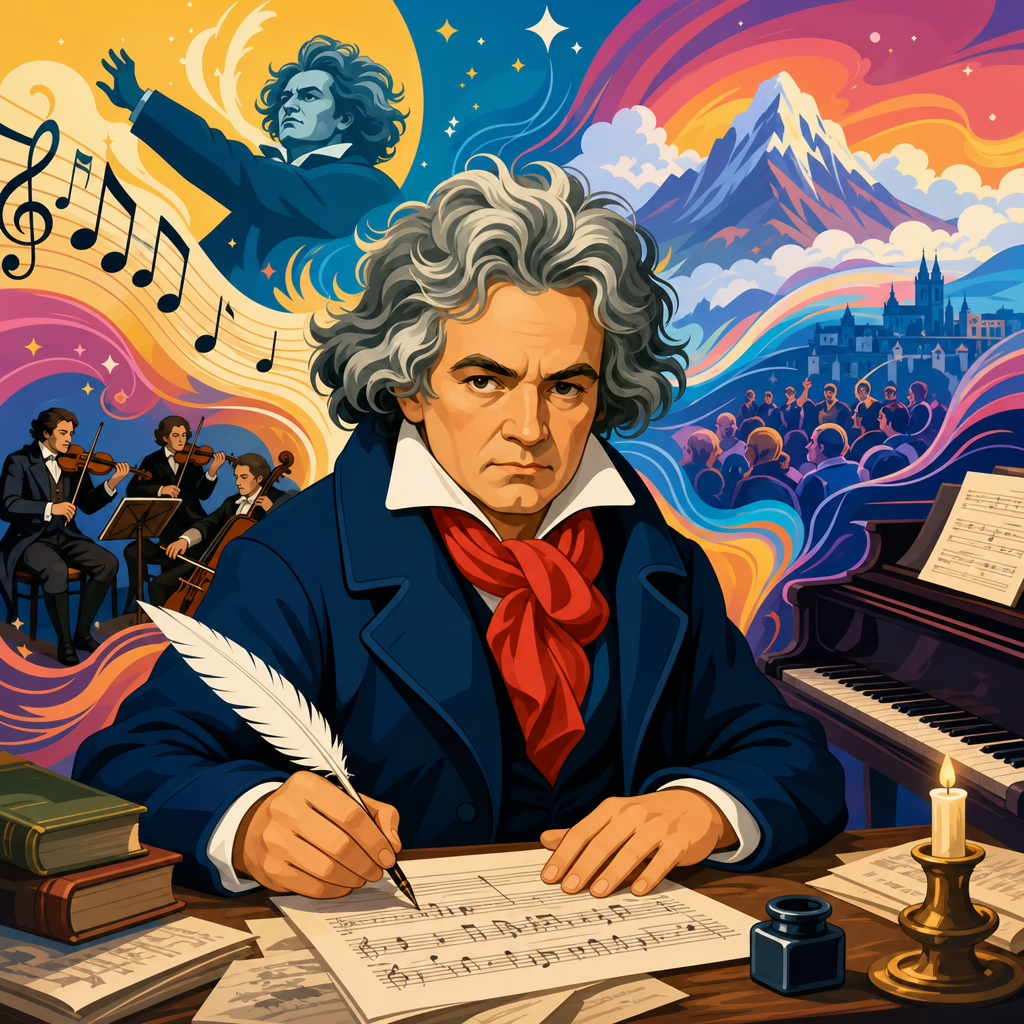
Beethoven’s Role in Defining Musical Genius
Few composers have shaped the modern idea of musical genius more decisively than Ludwig van Beethoven. When people describe an artist as visionary, uncompromising, original, or larger than life, they often rely on standards that Beethoven helped establish through his music, public image, and working methods. In practical terms, “musical genius” means more than high intelligence or technical skill. It describes a rare combination of invention, emotional force, formal command, persistence, and the ability to change what listeners believe music can do. Beethoven became the central example of that idea, and his influence continues to guide how performers, scholars, teachers, critics, and audiences evaluate greatness.
This matters because Beethoven’s role in defining musical genius reaches far beyond concert halls. His career altered expectations about the composer’s social status, the meaning of originality, the relationship between suffering and creativity, and the purpose of serious art. I have seen this firsthand in music history classrooms, program-note writing, and repertoire planning: even when a discussion starts with later composers, it often circles back to Beethoven as the benchmark. As a hub within Beethoven’s influence on future generations, this article surveys the miscellaneous themes that connect his legacy across culture, criticism, performance, education, politics, and popular imagination. Understanding those themes explains not only why Beethoven remains central, but also how the modern myth of genius was built, repeated, challenged, and renewed.
How Beethoven Changed the Composer’s Public Identity
Before Beethoven, many major composers worked primarily within courtly, ecclesiastical, or theatrical systems that tied them to patrons and practical obligations. Joseph Haydn served the Esterházy court for decades. Wolfgang Amadeus Mozart pursued greater independence, but still relied on aristocratic support, teaching, and commissions. Beethoven inherited this world and pushed against it. In Vienna, he cultivated patrons, but he also asserted unusual control over his career, negotiating stipends, publishing rights, and performance opportunities in ways that strengthened the composer’s image as an autonomous creator rather than a servant.
That shift was crucial to the rise of musical genius as a cultural ideal. Beethoven’s public standing suggested that a composer could claim authority based on artistic vision itself. His famous dedication change for the Third Symphony, withdrawing Napoleon’s name after political disillusionment, became a symbolic story about principle and independence. Whether retold with some embellishment or not, the episode reinforced an image of Beethoven as a creator answerable first to his art and conscience. Later generations absorbed this model. Composers from Berlioz to Brahms, Wagner, Mahler, and beyond worked in a world where Beethoven had already elevated the composer into a public intellectual and moral force.
His deafness also transformed perception. Rather than ending his career, hearing loss became part of the story of heroic inward creation. The Heiligenstadt Testament, written in 1802, revealed anguish, isolation, and determination. That document did not simply humanize Beethoven; it helped define genius as a struggle against extreme adversity. In later criticism, the suffering artist became a recurring pattern, and Beethoven was often treated as the clearest proof that profound art could emerge from personal crisis. This interpretation can oversimplify his life, yet it remains central to his legacy.
Originality, Craft, and the Sound of Greatness
Beethoven’s music defined genius not because it ignored tradition, but because it reworked inherited forms so powerfully that innovation felt inevitable. He studied Haydn, Mozart, Bach, and Handel closely. His sketchbooks show labor, revision, and structural problem-solving, not effortless inspiration. That matters because the modern idea of genius often swings between two extremes: the supernatural prodigy and the disciplined master. Beethoven fused both images. He appeared inspired, but the evidence of his process demonstrated relentless craft. For musicians and scholars, that combination became a durable standard.
Specific works illustrate how this happened. The “Eroica” Symphony expanded scale, harmonic tension, and thematic development beyond what many listeners expected from a symphony in 1804. The Fifth Symphony turned a compact rhythmic idea into a vast narrative of conflict and transformation. The late string quartets, especially Op. 130, Op. 131, and Op. 132, challenged conventional form and expressive boundaries so thoroughly that even sophisticated listeners found them difficult. Yet those pieces later became touchstones of profundity. In each case, Beethoven’s authority came from making structural rigor and expressive intensity reinforce each other.
His piano sonatas offer another lens. Works such as the “Pathétique,” “Waldstein,” “Appassionata,” and Op. 111 broadened the sonata from salon entertainment or pedagogical material into a serious vehicle for philosophical and emotional exploration. Performers still treat these works as milestones because they demand both technical command and interpretive insight. In conservatory training, a student’s relationship with Beethoven often marks a transition from playing notes correctly to shaping long-range architecture, tonal drama, motivic coherence, and rhythmic tension. That pedagogical role has helped preserve Beethoven as a practical definition of musical seriousness.
| Area | What Beethoven Changed | Long-Term Effect |
|---|---|---|
| Symphony | Expanded length, development, and dramatic scope | Set expectations for the symphony as a major artistic statement |
| Composer identity | Asserted creative independence from patronage norms | Elevated the composer as an autonomous cultural authority |
| Piano sonata | Deepened structural and emotional ambition | Made the genre central to advanced performance and study |
| String quartet | Pushed formal experimentation and introspection | Created a benchmark for complexity and artistic depth |
| Creative process | Left extensive sketches showing revision and labor | Linked genius with discipline, not just inspiration |
The Heroic Narrative and the Birth of Romantic Genius
Beethoven became the model for Romantic genius because his life and music could be narrated as a heroic journey. Nineteenth-century writers emphasized struggle, defiance, inward freedom, and triumph. The Fifth Symphony invited interpretation as fate confronted and overcome. The Ninth Symphony suggested universal aspiration through conflict and reconciliation. Even when these readings simplify the music, they proved culturally powerful. Beethoven gave later audiences a compelling story shape: the artist suffers, wrestles with limits, transforms pain into form, and speaks to humanity at large.
This model influenced biography, criticism, and concert culture. E.T.A. Hoffmann’s writing on instrumental music elevated composers like Beethoven as figures who revealed the sublime beyond ordinary language. Later monuments, festivals, centennial celebrations, and scholarly editions turned him into a civic and cultural icon. By the late nineteenth century, the serious concert canon was taking shape, and Beethoven stood at its center. Programming a Beethoven symphony signaled artistic weight. Performing a Beethoven cycle demonstrated institutional seriousness. Reviewing Beethoven became a way for critics to declare standards of judgment.
The heroic framing also affected composers who reacted against it. Wagner embraced Beethoven’s grandeur while claiming to extend it through music drama. Brahms worked under what commentators called “the shadow of Beethoven,” especially in the symphonic field. Tchaikovsky, Bruckner, Mahler, and Shostakovich all composed in dialogue with Beethovenian expectations of symphonic argument and existential scale. Even modernist figures who resisted Romantic mythology could not fully escape Beethoven’s example, because he had already defined what it meant for music to aim at historical significance.
Beethoven as a Hub for Performance, Scholarship, and Cultural Memory
Beethoven’s role in defining musical genius persisted because institutions kept renewing it. Conservatories made his sonatas, chamber works, and symphonies foundational repertoire. Publishers issued collected editions. Scholars examined autograph manuscripts, sketchbooks, tempo debates, and questions of historical performance practice. Orchestras built seasons around his anniversaries. Recording technology amplified his centrality further. From Artur Schnabel’s pioneering Beethoven sonata recordings to cycles by Wilhelm Furtwängler, Herbert von Karajan, Leonard Bernstein, Claudio Arrau, Alfred Brendel, and the Takács Quartet, interpreters have treated Beethoven as the place where artistic identity is tested and revealed.
That institutional reinforcement matters for future generations because it turns influence into habit. Young pianists encounter Beethoven early and return to him repeatedly at higher levels. Conductors often establish reputation through Beethoven cycles because those works expose balance, pacing, orchestral discipline, and philosophical reach. Musicologists return to Beethoven because his output raises major questions: how form generates meaning, how sketch studies illuminate thought, how editions shape performance, and how biography affects listening. In other words, Beethoven functions not just as a composer but as an ecosystem of inquiry.
He also remains present in public memory outside specialist circles. The opening of the Fifth Symphony is one of the most recognizable gestures in Western music. “Ode to Joy” from the Ninth Symphony became the anthem of the European Union and appears in political ceremonies, films, advertisements, and educational settings. “Für Elise,” though a relatively slight work compared with the late sonatas, is a global entry point for amateur pianists. These familiar pieces help explain why Beethoven’s image as genius survives where many equally important composers remain less visible to general audiences.
The Uses and Limits of the Beethoven Genius Myth
Although Beethoven’s reputation is deserved, the genius myth requires careful handling. In my experience, the most productive teaching does not simply repeat that Beethoven was unmatched; it asks how the category of genius was formed and what it hides. Hero worship can flatten collaboration, performance traditions, patronage networks, copyists, publishers, instrument makers, and audiences. It can also encourage the false belief that great art appears through torment alone. Beethoven worked through discipline, study, revision, and practical musicianship as much as through emotional intensity.
There are also cultural limits to the way Beethoven has been used as a universal measure. Canon formation in the nineteenth and twentieth centuries often elevated Germanic instrumental music above other traditions, and Beethoven became a pillar of that hierarchy. As music history broadens, scholars increasingly place him alongside neglected composers, women composers, non-European traditions, popular forms, and different models of creativity. This wider perspective does not diminish Beethoven’s achievements. Instead, it clarifies them by separating historical importance from exclusionary habits of prestige.
Still, the central point holds: Beethoven defined musical genius because he joined originality, ambition, technical command, personal myth, and institutional endurance more completely than almost any other composer. His works remain difficult, rewarding, and interpretively open. His career provided a script for artistic independence. His suffering was transformed into a narrative of resolve. His sketchbooks proved that genius can be worked out measure by measure. For future generations, Beethoven is not merely an influence to admire from a distance. He is the reference point through which modern culture learned to hear greatness, debate greatness, and imagine what a composer could be.
Beethoven’s lasting power comes from this combination of music, story, and example. He did not invent creativity, depth, or ambition, but he gave later generations a vivid model of all three operating at the highest level. That is why his role in defining musical genius remains so durable across classrooms, concert halls, scholarship, and public culture. He stands at the center of an ongoing conversation about excellence: how it is made, how it is recognized, and how it is remembered.
For readers exploring Beethoven’s influence on future generations, this hub offers a clear foundation. His legacy reaches into performance practice, critical standards, artistic identity, cultural memory, and the very language used to describe greatness. Follow the connected articles in this subtopic to examine those threads in more detail, and return to Beethoven’s music itself, because the strongest explanation of his genius is still found in the works.
Frequently Asked Questions
Why is Beethoven so central to the modern idea of musical genius?
Beethoven is central because he helped redefine what people expected a great composer to be. Before him, many composers were admired primarily as highly skilled craftsmen working within established conventions, often in service to courts, churches, or aristocratic patrons. Beethoven certainly inherited that world, but he also pushed beyond it. He came to represent the artist as an independent creative force: someone whose work expressed a singular inner vision rather than simply fulfilling a social function. That shift matters enormously to the modern idea of genius.
His music played a major role in creating that image. Beethoven’s works often seem to announce themselves with unusual force, concentration, and purpose. Whether in the dramatic opening of the Fifth Symphony, the vast scale of the “Eroica,” or the searching intensity of the late string quartets and piano sonatas, listeners encounter music that feels deliberately individual. It sounds as if it could only have been written by one mind wrestling with form, emotion, and meaning at the highest level. That sense of unmistakable personal voice became one of the defining markers of genius in later musical culture.
Just as important was Beethoven’s public image. He was increasingly presented not merely as a talented composer but as a serious, almost heroic figure who struggled against adversity in pursuit of artistic truth. His deafness intensified that perception, turning his life into a story of endurance, isolation, and triumph through creation. As a result, Beethoven became more than a composer people admired; he became a model for how genius itself could be imagined: original, uncompromising, emotionally profound, and larger than ordinary life.
How did Beethoven’s music change expectations for what a composer could achieve?
Beethoven expanded expectations in several directions at once: emotional range, structural ambition, technical challenge, and artistic seriousness. He inherited the forms of the Classical period, especially from Haydn and Mozart, but he treated those forms as frameworks to be stretched, intensified, and reimagined. Instead of simply writing elegant, balanced works, he often turned musical form into a drama of conflict and resolution. Themes are not just presented; they are tested, transformed, interrupted, and fought over. That sense of musical struggle became one of the most influential features of his style.
He also enlarged the scale and ambition of instrumental music. Symphonies, sonatas, quartets, and concertos had existed before Beethoven, of course, but he invested them with new philosophical and emotional weight. A symphony after Beethoven could seem like more than entertainment; it could feel like a statement about human experience. His “Eroica” Symphony challenged listeners with unprecedented length and intensity. The Ninth Symphony went even further, combining symphonic form with choral writing in a way that suggested music could address universal ideals such as brotherhood, freedom, and human dignity.
Another major change involved the performer and listener. Beethoven wrote music that demanded more from both. Performers needed greater stamina, technique, and interpretive insight. Listeners were asked to follow longer spans, sharper contrasts, and more complex emotional journeys. In that sense, Beethoven elevated the cultural status of serious music by making it something to be studied, contemplated, and returned to repeatedly. That expectation—that a composer can create works of deep personal and cultural significance—owes a great deal to Beethoven’s example.
Did Beethoven invent the idea of the tortured, visionary artist?
Not entirely, but he did more than almost anyone to solidify that image in music. The notion that exceptional creators suffer for their art existed before Beethoven, and there were already traditions of celebrating extraordinary talent. However, Beethoven gave that idea a uniquely powerful and lasting form. His life seemed to fit the story perfectly: a fiercely independent composer, often difficult in personal relations, battling illness, professional pressures, emotional disappointments, and eventually profound hearing loss, yet producing some of the most ambitious music in history.
His deafness, in particular, became central to the legend. The fact that he continued composing while losing and then largely losing his hearing made his achievement appear almost superhuman. It encouraged the view that true genius comes from an inner source deeper than ordinary practical limitation. The famous image of Beethoven hearing music inwardly, shaping vast works in silence, became one of the strongest symbols of artistic transcendence in Western culture.
At the same time, it is important not to reduce Beethoven to a stereotype. He was not simply “tortured” or chaotic; he was also disciplined, technically masterful, and deeply knowledgeable about musical tradition. His sketchbooks reveal intense labor, revision, and problem-solving. That matters because the modern idea of genius often swings between two extremes: natural inspiration on one side and relentless craft on the other. Beethoven’s example shows that both can coexist. He seemed visionary precisely because he joined extraordinary imagination to extraordinary persistence. That combination is one reason his legacy remains so authoritative.
How did Beethoven’s working methods contribute to his reputation as a genius?
One of the most revealing aspects of Beethoven’s legacy is that his genius was not based on effortless brilliance alone. His surviving sketchbooks show a composer who worked obsessively through ideas, testing possibilities, revising passages, and reshaping themes again and again. This record of labor is crucial because it deepens our understanding of what musical genius can mean. In Beethoven’s case, genius was not merely the ability to produce beautiful music quickly; it was the power to take raw material and transform it through relentless concentration into something structurally compelling and emotionally unforgettable.
That process is especially visible in the way he handled small motifs. Beethoven could begin with a compact musical idea—sometimes just a few notes—and build an entire movement from it. The famous opening figure of the Fifth Symphony is the most obvious example, but the principle appears throughout his work. He treated musical ideas as living material capable of growth, tension, and transformation. This gave his music a sense of organic unity that later generations admired as evidence of supreme compositional intelligence.
His working methods also reinforced his public image as uncompromising. Beethoven was not content to satisfy conventional taste if he believed a work needed to go further. He revised extensively, challenged performers, and often wrote music that anticipated future audiences more than immediate approval. In that way, his reputation for genius rests not just on inspiration or biography, but on method: rigor, self-criticism, formal control, and the refusal to settle for the merely acceptable. He helped establish the enduring belief that true artistic greatness comes from both imagination and struggle.
Why does Beethoven still shape how we talk about artistic originality and greatness today?
Beethoven still matters because many of the qualities people associate with artistic greatness were crystallized through his example. When we call an artist original, we usually mean more than novel or unusual. We mean that the artist has a distinctive voice, transforms inherited forms, takes risks, and creates work that feels necessary rather than decorative. Beethoven embodies that ideal. He did not reject tradition outright; he absorbed it so deeply that he could remake it from within. That is one of the strongest and most durable models of originality in Western art.
He also remains influential because his career helped redefine the relationship between artist and society. Beethoven is often seen as someone who answered first to the demands of the work itself, not simply to patrons, fashion, or easy popularity. That image continues to shape how audiences value authenticity. Even now, people tend to admire artists who seem driven by conviction, willing to challenge expectations, and committed to expressing something fundamental. Beethoven became one of the clearest historical examples of that stance.
Finally, his music continues to justify the reputation. The works themselves remain powerful enough to sustain the myth and the scholarship alike. They invite analysis because they are formally intricate, and they invite emotional attachment because they are so direct in their expressive force. Few figures unite those two strengths so convincingly. For that reason, Beethoven still serves as a touchstone when people discuss genius, not simply as a matter of celebrity or legend, but as a living standard for what profound artistic achievement can look and sound like.