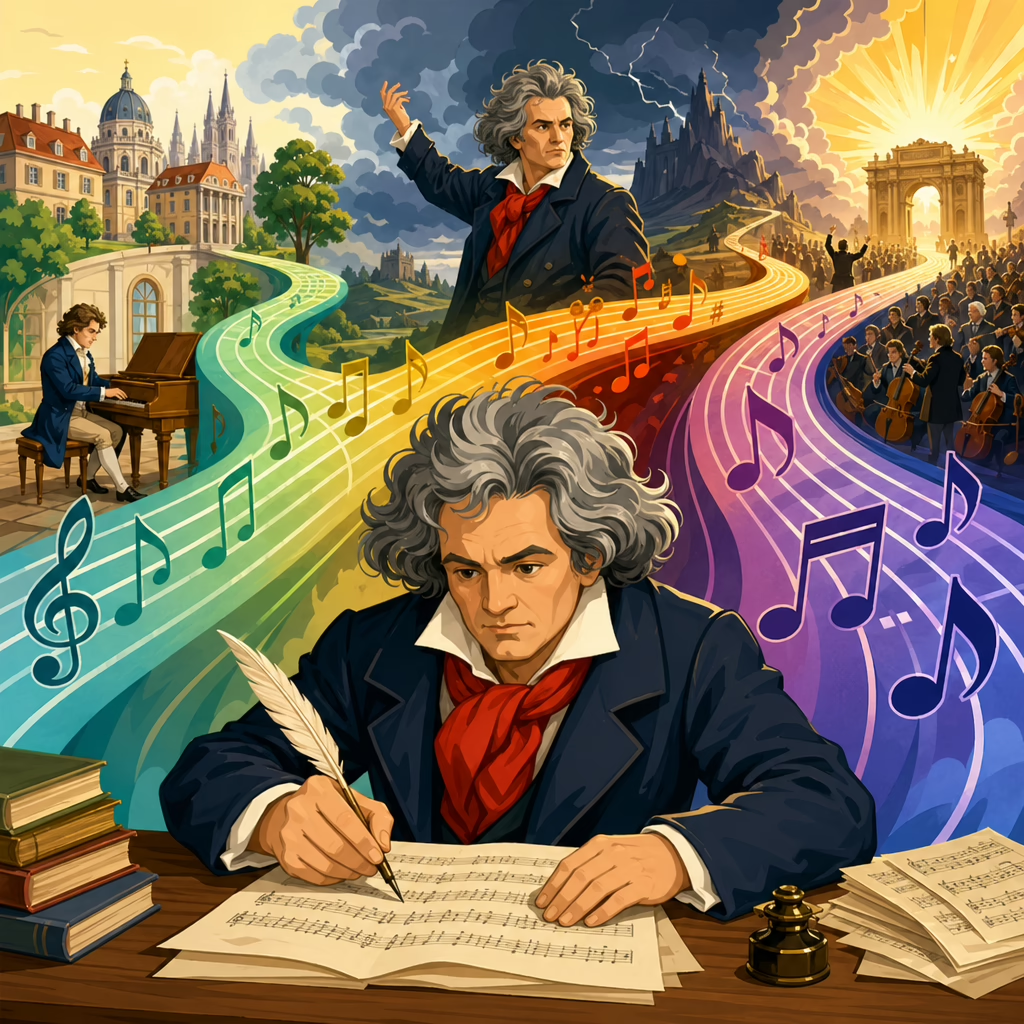
Beethoven’s Melodic Development from Opus 1 to 135
Beethoven’s melodic development from Opus 1 to Opus 135 traces one of the clearest arcs in Western music: a young composer mastering inherited Classical forms, a middle-period innovator turning melody into dramatic architecture, and a late master distilling expression into lines that seem simple on the page yet inexhaustible in meaning. In this Miscellaneous hub for Beethoven Music, “melodic development” means more than writing memorable tunes. It includes motivic transformation, phrase expansion, rhythmic compression, registral contrast, ornament as structure, and the way a tiny cell can generate an entire movement. Across the numbered and unnumbered works that frame his career, Beethoven moved steadily away from balanced, songlike continuity toward themes that behave like living organisms. That shift matters because melody is where many listeners first meet Beethoven, yet it is also where his deepest compositional thinking becomes audible. I have worked through these scores at the keyboard and in rehearsal rooms, and the same pattern always emerges: what sounds bluntly direct in Beethoven is usually the result of exact control. From the piano trios of Opus 1 to the final quartet, Opus 135, his melodies become less decorative, more concentrated, and more capable of carrying argument, memory, wit, and metaphysical weight within just a few notes.
Opus 1 and the Classical inheritance Beethoven reshaped
Beethoven’s published career begins in 1795 with the three Piano Trios, Opus 1, works that announce ambition while staying close enough to Haydn and Mozart to be legible to Viennese audiences. Their melodies still rely on periodic phrasing, diatonic clarity, and recognizable cadential punctuation, but even here the thematic material is unusually active. Instead of presenting a tune and then accompanying it, Beethoven often builds the line from sharply profiled intervals and rhythmic hooks that invite manipulation. In the G major Trio, Op. 1 No. 2, the opening theme gains momentum from compact contour and offbeat emphasis. In the C minor Trio, Op. 1 No. 3, the darker mode pushes melody toward rhetorical tension rather than gracious continuity.
That early tension is crucial. Haydn frequently develops motives brilliantly, but Beethoven’s melodic behavior already feels more urgent, less content to charm. He likes opening gestures that can be fragmented, sequenced, displaced, and intensified. This tendency appears again in the early piano sonatas, especially Op. 2 and Op. 10, where melodic identity often resides in a kernel rather than a full cantabile span. The “Pathétique” Sonata, Op. 13, offers a useful example. Its Grave introduction presents declamatory melodic shapes loaded with dramatic rests, while the Allegro’s first subject depends on jagged motion and propulsion. By contrast, the Adagio cantabile shows he could write broad lyric melody whenever he chose; the point is that he increasingly treated lyricism as one option within a wider developmental field, not the default mode.
Early expansion from piano sonatas to chamber music and the first symphony
As Beethoven moved through Opp. 7, 18, and 21, his melodic writing broadened in range and character. The String Quartets, Opus 18, are particularly revealing because quartet texture exposes thematic workmanship without orchestral color or pianistic resonance. In Op. 18 No. 1, melodic lines can sound conversational, traded among voices with flexibility that anticipates later quartet thinking. In Op. 18 No. 4 and No. 6, the themes are less about singable completeness than about gestures that stimulate dialogue. Beethoven learned to let a melodic idea unfold through texture and counterpoint, not just through surface tunefulness.
Symphony No. 1, Opus 21, confirms the same trajectory on a larger canvas. The first movement’s themes remain rooted in Classical syntax, yet their motivic edges are stronger than in most contemporaneous symphonic writing. He is already composing melodies that are memorable because of profile and function, not because they float above the form. This distinction explains why Beethoven’s early themes survive close analysis. Remove the harmony and many still retain identity through intervallic design and rhythm. In practical terms, performers feel this immediately: phrasing Beethoven requires attention to sforzandi, articulation, and dynamic rhetoric because the melody is embedded in those elements, not separable from them.
The question many listeners ask is simple: when does Beethoven start sounding unmistakably like Beethoven? The answer is that the change is gradual, but by the turn of the century his themes are increasingly compressed and goal-directed. Even in ostensibly relaxed movements, he avoids idle filler. Transitional passages often derive from principal material, and secondary themes frequently share hidden genetic ties with opening motives. This organic approach becomes a hallmark of his mature style.
The heroic middle period and the rise of motivic melody
Between roughly 1803 and 1812, Beethoven’s melodic language changed decisively. Works such as the “Eroica” Symphony, Op. 55, the “Waldstein” Sonata, Op. 53, the “Appassionata,” Op. 57, the Violin Concerto, Op. 61, and the Fifth Symphony, Op. 67, show a composer making melody serve large-scale narrative. The famous opening theme of the “Eroica” is not a polished tune in the operatic sense; it is a cell with harmonic daring, rhythmic asymmetry, and developmental potential. The line acquires meaning through expansion, collision, and return. Beethoven now trusts a fragment to carry an entire structure.
The Fifth Symphony provides the textbook case. Its four-note opening is often described as rhythm rather than melody, but that distinction collapses in Beethoven. The intervallic shape, registral placement, and repetition make it a melodic identity from the first bar. What follows is not embellishment of a completed tune but a demonstration that a microscopic idea can generate a symphonic universe. I have seen students understand Beethoven’s middle-period method the moment they stop looking for “the melody” as a separate layer and start hearing every phrase as transformation of a source cell.
The middle period also deepened Beethoven’s lyric gift. The slow movement of the “Emperor” Concerto, Op. 73, and the Larghetto of the Second Symphony, Op. 36, show long-breathed melody of extraordinary poise. Yet even these cantabile spans are structurally disciplined. Sequences are purposeful, accompaniment patterns shape expectation, and climaxes arrive through controlled registral ascent. The Violin Concerto’s opening movement offers one of his greatest melodic achievements: themes unfold with spaciousness, but they are never inert. Small motives circulate within the orchestra, preparing and answering the solo line so that melody becomes a shared field rather than a single strand.
Pastoral lyricism, song, and the broadening of expressive melody
Not all middle-period Beethoven is heroic or combative. The “Pastoral” Symphony, Op. 68, demonstrates how melodic development can be gentle, cumulative, and scene-making without becoming pictorial fluff. Its themes are deliberately plain, often close to folk inflection, yet their repetition and variation create immersion. Beethoven understood that simplicity can be the highest form of control. A rural-sounding melody must still support harmonic pacing and formal continuity; in the “Pastoral,” he achieves this by subtle rhythmic alteration and instrumental redistribution.
His songs and vocal works matter here because they sharpened his sense of line. “An die ferne Geliebte,” Op. 98, the first major song cycle in the repertory, links melodies across songs through recall and transformation. This is crucial for understanding later instrumental works. Beethoven was not abandoning tune; he was learning how melody can carry memory across time. The same principle operates in the Piano Sonata, Op. 81a, “Les Adieux,” where thematic gestures are semantically charged, and in the incidental music to “Egmont,” Op. 84, where melodic character defines political and emotional stance.
| Period | Representative works | Melodic traits | Why it matters |
|---|---|---|---|
| Early | Op. 1 Trios, Op. 13, Op. 18, Op. 21 | Periodic phrases, strong motivic edges, Classical balance under pressure | Shows Beethoven turning inherited tune types into developmental material |
| Middle | Op. 53, Op. 55, Op. 61, Op. 67, Op. 68 | Compressed cells, large-scale transformation, lyricism tied to architecture | Establishes melody as the engine of drama and form |
| Late | Op. 101, Op. 109, Op. 110, Op. 111, Opp. 127-135 | Fragmentation, recall, variation, songful inwardness, contrapuntal integration | Creates lines that are simultaneously simple, abstract, and profound |
Transitional works and the road to the late style
After 1812, Beethoven’s output slowed, but his melodic thinking grew more searching. The Piano Sonata, Op. 90, is a pivotal work. Its first movement compresses thematic material almost to aphorism, while the second unfolds one of his most tender and continuous melodies. This juxtaposition is not accidental. Beethoven is testing how much expressive weight a sparse melodic idea can bear and how lyric continuity can emerge after severe compression. The Seventh Symphony, Op. 92, though still often grouped with the middle period, also points forward. Its melodies are inseparable from rhythmic obsession; line and pulse become one.
The Piano Sonata, Op. 101, marks an unmistakable turn. The opening theme sounds intimate, even private, with asymmetrical phrase lengths and a woven texture that resists simple tune-and-accompaniment hearing. Beethoven increasingly writes melodies that feel remembered rather than announced. This quality intensifies in the songlike passages of the late piano sonatas and quartets, where the line often emerges from inner voices or appears in altered form before the listener fully grasps its identity. In compositional terms, thematic presentation becomes less frontal and more allusive.
This is also where counterpoint transforms Beethoven’s melodic style. Study the late works and you find that fugue and variation do not suppress melody; they refine it. A line must be intervallically strong to survive inversion, stretto, augmentation, or registral displacement. Beethoven’s late themes are therefore often bare-boned and exact. Their apparent simplicity is what gives them durability under intense manipulation.
Late piano sonatas and the inward turn of melody
The final piano sonatas, especially Opp. 109, 110, and 111, contain Beethoven’s most concentrated statements about melody. Op. 109 opens with a theme of striking delicacy, interrupted by contrasting material that prevents complacent lyric flow. The concluding variation movement demonstrates how a serene line can become the basis for rhythmic subdivision, ornamental expansion, and spiritual intensification without losing identity. Op. 110 goes further: the Arioso dolente presents melody as vulnerable speech, nearly broken by grief, then answered by fugue. Here Beethoven proves that expressive line and learned counterpoint can deepen each other rather than compete.
Op. 111, his last piano sonata, ends with the Arietta, one of the most discussed melodies in music history. Its opening is disarmingly plain, almost hymnlike. Yet the phrase structure, harmonic support, and registral spacing make it uniquely poised for transformation. The variations progressively alter texture, rhythm, and sonority, but the melodic source remains audible. Analysts have linked this method to variation traditions from Bach onward, but Beethoven’s achievement is distinct: he turns a modest melody into a temporal horizon, where development feels less like argument than revelation.
For listeners exploring Beethoven Music beyond the famous symphonies, these sonatas are indispensable hub works. They connect earlier concerns—motivic economy, dramatic contrast, lyric breadth—to late techniques of memory, suspension, and transcendence. They also correct a common misconception that Beethoven became abstract at the end. In truth, he became more melodic, but in a purified sense: less dependent on immediate catchiness, more dependent on line as concentrated thought.
From Opus 127 to Opus 135 the late quartets as the summit
The late string quartets, Opp. 127, 130, 131, 132, 133, and 135, bring Beethoven’s melodic development to its highest complexity. Op. 127 opens with grandeur but quickly reveals a supple lyric imagination. The slow movement’s theme supports variations that change texture and aura while preserving contour. Op. 132 contains the “Heiliger Dankgesang,” whose Lydian-inflected melody achieves austerity without dryness. Few themes better show Beethoven’s late gift for writing lines that sound ancient and immediate at once.
Op. 131 is a masterclass in melodic continuity across seven linked movements. The opening fugue subject is already intensely lyrical, proving again that counterpoint in Beethoven is not anti-melodic. Themes later in the work seem to answer earlier ones across movement boundaries, creating long-range resonance. The Cavatina from Op. 130 offers the opposite kind of profundity: a vulnerable melodic span whose expressive markings, including beklemmt, reveal how closely Beethoven tied melodic inflection to emotional state.
The Große Fuge, Op. 133, often treated as an outlier, should also be heard melodically. Its angular subjects are melodies designed for extreme contrapuntal stress. Finally, Op. 135 closes the journey with extraordinary economy. The finale’s “Muss es sein?” idea shows Beethoven returning, in one sense, to the germinal method of Opus 1, but now with late-style compression and philosophical wit. By Op. 135, melody is no longer merely theme or tune. It is question, process, memory, and form fused together.
From Opus 1 to Opus 135, Beethoven’s melodic development moves from sharpened Classical phrasing to a late style where a few notes can contain an entire world. Early works show him intensifying inherited models through motivic pressure. Middle-period masterpieces make melody the driver of drama, architecture, and public statement. Late sonatas and quartets strip away ornament and convention until melody becomes at once song, structure, and speculation. For anyone building a fuller understanding of Beethoven Music, this Miscellaneous hub is the right starting point because melody connects every genre he touched: piano sonata, trio, quartet, symphony, concerto, song, and sacred or theatrical music. The main benefit of hearing Beethoven through melody is practical as well as intellectual. You begin to recognize how his music thinks—how a cell grows, how a phrase remembers, how a line survives transformation. Use that lens as you move to deeper pages on individual works, and Beethoven’s output will stop seeming like a set of famous titles and start sounding like one continuous creative argument.
Frequently Asked Questions
1. What does “melodic development” mean in Beethoven’s music from Opus 1 to Opus 135?
In Beethoven’s case, melodic development means far more than the ability to invent a beautiful tune. Across the span from the early Opus 1 piano trios to the late String Quartet in F major, Op. 135, melody becomes a living structural force. At the beginning of his career, Beethoven worked within inherited Classical conventions shaped by Haydn and Mozart: balanced phrases, clear cadences, and themes that were easy to identify as self-contained musical ideas. Even then, however, he showed an unusual tendency to treat small melodic cells as material for expansion, fragmentation, and dramatic reorientation.
As his style matured, melody increasingly ceased to function as something merely “presented” and then decorated. Instead, it became the engine of form. A short interval, a rhythmic snap, or a seemingly modest turn figure could generate an entire movement. Beethoven often transformed melody through sequence, modulation, rhythmic displacement, registral expansion, and motivic compression, so that what sounded at first like a simple theme later reappeared with entirely new expressive weight. This is one reason his music can feel so inevitable: the melodies are not just memorable surfaces, but seeds from which whole structures grow.
By the late period, melodic development reaches an even more concentrated state. Themes may appear plain, hymn-like, fragmented, or almost conversational, yet they carry extraordinary expressive density. Beethoven’s late melodies often seem stripped of ornament, but they invite endless reinterpretation through harmony, counterpoint, silence, and formal placement. So when discussing Beethoven’s melodic development from Op. 1 to Op. 135, we are tracing a shift from skillful Classical thematic writing to a profoundly original method in which melody, motive, phrase design, emotional character, and large-scale architecture become inseparable.
2. How do Beethoven’s early works, especially around Opus 1, show both Classical influence and early signs of his own melodic voice?
Beethoven’s early works reveal a composer who had fully absorbed the language of the late eighteenth century, yet was already testing its limits from within. In pieces such as the Piano Trios, Op. 1, listeners encounter many hallmarks of Viennese Classicism: symmetrical phrase structures, lucid thematic contrast, elegant periodic melodies, and clear formal boundaries. These works prove that Beethoven did not begin as a revolutionary outsider; he first demonstrated complete command of the prevailing style. That foundation matters, because his later breakthroughs become more meaningful when we hear how deliberately he transformed inherited norms.
At the same time, early Beethoven is rarely content with merely presenting polished themes. Even in Op. 1, there is often a stronger sense of kinetic drive and developmental pressure than one might expect from a young composer making a public entrance. His melodies tend to contain sharply etched rhythmic identities, and he frequently draws attention to compact motives that can be manipulated later. Rather than relying only on graceful continuity, he often builds tension through contrast, interruption, or insistence. A phrase may begin conventionally but then push forward with unexpected accentuation or harmonic shading, hinting at a more dramatic melodic imagination.
Another early sign of Beethoven’s individuality is his treatment of thematic hierarchy. In many Classical works, the opening melody is the obvious center of attention, while secondary ideas serve supporting roles. Beethoven often complicates this relationship. Transitional material, accompanimental figures, or tiny motivic fragments can become just as important as the “main tune.” This blurring of levels is one of the defining features of his mature style: everything can become thematic, and anything thematic can become developmental material.
So the early period is best understood not as a preliminary stage before Beethoven “became Beethoven,” but as the place where his core instincts are already visible. He begins with Classical clarity, but inside that clarity we hear unusual concentration, argumentative energy, and a tendency to make melody do structural work. Those qualities will intensify over the decades until they become central to his musical identity.
3. What changes in Beethoven’s middle period made his melodies feel more dramatic and architecturally powerful?
The middle period is where Beethoven’s melodic thinking becomes unmistakably monumental. In works from this phase, melody is no longer simply elegant thematic content placed inside an already established form; it begins to shape form on a much larger scale. One major change is the degree of motivic concentration. Beethoven increasingly builds entire movements from compact, highly recognizable melodic germs. These ideas may be rhythmically forceful, intervallically distinctive, and immediately memorable, but their real power lies in their capacity for transformation. A small gesture can be expanded into a broad cantabile line, broken into fragments, driven through multiple keys, or recast in a different expressive register.
This is also the period in which Beethoven’s melodies take on a new public and dramatic character. Themes often sound declarative, striving, heroic, or processional, not because they are always long or ornate, but because they generate momentum and consequence. The listener senses that a melody is not merely appearing; it is acting. Beethoven’s phrase structures in this period frequently become more open-ended, more directional, and less dependent on tidy closure. Cadences may be deferred, repeated, intensified, or destabilized, allowing melodic energy to accumulate over larger spans.
Another crucial development is the fusion of melody with harmonic and rhythmic architecture. Middle-period Beethoven often writes themes that derive their impact from the interaction of contour, bass movement, dynamic profile, and pulse. In other words, the melody is powerful not in isolation, but because it is embedded within a larger dramatic system. This is especially important in understanding why his themes from this era can feel both direct and vast. They are shaped to survive pressure: development sections, contrapuntal treatment, orchestral expansion, and long-range tonal planning.
Perhaps most importantly, Beethoven’s middle-period melodic style often transforms contrast into narrative. Opposing themes are not simply different in mood; they can feel like competing forces within a larger drama. Even lyrical secondary material may carry tension beneath the surface, and a triumphant idea may later return altered by struggle or reinterpretation. This deepening of thematic psychology is part of what gives middle-period Beethoven such architectural power. Melody becomes dramatic architecture because it no longer just decorates structure; it creates trajectory, conflict, and resolution across the entire work.
4. Why are Beethoven’s late-period melodies often described as simple on the page but profound in performance and analysis?
Late Beethoven often writes melodies that appear disarmingly plain. A line may be stepwise, hymn-like, sparse, or built from a few repeated intervals. On paper, such themes can look less overtly impressive than the bold gestures of the middle period. Yet in sound, and especially over time, they reveal astonishing depth. This happens because Beethoven’s late melodic language depends less on immediate surface display and more on context, implication, and internal resonance. The melody is frequently inseparable from silence, pacing, harmonic ambiguity, and contrapuntal framing. A short phrase may feel vast because of where it appears, how it is repeated, or what tonal and expressive questions it leaves unresolved.
One key feature of late style is compression. Beethoven no longer needs to announce significance through obvious breadth or force. Instead, he can place immense expressive pressure inside a few notes. A modest melodic turn may become the focus of variation, inversion, canon, rhythmic reinterpretation, or philosophical contrast. This economy gives the music a sense of inexhaustibility. The listener may think the line is straightforward at first hearing, but repeated encounters reveal shifting layers of irony, tenderness, austerity, transcendence, humor, or spiritual concentration.
Late Beethoven also rethinks phrase structure in ways that affect melody profoundly. Rather than moving through regular four- and eight-bar units, he often writes lines that seem to breathe according to speech, prayer, memory, or inward reflection. Melodies can feel suspended, interrupted, resumed, or reframed, as though they are discovering their own shape in real time. This freedom does not indicate looseness; it reflects a different kind of control, one in which expressive truth matters more than textbook symmetry.
Works near the end of the opus sequence, including the late quartets and Op. 135, show this quality especially clearly. Their melodies may appear transparent, even elemental, but they invite deep listening because every interval, register, and articulation seems weighted with meaning. That is why scholars and performers often return to the phrase “simple on the page.” It captures the paradox of late Beethoven: the notation can look bare, but the musical thought behind it is among the richest in the repertory.
5. If someone wants to follow Beethoven’s melodic development across his career, what should they listen for from Opus 1 to Opus 135?
A good way to follow Beethoven’s melodic development is to listen less for “great tunes” in isolation and more for how musical ideas behave over time. In the early works, notice the Classical framework: balanced themes, clean phrase divisions, and clearly contrasting subjects. Then listen for Beethoven’s departures from that norm. Ask whether a tiny rhythmic figure keeps returning, whether a transition sounds unusually thematic, or whether a melody seems designed for development rather than simple presentation. In Op. 1 and other early pieces, these details begin to reveal Beethoven’s unusually active