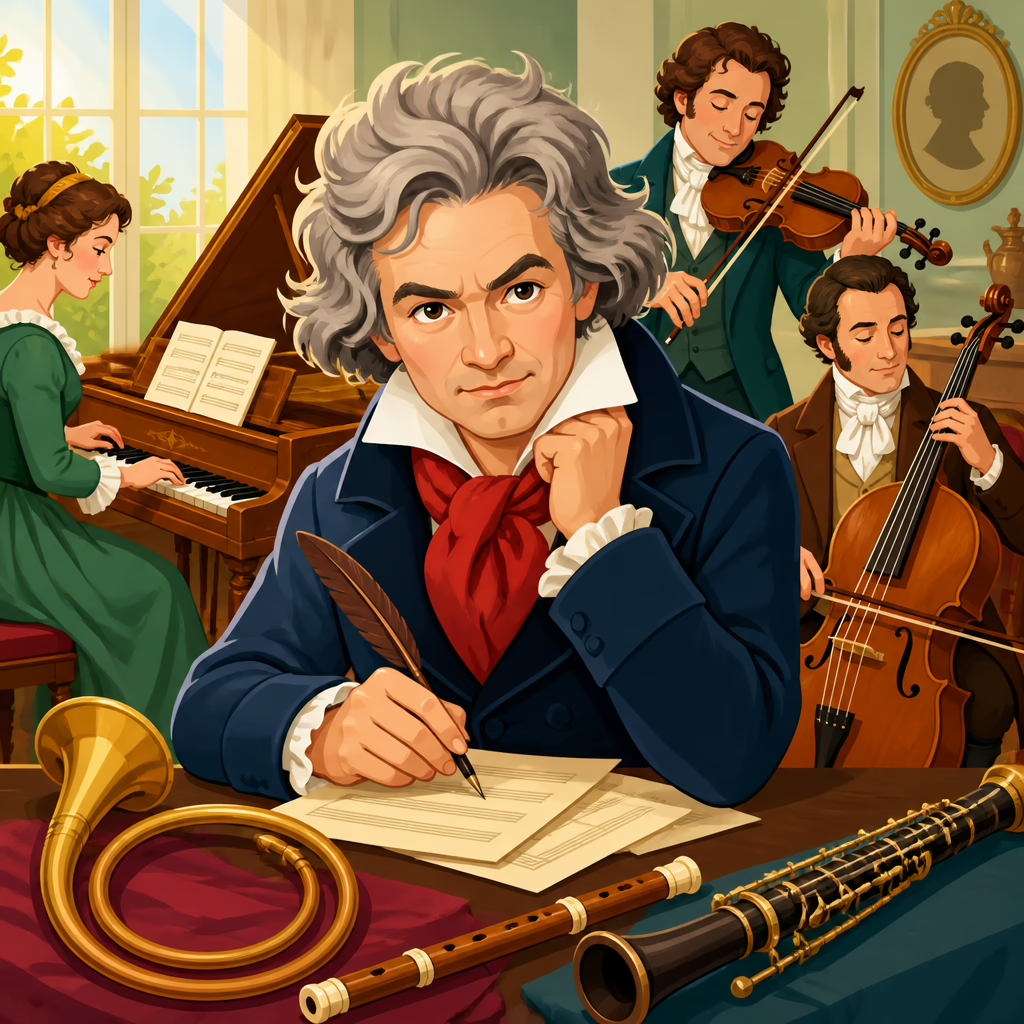
Beethoven Recordings That Use Rare Early Instruments
Beethoven recordings that use rare early instruments offer a different way to hear familiar scores: not as museum pieces, but as vivid, sometimes unruly sound events shaped by the materials, mechanics, and playing habits of Beethoven’s own era. In this context, “early instruments” usually means original instruments from the late eighteenth and early nineteenth centuries, or meticulous replicas built to the same specifications. “Rare” narrows the field further. It points to recordings that go beyond standard period-instrument practice and feature uncommon resources such as Viennese fortepianos with split knee levers, natural horns with historical crooks, narrow-bore trombones, wooden flutes with fewer keys, early timpani with calfskin heads, or string setups using gut strings and transitional bows. I have spent years comparing these recordings against modern-instrument benchmarks, and the difference is never just color. Instrument design alters articulation, balance, tuning behavior, dynamic range, and even tempo decisions.
That matters especially in Beethoven, whose music sits at a technological crossroads. He inherited Classical instrument types from Haydn and Mozart, yet wrote with an aggressively expanding imagination. On modern concert instruments, performers can smooth over that tension. On rare early instruments, the tension becomes audible and instructive. Sudden sforzati bite harder because the strings speak differently; wind chords carry a grainier individuality because keywork and bore design limit homogeneity; brass fanfares sound riskier because natural instruments do not iron out every pitch. For listeners trying to understand why a conductor chooses one Beethoven cycle over another, these recordings reveal practical answers inside the sound itself. They illuminate orchestral transparency, expose Beethoven’s registral thinking, and clarify how period sonorities change our judgment of drama, lyricism, and scale. This article focuses on the most significant Beethoven recordings that use rare early instruments, what makes those instruments rare, and how to listen for the musical consequences rather than treating authenticity as a slogan.
What counts as a rare early instrument in Beethoven recording practice
Not every period-instrument Beethoven set qualifies. Since the 1980s, informed performance has become established enough that copies of early nineteenth-century strings, winds, and brass are no longer unusual by themselves. Rarity comes from specificity. A recording stands out when it uses documented instrument models associated with Vienna around 1800 to 1827, or when soloists perform on surviving originals that preserve uneven tonal response, lighter action, and limited sustaining power. Think of a Conrad Graf fortepiano from the 1820s, an Anton Walter-style instrument closer to Beethoven’s earlier keyboard world, or a Streicher copy that projects a leaner treble and more vocal middle register than a modern Steinway. In orchestral terms, rarity may involve not just valveless trumpets and horns, but exact crook choices, classical bassoons with narrower bores, and timpani struck with hard sticks on skin heads tuned in intervals that emphasize harmonic tension.
These details are not pedantic. They alter the musical argument. A natural horn section can blaze in E-flat yet sound dangerous in more remote harmonies because hand-stopping changes timbre. A wooden flute in Beethoven’s Sixth Symphony speaks with less metallic penetration, allowing oboes and clarinets to emerge as equal partners rather than blended color wash. Gut-strung violins decay faster, which makes repeated rhythmic figures cleaner and can prevent thick textures from turning muddy. Early trombones in the Fifth or Ninth carry less overpowering mass than their modern descendants, so choral and lower-string lines remain audible. When I compare recordings, I ask a practical question: does the instrumentarium reveal notation that usually gets buried? The best rare-instrument Beethoven recordings answer yes within minutes.
Symphony cycles that changed the conversation
Among complete symphony cycles, John Eliot Gardiner’s recordings with the Orchestre Révolutionnaire et Romantique remain a central reference because they used period instruments with uncompromising attack, brisk tempi, and sharply profiled phrasing. These were not the very first historical Beethoven recordings, but they helped many listeners hear the symphonies as revolutionary again. Hard timpani sticks, lean strings, and incisive natural brass make the Eroica funeral march and the Seventh Symphony’s rhythmic machinery feel less monumental in a late-Romantic sense and more kinetically unstable. Gardiner’s set is not rare because period instruments are unusual today; it is rare because the execution captures the friction and asymmetry that modern orchestras often suppress.
Roger Norrington’s London Classical Players cycle is equally important, though different in temperament. Norrington pursued minimal vibrato and highly articulated textures, creating a drier, more exposed sound. In the Pastoral Symphony, storm passages can seem startlingly physical rather than luxuriant. Some listeners find the approach austere, but it demonstrates how early instrument response supports transparent contrapuntal hearing. Frans Brüggen’s Orchestra of the Eighteenth Century added another model: less confrontational than Gardiner, more singing than Norrington, yet still grounded in historical brass and woodwind color. Brüggen’s Beethoven often convinces skeptics because it pairs period sonority with long architectural phrasing.
For a broader framework on evaluating these differences across complete sets, see the main guide at how to compare Beethoven symphony cycles like a critic. That larger comparison helps place rare early instruments within decisions about balance, repeats, venue acoustics, and ensemble size. Another major benchmark is Nikolaus Harnoncourt with the Chamber Orchestra of Europe. The orchestra was not a fixed period band in the strictest sense, but the project integrated historical practices and instrument choices in a way that made accents, rests, and dynamic markings unusually consequential. Harnoncourt showed that early-instrument logic is not merely about speed; it is about rhetoric, the sense that every phrase behaves like speech with consonants and stresses.
Fortepiano recordings that reveal Beethoven’s keyboard world
If the symphonies demonstrate orchestral impact, Beethoven’s piano music reveals the most radical consequences of rare early instruments. Modern pianos can sustain, blend, and dominate in ways Beethoven never knew. On a fortepiano, especially an original or exact copy of a Walter, Graf, Broadwood, or Streicher, textures separate more cleanly and expressive devices become more local and speech-like. Ronald Brautigam’s Beethoven sonata cycle on fortepiano is indispensable here. Using instruments built after historical models by Paul McNulty, Brautigam shows how bass lines punch without booming and how treble passagework can glitter without becoming percussively monochrome. The “Waldstein” and “Appassionata” gain volatility rather than sheer weight.
For an even more tactile encounter, listeners should seek recordings on surviving original instruments by artists such as Melvyn Tan, Andreas Staier, or Kristian Bezuidenhout in repertory close to Beethoven’s circle. The exact instrument matters. A Viennese action permits rapid repetition and delicately graded attack, but offers less sustaining legato than an English Broadwood. That changes pedaling strategy, ornament shape, and left-hand projection. In the Op. 110 and Op. 111 sonatas, trills and broken textures can sound less like clouds and more like articulated strands. I have found that listeners new to fortepiano often need one adjustment: stop expecting orchestral grandeur from the keyboard alone and instead listen for contrast, register, and harmonic timing. The instrument’s comparative fragility is a source of information, not a defect.
| Recording focus | Representative artists | Rare instrument feature | What to listen for |
|---|---|---|---|
| Symphony cycles | Gardiner, Norrington, Brüggen | Natural brass, gut strings, hard-stick timpani | Sharper accents, lighter bass, more exposed winds |
| Piano sonatas | Brautigam, Staier, Bezuidenhout | Walter, Graf, Streicher, Broadwood-type fortepianos | Faster decay, clearer inner voices, varied registers |
| Concertos | Immerseel, Levin, Bilson | Period orchestra with solo fortepiano | True dialogue instead of soloist domination |
| Choral works | Herreweghe, Gardiner | Early trombones, natural trumpets, classical woodwinds | Lean choral texture, brighter brass edge, textual clarity |
Concertos and chamber recordings where instrument dialogue becomes audible
Beethoven’s piano concertos may be the best entry point for listeners curious about rare early instruments because the contrast between solo keyboard and orchestra is immediate. Jos van Immerseel’s recordings with Anima Eterna Brugge are exemplary. The fortepiano does not tower over the ensemble; it converses with it. Woodwinds matter more, timpani interjections register more clearly, and tuttis no longer feel like generic build-up before the piano returns. In the Fourth Concerto, the famous opening statement sounds intimate and exploratory on a period keyboard, and the second movement’s confrontation between soloist and strings gains dramatic force because the string sonority is lean enough to sound implacable without becoming thick.
Robert Levin and Malcolm Bilson also deserve attention for combining scholarship with vivid musicianship. Their work demonstrates that cadenzas, embellishment, and tempo flexibility make better sense when the instrument can turn on a dime. A modern piano often encourages legato continuity and sustained resonance; a fortepiano invites rhetorical segmentation, which aligns well with Beethoven’s abrupt changes of character. Chamber recordings show the same principle on a smaller scale. In sonatas for violin and fortepiano, the keyboard becomes an equal partner rather than an upholstered foundation. The “Kreutzer” Sonata on period instruments can be startlingly fierce because the violin’s gut-string edge and the fortepiano’s crackling attack produce true argument, not polished blend. This is one area where rare instruments do not reduce intensity; they redirect it into sharper profile.
How rare winds, brass, and timpani reshape Beethoven’s orchestral drama
Many listeners notice fortepiano first, but the most revelatory changes in Beethoven recordings often come from the wind and brass departments. Early clarinets have a woody, speech-like core and less uniformity across registers. Classical oboes can sound pungent and narrow in a way that cuts through strings without modern volume. Bassoons speak more grainily, making octave doublings easier to follow. Natural trumpets and horns produce a hierarchy of secure and less secure notes depending on the harmonic series and hand technique. That means fanfares have real edge, and some pitches arrive with thrilling roughness. Beethoven exploited exactly that brightness and strain.
Timpani may matter most of all. Period sticks and calfskin heads create a harder, more immediate articulation, especially in the Fifth, Seventh, and Ninth Symphonies. Instead of a generalized boom, you hear pitch center, stick contact, and rhythmic profile. In historically grounded performances, the scherzo of the Ninth can sound frighteningly precise because the timpani are not just supporting pulse; they are participating in thematic definition. Early trombones also transform climaxes. Their narrower, less engulfing tone allows vocal lines and string figuration to survive inside loud passages. I have repeatedly found that listeners who claim period Beethoven sounds small change their minds when they hear how much structural detail remains audible in fortissimo writing. The drama comes less from mass and more from contrast, attack, and color differentiation.
How to choose the right recording and what limitations to expect
The best Beethoven recordings that use rare early instruments are not automatically the best for every listener or every work. If you value granite-like orchestral weight in the Ninth or a vast singing line in the late sonatas, some period readings will feel too lean. Original instruments can also expose tuning instability, uneven response, and noisy mechanical action. Those traits are historically plausible, but not everyone enjoys them. Recording quality matters as well. A closely miked fortepiano can exaggerate key noise and diminish bloom; a reverberant hall can blur the very transparency these instruments are supposed to provide. I usually recommend starting with one symphony cycle, one fortepiano sonata disc, and one concerto set rather than diving immediately into a complete shelf.
For symphonies, Gardiner offers urgency, Brüggen balance, and Norrington radical clarity. For piano sonatas, Brautigam is the most consistently persuasive gateway because his technique and recorded sound help newcomers hear the instrument’s expressive logic. For concertos, Immerseel provides outstanding orchestral dialogue. After that, branch into more specialized projects on original keyboards or less standardized orchestral forces. The reward is substantial. Rare early instruments make Beethoven’s music feel less inevitable and more newly invented. They reveal the scores as solutions to real acoustic problems and opportunities presented by specific tools. That perspective deepens listening even when you return to modern performances. If you want to hear Beethoven with fresh ears, choose one of these recordings and compare it carefully with a favorite modern version tonight.
Frequently Asked Questions
What counts as a “rare early instrument” in Beethoven recordings?
In this context, a rare early instrument is more than just an old instrument. It usually refers to an original instrument from Beethoven’s lifetime, or a historically precise copy, that represents a specific and less commonly heard sound world from the late eighteenth or early nineteenth century. That can include Viennese fortepianos by makers such as Anton Walter, Conrad Graf, or Johann Fritz; natural horns and trumpets without modern valves; timpani built to period dimensions and fitted in historically appropriate ways; gut-strung violins, violas, cellos, and basses; and woodwinds whose bore, keywork, and tone differ dramatically from modern equivalents.
The word “rare” matters because not every period-instrument recording automatically fits the description. Some ensembles use broadly historical setups, but the most distinctive Beethoven recordings go further by choosing unusual instrument types, surviving originals with documented provenance, or replicas of very specific models associated with Vienna and the early Romantic transition. Those choices affect articulation, balance, tuning stability, volume, and color. Instead of the sleek uniformity listeners often associate with modern symphonic playing, rare early instruments can produce grainier textures, sharper attacks, lighter bass foundations, and more individualized timbres across the orchestra. The result is not a novelty effect, but a closer encounter with the materials Beethoven and his contemporaries actually wrote for and heard.
How do Beethoven’s works sound different on rare early instruments compared with modern instruments?
The differences are often immediate. On early strings with gut rather than modern metal strings, the sound tends to be leaner, more textured, and more responsive to articulation changes. Notes can speak with a quicker edge and decay more naturally, which makes rhythmic figures feel springier and less saturated. Natural horns and trumpets bring a more overtly brassy, uneven, and coloristic quality than modern valved instruments. Instead of delivering every note with identical ease, they reveal which pitches sit naturally on the instrument and which require more effort, and that gives Beethoven’s writing a vivid physical profile. Woodwinds, too, become far more individual. Early oboes, clarinets, bassoons, and flutes often stand out as distinct voices rather than blending into a generalized orchestral middle.
Keyboard works are especially transformed when played on period fortepianos. A Beethoven sonata on an early Viennese piano can sound lighter, more transparent, and more volatile than on a modern concert grand. The bass is less thunderous, the treble often more bell-like or intimate, and dynamic contrasts can feel abrupt in a way that suits Beethoven’s rhetoric. Fast passages may sparkle rather than roar, while accents and sforzandos can sound biting instead of purely massive. Importantly, these differences do not make the music smaller. In many cases, they make it more dramatic, because the contrasts in register, attack, and instrumental character are exposed rather than smoothed over. Familiar scores can suddenly feel less monumental in a nineteenth- and twentieth-century symphonic sense and more like living theater built from friction, surprise, and sharply profiled sonorities.
Are these recordings mainly for specialists, or can casual listeners enjoy them too?
They are absolutely enjoyable for casual listeners, even if they are often discussed in specialist terms. You do not need prior knowledge of historical performance practice to hear that something distinctive is happening. In fact, many first-time listeners are drawn in precisely because these recordings sound less predictable than mainstream performances. Tempos may feel more urgent, accents more pointed, and instrumental colors more varied. A well-made Beethoven recording on rare early instruments can make a famous symphony or piano sonata feel startlingly fresh, almost as if a familiar painting had been cleaned and its original contrasts restored.
That said, expectations matter. If someone is used to the sustained power, fullness, and polished blend of a large modern orchestra, a period-instrument Beethoven recording may initially sound lighter, rougher, or more exposed. That is not a flaw; it is part of the appeal. These recordings often reveal inner lines, dance rhythms, and harmonic tensions that can be obscured in heavier interpretations. Casual listeners often respond well when they begin with pieces they already know, such as the Fifth or Seventh Symphony, the “Eroica,” or a major piano sonata, because the comparisons become immediately meaningful. Rather than thinking of rare early instrument recordings as academic alternatives, it is better to hear them as compelling performances that offer a different dramatic logic. They invite curiosity, but they do not require expertise.
What should listeners pay attention to when comparing Beethoven recordings on rare early instruments?
A good comparison starts with instrumental color and orchestral balance. Listen to how clearly the winds emerge from the texture, how the brass cut through without the homogenized smoothness of modern instruments, and how the timpani contribute not just weight but attack and character. In string writing, notice whether repeated notes bounce with more lift, whether phrases taper differently, and how much transparency there is in contrapuntal passages. In keyboard recordings, focus on how the instrument handles extremes of register, how quickly sound fades, and how Beethoven’s dynamic markings translate on a fortepiano versus a modern piano.
It is also useful to pay attention to the way technical limits become expressive features. Early instruments do not behave like modern ones, and that affects musical rhetoric. Certain horn notes may flare or narrow, wind passages may change color across registers, and fortepiano chords may strike more like speech than like sustained symphonic blocks. These qualities can make Beethoven’s writing sound more improvisatory, more volatile, and sometimes more daring. Tempo choices are another important factor. Historically informed performances are not all fast, but many are built around a stronger sense of dance pulse and articulation. Finally, compare how conductors or performers handle contrast. Beethoven’s music thrives on sudden shifts in dynamics, texture, and mood, and rare early instruments often sharpen those edges. The most memorable recordings are usually the ones that combine historical setup with interpretive conviction, not just historical correctness.
Why are rare early instrument Beethoven recordings important for understanding the music today?
These recordings matter because they challenge assumptions that have become so familiar that many listeners mistake them for the music itself. Beethoven’s works have long been central to concert life, but that centrality has also encouraged traditions of sound that reflect later nineteenth- and twentieth-century ideals: larger orchestras, heavier strings, more uniform wind sections, more powerful pianos, and a stronger emphasis on sustained grandeur. Rare early instrument recordings remind us that Beethoven wrote for a more heterogeneous, less standardized musical world. The instruments available to him shaped what he imagined, what he expected performers to do, and how audiences would have experienced boldness, tension, humor, and shock.
They are important not because they provide one final “authentic” answer, but because they reopen interpretive possibilities. Hearing Beethoven on rare early instruments can clarify why certain textures are so exposed, why some dynamic markings are so extreme, and why rhythmic propulsion is often central to the music’s force. These recordings can also restore a sense of risk. Beethoven’s scores are sometimes treated as monuments, but period-informed performances often reveal them as experiments in sonority and drama. For modern listeners, that is invaluable. It deepens historical understanding while also making the music feel more immediate. The best of these recordings do not place Beethoven behind glass; they bring him closer by letting the physical realities of his sound world speak again.