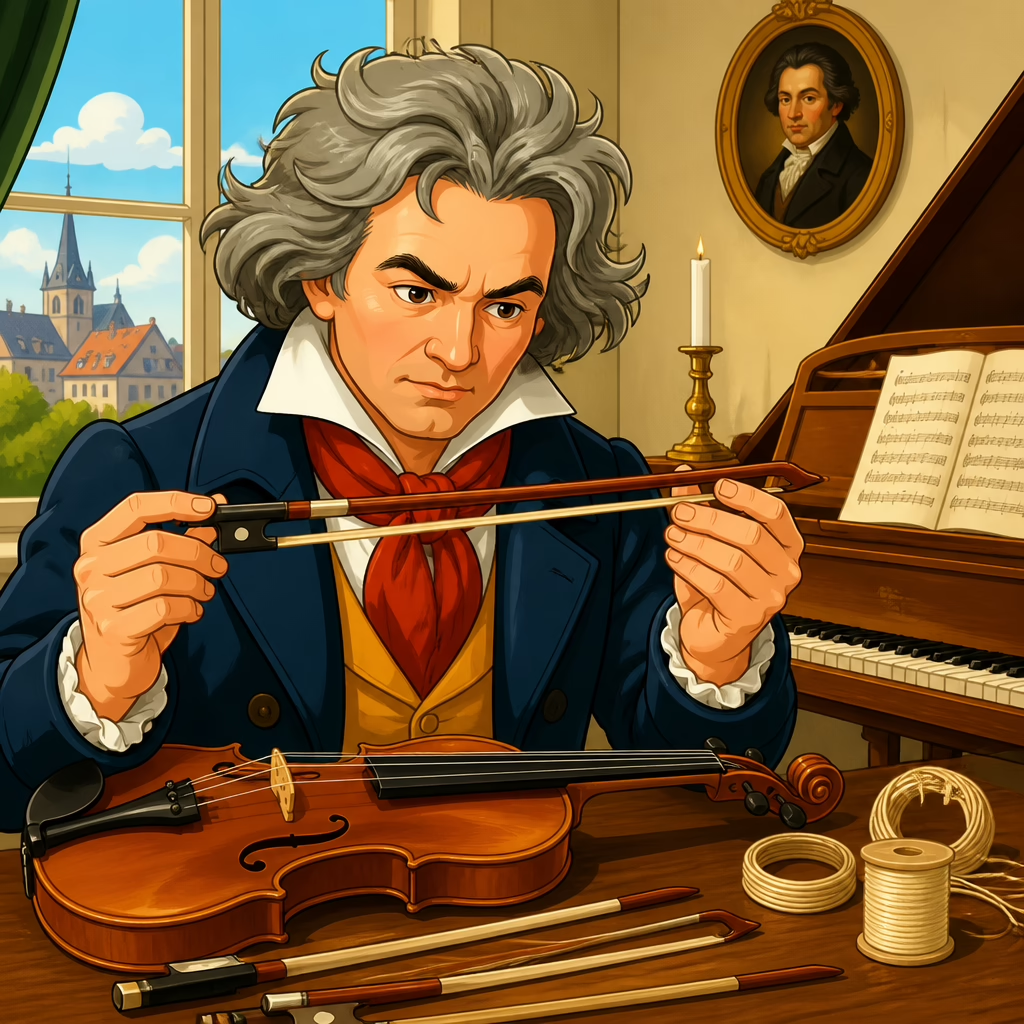
Beethoven on Historical Bows and Gut Strings
Beethoven on historical bows and gut strings sounds less like a museum exercise than a radical change in musical grammar. The phrase refers to performances that use period-style bows based on late eighteenth- and early nineteenth-century models and strings made primarily from sheep gut rather than modern steel or synthetic cores. In practical terms, those materials alter attack, sustain, resistance, tuning behavior, blend, and dynamic shape. When orchestras apply them to Beethoven, they do not simply change color; they reshape rhythm, articulation, tempo relationships, and the balance between winds and strings. I have heard and worked through these differences in rehearsal rooms where a single bowing revision can make an entire scherzo snap into focus, and where a gut-strung violin section suddenly lets natural horns speak through textures that often feel overupholstered on modern instruments.
The subject matters because Beethoven sits at a fault line between Classical and Romantic performance habits. His orchestral writing still depends on the sharply profiled rhetoric inherited from Haydn and Mozart, yet his dynamic range, motivic compression, and theatrical scale pushed instruments and players to their limits. Historical bows and gut strings reveal how much of that tension is embedded in the physical means of sound production. The leaner core and quicker decay of gut emphasize gesture over blanket legato; the convex or transitional bow shapes encourage differentiated strokes; the reduced string tension changes what counts as forte, cantabile, and accent. Listeners comparing recordings often sense more clarity and urgency without knowing why. Understanding the equipment explains the result and gives a more precise way to judge whether a performance is persuasive, merely fashionable, or genuinely illuminating.
What historical bows and gut strings change in Beethoven
A historical bow is not one fixed object. Beethoven’s lifetime spans late Classical bows associated with Cramer and early Tourte-influenced designs that gradually approach the modern bow. The key differences from a modern bow are balance point, weight distribution, stick camber, and frog design. Many period bows feel lighter at the tip and more speech-like in articulation. They naturally favor a quick consonant at the front of the note and a taper afterward. That matters in Beethoven because his notation is full of sf, fp, hairpins, slurs broken by accents, and repeated-note figures that depend on bite followed by release. A modern bow can reproduce those marks, but it often sustains too evenly unless a player actively resists the instrument’s legato bias.
Gut strings create a parallel shift. Plain gut upper strings and gut-wound lower strings respond with more friction under the bow and less tensile stiffness than steel. The sound has a textured onset, rich inner overtones, and a faster decay. Pitch can be more flexible, especially under pressure or changes in humidity, and articulation speaks differently at the string crossing. In Beethoven, this means rapid repeated notes can chatter with expressive grain rather than smooth uniformity, and forte passages bloom from the attack instead of from sheer sustained density. It also means that long lines require active bow management and nuanced vibrato choices. On gut, vibrato becomes an ornament and color resource rather than a continuous default, which lets harmonic tension and dissonance register more explicitly.
The result is not automatically thinner. In a resonant hall, a good period string section can sound astonishingly present because the overtone profile leaves space around each note. Beethoven’s textures gain transparency, and transparency often reads as power. The opening of the Fifth Symphony, for instance, can hit harder when the rests are dry, the repeated notes are compact, and the cellos and basses articulate with spring rather than mass. Likewise, the Seventh’s dance rhythms benefit from the bow’s natural lift, which keeps the pulse airborne instead of earthbound.
How equipment reshapes articulation, tempo, and phrasing
The most audible consequence of historical setup is articulation. Beethoven’s slurs are rarely decorative; they group notes into rhetorical units. On period bows, a four-note slur often has a built-in hierarchy: a speaking first note, a carried middle, and a slight relaxation at the end. That profile can make even simple scales sound argumentative. In rehearsals, when string players switch from a modern sustained stroke to a period détaché or lifted martelé equivalent, entire paragraphs of Beethoven start making syntactic sense. The Eroica’s first movement gains edge because off-beat figures and sforzati stop merging into one generalized excitement.
Tempo is connected to articulation more than to ideology. Critics sometimes assume period-instrument Beethoven is fast because conductors want to be provocative. In stronger performances, the speed follows from note length and speaking weight. Shorter decay and quicker rebound allow a brisk pulse without blur. The finale of the Fourth Symphony is a classic example: on gut strings and classical bows, its motor rhythm can stay light, precise, and slightly dangerous at a tempo that would sound merely hectic with modern legato. Conversely, some slow movements become broader on period instruments because sustaining a line on lower-tension strings requires room for resonance and breath. Historically informed practice is not a one-directional push toward speed; it is a recalibration of motion according to how the instruments carry textural information.
Phrasing also changes because Beethoven’s crescendos and accents interact with the bow differently. A modern string section can produce a long seamless crescendo by adding pressure across a stable sound column. Gut strings resist that kind of linear inflation. Crescendos often emerge through articulated accumulation: more bow, more speed, slightly brighter contact, then genuine release. This produces a dramatic contour closer to speech than to orchestral wash. The payoff comes in passages like the first movement development of the Seventh, where repeated rhythmic cells become obsessive because each swell feels physically generated, not merely indicated by a volume slider.
Balance, orchestral color, and why winds suddenly matter more
One of the greatest benefits of historical bows and gut strings in Beethoven is restored proportional balance. Modern steel-strung sections can blanket woodwinds, especially in middle registers where Beethoven often gives clarinets, bassoons, and horns crucial harmonic or rhythmic information. Gut strings project differently: they occupy less continuous acoustic space and leave more room for winds to cut through. As a result, listeners hear counterpoint that can vanish in plush modern performances. In the Pastoral Symphony, inner wind figures stop sounding ornamental and instead become structural parts of the scene-painting.
This balance is particularly important because Beethoven wrote for natural brass and timpani that interacted with strings in a more percussive, less homogenized environment. Historical string equipment supports that ecosystem. The winds do not need to force tone to be audible, and the strings do not need to over-sustain to seem important. In the best recordings, the orchestra sounds less like a string choir with accompaniment and more like a federation of distinct timbral actors. That distinction is central to Beethoven’s dramaturgy. The famous horn calls in the Eroica or the bassoon punctuations in the Eighth gain character because they are not submerged under a modernized string carpet.
| Performance factor | Historical bows and gut strings | Modern bows and steel or synthetic strings |
|---|---|---|
| Note attack | Quick, grainy, speech-like onset | Smoother, more uniform onset |
| Decay | Faster release, clearer rests | Longer sustain, thicker overlap |
| Dynamic shape | Built through articulation and bow speed | Built through sustained pressure and volume |
| Wind balance | Greater transparency for inner lines | Strings more likely to dominate texture |
| Rhythmic feel | Buoyant, sprung pulse | Heavier, more legato continuity |
Color is not an incidental bonus here; it guides interpretation. Beethoven’s string writing often alternates between muscular unison and exposed chamber-like exchange. Gut strings make those contrasts vivid. Violas and second violins gain a nasal, articulate presence that can transform accompanimental figures into argumentative commentary. Cellos have less metallic edge but more woody definition, which makes bass lines feel directional rather than simply weighty. The whole ensemble can sound rougher at the edges, but that roughness is often the point. Beethoven’s sound world was not upholstered for comfort.
What to listen for in recordings and live performance
If you are evaluating Beethoven on historical bows and gut strings, listen first to rests. Silence between gestures tells you whether the players are using the setup to clarify syntax or merely to create period color. In the Fifth and Seventh Symphonies, meaningful rests generate propulsion. Second, track repeated notes. On gut strings they should vary in grain and direction while staying rhythmically exact. Bland repetition suggests modern habits transferred onto old equipment. Third, compare how often winds emerge with intelligible phrasing during full orchestral passages. If oboes, bassoons, and horns sound like equal participants, the balance is probably working.
Also pay attention to vibrato. A convincing period-style Beethoven performance does not mean zero vibrato. It means selective vibrato used to mark harmonic stress, warmth, or expressive emphasis. Continuous vibrato can smear harmonic profile and weaken the rhetorical force of Beethoven’s dissonances. Yet an overly ascetic refusal to vibrate can sound doctrinaire and emotionally thin. The strongest orchestras and concertmasters find a middle path that keeps the line alive while preserving textural transparency.
Bowing choices are another clue. Listen for whether slurs sound purposeful, especially in transitions and accompanimental patterns. In Beethoven, bad bowing decisions expose themselves quickly because motives recur under pressure. Historically aware ensembles often use shorter, more differentiated strokes in scherzos and finales, but they should also sustain when the phrase truly demands it. The Romanze-like lyricism in the slow movement of the Fourth or the noble paragraphs in the Missa-influenced moments of the Ninth require breadth, not incessant clipping.
For a broader framework on evaluating Beethoven recordings, see the main guide at how to compare Beethoven symphony cycles like a critic. In this narrower context, the main question is simple: do historical bows and gut strings reveal structure, timing, and character more convincingly than a modern setup would in the same hands? When the answer is yes, the performance usually feels inevitable rather than novel.
Limits, tradeoffs, and the best modern lessons from period practice
Historical equipment is not a guarantee of truth. Intonation can suffer, ensemble can fray, and climaxes can underwhelm if the players lack technical command or if the hall is acoustically dry. Some conductors mistake lightness for significance and end up shrinking Beethoven’s scale. Others fetishize metronome marks without considering room response, orchestral size, or the difference between notated speed and perceived momentum. I have heard period performances where every texture was transparent and almost none of it was compelling. Style is only persuasive when allied to discipline, line, and dramatic purpose.
There are also legitimate reasons some listeners prefer modern strings and bows in certain Beethoven works. The Ninth Symphony in a large hall can benefit from the sheer carrying power of a modern string section, especially when choirs and expanded brass are involved. Late Beethoven often invites a breadth of sonority that some period bands struggle to achieve consistently. At the same time, modern orchestras have learned important lessons from historical practice: lighter articulation, reduced vibrato, antiphonal violins, sharper timpani presence, and more observant treatment of accents and slurs. The best contemporary Beethoven frequently blends modern resources with historically informed thinking.
The central insight remains clear. Historical bows and gut strings do not make Beethoven smaller, older, or academically correct. They expose the engine of the music: attack against resonance, gesture against line, rhetoric against mass. They help explain why Beethoven’s scores can sound revolutionary when phrasing is carved rather than spread, when wind lines speak through the texture, and when rhythm is sprung from the bow instead of hammered into a uniform surface. If you want to hear Beethoven’s orchestral language with sharper edges and stronger internal logic, seek out performances that use these tools well, then compare them closely with modern-instrument rivals. Your ears will start catching not just different timbres, but different ideas of what the music is saying.
Frequently Asked Questions
What does “Beethoven on historical bows and gut strings” actually mean?
It refers to performances that use period-appropriate string technology rather than modern orchestral equipment. In practice, that usually means bows modeled on late eighteenth- and early nineteenth-century designs and strings made largely from sheep gut, sometimes with metal winding on the lower strings. These are not cosmetic substitutions. They change how the instrument speaks, how much resistance the player feels under the hand, how notes begin and decay, and how phrases naturally rise and fall.
With historical bows, the balance point, stick shape, and general responsiveness differ from a modern Tourte-style bow. That affects articulation and encourages a different relationship to accent, stroke length, and release. Gut strings respond differently from steel or synthetic-core strings as well. They often produce a more complex, grain-rich sound with a quicker bloom and less uniform sustain. As a result, Beethoven can sound less like a massive continuous wall of sound and more like a language built from sharply profiled gestures, contrasts, and rhetorical turns.
So the phrase is really about a change in musical grammar, not just instrumentation. It invites players to rethink tempo, phrasing, dynamic contour, balance, and ensemble interplay in ways that may align more closely with the expressive world Beethoven knew. For listeners, the effect can be startlingly fresh: more transparency, more bite, more volatility, and often a stronger sense that every accent and sforzando matters.
How do historical bows and gut strings change the sound of Beethoven compared with modern instruments?
The most immediate difference is in articulation. Historical bows tend to make the beginning of a note more clearly defined while allowing the sound to taper more naturally. That means short notes can spring to life with a speaking quality, and longer notes do not automatically sustain with the same even pressure familiar from modern setups. In Beethoven, where rhythmic motive and dynamic punctuation are central, this can make the music feel more urgent and more verbally inflected.
Gut strings also alter the tonal profile. They typically offer a warmer, less metallic sound with more variation inside the note itself. Instead of a highly stabilized, uniformly projecting tone, you often hear a richer spectrum of texture, including slight edge, softness, grain, and color change depending on register and pressure. This is especially important in Beethoven because his orchestral writing relies on tension between brilliance and roughness, lyricism and attack. Gut strings can reveal those contrasts in a very direct way.
Blend and balance change too. Inner parts often emerge more distinctly, and the relationship between strings and winds can become more equal. In many modern performances, the string section can sustain a dense, continuous sonority that dominates the texture. On gut strings, the sound may be more transparent, which allows winds, brass, and timpani to register with greater clarity. The result is not necessarily smaller in impact. In fact, many listeners experience it as more dramatic because the contrasts are more immediate, the accents are sharper, and the musical structure is easier to hear.
Dynamic shape is another major factor. Historical equipment often encourages crescendos and diminuendos that are tied to the physical nature of each bow stroke and the speaking properties of the string. That can make Beethoven’s dynamic markings feel less like generalized volume instructions and more like compositional energy. Sudden fortes hit harder, quiet passages carry more tension, and repeated rhythmic figures can feel driven rather than merely loud.
Why do many musicians and scholars believe this approach is especially revealing in Beethoven?
Beethoven stands at a moment of transition. He inherited late Classical conventions from Haydn and Mozart, but he expanded their scale, intensity, and structural ambition. Performing his music on historical bows and gut strings helps illuminate that in-between world. It preserves the clarity, buoyancy, and speech-like articulation of the eighteenth century while also exposing the extraordinary force Beethoven pushed through those means. In other words, it lets audiences hear not only how radical Beethoven was, but also what exactly he was radicalizing.
His scores are full of details that come alive under period conditions: sharp accents, disruptive sforzandi, hairpin dynamics, repeated-note figures, syncopations, exposed textures, and abrupt shifts of character. On modern instruments, some of these features can be absorbed into a larger, smoother orchestral blend. Historical setups often resist that smoothing. They make the edges audible. That can clarify the argumentative quality of Beethoven’s writing, where musical ideas collide, interrupt one another, and generate momentum through friction rather than through sheer homogeneity of sound.
There is also a historical logic to the approach. Beethoven composed with players, instruments, halls, and sonorities very different from those of the modern symphony orchestra. No one can recreate his exact listening environment, but using historical bows and gut strings brings performers closer to the physical realities embedded in the music. That proximity can influence choices about tempo, articulation, bowing, vibrato, and orchestral balance in ways that are not academic but audibly practical.
Perhaps most importantly, this approach often makes Beethoven feel less monumental in the static sense and more revolutionary in the active sense. The music can regain volatility, wit, danger, and asymmetry. Instead of presenting Beethoven as a polished marble monument, historical performance can restore a sense of unpredictability and forward thrust, which many musicians consider central to his style.
Does performing Beethoven this way make the music quieter, rougher, or less emotionally powerful?
Not necessarily, and this is one of the most common misunderstandings. Historical bows and gut strings do not simply reduce volume or produce an underpowered version of Beethoven. They redistribute power. Rather than depending on a uniformly large and sustained string sound, they create impact through attack, rhythmic precision, contrast, and timbral variety. A fortissimo may not resemble the broad, saturated sonority of a modern orchestra, but it can feel more explosive because it arrives with greater edge and sharper definition.
The sound can indeed be rougher in the best sense of the word. That roughness often reflects a wider expressive palette, not inferior control. Beethoven’s music does not always ask for sleekness. It frequently demands tension, agitation, provocation, and even abrasion. Period materials can capture that expressive friction vividly. When a phrase strains, cracks slightly at the edge, or pushes against the grain of the instrument, that may be closer to the emotional truth of the music than a perfectly polished surface.
As for emotional power, many listeners find it intensified rather than diminished. Slow movements can become more intimate and vulnerable because gut strings allow for delicate shifts of color and pressure. Fast movements can feel more dangerous because the articulation is less generalized and the rhythmic profile is more alive. The orchestra may sound more transparent, but transparency often heightens drama by exposing conflict within the texture. You hear the push and pull between sections, the urgency of accompaniment figures, and the instability underneath apparently simple gestures.
So while the emotional result is different from a large modern symphonic reading, it is not smaller in artistic consequence. It is often more immediate, more human, and more unpredictable. That can make Beethoven’s expressive world feel startlingly close rather than ceremonially distant.
What should listeners pay attention to when hearing Beethoven played on historical bows and gut strings?
Start with the beginnings and endings of notes. One of the clearest changes is the way phrases speak. Listen for how quickly notes catch, how naturally they release, and how often the line seems shaped by tiny inflections rather than by continuous pressure. In Beethoven, this can transform repeated motives, accompaniment patterns, and short rhythmic cells into expressive events with real rhetorical weight.
Next, pay attention to texture. Inner voices often come through more clearly, and the dialogue between strings and winds can feel less hierarchical. Instead of hearing a string mass with wind color added on top, you may hear a more conversational orchestral fabric in which bass lines, viola figures, oboe interjections, and timpani accents all contribute actively to the argument. This is particularly rewarding in Beethoven because so much of his drama lives in the interaction of layers rather than in melody alone.
Also listen to dynamic contrast in a more detailed way. Historical performance often makes crescendos feel cumulative and directional rather than simply louder. Sudden accents can sound more percussive, and quiet passages may carry unusual tension because the sound remains alive even at lower volume. Beethoven’s famous sforzandi, offbeat accents, and abrupt turns of mood often become more intelligible when you hear them not as oversized gestures but as part of a tightly worked expressive syntax.
Finally, notice the emotional character of the sound itself. Gut strings and historical bows can produce a blend of warmth, bite, fragility, and brilliance that differs from the modern orchestral norm. Try to hear that not as an antique novelty but as an interpretive key. The point is not to make Beethoven sound old. It is to let the material qualities of the instruments reveal a style of energy, speech, and contrast that modern equipment can sometimes smooth over. For many listeners, once that way of hearing clicks, Beethoven’s music feels newly unstable, daring, and alive.