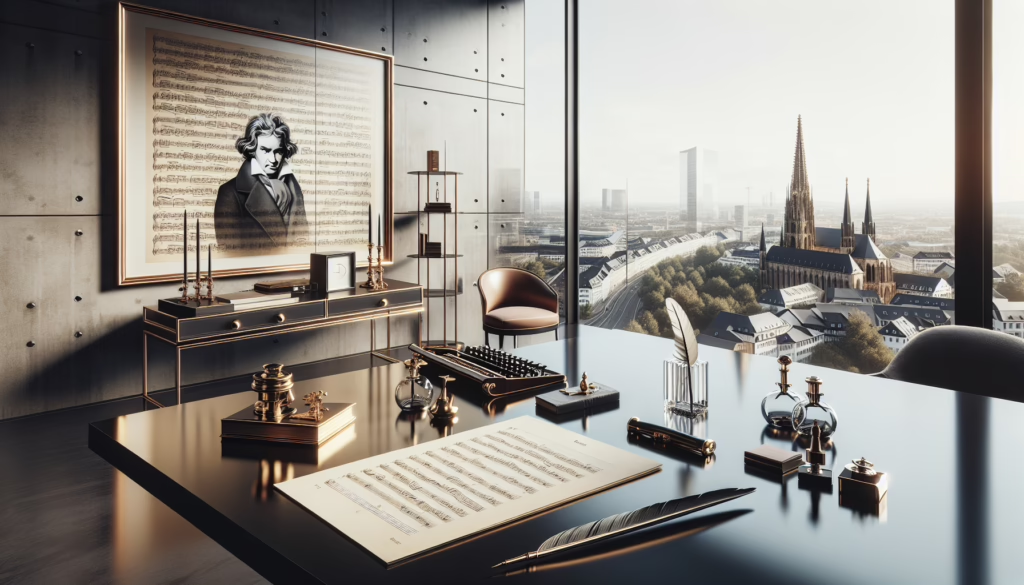
Beethoven Archives in Bonn: A Deep Dive
Beethoven Archives in Bonn offer the most concentrated documentary record of Ludwig van Beethoven’s life, work, reception, and legacy, making them essential for anyone studying the composer beyond the familiar image of the solitary genius. In practical terms, “archives” here means far more than a stack of manuscripts. It includes autograph scores, sketchbooks, letters, conversation books, early editions, portraits, legal documents, household objects, and the institutional records that explain how these materials were collected, authenticated, conserved, and interpreted. Bonn matters because it is Beethoven’s birthplace and because the city’s Beethoven-Haus developed into the central repository for original sources after the nineteenth-century dispersal of the composer’s estate. I have worked with music archives and manuscript catalogs long enough to know that a reliable archive does two things at once: it preserves fragile originals and creates the context that turns isolated objects into usable evidence. That is exactly what the Bonn holdings do. For scholars, performers, collectors, and serious visitors, the archives answer practical questions. What survives in Beethoven’s own hand? Which sources are primary, secondary, or suspect? How do curators verify provenance? What can sketches reveal about compositional process? Why do multiple versions of a work exist? A deep dive into the Bonn materials clarifies all of this while also serving as a hub for broader Beethoven collections research.
What the Beethoven Archives in Bonn Actually Contain
The core institution is Beethoven-Haus Bonn, founded by the association established in 1889 and centered on the house at Bonngasse where Beethoven was born in December 1770. Its archive and research center hold one of the world’s most important Beethoven collections, built through purchase, donation, and long-term scholarly cataloging. The holdings include autograph manuscripts for individual works, compositional sketches, corrected proofs, correspondence to and from Beethoven, contemporary copies prepared by copyists, first and early printed editions, portraits, memorabilia, and a substantial library of secondary literature. These categories matter because each source type answers a different question. An autograph score can show revision layers in ink. A sketchleaf can reveal abandoned thematic ideas. A first edition may preserve readings from a lost manuscript. A letter may document a commission, publication dispute, or health crisis.
In Bonn, the archive is not limited to iconic treasures such as the “Moonlight Sonata” or Ninth Symphony tradition. The so-called miscellaneous dimension of the collection is often where the richest context lives. Household papers, visitors’ accounts, lockets containing hair, notebooks, legal receipts, ownership inscriptions, and portrait variants all contribute to the reconstruction of Beethoven’s social and professional world. Researchers regularly discover that a minor-seeming item, such as an annotated copy or an undated note, can change chronology or attribution when matched with handwriting analysis, watermark evidence, or known paper stocks. This is why archive descriptions emphasize shelf marks, provenance trails, and condition reports rather than romantic storytelling. The Bonn archives also preserve institutional files documenting acquisitions and prior scholarship, which are crucial for tracing how modern Beethoven studies were built.
Why Bonn Became the Central Hub for Beethoven Research
Beethoven died in Vienna in 1827, and his estate dispersed over time through heirs, publishers, collectors, and dealers. The concentration of sources in Bonn was therefore not automatic. It was the result of deliberate collecting by the Beethoven-Haus association, support from donors, and a sustained German and international effort to secure materials related to the composer’s life. Because Bonn could claim the symbolic authority of Beethoven’s birthplace, it became the natural center for memorialization. More importantly, it developed the scholarly infrastructure to justify that status: professional cataloging, conservation labs, a reference library, exhibitions, and collaborations with editors preparing critical editions.
That central role has practical consequences. When performers need to verify an articulation in a piano sonata, or when editors compare variant readings in a string quartet, Bonn is often a necessary stop in the documentary chain. The archives connect with the larger ecosystem of Beethoven collections in Vienna, Berlin, Kraków, Budapest, Washington, and private hands, but Bonn functions as the organizing node. In my experience, the value of such a hub is not simply possession; it is standardization. The archive supplies dependable descriptions, accepted sigla, and cross-references that let scholars compare sources without reinventing the foundation every time. This is especially important in Beethoven studies, where authenticity questions can be thorny and where nineteenth-century collecting habits sometimes blurred the line between original document, authorized copy, and later souvenir.
Key Source Types and What Each Reveals
Understanding Beethoven archives in Bonn starts with source criticism. Not all documents carry the same evidentiary weight, and the archive’s strength lies in preserving enough material to allow comparison. Autograph manuscripts are primary witnesses because they preserve Beethoven’s own notation, corrections, cancellations, and layout habits. Yet they are not always final. Beethoven often revised heavily, and a later copy used for engraving may contain authorized changes absent from an earlier autograph. Sketchbooks and loose sketches are indispensable because Beethoven was a relentless reviser; they show motives being tested, transposed, fragmented, and recombined. For works such as the Eroica Symphony, the late quartets, and the piano sonatas, sketch evidence has fundamentally shaped modern understanding of form and development.
Letters are equally important. They anchor chronology, publication history, patronage networks, and day-to-day realities. Beethoven’s correspondence with publishers such as Breitkopf & Härtel, Artaria, and Schott exposes negotiations over fees, unauthorized editions, and the practical problems of circulating music across Europe. Conversation books, especially from the years of profound deafness, document exchanges with visitors who wrote their side of the discussion. These books are incomplete because Beethoven often replied orally, but they still preserve rare social texture. Early printed editions and copyists’ manuscripts matter because they can transmit readings lost elsewhere. Bonn’s archival practice recognizes this hierarchy without flattening it: every source is useful, but useful for different reasons.
| Source type | What it shows | Typical research use |
|---|---|---|
| Autograph manuscript | Beethoven’s own notation, revisions, cancellations | Establishing authoritative readings and revision stages |
| Sketchbook or sketchleaf | Compositional experiments and abandoned ideas | Studying creative process and chronology |
| Letter | Dates, patrons, publishers, personal circumstances | Biographical reconstruction and publication history |
| Conversation book | Written side of exchanges during deafness | Social history and late-life context |
| First or early edition | Disseminated text and editorial interventions | Comparing variants and reception history |
Cataloging, Authentication, and Conservation in Practice
One reason the Beethoven Archives in Bonn are trusted is that they treat artifacts as evidence, not trophies. Authentication typically combines provenance research, handwriting comparison, watermark analysis, paper-type identification, historical references, and comparison with securely dated documents. A signature alone proves little. Dealers in the nineteenth century sometimes detached leaves, added labels, or inflated claims. Responsible archives therefore preserve acquisition records and note uncertainties openly. In Beethoven studies, accepted cataloging traditions and thematic work lists provide external controls, but the object itself still has to be read carefully. Ink color, ruling patterns, pagination, and correction layers can all matter.
Conservation adds another layer. Manuscripts from the late eighteenth and early nineteenth centuries are vulnerable to light damage, fluctuations in humidity, acidity, and mechanical stress from repeated handling. Bonn’s conservation protocols, like those of major manuscript repositories elsewhere, rely on climate-controlled storage, custom housings, limited exhibition periods, and high-resolution digitization to reduce wear on originals. This is not merely technical housekeeping. Conservation choices shape scholarship. If a brittle sketchleaf can be safely imaged under controlled conditions, scholars worldwide can inspect erasures, paper edges, and stitching evidence that once required travel and direct access. At the same time, digitization is not a perfect substitute. Physical examination can still reveal paper thickness, chain lines, pressure marks, and other material clues that flat images may miss. The best archive balances access with preservation rather than treating them as opposites.
How the Bonn Holdings Change the Way Beethoven Is Understood
The popular Beethoven story emphasizes heroic struggle, deafness, and monumental masterpieces. The Bonn archives support that narrative only in part. They also reveal a working composer immersed in contracts, borrowing, corrections, domestic disorder, and continuous experimentation. Sketch material demonstrates that even passages now treated as inevitable often emerged through laborious rethinking. Letters complicate the image of pure artistic isolation by showing dependence on aristocratic patrons, publishers, copyists, instrument makers, physicians, and friends. Objects and memorabilia, sometimes dismissed as miscellaneous, help reconstruct habits of commemoration and the nineteenth-century formation of Beethoven’s public image.
This broader view has influenced performance and editing. When scholars identify late corrections in a source, performers may rethink tempo relationships, articulation, pedaling, dynamics, or phrasing. When chronology shifts because a note is redated through paper evidence, historians may reassess Beethoven’s response to political events or personal crises. The Bonn archives have also been central to critical editions, which differ from older practical editions by documenting source relationships and editorial decisions transparently. That transparency matters. A musician preparing the Hammerklavier Sonata or Missa solemnis needs to know not only what the edited text says, but why it says it and where uncertainty remains. Bonn’s materials make those judgments more accountable.
Using the Archive: What Scholars, Performers, and Visitors Should Expect
For researchers, preparation is everything. Before arriving, identify shelf marks, consult digital catalogs, review published facsimiles, and note which documents are originals, copies, or prints. The Beethoven-Haus digital resources are especially useful because they allow preliminary source comparison and help refine research questions before requesting access. In practice, the most productive archive visits start with a narrow problem: a disputed reading in Op. 111, a publication timeline for the Razumovsky Quartets, or provenance for a portrait miniature. Broad curiosity is valuable, but archives reward precise questions.
Performers benefit differently. A pianist may not need to become a philologist, yet even limited engagement with sources can transform interpretation. Seeing Beethoven’s emphatic corrections, uneven spacing, and overwritten dynamic markings often exposes where a clean modern edition has hidden friction or ambiguity. Visitors without scholarly aims still gain something substantial if they approach the museum and archive as connected spaces. The exhibition objects tell the public story; the research collections show how that story is proven. For a miscellaneous hub within Beethoven collections, that distinction is the key takeaway. Bonn is not simply a memorial site. It is the place where manuscripts, books, images, and everyday remnants converge into a documented, testable account of Beethoven’s life and works. Anyone exploring Beethoven collections should use Bonn as the reference point, then follow related materials outward to Vienna, major libraries, digital catalogs, and specialized studies. Start with the archive, read the sources closely, and let the evidence lead.
Frequently Asked Questions
What are the Beethoven Archives in Bonn, and why are they so important?
The Beethoven Archives in Bonn are among the most significant research collections in the world devoted to a single composer. They preserve and interpret a remarkably dense body of documentary evidence related to Ludwig van Beethoven’s life, music, working methods, public reception, and posthumous legacy. What makes the archives especially important is that they move far beyond the popular image of Beethoven as an isolated, almost mythic genius. Instead, they reveal him as a working composer embedded in social networks, legal arrangements, family conflicts, publishing markets, performance traditions, and the political culture of his time.
In this context, the word “archives” should be understood broadly. The collection includes autograph manuscripts, sketchbooks, correspondence, conversation books, first and early editions, portraits, memorabilia, legal papers, household and personal objects, and institutional records that help explain how Beethoven’s image and reputation were built over time. Together, these materials allow scholars to reconstruct not only what Beethoven composed, but how he composed, how he revised, how he communicated, how his music circulated, and how later generations interpreted him.
Bonn is especially meaningful because it is Beethoven’s birthplace and the city most closely associated with the organized preservation of his legacy. The archives function as a center of documentation, scholarship, editing, and public history. For researchers, they are indispensable because they concentrate evidence that might otherwise be scattered across private collections, libraries, and museums. For general visitors, they make Beethoven tangible: not just a monument in music history, but a real person whose life can be traced through paper, ink, objects, and institutional memory.
What kinds of materials can researchers and visitors find in the Beethoven Archives?
The holdings typically encompass an extraordinary range of primary and secondary materials, and that breadth is one of the archives’ greatest strengths. At the center are music manuscripts: autograph scores written in Beethoven’s own hand, working drafts, corrected copies, and sketch materials that document the development of compositions from initial ideas to finished works. These are invaluable for understanding Beethoven’s compositional process, especially his habit of revising, rethinking, and reshaping ideas over time.
Just as important are the sketchbooks and loose sketches, which allow scholars to observe Beethoven thinking on the page. They show themes in embryonic form, abandoned directions, structural experiments, and links between different projects. Letters form another major category. Beethoven’s correspondence with publishers, patrons, family members, friends, copyists, and colleagues sheds light on his finances, professional negotiations, artistic ambitions, health concerns, and daily frustrations. These documents help correct simplistic narratives and reveal how much administrative and interpersonal labor surrounded the making of great music.
The conversation books are especially famous because they offer a window into Beethoven’s later years, when his hearing loss made written communication increasingly necessary. Visitors and scholars alike are often fascinated by these records because they preserve fragments of ordinary interaction: practical matters, social exchanges, artistic discussions, and glimpses of Beethoven’s routine. Early editions and printed music show how works were first transmitted to performers and the public, while portraits, busts, and visual representations document the construction of Beethoven’s public image. Legal and household documents can illuminate issues such as guardianship disputes, property, inheritance, and domestic life. When all of these sources are studied together, the archives become not merely a repository of artifacts, but a full documentary ecosystem around Beethoven’s world.
How do the Beethoven Archives help scholars understand Beethoven’s creative process?
The archives are crucial because they preserve evidence of composition in motion rather than only polished final products. Beethoven’s reputation as a composer of immense structural control can sometimes make people imagine that his works emerged fully formed. The archival record shows something much more dynamic. Through sketches, drafts, corrections, annotations, and variant readings, researchers can trace how themes were tested, transformed, discarded, and revived. This is one of the clearest ways the archives deepen our understanding of Beethoven: they demonstrate that creativity was, for him, often a process of intense struggle, experimentation, and revision.
Sketchbooks are especially revealing. A melody that appears simple and inevitable in a finished sonata or symphony may exist in the archives in several earlier forms, surrounded by rhythmic alternatives, harmonic reworkings, and structural notes. Scholars use these materials to examine chronology, identify patterns in Beethoven’s working habits, and understand how he solved compositional problems. They can see whether he began with motivic cells, broad formal plans, or specific expressive ideas, and they can observe how one work may overlap conceptually with another.
Autograph scores also matter because they preserve layers of decision-making. Erasures, insertions, rewritten passages, and performance-related markings can all offer clues about Beethoven’s priorities and late-stage revisions. Comparing manuscripts with first editions can reveal where publishers introduced changes, where Beethoven corrected proofs, or where transmission errors affected later performance traditions. In practical terms, this means the archives are foundational for critical editions and historically informed interpretation. For performers, conductors, and editors, the archival evidence can reshape tempo decisions, articulation, phrasing, dynamics, and even questions of larger structure. In short, the archives allow Beethoven’s music to be studied not as a fixed monument, but as the result of a living, evolving creative process.
Are the Beethoven Archives only for specialists, or can general visitors benefit from them too?
They are absolutely valuable for both specialists and general visitors, though each group engages with them differently. For scholars, editors, graduate students, and performers, the archives are a research infrastructure: a place to consult primary sources, verify readings, study provenance, and contribute to the broader field of Beethoven scholarship. For non-specialists, however, the archives can be just as compelling because they make a towering historical figure feel concrete and human.
A general visitor may not be interested in textual criticism or source comparison, but they can still be deeply moved by seeing Beethoven’s handwriting, a letter bearing his signature, a period portrait, or an object connected to his daily life. These materials create an immediacy that biographies alone cannot provide. They also help dismantle clichés. Instead of encountering only the heroic, abstract image of “Beethoven the genius,” visitors encounter Beethoven as a son, uncle, client, correspondent, patient, tenant, and professional artist navigating the demands of real life.
The educational value is also substantial. Exhibitions and interpretive materials can explain how archives work, why preserving historical documents matters, and how music history is actually written. This is often eye-opening for visitors who may have assumed that knowledge about famous composers is complete and settled. In reality, archives show that historical understanding is built from evidence, interpretation, and sometimes debate. That makes the experience accessible and intellectually engaging even for people with no formal training in musicology. So while the archives are unquestionably a scholarly destination, they are not an exclusive one. They reward curiosity at many levels.
What does the Beethoven Archives in Bonn reveal about Beethoven’s legacy and reception after his lifetime?
One of the most fascinating aspects of the Beethoven Archives is that they document not only Beethoven’s life and works, but also what happened to his reputation after his death. This is essential because “Beethoven” as the world knows him today is partly a historical person and partly a cultural construction shaped by editors, collectors, institutions, performers, publishers, critics, educators, and memorial practices. The archives help trace how that construction took place.
Materials related to early editions, commemorations, portraits, cataloging projects, collecting practices, and institutional history show how Beethoven was transformed into a symbol of artistic seriousness, moral depth, and musical genius. Researchers can study how specific works entered the canon, how certain images of Beethoven became dominant, and how different periods interpreted him according to their own values. For example, nineteenth-century nationalism, concert culture, the rise of public monuments, and scholarly editing all played roles in defining Beethoven’s stature. Archival records make these processes visible rather than leaving them as vague assumptions.
This matters because it changes the way we understand legacy. Legacy is not simply what a composer leaves behind; it is also what later generations choose to preserve, publish, celebrate, and emphasize. The Bonn archives are therefore not just a storage site for relics. They are a record of memory-making itself. They show how Beethoven became Beethoven in the modern imagination. For readers, listeners, and visitors, that insight is powerful because it connects the composer’s original world with the long afterlife of his music in scholarship, performance, education, and public culture.