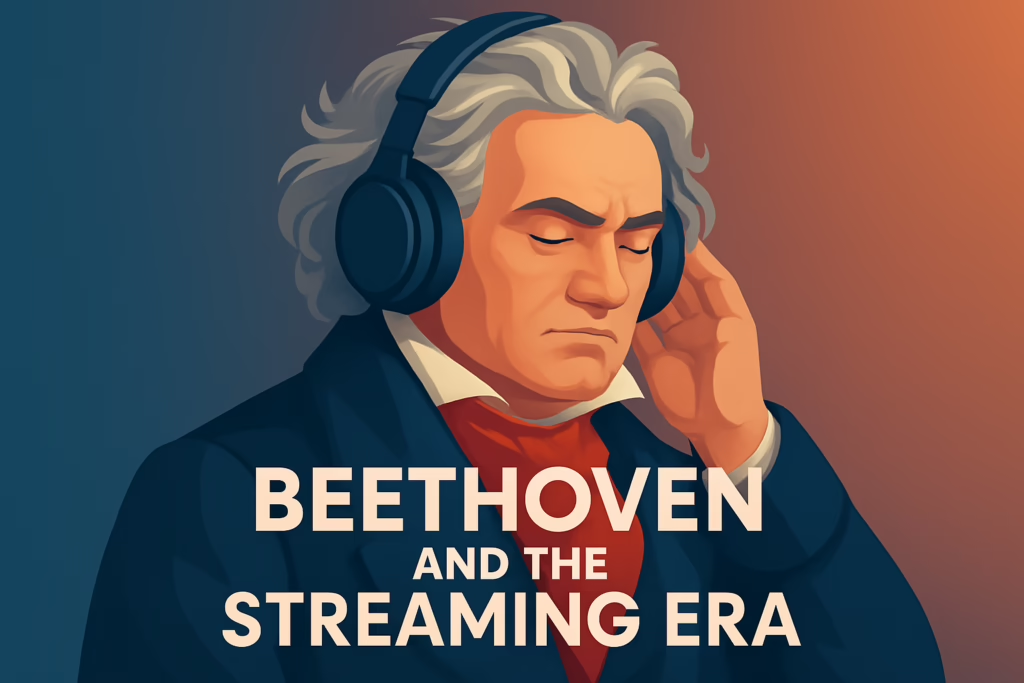
Beethoven and the Streaming Era
Beethoven and the streaming era may seem like an unlikely pairing, yet the connection is direct: one of history’s most influential composers is now discovered, studied, monetized, and reinterpreted through platforms built for instant access and algorithmic distribution. Ludwig van Beethoven, born in 1770, stands at the center of the Western classical canon, known for works such as the Fifth Symphony, the Ninth Symphony, the late string quartets, and the Piano Sonata No. 14, often called the “Moonlight Sonata.” The streaming era refers to the current media environment in which music reaches listeners primarily through on-demand digital services including Spotify, Apple Music, YouTube, Idagio, Amazon Music, and Tidal. Understanding Beethoven in this context matters because streaming has changed not only who hears classical music, but how it is categorized, recommended, licensed, performed, and valued.
In practical terms, I have seen this shift in programming meetings, label metadata audits, and audience development work: Beethoven no longer arrives only through a concert hall subscription, a conservatory syllabus, or a CD boxed set. He appears in sleep playlists, film-score recommendation chains, study-music compilations, and viral short-form videos built around a familiar motif. For cultural institutions, this creates both opportunity and distortion. Streaming expands access globally and lowers barriers for first-time listeners, but it also compresses long-form works into track-level metrics that were never designed for symphonic architecture. A four-movement sonata is measured beside a two-minute ambient cue, and discovery can favor the instantly recognizable over the historically significant.
That tension defines the modern Beethoven question. How should a composer associated with deep listening survive in an economy optimized for skips, saves, and passive consumption? The answer is not to resist technology, but to understand how streaming systems shape behavior. Metadata determines whether a listener finds the Berlin Philharmonic’s recording of Symphony No. 7 or a piano reduction buried under inconsistent naming. Playlist placement can turn Bagatelle No. 25, “Für Elise,” into a top entry point while leaving the Diabelli Variations largely invisible. Rights status affects recordings even though Beethoven’s compositions themselves are in the public domain. In other words, the music is old, but the delivery infrastructure is new, and that infrastructure now influences Beethoven’s place in public life.
How streaming changed access to Beethoven
Streaming changed access by making Beethoven available across geography, income levels, and levels of expertise. A listener in a city without a major orchestra can now compare ten recordings of the Eroica Symphony in minutes. Students can hear historically informed performances alongside modern symphonic interpretations without buying physical media. Teachers can link directly to a movement, and casual listeners can sample canonical works before committing to a full concert. This is a meaningful democratization of repertoire that was once filtered through institutions with high cultural and economic thresholds.
Services built for classical listening have improved this access further by addressing a core problem: standard streaming interfaces were originally designed for songs, artists, and albums, not for composers, conductors, soloists, ensembles, movements, opus numbers, and catalog systems. Idagio and Apple Music Classical, for example, emphasize work-based navigation. That matters for Beethoven because users often search by composition title, key, opus number, or nickname. A robust interface should connect “Piano Sonata No. 8 in C minor, Op. 13” with “Pathétique Sonata” and separate complete recordings from isolated movements. When this information is structured correctly, discovery becomes educational rather than accidental.
Yet broader access comes with tradeoffs. Streaming encourages fragmented listening. Many users encounter Beethoven through one movement extracted from a larger whole, often inserted into mood-based playlists such as Focus, Calm, or Deep Reading. Those playlists can be useful gateways, but they flatten context. The second movement of the Seventh Symphony means something different when heard after the first movement’s propulsion and before the scherzo’s release. In streaming, context is often optional. For new listeners, that can produce familiarity without understanding, recognition without form, and admiration without a sense of scale.
Why Beethoven performs so well on modern platforms
Beethoven performs well on streaming platforms because his music combines instant recognizability with emotional range and public-domain availability. The famous four-note opening of Symphony No. 5 is one of the most identifiable motifs in music history. “Für Elise” is learned by beginners worldwide and searched constantly. The “Moonlight Sonata” appears in relaxation, piano, and melancholy playlists. This broad recognizability gives platforms multiple entry points, and each entry point feeds recommendation systems that privilege familiar patterns of engagement.
Another reason is interpretive abundance. Because the compositions are in the public domain, any label or ensemble can record them without paying composition royalties, though they still own and monetize their specific recordings. This has produced a vast catalog: Wilhelm Furtwängler, Herbert von Karajan, Carlos Kleiber, John Eliot Gardiner, Claudio Abbado, Daniel Barenboim, Mitsuko Uchida, Igor Levit, and many others offer distinct Beethoven approaches. Streaming benefits from abundance because it thrives on deep catalogs and repeat listening. Beethoven supplies both. If a user likes one performance of the Emperor Concerto, the platform can recommend dozens more, extending session time and engagement.
Algorithmically, Beethoven also fits several high-performing use cases at once: concentration music, prestige listening, music education, cinematic emotion, and instrumental background listening. Few composers occupy all of those spaces. Bach dominates study and structure; Mozart often leads in elegance and accessibility; Beethoven bridges intensity, familiarity, and narrative. That makes him especially adaptable to modern recommendation systems, which sort music by user behavior rather than historical importance alone.
| Streaming factor | Why it helps Beethoven | Example |
|---|---|---|
| Recognizable motifs | Users identify works quickly and stay engaged | Symphony No. 5 opening drives high search and playlist inclusion |
| Public-domain compositions | Many labels can create new recordings | Multiple complete symphony cycles compete on one platform |
| Mood versatility | Works fit focus, sleep, drama, and piano playlists | “Moonlight Sonata” appears in calm and melancholy categories |
| Educational demand | Students and teachers repeatedly access key repertoire | Sonatas and quartets are streamed for study and comparison |
Metadata, search, and the classical music problem
If there is one technical issue that determines Beethoven’s success in streaming, it is metadata. In pop music, a track usually has one artist, one title, and one standard release format. Beethoven recordings are more complex. A single work can include composer, work title, key, opus number, movement title, soloist, conductor, orchestra, ensemble, recording date, label, and edition details. If these fields are inconsistent, search quality collapses. I have worked on catalogs where “Symphony No.5,” “Symphony No. 5 in C Minor,” and “Beethoven: 5th Symphony” were treated as separate entities, reducing discoverability and polluting recommendation data.
Industry standards exist to solve this. DDEX messaging, ISRC identifiers for recordings, and consistent work-level metadata improve ingestion across services. Specialist platforms also rely on normalized composer names, work hierarchies, and variant titles. For Beethoven, this is essential because many works circulate under nicknames that are useful commercially but imprecise musicologically. “Moonlight” attracts traffic, but “Piano Sonata No. 14 in C-sharp minor, Op. 27 No. 2” is the formal identifier. The best platforms preserve both, allowing direct search and accurate classification at the same time.
Metadata also shapes revenue and visibility. If a performance is mislabeled, it may miss editorial playlists, composer pages, and recommendation pathways. A complete cycle of the piano sonatas can be effectively invisible to users who search by opus number if the underlying data is weak. For orchestras, labels, and archives, metadata is not administrative trivia. It is a core part of audience access, brand authority, and long-term digital preservation.
Playlists, algorithms, and the risk of flattening Beethoven
Playlists are now one of the main ways listeners encounter classical music, and Beethoven is among the biggest beneficiaries. Editorial playlists can introduce a broad audience to major works without requiring prior knowledge. An “Introduction to Beethoven” sequence built around the Fifth Symphony, Violin Concerto, “Moonlight Sonata,” and String Quartet Op. 131 can be an effective on-ramp. Algorithmic playlists such as Discover Weekly or personalized classical mixes can surface lesser-known recordings based on prior behavior, expanding listening beyond the obvious warhorses.
However, playlists often reward excerpts over structure. Movements with immediate atmosphere outperform entire works that unfold over thirty to seventy minutes. That creates a subtle but important distortion. Beethoven was a master of long-range tension, thematic transformation, and formal argument. His innovation is not fully captured by isolated highlights. If platforms overemphasize the Adagio or the famous opening while neglecting complete cycles, users may know Beethoven’s surfaces better than his architecture.
This is where curatorial responsibility matters. The strongest editorial teams balance gateway tracks with full-work pathways. They might place the first movement of the “Moonlight Sonata” in a mood playlist, then link to the full sonata and recommend other Op. 27 works. They might use the “Ode to Joy” chorus as an entry point, then explain the Ninth Symphony’s historical significance, choral finale, and performance traditions. Good streaming curation does not merely collect pleasant tracks; it builds informed listening habits.
Recording economics in a world where Beethoven is free to record
Beethoven’s compositions are free to record because copyright in the underlying works has expired, but that does not mean Beethoven is economically simple in the streaming era. Recording a symphony cycle still requires orchestra fees, conductor fees, venue rental, engineers, editing, mastering, artwork, marketing, and distribution. Streaming payouts, especially on a per-stream basis, are often too low to recoup large-scale classical recording costs quickly. This is one reason labels rely on prestige branding, cross-format sales, sync licensing, touring, philanthropy, and institutional backing.
For performers, Beethoven remains commercially important because he functions as both repertory foundation and digital calling card. A young pianist releasing the “Appassionata” or “Hammerklavier” enters an established market conversation instantly. An orchestra streaming a Beethoven cycle can reinforce artistic credibility globally. But competition is fierce because the catalog is crowded. New releases do not compete only with current peers; they compete with decades of legendary recordings, many of which are continually remastered and reissued.
That reality changes strategy. Successful Beethoven releases need differentiation: historically informed performance on period instruments, a documented interpretive angle, unusually strong sound engineering, a high-profile venue, educational companion content, or video integration. In the streaming era, the recording alone is often not enough. Context sells access, and authority sustains repeat listening.
How institutions can present Beethoven better online
Orchestras, conservatories, publishers, and public broadcasters can present Beethoven better online by designing for search intent and listening behavior rather than assuming institutional reputation will carry the content. A Beethoven landing page should answer basic user questions immediately: Which works should I start with? What are the best-known symphonies? How do opus numbers work? What is the difference between a sonata, quartet, and concerto? These are AEO-friendly questions, and answering them clearly improves discoverability across search engines and AI summaries.
Just as important, institutions should connect content types. A performance page for Symphony No. 3 should link to program notes, short explainer videos, composer biography, recording recommendations, and ticketing. Internal linking sends strong SEO signals, but it also genuinely helps users. Schema markup, transcripted audio, and precise headings increase machine readability, which is essential for GEO visibility when generative systems summarize sources.
From experience, the most effective Beethoven content combines authority with usability. Audiences respond when experts explain why one recording emphasizes sharper tempos, why period brass changes the sonic profile, or why late Beethoven can sound disorienting at first. Streaming has not reduced the need for expertise. It has increased the need for expertise that is accessible, structured, and digitally legible.
The future of Beethoven in digital listening
Beethoven will remain central in digital listening, but his presence will increasingly depend on how well platforms and institutions preserve context around the music. AI recommendation systems are getting better at identifying user intent, which could help full-work discovery if metadata and editorial structures improve. Voice search may also favor canonical composers, since users naturally ask for “Beethoven Fifth Symphony” or “best Beethoven piano sonata.” That gives established repertoire an advantage, especially when catalogs are well organized.
At the same time, there is a cultural responsibility to resist reducing Beethoven to background music or a few overused fragments. His enduring value lies in scale, risk, emotional breadth, and structural invention. Streaming can support that value if it presents the music in complete, intelligible, and compelling ways. It can fail if it treats Beethoven as little more than a supply of familiar clips.
The best path forward is hybrid: use playlists and algorithms for discovery, then guide listeners toward complete works, multiple interpretations, and informed context. That model serves beginners and experts alike. It also reflects how people actually learn music now—through a blend of search, recommendation, comparison, and repeated listening across devices.
Beethoven and the streaming era are not opposites. They are a test of whether modern platforms can carry serious art without stripping away the conditions that make it meaningful. Streaming has made Beethoven more available than at any point in history, but availability alone is not understanding. Metadata quality, thoughtful curation, strong institutional publishing, and economically realistic recording strategies determine whether listeners encounter a living repertoire or a set of detached classics. For labels, orchestras, teachers, and platforms, the benefit of getting this right is substantial: broader reach, better education, stronger audience loyalty, and a richer digital culture. If you manage music content or simply want to hear Beethoven more deeply, start with one complete work, compare two recordings, and follow the context as carefully as the melody.
Frequently Asked Questions
How does Beethoven fit into the streaming era?
Beethoven fits into the streaming era because streaming has become one of the main ways people encounter music of every kind, including classical masterworks. Instead of discovering Beethoven only through concert halls, conservatories, CDs, or radio broadcasts, listeners now find his symphonies, piano sonatas, and string quartets on demand through Spotify, Apple Music, YouTube, Idagio, and other digital platforms. That shift matters because it changes access, scale, and context. A listener can move from a pop playlist into the opening motif of the Fifth Symphony in seconds, or compare dozens of interpretations of the Ninth Symphony without ever leaving one app.
Streaming also reshapes how Beethoven is presented. Algorithms recommend recordings based on mood, activity, listening history, and genre crossover, which means Beethoven may appear in study playlists, focus playlists, cinematic playlists, or introductory classical collections. In practical terms, this makes his music more reachable for people who might never buy a classical album or attend a live performance. At the same time, it places Beethoven inside a digital ecosystem built around convenience, discoverability, and constant competition for attention. His work survives in that environment not because it is simplified, but because it continues to reward repeated listening, whether someone is hearing the “Moonlight” Sonata for the first time or comparing historically informed performances of the late quartets.
Why is Beethoven still so popular on streaming platforms?
Beethoven remains popular on streaming platforms because his music combines immediate recognizability with extraordinary depth. Few composers wrote themes as memorable as the opening of the Fifth Symphony, the “Ode to Joy” melody from the Ninth Symphony, or the first movement of the Piano Sonata No. 14, commonly called the “Moonlight” Sonata. These works are culturally familiar even to listeners with little formal knowledge of classical music, and that familiarity translates well to streaming, where recognizable pieces often attract more clicks, saves, and repeat plays.
Another reason is versatility. Beethoven’s catalog serves different kinds of listening. Some people stream him for concentration and calm, especially solo piano works and slower movements. Others seek drama and scale in the symphonies. Students and musicians use streaming to study interpretation, orchestration, phrasing, and tempo choices across multiple recordings. Film, advertising, and popular culture have also kept his music in circulation, so many listeners arrive already aware of certain works even if they cannot name them at first.
Perhaps most importantly, Beethoven’s music adapts to modern listening habits without losing its power. A single movement can thrive as a standalone stream, yet larger works still invite deep, full-length listening. That combination is rare. In the streaming era, where short attention spans and serious musical engagement coexist, Beethoven remains one of the clearest examples of a composer whose work can function both as an entry point for newcomers and as a lifelong subject of study for committed listeners.
How do streaming platforms affect the way Beethoven is performed and interpreted?
Streaming platforms affect Beethoven performance by increasing visibility, competition, and listener choice. In earlier eras, many listeners knew a work through one favored recording or a local orchestra’s interpretation. Now they can hear major international ensembles, period-instrument specialists, soloists, chamber groups, and young independent artists side by side. That easy comparison has raised awareness of interpretive differences in tempo, articulation, phrasing, ornamentation, balance, and recording style. As a result, performers know their Beethoven recordings will be judged not just in isolation, but against a vast digital archive available instantly to a global audience.
This environment encourages both tradition and experimentation. Some artists aim for canonical authority, offering readings rooted in long-established performance practice. Others pursue historically informed approaches using instruments and techniques closer to Beethoven’s own time. Still others reframe the music through unusual programming, crossover projects, ambient reinterpretations, jazz adaptations, or visually driven video performances designed for digital audiences. Streaming has not replaced the concert tradition, but it has expanded the number of ways Beethoven can be heard and contextualized.
There is also a more subtle impact: platform design can influence repertoire choices. Well-known pieces often perform better in discovery systems than obscure works, so artists and labels may record familiar sonatas and symphonies more often than less-streamed repertoire. Even so, streaming has made it easier for niche performances to find their audience. A historically informed cycle of the late quartets or a fresh piano sonata set can now circulate globally without relying entirely on physical distribution. In that sense, streaming has made Beethoven interpretation more public, more searchable, and more diverse.
Can Beethoven’s music still be monetized effectively in a streaming-driven industry?
Yes, but monetizing Beethoven in the streaming era works differently from monetizing contemporary popular music. Beethoven’s compositions themselves are in the public domain, which means no one owns the underlying works in the way a modern songwriter or publisher might own a recent song. However, specific recordings, performances, arrangements, editions, and audiovisual productions can still generate revenue. Orchestras, soloists, chamber ensembles, record labels, and digital content creators earn income from streams of their recorded performances, as well as from YouTube views, licensing, subscriptions, sync placements, educational content, and live performances promoted through digital exposure.
The challenge is that classical streaming economics can be difficult. A Beethoven symphony is long, and payment systems on mainstream platforms do not always reward duration, complexity, or production cost in ways that favor classical music. A major orchestral recording may require substantial artistic and technical investment, yet its stream-based revenue may be modest unless it reaches a large and sustained audience. That is one reason labels and artists often combine streaming with broader strategies such as deluxe recordings, editorial playlist placement, branded video content, institutional partnerships, and touring.
Still, Beethoven remains commercially important because demand is stable and international. His name carries prestige, his repertoire is evergreen, and his music has uses across education, film, television, wellness, and cultural programming. For many artists, recording Beethoven is not only a direct revenue opportunity but also a reputation-building move. A strong Beethoven release can establish artistic credibility, attract media attention, support concert bookings, and introduce performers to listeners who later follow them into less familiar repertoire. In that way, Beethoven remains highly monetizable, even if success depends on a diversified digital strategy rather than streaming payouts alone.
What does Beethoven’s presence on streaming services mean for the future of classical music?
Beethoven’s strong presence on streaming services suggests that classical music can remain culturally relevant when it is made accessible, searchable, and easy to explore. His music acts as a bridge between the traditional classical canon and contemporary digital listening habits. For many users, Beethoven is the gateway composer: familiar enough to try, rich enough to keep returning to, and important enough to anchor broader discovery. A listener who starts with the “Moonlight” Sonata may continue to piano concertos, then symphonies, then Schubert, Brahms, Mahler, or modern composers. That pattern matters because it shows how legacy repertoire can drive ongoing engagement rather than simply preserve nostalgia.
At the same time, Beethoven’s digital success highlights some important tensions in the future of classical music. Streaming can democratize access, but it can also flatten context. A symphony movement may appear next to film scores, lo-fi study tracks, or cinematic playlists without much historical explanation. That makes curation, education, and editorial framing more important than ever. Institutions, teachers, critics, and performers have a real opportunity to use streaming not just to distribute Beethoven, but to help audiences understand why the music matters, how it was shaped by its historical moment, and why its emotional and structural force still resonates today.
Ultimately, Beethoven in the streaming era shows that classical music is not frozen in the past. It can live inside new technologies without surrendering its seriousness or artistic complexity. If platforms, performers, and educators use digital tools well, Beethoven’s ongoing visibility may point toward a future in which classical music is both more widely available and more meaningfully understood. That would make streaming not the end of tradition, but a powerful new chapter in how enduring music reaches the world.