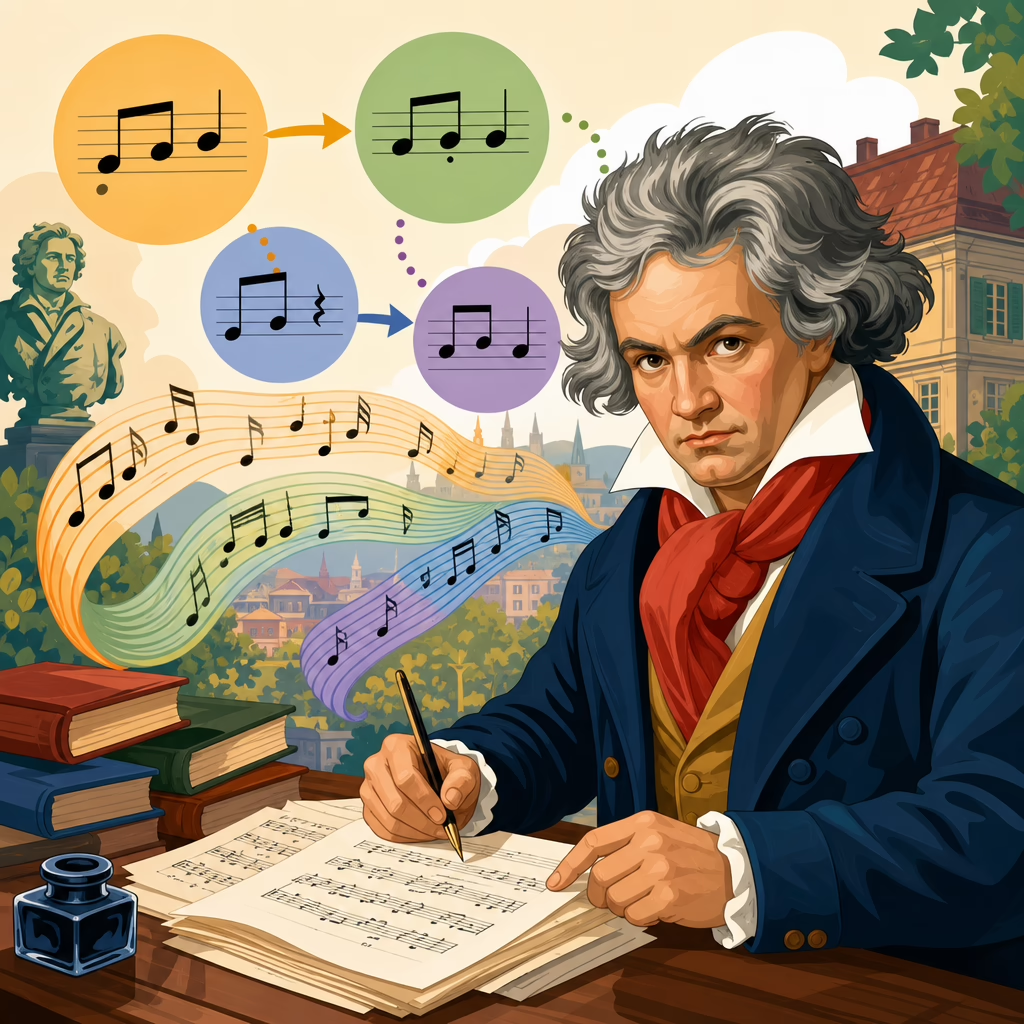
Beethoven and the History of Motivic Analysis
Beethoven stands at the center of the history of motivic analysis because his music made tiny musical ideas feel structurally decisive, emotionally charged, and analytically unavoidable. In music theory, a motive is a short, recognizable figure defined by interval, rhythm, contour, or some combination of those traits; motivic analysis studies how that figure returns, changes, combines with other figures, and helps generate larger form. The subject matters because it sits where listening, composition, and scholarship meet. When analysts ask why a Beethoven movement sounds unified despite extreme contrast, or how a development section can feel both surprising and inevitable, they often end up tracing motives. I have taught Beethoven scores to students and performers for years, and the same pattern recurs: once a class learns to hear a motive not as decoration but as a generative cell, whole movements become more intelligible. The history of motivic analysis is therefore not just a history of one technique. It is a record of how scholars learned to describe musical coherence, organic growth, thematic transformation, and formal drama through Beethoven’s works.
That history is also unusually revealing because Beethoven’s reception shaped analytic language itself. Nineteenth-century critics heard unity and necessity in his music before theorists had stable technical vocabularies to explain those qualities. Later writers, from Adolf Bernhard Marx to Arnold Schoenberg, Donald Francis Tovey, Rudolph Reti, Heinrich Schenker, and William Caplin, did not simply analyze Beethoven; they used Beethoven to test broader claims about how music works. Some emphasized thematic unity, others voice-leading, formal function, rhythmic process, or developing variation. Their disagreements matter. Motivic analysis can illuminate structure, but it can also overreach when every resemblance is treated as proof of organic design. The most useful historical view treats motives as one analytical layer among several, especially in Beethoven, where motive, harmony, texture, register, and form constantly interact. Understanding that balance helps readers avoid two common errors: reducing pieces to catchy cells, or ignoring the remarkable discipline with which Beethoven turns small figures into large consequences.
Early Ideas of Unity and the Beethoven Problem
The earliest stage in the history of motivic analysis begins before the term was standardized. Around Beethoven’s lifetime and shortly after, critics sensed that his works possessed a distinctive internal logic. E. T. A. Hoffmann’s famous writing on the Fifth Symphony did not offer modern motivic charts, yet it recognized a powerful continuity built from concentrated material. This was new enough to need explanation. In Haydn and Mozart, listeners certainly heard recurring figures, but Beethoven’s tendency to press a compact gesture through multiple formal zones made motivic concentration impossible to ignore. The opening of the Fifth Symphony remains the textbook case: the short-short-short-long rhythm is not merely an opening tag. It shapes melodic profiles, accompaniment patterns, transitions, codas, and even the finale’s rhetoric through memory and contrast. Early criticism responded by describing force, necessity, and character, laying the groundwork for later technical analysis.
Adolf Bernhard Marx, one of the key nineteenth-century theorists, helped move discussion from impression to method. His writings on form and thematic process treated themes as active agents rather than static tunes. Although his language differs from later theory, Marx’s approach encouraged analysts to ask how a germinal idea unfolds over time. Beethoven was crucial here because his sonata movements often blur the line between theme and motive. A broad cantabile melody may still derive from a terse rhythmic cell, and a transition may feel driven less by a new tune than by the intensification of earlier material. Marx’s contribution was not a final system of motivic analysis but a conceptual shift: unity could be demonstrated through derivation. That premise would dominate Beethoven scholarship for generations.
Organicism, Developing Variation, and the Search for Growth
By the late nineteenth and early twentieth centuries, Beethoven had become the central example for organicist theories of musical form. The claim was straightforward: a great work grows like a living organism from a basic seed. This metaphor could become vague, but at its best it captured something listeners genuinely hear in Beethoven. Brahms’s advocate Schoenberg later gave the most influential technical expression to this idea through the concept of developing variation. In Schoenberg’s account, a composer preserves enough of an idea for recognition while varying it enough to generate continuation. Beethoven provided model instances everywhere: the first movement of the Piano Sonata in F minor, Op. 57, turns terse rhythmic and intervallic shapes into escalating dramatic argument; the first movement of the String Quartet in C-sharp minor, Op. 131, spins a fugue subject into a dense web of related figures; the “Eroica” Symphony’s opening movement repeatedly reshapes its basic gestures across vast formal distances.
Schoenberg’s importance in the history of motivic analysis lies in his precision. He did not mean mere repetition. He meant controlled alteration producing coherence and forward motion. That distinction is vital in Beethoven studies. A motive may return transposed, rhythmically compressed, expanded, fragmented, reharmonized, or displaced into accompaniment. What matters is not visual sameness on the page but audible family resemblance combined with functional change. In teaching the first movement of the Piano Sonata in C minor, Op. 13, I have found that students initially notice only the Grave introduction versus the Allegro contrast. Motivic analysis reveals that the relationship is tighter: rhythms and contours from the introduction haunt later passages, making the movement feel dramatically integrated rather than sectional. This is exactly the kind of growth model that made Beethoven central to twentieth-century theory.
Reti, Tovey, and Competing Ways of Hearing Motives
No account of this history is complete without Rudolph Reti and Donald Francis Tovey, whose very different methods shaped anglophone Beethoven reception. Reti’s The Thematic Process in Music argued that deep thematic unity often lies beneath surface contrast. He traced hidden relationships among themes by reducing them to intervallic and contour patterns. In Beethoven, that meant apparently contrasting melodies could be heard as variants of one underlying idea. Reti’s method was powerful because it trained readers to look beyond literal recurrence. It was also controversial. Critics argued that some of his identifications were too permissive, finding kinship where ordinary listening would not. That criticism remains fair. Motivic analysis gains authority when it explains what informed listeners can plausibly hear, not when it depends on arbitrary abstraction.
Tovey offered a more musicianly, less system-bound alternative. His essays on Beethoven combine formal insight, tonal hearing, and motivic observation without insisting that every piece derive from a single nucleus. Tovey recognized the importance of small figures, especially in transitions and developments, yet he resisted reducing whole movements to one secret pattern. His reading of Beethoven often feels closer to rehearsal-room reality: motives matter because they participate in tonal motion, phrase rhetoric, texture, and dramatic pacing. That balanced approach has aged well. When analyzing the first movement of the “Appassionata,” for example, it is not enough to note recurring intervallic cells. One must also account for registral extremes, dominant preparation, the destabilizing effect of syncopation, and the movement’s delayed release of energy. Tovey’s legacy reminds scholars that motivic analysis is strongest when embedded in a full account of musical action.
Schenkerian Responses and the Limits of Surface Pattern
Heinrich Schenker is sometimes positioned against motivic analysis, but the relationship is more nuanced. Schenker objected to analyses that treated surface motives as self-sufficient explanations of coherence. For him, true unity depended fundamentally on tonal structure and voice-leading. Yet Schenkerian analysis never made motives irrelevant. In Beethoven especially, motivic events often articulate or intensify deeper structural processes. The opening of the Piano Sonata in E minor, Op. 90, gains force not only from recurring figures but from how those figures project linear motion and prolong harmonic tension. Schenker’s challenge forced analysts to distinguish between motivic recurrence and structural necessity. A repeated rhythm might be memorable without being formally decisive; conversely, a subtle motivic variant may matter because it coincides with a major tonal arrival.
This tension improved Beethoven scholarship. Rather than asking whether a movement is unified by motive or by harmony, later analysts increasingly asked how the two interact. In the first movement of the Fifth Symphony, the famous opening rhythm acquires different meanings depending on its harmonic and formal setting: urgent announcement, transitional propulsion, obsessive fragmentation, triumphant recall. The motive alone does not create those meanings. Context does. That lesson remains essential. Motivic analysis became more rigorous once theorists stopped treating motives as magical DNA and started examining their placement within phrase structure, tonal design, and formal function.
Later Twentieth-Century Method: Form, Function, and Context
From the later twentieth century onward, Beethoven analysis became less dominated by a single grand theory and more attentive to methodological combination. Analysts such as Leonard Meyer, Carl Dahlhaus, Charles Rosen, Alan Tyson, Lewis Lockwood, and William Caplin approached Beethoven from overlapping but distinct angles. Rosen’s writing on sonata form showed how motivic concentration interacts with tonal drama and rhetorical timing. Caplin’s theory of formal functions clarified how motives behave differently in presentation, continuation, transition, and cadential zones. A figure repeated in a presentation phrase establishes identity; fragmented in continuation, it drives acceleration; expanded near cadence, it can support closure. Beethoven often exploits these functional shifts with exceptional clarity, which is why his works remain central in theory pedagogy.
For readers interested in how motive supports large-scale sonata argument, the broader formal perspective in this guide to Beethoven’s expansion of sonata form provides useful context. Within the narrower history of motivic analysis, the key point is that modern scholars rarely isolate motive from form. Consider the first movement of the “Waldstein” Sonata, Op. 53. Its repeated-chord energy, scale fragments, and registral displacements do not merely decorate the exposition. They articulate formal zones, blur thematic boundaries, and prepare the unusual return path later in the movement. Motivic analysis succeeds here because it explains process, not because it labels resemblances.
| Analyst or tradition | Main focus | What it reveals in Beethoven | Typical limitation |
|---|---|---|---|
| Marx and early formalists | Thematic derivation | How movements grow from related ideas | Can remain conceptually broad |
| Schoenberg | Developing variation | How alteration creates continuity and momentum | May understate tonal context |
| Reti | Hidden thematic unity | Links across apparently contrasting themes | Can over-identify weak similarities |
| Schenkerians | Voice-leading structure | Why some motives matter more than others | May downplay surface character |
| Caplin and formal-function theory | Phrase and formal role | How motives change function across sections | Less focused on long-range symbolism |
Case Studies That Shaped the Field
Certain Beethoven works became proving grounds for the history of motivic analysis because they reward multiple methods at once. The Fifth Symphony is the obvious example, but its fame can obscure subtler cases. The first movement of the Piano Sonata in D minor, Op. 31 No. 2, often called “Tempest,” shows how a recitative-like opening gesture can generate broad structural consequences through rhythm, register, and harmonic interruption. The String Quartet in F major, Op. 59 No. 1, demonstrates motivic integration across chamber textures, where inner voices carry crucial variants that orchestral listeners might miss. The Diabelli Variations, Op. 120, reveal Beethoven’s late style at its most analytical: he dissects a trivial waltz into intervallic, rhythmic, contrapuntal, and formal possibilities, effectively turning composition itself into an essay on motivic transformation.
Late Beethoven in particular changed the terms of scholarship. Analysts could no longer rely on simple thematic recurrence because many late works distribute identity across texture, rhythm, counterpoint, and silence. In the Piano Sonata in A-flat major, Op. 110, for instance, motivic relationships matter, but they operate within a larger network of fugue technique, lament gesture, and registral symbolism. The Missa solemnis and late quartets pushed commentators to refine their tools, since obvious thematic labels often fail to capture how continuity works. This is one reason the history of motivic analysis never stabilized into one doctrine. Beethoven kept exceeding each method designed to explain him.
What Motivic Analysis Can and Cannot Do
The mature lesson of this history is practical. Motivic analysis is indispensable for Beethoven because it clarifies how compressed ideas generate continuity across contrast, especially in sonata movements, variation sets, and late contrapuntal works. It helps performers shape articulation and pacing, helps listeners follow argument, and helps scholars explain why passages belong together. Yet it cannot replace other forms of hearing. A motive does not determine tempo, sonority, pedal, orchestration, or expressive timing by itself. Nor does every resemblance signify deliberate large-scale planning. Beethoven revised extensively, and some relationships may emerge from habitual craft rather than single-seed design. Good analysis admits that possibility.
Still, the central historical fact remains firm: Beethoven made motivic thinking impossible to ignore, and generations of theorists built their methods in response. From early notions of organic unity to developing variation, from skeptical voice-leading critiques to contextual formal analysis, the field matured by arguing over Beethoven. The best modern approach combines those insights. Hear the motive clearly. Test it against harmony and form. Ask what changes, what stays constant, and why that matters in real time. If you want to understand Beethoven at the level where local gesture becomes large-scale necessity, start with the history of motivic analysis, then return to the scores and listen for how a few notes can govern an entire musical world.
Frequently Asked Questions
What is motivic analysis, and why is it so closely associated with Beethoven?
Motivic analysis is the study of how a small musical idea helps shape a larger piece. A motive is usually a short, recognizable figure defined by rhythm, interval pattern, melodic contour, or a combination of those features. Analysts look at how that figure returns, changes, expands, fragments, combines with other figures, or appears in new harmonic and formal settings. The central question is not simply whether a motive comes back, but how its recurrence helps generate coherence, tension, contrast, and large-scale form.
Beethoven is so closely associated with motivic analysis because his music often makes these small ideas feel structurally decisive. In many of his works, what might seem like a compact gesture at the opening becomes the seed from which entire movements grow. Listeners can hear a strong sense of inevitability: rhythmic cells, intervallic patterns, and characteristic contours keep reappearing in transformed ways, linking distant passages and making the whole piece feel tightly organized. This gave later theorists and critics a powerful model for explaining musical unity.
His reputation also matters historically. As nineteenth- and twentieth-century thinkers searched for ways to describe organic coherence in instrumental music, Beethoven became the exemplary case. His music seemed to demonstrate that great composition could arise from disciplined development of minimal material. That made him central not only to compositional pedagogy, but also to analytical traditions that value thematic integration, developmental logic, and the relationship between surface detail and large-scale structure.
Why do analysts often say that Beethoven’s music made small motives feel “structurally decisive”?
When analysts describe Beethoven’s motives as structurally decisive, they mean that the motive does more than decorate the musical surface. It influences phrasing, drives transitions, shapes climaxes, stabilizes returns, and often helps explain why one section leads naturally to another. In Beethoven, a motive can operate across multiple levels at once: it may be audible in a melody, implied in accompaniment, embedded in bass motion, and echoed in harmonic rhythm. That layering gives the impression that the same idea is governing the piece from within.
This is especially important because motivic analysis is not just about spotting repetition. A motive becomes structurally meaningful when its transformations help define form. For example, a brief rhythmic pattern may first appear as a bold opening gesture, then later energize a transition, then return in compressed form during development, and finally reappear in a more stable version at the recapitulatory moment. In that case, the motive is actively organizing the listener’s experience of departure, instability, and return. The piece sounds coherent not because the music repeats mechanically, but because a familiar idea keeps adapting to changing formal needs.
Beethoven’s music is often cited here because he was especially skilled at making these relationships audible. Even when he transforms a motive significantly through inversion, rhythmic alteration, fragmentation, sequence, or registral displacement, the connection remains strong enough to be felt. That balance between sameness and change is one reason his works became touchstones in the history of analysis. They seem to prove that a tiny idea can carry enormous structural and expressive weight.
How does motivic analysis connect listening, composition, and music theory in Beethoven’s works?
Motivic analysis sits at a meeting point between what composers write, what listeners hear, and what theorists try to explain. From a compositional standpoint, it helps show how a work can be generated from limited material. Instead of imagining a piece as a chain of unrelated themes, motivic thinking presents composition as a process of developing and transforming core ideas. In Beethoven’s case, this is one reason his music is often described as economical, concentrated, and organic: the piece seems to grow from within rather than being assembled from disconnected parts.
From the listener’s perspective, motives provide orientation. Even when a listener does not consciously label a pattern as a motive, they may still sense its return and transformation. That recognition helps create memory, expectation, and satisfaction. A familiar rhythmic snap, a distinctive interval, or a recurring contour can make a long movement feel connected across time. Beethoven’s music is particularly effective at this because his motives are often vivid, easy to grasp, and strongly profiled, yet flexible enough to survive dramatic change.
From the standpoint of music theory, motivic analysis gives scholars a language for discussing coherence in precise ways. It allows analysts to trace relationships between opening ideas and later passages, to show how melodic detail interacts with harmony and form, and to explain why certain moments feel like intensifications, disruptions, or fulfillments. In Beethoven studies, this approach has been especially influential because his music rewards close hearing. Small details often matter disproportionately, and analysis can demonstrate how those details participate in broader formal and expressive processes. That is why Beethoven remains central in classrooms, scholarship, and debates about what musical unity really means.
What kinds of transformations do analysts look for when studying motives in Beethoven?
Analysts look for both obvious and subtle transformations. The most basic kinds include exact repetition and sequential repetition, where a motive returns at a different pitch level. But in Beethoven, the more revealing cases often involve change. A motive may be fragmented into smaller pieces, expanded into longer spans, compressed into shorter durations, shifted into a different register, transferred from melody to accompaniment, or recast in a new harmonic environment. It may also appear in inversion, with its intervallic direction reversed, or in rhythmic alteration, where the timing changes while the contour remains recognizable.
Contour and interval are especially important because a motive does not have to return with the same notes to remain identifiable. Sometimes the rhythm stays constant while the pitches change; sometimes the interval pattern remains while the rhythm is varied; sometimes only the general shape survives. Analysts therefore ask which features are essential to the motive’s identity. In one passage, rhythm may be the defining trait; in another, an intervallic cell may be the real point of continuity. Good motivic analysis does not merely collect similarities. It evaluates which similarities are musically compelling and structurally consequential.
In Beethoven, these transformations often correspond to expressive and formal shifts. A motive stated firmly at the opening might later appear broken, unstable, or urgent in development. A tense version may resolve into a broader, more lyrical one. A compact gesture can become grand through augmentation or orchestral expansion. These changes are not just technical maneuvers; they contribute to the drama of the piece. That is one reason Beethoven’s works have been so central to the history of motivic analysis: they show that transformation can be both analytically traceable and emotionally meaningful.
Why has Beethoven remained so important in the history of motivic analysis for later scholars and teachers?
Beethoven remained important because his music became a model for explaining how musical unity works. Nineteenth-century critics and theorists increasingly valued the idea that great instrumental music should exhibit internal coherence, developmental strength, and organic growth. Beethoven’s works seemed to embody those ideals with unusual clarity. As a result, scholars repeatedly returned to his music when defining what counts as a motive, what thematic development means, and how small details can generate large forms.
He also became central in pedagogy. Teachers could point to Beethoven to show students that motivic work is not an abstract concept but a practical compositional principle. His music offers vivid examples of how a short figure can energize an entire movement, connect distant sections, and make a formal plan audible. Because these examples are both sophisticated and perceptible, Beethoven has served for generations as a bridge between introductory listening skills and advanced analytical method. Students can often hear the force of the motive before they fully understand the terminology, which makes his music especially effective for teaching.
At the same time, Beethoven’s importance has encouraged debate, which is healthy for the field. Some scholars celebrate motivic unity as the key to understanding his music, while others caution that analysts can overstate hidden connections or ignore other dimensions such as harmony, texture, genre, performance, rhetoric, and historical context. Even so, Beethoven remains central because his works keep prompting the core question that motivic analysis asks: how can a tiny musical idea become the source of large-scale coherence and expressive power? That question has shaped the history of music theory, and Beethoven has remained one of its most compelling answers.