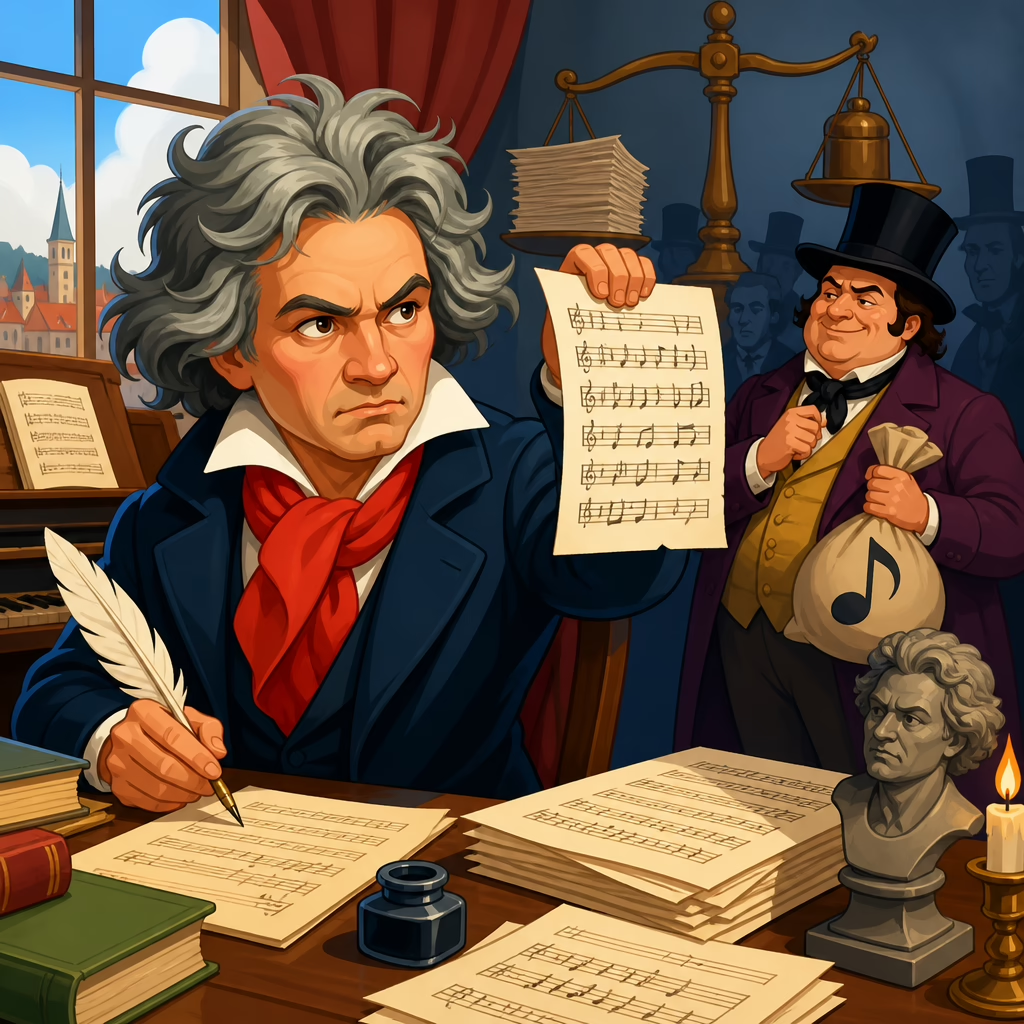
Beethoven and Copyright: The Early Fight for Musical Rights
Beethoven and copyright belong together because his career unfolded during a turning point in the ownership of music, when printed scores, public performance, aristocratic patronage, and emerging commercial publishing collided. To understand the early fight for musical rights, it helps to define copyright in its historical sense: not the modern bundle of exclusive rights recognized under international treaties, but a patchwork of local printing privileges, contracts, and customary claims over who could publish, copy, sell, and profit from a composition. In Beethoven’s lifetime, those rules were inconsistent across the German states, Austria, France, and Britain, and that inconsistency shaped how he earned money, negotiated with publishers, and protected his work.
This subject matters because Beethoven was not only a composer of symphonies, sonatas, and quartets; he was also a practical operator in a volatile music market. I have worked through many of the surviving letters, publishing agreements, and first-edition disputes that reveal him as a relentless defender of his financial interests. He sold works to multiple publishers, complained about unauthorized reprints, bargained over fees, and understood that a manuscript could be monetized in more than one territory. His experience shows how musical rights evolved before modern copyright law gave composers broader legal security. For readers exploring the business of Beethoven, this miscellaneous hub is the essential bridge between patronage, publishing, piracy, and performance economics.
Why copyright was uncertain in Beethoven’s Europe
When Beethoven was born in 1770, Europe did not offer composers a uniform legal system for protecting music. The Statute of Anne had already established an important copyright framework in Britain in 1710, but its practical relevance to continental composers was limited. In the Habsburg lands and many German territories, protection often depended on printer’s privileges granted by rulers or municipal authorities rather than a general author-centered law. A privilege might stop unauthorized local reprints for a period, yet it did not automatically prevent copying across borders. For music publishers, that meant opportunity. For composers, it meant leakage.
Printed music was especially vulnerable because once a score entered the market, engraving plates and manuscript copies could circulate quickly. A piano sonata published in Vienna could be reprinted in Bonn, Leipzig, Paris, or London with little compensation returning to the composer. Beethoven recognized this problem early. Unlike a court Kapellmeister tied to a single employer, he pursued relative independence in Vienna. That freedom gave him leverage, but it also exposed him to risk. Without a single pan-European system, he had to negotiate repeatedly, territory by territory, publisher by publisher.
The instability was intensified by the Napoleonic era. Political boundaries shifted, censorship systems changed, and trade routes were disrupted. Music publishing still expanded, driven by middle-class demand for domestic piano music and chamber repertory. Beethoven’s works fit that market perfectly. Yet each expansion in demand increased the incentive for unauthorized reproduction. This is why any serious account of Beethoven and copyright must begin with fragmented law rather than with a simple idea of legal ownership.
How Beethoven actually made money from his compositions
Beethoven’s income came from a mix of sources: aristocratic stipends, teaching, benefit concerts, dedications, and, crucially, the sale of works to publishers. He did not usually receive royalties in the modern sense. More often, he sold a composition outright for a fee, sometimes with separate arrangements for different markets. That distinction is vital. A composer today may expect continuing participation in sales, licensing, streaming, and performance income. Beethoven often fought just to maximize the initial payment and to limit immediate exploitation by rivals.
He learned to use competition among publishers to his advantage. Firms such as Artaria in Vienna, Breitkopf & Härtel in Leipzig, Simrock in Bonn, and various London houses wanted prestigious new works. Beethoven would hint at alternate offers, delay delivery, or divide rights geographically. In practice, this resembled an early territorial licensing strategy. If a Viennese publisher had rights in one region, another might still acquire rights elsewhere, assuming contracts allowed it. The method could raise revenue, but it also produced confusion when terms were vague or when editions appeared too close together.
His Opus numbers themselves became part of commercial identity. A new Beethoven opus signaled novelty, prestige, and marketable distinction. Publishers used title pages, dedications, and subscription notices to attract buyers. Beethoven understood presentation. He cared about who issued his works, how quickly they appeared, and whether errors damaged his reputation. In my experience studying these transactions, his business letters read less like romantic inspiration and more like hard negotiation under imperfect legal conditions.
Publishers, piracy, and the struggle for control
The central conflict in Beethoven’s copyright story was not abstract philosophy. It was control over copying. Music piracy in his era often took the form of unauthorized reprints rather than secret bootlegging. A publisher could acquire or obtain access to an edition, engrave a near-identical version, and sell it in another jurisdiction where enforcement was weak. Because music notation is functional, minor alterations did not change the underlying commercial theft. The result was price competition that undercut authorized editions and reduced the composer’s bargaining power.
Beethoven complained repeatedly about these practices. He distrusted some publishers, favored others, and often demanded proof that agreements would be honored. Errors in engraved editions posed a second problem. Even an authorized print could misrepresent the work through wrong notes, missing dynamics, or altered articulation. For a composer as exacting as Beethoven, that was both a financial and artistic injury. Correct text mattered because amateur musicians, teachers, and performers relied on printed editions as definitive sources.
One useful way to frame the market is to compare the main pressure points he faced:
| Issue | What it meant in Beethoven’s time | Practical effect on the composer |
|---|---|---|
| Territorial rights | Rights were often local or regional, not universal | Beethoven sold to multiple publishers but risked overlap and dispute |
| Unauthorized reprints | Publishers copied editions in jurisdictions with weak enforcement | Lost income, lower fees, and diluted market exclusivity |
| Engraving errors | Printed scores frequently introduced mistakes | Damage to reputation and need for corrections |
| Outright sale model | Composers were commonly paid a one-time fee | Immediate cash but little long-term participation in sales |
| Dedications and patronage | Elite support still influenced publication and prestige | Financial cushion, but not full legal protection |
These pressures explain why Beethoven could appear combative. He was not merely difficult. He was responding rationally to a market that rewarded vigilance and punished passivity.
Landmark disputes and business lessons from Beethoven’s letters
Several episodes show Beethoven’s tactical approach. His dealings with Breitkopf & Härtel are especially revealing. The Leipzig publisher sought major works and cultivated a serious editorial reputation, but negotiations could be slow and tense. Beethoven worried about payment, timing, and unauthorized circulation of manuscripts. He also pursued relationships with London publishers because Britain offered a lucrative market for piano and chamber music. The fact that he could pit one center against another demonstrates his awareness of market segmentation long before modern rights management.
Another important case involves the orchestral work known as Wellington’s Victory, Op. 91. The piece had immediate popular appeal, and its commercial exploitation involved disputes over mechanical performance devices associated with Johann Nepomuk Mälzel, inventor of the metronome and promoter of the panharmonicon. Their relationship deteriorated into legal conflict over authorship claims, arrangement rights, and financial participation. This was not copyright in the later international sense, yet it was unmistakably a fight over intellectual control and monetization. The episode shows that Beethoven defended not only printed notation but also derivative uses and performance-related revenue streams.
His letters also reveal a consistent pattern: demand an advance, retain flexibility where possible, and complain loudly when editions appeared without proper authorization or care. That pattern is familiar to anyone who has worked around modern publishing contracts. Rights become valuable when distribution scales, and Beethoven lived precisely at the moment when music distribution was scaling beyond local courts into broader consumer markets.
Why Beethoven’s fight changed the status of composers
Beethoven did not invent musical copyright, and he was not single-handedly responsible for later legal reforms. Still, his career marks a decisive cultural shift. Earlier composers often worked within patronage systems where the employer effectively controlled output. Beethoven preserved ties to patrons, especially through the annuity arranged in 1809 by Archduke Rudolf, Prince Kinsky, and Prince Lobkowitz, but he also asserted a stronger personal claim over his compositions as marketable property. That claim mattered symbolically and economically.
By treating works as assets to be negotiated, protected, and strategically released, he helped define the composer as an independent professional rather than a servant producing on command. This model influenced the nineteenth century, when authors’ rights gained stronger legal recognition across Europe. France had already advanced the idea that authors possessed inherent rights over their creations, and later harmonization efforts built on such principles. Beethoven’s battles supplied practical evidence that composers needed enforceable protection if they were to survive outside salaried court employment.
His example also exposes the limits of romantic myths. Great art did not float above commerce. It depended on contracts, paper supply, engraving labor, transport networks, legal privileges, and relentless correspondence. Understanding that reality deepens, rather than diminishes, Beethoven’s achievement.
The modern relevance of Beethoven’s copyright battles
Beethoven’s world looks distant, yet the core issues are current. Replace engraved scores with digital files, and the same questions return: who owns the work, who may reproduce it, which territories are covered, what happens when copies spread instantly, and how does the creator get paid? Today, copyright law generally gives composers exclusive rights to reproduce, distribute, perform, and authorize adaptations for a limited term, later followed by public domain status. Beethoven never enjoyed such a coherent framework. His struggles help explain why those rights became necessary.
For musicians, publishers, scholars, and arts administrators, this hub topic connects multiple strands of the business of Beethoven. It links to questions about first editions, patronage economics, concert entrepreneurship, instrument technology, and the rise of the middle-class sheet-music market. It also clarifies why critical editions matter today. Because early prints were commercially pressured and often inaccurate, modern editors compare autograph manuscripts, copyists’ parts, first editions, and correspondence to reconstruct authoritative texts. Bärenreiter, Henle, and scholarly complete-edition projects exist partly because the original marketplace was messy.
The lasting lesson is plain. Beethoven fought for musical rights because he knew a composition had artistic value and commercial value at the same time. When those values were left unprotected, others captured the benefit. Readers exploring the broader business of Beethoven should use this hub as the starting point for the miscellaneous side of the story: publishing disputes, territorial rights, piracy, edition quality, legal gray zones, and the emergence of the composer as owner. Follow those threads, and Beethoven’s career stops looking like legend alone. It becomes a case study in how creators learned to claim the worth of their work.
Frequently Asked Questions
Why is Beethoven so important to the history of copyright in music?
Beethoven matters because his career unfolded at a moment when the older world of court patronage was colliding with a newer commercial marketplace for music. In earlier generations, composers often worked primarily for churches, courts, or noble households, and the question of who “owned” a piece of music was shaped less by modern legal doctrine than by custom, status, and local privilege. By Beethoven’s time, however, printed scores were becoming valuable commodities, publishers were competing across cities and states, and composers were increasingly trying to live not only from salaried service but also from the sale and circulation of their works. That made the issue of control over musical works far more urgent.
Beethoven stood right in the middle of this shift. He was not simply writing music for a single employer who could claim it by virtue of patronage. Instead, he negotiated with publishers, sold rights to compositions, sought favorable terms, and tried to protect his financial interests in an environment where unauthorized reprints were common. His career shows the transition from music as a service embedded in aristocratic culture to music as intellectual and commercial property with growing market value. In that sense, Beethoven is important not because he invented copyright, but because his professional life illustrates how composers began to assert stronger claims over the reproduction and distribution of their works.
Just as importantly, Beethoven’s stature helped elevate the cultural image of the composer as an individual creative authority. That cultural prestige supported the broader idea that a musical work was not merely a functional product for performance but the expression of an author deserving legal and economic recognition. The early fight for musical rights was therefore not only a legal story; it was also a story about changing attitudes toward creativity, authorship, and the dignity of artistic labor. Beethoven became one of the clearest symbols of that transformation.
What did “copyright” actually mean during Beethoven’s lifetime?
During Beethoven’s lifetime, “copyright” did not mean the unified, internationally recognized bundle of exclusive rights that people often imagine today. There was no single modern system automatically granting broad protection over reproduction, distribution, public performance, adaptation, and enforcement across multiple countries. Instead, legal protection for music was fragmented and local. Composers and publishers relied on a mixture of printing privileges, territorial monopolies, private contracts, and customary business practices. Protection often depended on the city, principality, kingdom, or empire in which a work was issued.
In practical terms, that meant a publisher might secure the right to print a piece in one jurisdiction while having little power to stop another printer from reproducing it elsewhere. A composer could sell a manuscript to a publisher under terms that recognized a degree of control, yet unauthorized editions might still appear in neighboring markets. Enforcement was often weak, expensive, or simply impossible across political borders. Since the German-speaking lands alone were divided into many states with different rules and institutions, the problem was especially severe for composers whose works circulated widely.
It is also important to remember that the economic focus of these early rights was often on printing rather than on performance in the modern sense. Public performance rights, as later understood through collecting societies and licensing regimes, were not yet fully developed. The main commercial issue was the printed score: who could engrave it, publish it, sell it, and profit from its circulation. So when discussing Beethoven and copyright, it is more historically accurate to think in terms of early publishing rights and authorial claims within a patchwork legal landscape. That patchwork is precisely what made the “fight” for musical rights so difficult and so formative.
How did publishers, piracy, and unauthorized editions affect Beethoven’s music?
Publishers were essential to Beethoven’s success, but they were also part of a highly competitive and imperfect marketplace. To reach audiences beyond private patrons and premiere performances, Beethoven needed his music printed and distributed. Publishers made that possible by financing engraving, printing, advertising, and sales. At the same time, once a work entered the market, it became vulnerable to copying, reprinting, and imitation by rival firms, especially in places where legal protection was limited or nonexistent. This created constant tension between artistic creation and commercial exploitation.
Unauthorized editions could hurt Beethoven in several ways. Most obviously, they could reduce the income he might otherwise receive from legitimate sales. If another printer issued a cheaper copy without paying for the rights, the authorized publisher’s market was weakened, and Beethoven’s bargaining power could suffer. Beyond money, there was also the issue of accuracy. Musical works depend on precise notation, and unauthorized copies were often riddled with errors introduced through hasty engraving or copying from imperfect sources. That meant pirated editions could distort Beethoven’s intentions, confuse performers, and damage the integrity of the work itself.
These risks explain why Beethoven paid close attention to contracts, editions, and publication strategy. He often negotiated intensely and sometimes sold different works, or different regional rights, to different publishers in an effort to maximize income and manage circulation. But even a shrewd composer could not fully control how music traveled in such a fragmented market. The spread of unauthorized editions reveals a central reality of the period: musical authorship was becoming commercially valuable faster than the law could reliably protect it. Beethoven’s experience with publishers and piracy therefore captures the instability of an age when music was increasingly treated as property, but the mechanisms for defending that property were still incomplete.
Did Beethoven earn money from performances of his music the way composers and songwriters do today?
Not in the modern sense. Today, composers and songwriters may receive royalties from public performances through highly organized legal and institutional systems, including performance rights organizations, licensing networks, and international treaties. In Beethoven’s era, that framework did not yet exist in any comparable form. While performances could certainly raise a composer’s prestige, attract patrons, and stimulate sales of printed music, they did not generally generate the kind of recurring, legally structured performance income that creators often rely on today.
Beethoven’s earnings came from a combination of sources: aristocratic patronage, commissions, concert activity, teaching, gifts or stipends from supporters, and payments from publishers for the rights to print his compositions. Public performances were still crucial, but often indirectly so. A successful performance could build demand, enhance reputation, and increase the value of a composer’s next publication or commission. It could also strengthen relationships with wealthy admirers and institutions. Yet the legal idea that each performance itself should produce an ongoing royalty stream for the composer was not firmly established.
This difference helps explain why printed scores were so central to the copyright struggles of Beethoven’s time. Since reliable performance royalties were largely absent, the publication and sale of music could represent one of the most important ways for a composer to turn artistic work into durable income. That made control over engraving, printing, and authorized distribution especially significant. In other words, if modern copyright often emphasizes both reproduction rights and performance rights, Beethoven’s world leaned much more heavily toward the former. Understanding that imbalance is essential to understanding the early economics of musical rights.
How did Beethoven’s era help shape the modern idea of musical rights?
Beethoven’s era helped shape modern musical rights by exposing the mismatch between a growing market for music and outdated legal tools for protecting it. As commerce in printed scores expanded, composers and publishers increasingly needed clearer rules about authorship, ownership, territorial control, and enforcement. The old system of scattered privileges and local monopolies was no longer adequate for works that could circulate quickly across multiple jurisdictions. The frustrations experienced by composers such as Beethoven made visible the need for broader and more coherent legal protections.
The period also contributed to a deeper conceptual shift: the musical composition itself was coming to be seen as a distinct intellectual creation linked to its author. That may sound obvious now, but it represented a major evolution from older assumptions in which music was often tied more closely to patronage, occasion, or practical function. As the prestige of the individual composer rose, so did the moral and economic claim that the composer should have recognized rights in the work beyond the initial act of writing it. This emerging understanding laid cultural groundwork for later copyright developments in the nineteenth century and beyond.
Beethoven’s legacy, then, is not that he personally secured the full modern regime of musical copyright. Rather, his career dramatized why that regime would eventually be demanded. His struggles with publishers, cross-border reprints, contractual bargaining, and the commercial value of musical authorship all pointed toward the need for stronger legal recognition of creative rights. Later national laws and international agreements would build far more elaborate systems than anything available in his lifetime, but the pressures that drove those reforms were already visible in his world. Beethoven stands as one of the clearest early examples of a composer confronting the modern problem of how artistic genius, market circulation, and legal ownership should relate to one another.