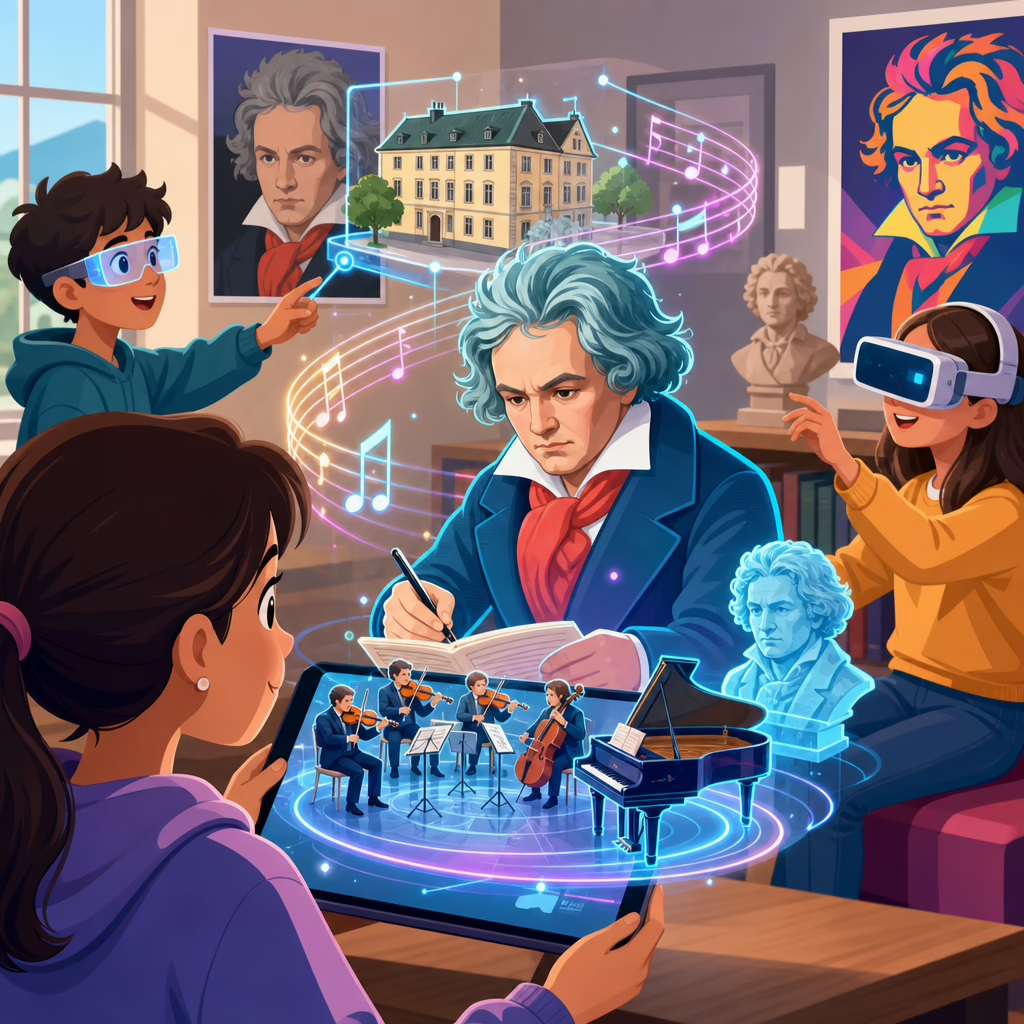
Augmented Reality Projects Featuring Beethoven’s Works
Augmented reality projects featuring Beethoven’s works are redefining how audiences encounter a composer often treated as fixed in concert halls, textbooks, and museum vitrines. In this context, augmented reality, or AR, means digital audio, animation, text, or three-dimensional objects layered onto a user’s real environment through a phone, tablet, headset, or projection system. Beethoven’s works include the obvious landmarks such as the Fifth Symphony, the Ninth Symphony, the “Moonlight” Sonata, Fidelio, and the late string quartets, but they also include sketches, letters, performance traditions, and historical spaces connected to their creation. I have worked on multimedia interpretation plans for music collections, and the practical lesson is clear: AR succeeds when it does more than decorate sound with floating graphics. It must help listeners understand structure, context, and emotion without getting between them and the music.
This matters because Beethoven sits at a unique crossroads of cultural recognition and interpretive challenge. Nearly everyone knows the four-note opening of the Fifth, yet far fewer listeners can explain sonata form, motivic development, historical instruments, or why the Ninth remains politically and artistically charged. AR can bridge that gap by making invisible ideas visible. A phone can reveal orchestral seating while a movement plays. A museum tablet can overlay corrected passages from a sketchbook. A headset can place a visitor inside the first performance environment of an opera excerpt. For educators, curators, orchestras, and cultural institutions building a multimedia gallery, Beethoven is therefore an ideal hub topic: familiar enough to attract broad interest, rich enough to support many specialized offshoots.
The category “miscellaneous” is especially valuable here because the strongest Beethoven AR work does not fit one neat box. Some projects are educational apps. Others are museum installations, concert enhancements, public art trails, archive interfaces, or accessibility tools. Some focus on masterpieces, while others center on manuscripts, instruments, hearing loss, reception history, or audience participation. A good hub article should map this terrain clearly, answer practical questions, and point readers toward deeper subtopics such as symphonic visualization, museum interpretation, interactive music education, archival storytelling, and immersive performance design.
What augmented reality adds to Beethoven interpretation
AR adds value to Beethoven interpretation when it clarifies relationships that are hard to hear or imagine in real time. In my experience, the most effective layer is not spectacle but guidance. For example, in a movement from the Eroica Symphony, an AR interface can highlight how a short rhythmic cell moves from strings to winds to brass. During the first movement of the Fifth Symphony, it can mark the recurrence and transformation of the famous motif across sections, helping listeners grasp development rather than hearing only repetition. In chamber music, a tablet view can identify which instrument carries the thematic argument at any moment, which is especially useful in the late quartets, where texture can become intellectually dense for newcomers.
AR also restores physical context. Beethoven’s piano sonatas sound different when audiences understand the instruments he wrote for. A gallery installation can overlay a fortepiano model onto a modern room, labeling range, pedal mechanisms, and tonal limitations. That instantly explains why articulation, voicing, and sustain in works such as the “Pathétique” or “Waldstein” should not be approached as if Beethoven were composing for a modern concert grand. Similarly, an opera-focused experience can reconstruct stage positions from Fidelio, showing where singers, chorus, and orchestra would have been placed and how those choices shaped dramatic pacing.
Another major advantage is emotional orientation. Beethoven’s biography is often reduced to clichés about genius and deafness, yet carefully designed AR can present emotional stakes without distortion. Instead of melodrama, a project might let users scan a reproduction of the Heiligenstadt Testament and hear narrated excerpts while visual annotations explain the letter’s historical setting. That method ties a primary source to the music’s expressive world without claiming simplistic one-to-one causation. The result is a stronger, more trustworthy encounter.
Core project types in a multimedia gallery hub
Most augmented reality projects featuring Beethoven’s works fall into a few recurring formats, and understanding those formats helps readers navigate this subtopic efficiently. Museum overlays are the most established. These projects use phones or tablets to animate manuscripts, portraits, instruments, or rooms. A visitor points a device at an object and receives layered interpretation: transliterated notes, orchestral playback, timeline cues, or conservation details. Institutions with Beethoven holdings, including libraries and composer houses, often favor this model because it extends existing exhibitions without requiring a complete rebuild.
Concert-companion AR is another growing category. Here the technology supports a live performance rather than a static exhibit. Audiences may access synchronized program notes, score excerpts, or spatial diagrams during selected passages. The challenge is restraint. In practice, concert AR works best in rehearsals, education concerts, and family programming; in a formal evening performance, too much screen use fragments attention. The strongest implementations therefore keep interactions optional and limited to transitions, key motives, or post-concert exploration.
Educational apps form a third category. These are especially effective for Beethoven because they can break a large work into manageable modules. A learner can isolate the scherzo of the Ninth, compare period and modern instruments, and then test understanding through interactive prompts. Public-space AR trails are a fourth category. Cities can create location-based experiences that connect Beethoven’s works to theaters, salons, publishers, or commemorative sites. Finally, archive-driven projects let users explore sketches and revisions, revealing how themes changed from notebook idea to finished score.
| Project type | Typical setting | Best Beethoven use case | Main limitation |
|---|---|---|---|
| Museum overlay | Composer house, library, gallery | Manuscripts, instruments, portraits, letters | Depends on object recognition and visitor flow |
| Concert companion | Hall, rehearsal, education event | Symphonic motives, seating maps, listening guides | Can distract from live performance |
| Educational app | School, home, online course | Form analysis, instrument identification, timelines | Needs careful curriculum alignment |
| Public AR trail | City route, historic district | Biography, premieres, reception history | Location accuracy and weather affect use |
| Archive interface | Digital collection, reading room | Sketch studies, revisions, source comparison | Rights management and metadata quality |
Notable use cases: symphonies, sonatas, opera, and manuscripts
Symphonies are the clearest starting point for AR because they combine scale, familiarity, and visualizable structure. The Fifth Symphony works well for motif tracking. The Sixth, “Pastoral,” suits landscape-based overlays that compare musical scene painting with actual environmental imagery, though curators should avoid turning it into simplistic background music for nature animation. The Ninth supports chorus translation, formal mapping, and reception history, including its use in state ceremonies and public celebrations. When I have tested prototype interpretive layers with general audiences, the biggest gains came from showing where listeners were in a movement and why a return, transition, or fugato mattered.
Piano sonatas offer a more intimate but equally rich field. AR can map hand crossings, harmonic pivots, and pedal implications on a keyboard model while an excerpt plays. A strong “Moonlight” Sonata feature, for instance, would compare the sustained sonorities possible on modern pianos with the more transparent resonance of Beethoven’s era. This kind of comparison grounds interpretation in instrument history rather than romantic myth. For advanced users, overlays can include phrase structure, voice-leading cues, and fingering variants drawn from pedagogical traditions.
Fidelio and the late quartets are ideal for readers interested in less conventional AR storytelling. With Fidelio, dramatic space matters: prison cells, offstage calls, and ensemble positioning can all be visualized to explain tension. With the late quartets, manuscript overlays and ensemble-view AR are often more effective than broad spectacle because these works reward close reading. A user can examine revisions in the Große Fuge or trace thematic links across a quartet movement. Manuscript-centered projects also reveal Beethoven as a working composer who revised, crossed out, condensed, and rebuilt ideas repeatedly.
Design principles that make these projects effective
The first principle is musical timing. AR cues must follow the score accurately enough that listeners connect what they hear with what they see. In orchestral contexts, this usually requires either pre-synchronized media for fixed recordings or a flexible trigger system for live conductors. Out-of-sync visuals destroy trust quickly. The second principle is interpretive hierarchy. Users should always know the main point of a screen or overlay: motif, instrument, place, source, or narrative context. When every element competes equally, the project becomes decorative noise.
Third, primary sources should anchor claims whenever possible. Beethoven projects gain credibility when they cite letters, autograph manuscripts, early editions, and historically informed performance research. Referencing catalog records, conservation data, or recognized scholarly editions is not academic excess; it prevents misleading simplifications. Fourth, accessibility must be designed in from the beginning. Captioning, transcripts, contrast control, seated and standing viewing angles, and multilingual support are essential. Because Beethoven is so often linked to hearing discourse, accessibility failures are especially glaring in this area.
Fifth, hardware should serve the setting. Phones are flexible and cheap but create social isolation. Tablets work well in galleries because they support shared viewing. Head-mounted AR can be powerful for reconstruction of spaces, but sanitation, staffing, and device management raise costs fast. Projection-based AR avoids handheld friction and often works better for group learning. The correct choice depends on dwell time, staffing, network reliability, and whether the project needs portability or precise spatial anchoring.
Technology stack, production workflow, and common pitfalls
Most teams building AR around Beethoven’s works use a workflow that combines curatorial research, audio preparation, 3D or motion design, and platform development. Common toolchains include Unity with AR Foundation, Unreal Engine for higher-end visual environments, WebAR frameworks for browser access, and content management systems that deliver metadata, transcripts, and image assets. Spatial audio is increasingly important, especially for orchestral seating demonstrations. If a user walks closer to virtual horns during a Beethoven symphony excerpt, the mix should respond convincingly. That demands more than basic stereo playback.
Rights and source quality are frequent stumbling blocks. Beethoven’s compositions are in the public domain, but not every recording, scholarly edition, photograph, or scan is free to reuse. Museums must clear image rights, performers must approve recording use, and modern critical commentary may require permission. Another pitfall is overestimating user patience. In testing, visitors rarely want long onboarding. They want a quick scan, immediate payoff, and optional depth. The best projects therefore deliver a useful first layer in under thirty seconds, with deeper branches available for engaged users.
There is also a temptation to treat AR as a substitute for good interpretation. It is not. If the script is vague, the metadata inconsistent, or the musical examples poorly edited, no amount of floating notation will save the experience. Evaluation should include completion rates, dwell time, repeat use, and comprehension outcomes, not just download numbers. For educators, simple before-and-after listening tasks can reveal whether users actually understand Beethoven better after using the tool.
How to organize this miscellaneous hub for readers and future articles
As a sub-pillar hub under Multimedia Gallery, this page should direct readers toward the full ecosystem of Beethoven AR topics while remaining useful on its own. The best structure is to group future articles by user intent. One cluster should cover museum and archive experiences, including manuscript overlays, composer-house interpretation, and digital exhibition design. A second should cover performance-linked experiences such as concert companions, rehearsal tools, and scenic reconstruction for Fidelio. A third should cover learning products: classroom apps, keyboard visualization, and family engagement modules. A fourth should address technical implementation, including WebAR, spatial audio, object recognition, and evaluation methods.
Readers also need direct answers to practical questions. What devices work best? Which works are easiest to adapt? How expensive is production? How do you handle rights? What are the accessibility requirements? A strong hub page answers each briefly, then points toward deeper articles. In editorial terms, this creates clear internal pathways and prevents the miscellaneous label from becoming a dumping ground. The goal is not to collect random Beethoven technology experiments, but to present a coherent map of how augmented reality projects featuring Beethoven’s works function across culture, education, and public interpretation.
Augmented reality projects featuring Beethoven’s works succeed when they make music, history, and material culture easier to understand without flattening their complexity. The best examples do three things at once: they guide listening, restore historical context, and respect the user’s attention. Across museum overlays, concert companions, educational apps, public trails, and archive interfaces, the pattern is consistent. Strong projects use precise timing, reliable sources, accessible design, and hardware suited to the setting. Weak projects chase novelty, overload screens, or make claims unsupported by evidence.
For a Multimedia Gallery hub, the miscellaneous category is not a loose end. It is the connective tissue linking symphonies, sonatas, opera, manuscripts, instruments, biography, and digital interpretation methods. Beethoven remains one of the best subjects for AR because his music is widely known, structurally rich, and attached to abundant archival material. That combination lets creators serve beginners and specialists at the same time. If you are planning content in this subtopic, start with one clear use case, build around a specific Beethoven work, and expand only after user testing shows the interpretation is genuinely helping people see and hear more.
Frequently Asked Questions
What are augmented reality projects featuring Beethoven’s works?
Augmented reality projects featuring Beethoven’s works are digital experiences that place music, visuals, narration, text, or interactive 3D objects into a user’s real-world surroundings. Instead of encountering Beethoven only through a concert performance, a recording, or a museum display case, audiences can point a phone or tablet at a room, a score, a statue, or a historic site and see additional layers of interpretation appear in real time. In practical terms, that might mean hearing motifs from the Fifth Symphony while animated notation highlights the famous rhythmic cell, exploring a three-dimensional model of an orchestra during the Ninth Symphony, or viewing contextual overlays that explain Beethoven’s compositional process in works such as the “Moonlight” Sonata.
What makes these projects distinctive is that they do not merely reproduce the music; they reshape how people engage with it. AR can show how themes develop, where instruments enter, how a venue changes perception, or how historical and biographical context informs the listening experience. A museum might use AR to reconstruct Beethoven’s working environment, while an educational app might let users “walk through” a sonata form as if it were an architectural space. The result is a more participatory encounter with works that are often treated as distant masterpieces. For many audiences, AR makes Beethoven feel less like a fixed monument and more like an active, explorable creative force.
How does augmented reality change the way audiences experience Beethoven’s music?
AR changes the experience by making listening more spatial, visual, and interactive. Beethoven’s music is often discussed in highly abstract terms such as form, motive, development, harmonic tension, and orchestration. Those ideas are essential, but they can be difficult for general audiences to grasp through words alone. Augmented reality translates those musical concepts into something more immediate. A user might see melodic lines represented as moving shapes across a room, watch sections of an orchestra light up as they enter, or follow a visual map of the first movement of a symphony as it unfolds. This kind of guided immersion helps listeners connect structure to sound without reducing the music’s complexity.
It also shifts the audience from passive reception to active discovery. In a conventional setting, the listener hears a performance from beginning to end with limited ability to inspect details as they happen. With AR, users can pause, replay, zoom in, compare themes, read commentary, or trigger optional layers of explanation. Someone exploring the “Moonlight” Sonata, for example, might isolate the left-hand accompaniment pattern, examine how the texture creates atmosphere, and then return to the full piece with a more informed ear. That combination of freedom and guidance can deepen appreciation for experienced listeners while making Beethoven more approachable for newcomers.
Which Beethoven works are especially well suited to augmented reality interpretation?
Many of Beethoven’s best-known works lend themselves exceptionally well to AR because they contain strong contrasts, recognizable themes, and clear structural landmarks. The Fifth Symphony is a natural candidate because its iconic four-note opening can be traced through the movement in ways that AR can make visually obvious. The Ninth Symphony also works powerfully in AR because of its scale, its choral finale, and its cultural symbolism; a project can use layered visuals to show how the orchestra, soloists, and chorus interact while also placing the “Ode to Joy” theme in historical and social context. The “Moonlight” Sonata is another strong example because its atmosphere, pacing, and pianistic texture invite immersive visual environments that can help users feel how the work creates emotional tension.
That said, AR should not be limited to Beethoven’s most famous pieces. String quartets, piano sonatas beyond the “Moonlight,” the “Eroica” Symphony, the “Pastoral” Symphony, the Violin Concerto, and even sketch materials can all benefit from this format. The “Pastoral” is particularly compelling because AR can connect music with environmental imagery and motion in the listener’s surroundings without turning the piece into a simplistic literal illustration. Meanwhile, Beethoven’s sketchbooks and revisions are ideal for educational AR because they reveal the labor behind the finished work. In other words, the best AR choices are not just the most famous compositions, but the ones whose form, texture, evolution, or historical resonance can be illuminated through layered, interactive media.
What are the main goals of AR Beethoven projects in education, museums, and performance settings?
The goals usually fall into three broad categories: interpretation, access, and engagement. In educational settings, AR helps explain musical ideas that students may find intimidating when presented only through notation or lecture. It can visualize sonata form, thematic development, orchestration, and rhythmic design in a way that supports different learning styles. For teachers and institutions, this means Beethoven’s music can be introduced not only as a cultural requirement, but as something students can actively investigate. By combining sound with responsive visual layers, AR can help bridge the gap between technical music analysis and direct listening experience.
In museums and heritage institutions, AR often aims to animate objects and contexts that would otherwise remain static. A manuscript page, historical instrument, portrait, or room associated with Beethoven can become the starting point for a richer narrative. Visitors might see annotations rise from a score, hear excerpts tied to a displayed artifact, or watch a digital reconstruction of a nineteenth-century performance setting. In concert and festival environments, the goal is slightly different: AR can complement live performance by offering optional interpretive layers before, during, or after the event. Done well, it expands understanding without overwhelming the music itself. Across all these settings, the most effective projects use AR not as a novelty, but as a thoughtful interpretive tool that deepens cultural connection and broadens audience participation.
What makes an augmented reality Beethoven project successful rather than gimmicky?
A successful project begins with a clear musical and interpretive purpose. The technology should serve Beethoven’s works, not distract from them. If AR visuals are too busy, too literal, or unrelated to the music’s structure and expressive character, the result can feel superficial. The strongest projects ask meaningful questions: What does the audience need help hearing? What part of Beethoven’s compositional process can be made more legible? How can historical context be added without interrupting emotional impact? When those questions guide design, AR becomes a genuinely useful medium for listening, learning, and interpretation rather than a decorative add-on.
Execution matters just as much as concept. High-quality audio, accurate synchronization, intuitive navigation, accessible design, and historically informed content are all essential. A good AR project should work for both specialists and curious newcomers, offering layered depth rather than assuming a single level of knowledge. It should also respect the ambiguity and expressive richness of Beethoven’s music. Not every feeling or formal process needs a literal visual equivalent. Sometimes the best AR intervention is subtle: a cue that reveals thematic return, a spatial map of ensemble texture, or a contextual note that frames a listening decision. In short, successful AR Beethoven projects balance scholarship, usability, and artistic restraint. They expand the audience’s encounter with the music while preserving what makes the works enduringly powerful in the first place.