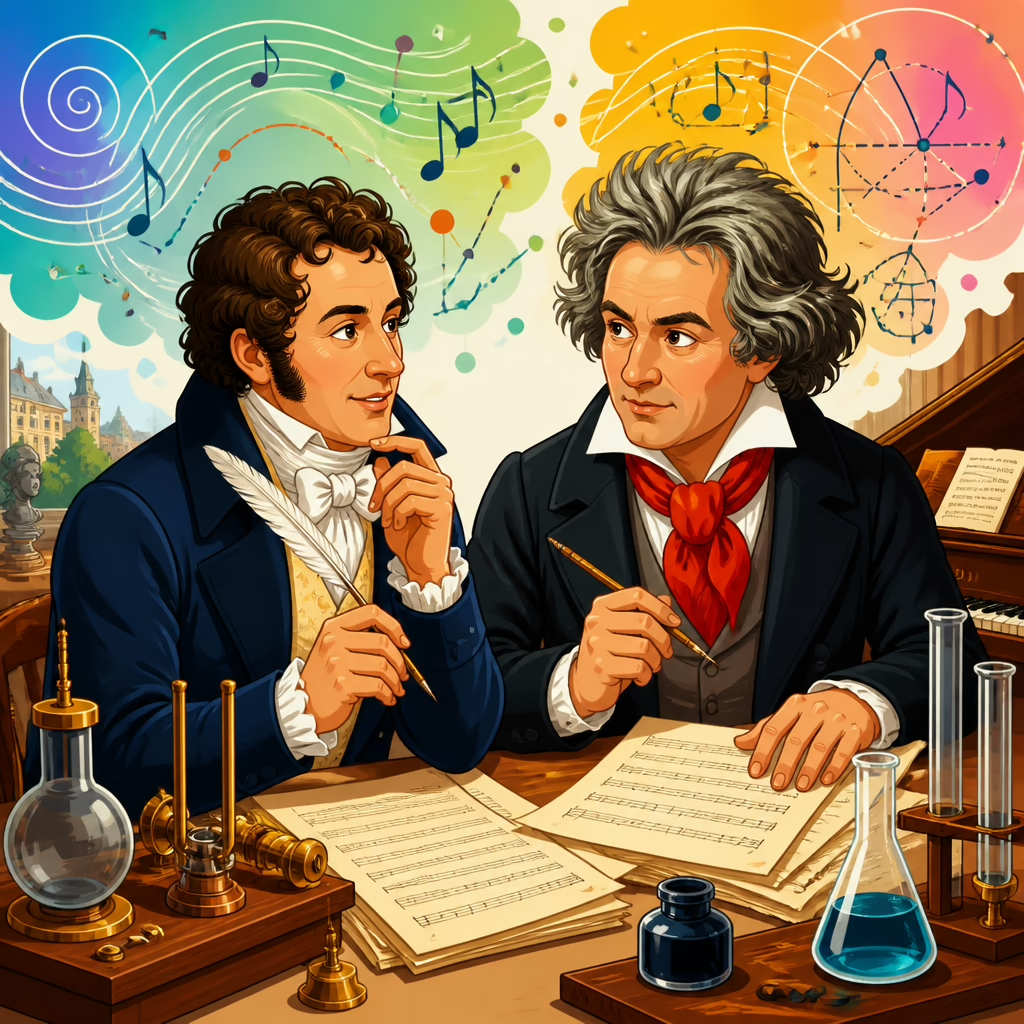
Anton Reicha and Beethoven as Experimental Thinkers
Anton Reicha and Ludwig van Beethoven are often introduced as boyhood friends from Bonn who later took different paths in Vienna and Paris, but that summary misses the more revealing truth: both were experimental thinkers who treated composition as a field for testing ideas. In this focused look at their relationship, “experimental” means something precise. It refers to a working method in which musical rules are not simply obeyed, but examined, stretched, and sometimes rebuilt through counterpoint, rhythm, form, instrumentation, and listening habits. Reicha did this openly in treatises and demonstrative compositions; Beethoven did it more dramatically in works that transformed public expectations from within established genres.
The comparison matters because it corrects a common imbalance in music history. Beethoven is usually cast as the solitary revolutionary, while Reicha appears as a secondary theorist or an eccentric footnote. Yet when I have worked through their scores side by side, especially fugues, wind writing, and late-period formal experiments, the overlap in mindset is impossible to ignore. They were not stylistic twins, and they did not influence each other in a simple one-way manner. Rather, they emerged from related educational conditions in Bonn, absorbed the same late eighteenth-century debates about learned style and expressive freedom, and pursued original solutions to similar compositional problems.
Understanding that shared intellectual climate helps explain why Reicha belongs in any serious discussion of Beethoven’s contemporaries. Born in Prague in 1770, Reicha was only months younger than Beethoven. Both spent formative years in Bonn, both played professionally, both encountered rigorous training rooted in keyboard, ensemble practice, and contrapuntal discipline, and both later navigated Vienna’s demanding musical culture. Reicha eventually became one of Europe’s most important composition teachers in Paris, while Beethoven became the central composer of his age. Their careers diverged, but their habits of thought remained linked by a persistent willingness to ask what music could do if inherited constraints were treated as starting points rather than limits.
This article stays tightly on that point. It does not attempt a broad biography of either composer. Instead, it examines how Reicha and Beethoven approached experiment in three connected areas: their Bonn foundations, their treatment of form and counterpoint, and their practical reimagining of instrumental sound, especially for winds. Seen clearly, Reicha was not “Beethoven without the masterpieces,” and Beethoven was not “Reicha with better luck.” Each was testing the borders of the classical language. Reading them together reveals a richer picture of innovation around 1800, one grounded in craft, curiosity, and disciplined risk.
Bonn foundations: shared training, shared questions
Their experimental habits did not appear out of nowhere. Bonn in the 1780s was a court environment where practical musicianship and intellectual ambition could coexist. Beethoven’s early development under Christian Gottlob Neefe established a strong base in keyboard playing, figured bass, composition, and the study of Bach. That environment matters here because it encouraged analytical thinking alongside performance. For readers wanting the broader context of that formation, the main guide on Christian Gottlob Neefe and Beethoven’s earliest training shows how serious that grounding was. Reicha, too, matured within this world of disciplined study, ensemble experience, and exposure to serious repertory rather than mere salon entertainment.
What makes Bonn significant is not simply that both men happened to live there. It is that the city exposed them to a model of music as both craft and inquiry. Court musicians had to play, arrange, accompany, and compose under real conditions. That kind of daily labor creates practical experimenters. A composer learns quickly whether a modulation works, whether wind players can balance a texture, whether a fugue subject has genuine developmental potential, and whether a formal surprise clarifies or confuses. Reicha and Beethoven both absorbed music from the inside out, not as abstract doctrine but as a tested set of procedures.
They were also shaped by the late Enlightenment appetite for systems, classification, and reasoned reform. Reicha’s later theoretical writings make this explicit, but the intellectual tendency was shared more broadly. The question was not whether rules existed; it was whether rules described permanent truths or provisional habits. Beethoven seldom wrote treatises, yet his music repeatedly implies that conventions can be reweighted. Reicha stated the principle directly in his pedagogical work and demonstrated it in compositions that challenged regular phrase lengths, predictable cadential timing, and orthodox fugue procedure. In both cases, experiment grew from competence. Only a composer fluent in convention can productively resist it.
Counterpoint as a laboratory
The clearest meeting point between Reicha and Beethoven is counterpoint. For many listeners, counterpoint sounds like an academic subject separated from expressive drama. In practice, for these two composers, it was a laboratory for invention. Reicha’s published fugues and theoretical texts often set out unusual premises: asymmetrical subjects, unexpected tonal answers, irregular accents, and procedures that tested what a fugue could sustain without collapsing. He wanted to prove that learned writing need not be conservative. The fugue could be a site of discovery.
Beethoven approached the same field less as a pedagogue and more as a dramatist. From the “Grosse Fuge,” Op. 133, to the fugues in the late piano sonatas and the Missa solemnis, he used contrapuntal technique to intensify argument. Subjects are not merely combined; they clash, mutate, and return under pressure. I have always found that Beethoven’s late counterpoint feels experimental not because it ignores rules, but because it overloads them with expressive purpose. He asks fugue to carry the weight of crisis, transcendence, humor, and fracture all at once.
Reicha’s contribution is crucial because it demonstrates that such experimentation was part of a wider compositional conversation. His “36 Fugues” for piano, published in 1803, include procedures many contemporaries considered provocative. Some explore uncommon meters; others disrupt expected periodicity or tonal planning. Haydn reportedly reacted skeptically to aspects of the collection, which tells us less about failure than about how far Reicha was pushing inherited boundaries. Even when individual fugues seem more argumentative than lovable, they document a mind testing the resilience of form.
Beethoven’s relation to this mindset was not derivative, but parallel. Both composers knew that strict forms gain power when their assumptions are exposed. A regular four-bar phrase, a conventional countersubject, or a stable tonal answer is effective partly because listeners recognize its norm. Alter that norm intelligently and attention sharpens. That is the heart of musical experiment. Reicha often foregrounded the procedure itself; Beethoven more often embedded the procedure in overwhelming musical rhetoric. One invites analysis first and admiration second. The other often reverses the order.
Formal innovation beyond textbook classicism
Experiment for Reicha and Beethoven also meant rethinking form. Textbook accounts of classical form can leave the false impression that sonata form, variation form, and rondo design were fixed containers. In actual practice, both composers treated form as flexible architecture. Beethoven’s middle- and late-period works are famous for expansions of coda, unstable recapitulations, compressed development sections, and transitions that carry structural weight usually reserved for themes. Reicha pursued analogous questions, often with less public impact but no less intellectual seriousness.
One reason Reicha can seem elusive is that his experiments are distributed across many genres and often framed analytically rather than theatrically. In chamber works, piano pieces, and theoretical examples, he probes how continuity can survive when symmetry is weakened. Phrases may extend unexpectedly; sectional boundaries may blur; and thematic materials may be organized by transformation more than by balanced repetition. These are not random irregularities. They are deliberate efforts to see whether coherence depends on inherited proportions or on deeper relationships among motives, harmony, and texture.
Beethoven’s Eroica Symphony offers a famous case of formal risk with public consequence: enormous scale, disruptive harmonic events, and a development section that behaves like a second dramatic world rather than a transitional middle. Reicha’s experiments usually operate on a smaller public stage, but the underlying question is similar. How much pressure can a form absorb before listeners need a new model for understanding it? Their answers differ in style, yet both composers treat form as dynamic process rather than template.
| Area of experiment | Anton Reicha | Ludwig van Beethoven |
|---|---|---|
| Counterpoint | Tests fugue rules openly through unusual subjects, meters, and tonal answers | Uses fugue to generate dramatic conflict and large-scale expressive architecture |
| Phrase structure | Often weakens regular symmetry to examine alternative kinds of coherence | Expands, compresses, or displaces phrases for tension and narrative momentum |
| Form | Treats forms as analytical problems to be reconfigured from within | Turns formal disruption into public musical drama within major genres |
| Audience effect | Often invites reflective listening and intellectual scrutiny | Frequently produces immediate shock, propulsion, and emotional force |
The table shows why simple hierarchies fail. Beethoven is not merely the bolder innovator in every category, and Reicha is not merely the dry theorist. Reicha’s experiments can be more radical at the level of stated procedure, while Beethoven’s may be more transformative in reception and artistic result. Both challenge the assumption that classicism was a settled language by 1800. In their hands, form remains negotiable.
Wind writing and the sound of new possibilities
If counterpoint reveals their intellectual kinship, wind writing shows their practical imagination. Reicha was one of the defining early nineteenth-century composers for wind quintet, and his works helped establish the medium as something more than diverting background music. He understood the specific capabilities of flute, oboe, clarinet, bassoon, and horn with unusual clarity, shaping lines that exploited color contrast, registral character, articulation, and conversational exchange. This was experimental thinking in concrete terms: he wrote not for “winds” in general, but for distinct instruments with evolving identities.
Beethoven’s use of winds in symphonies, chamber music, and concert works reflects a similar enlargement of instrumental personality. Consider the Eroica, the Fifth, the Pastoral, or the Septet: winds do not simply double strings or fill harmonic space. They introduce themes, define atmosphere, and create structural turning points. The oboe cadenza-like moment in the first movement of the Fifth Symphony is a compact example of Beethoven interrupting momentum to let timbre itself become a formal event. Reicha, working extensively in chamber settings, pursued related insights from another angle: the redistribution of structural importance across an ensemble once treated as secondary.
Here their shared experimental attitude intersects with broader technological and institutional change. Around 1800, wind instruments were improving in mechanism, intonation, and reliability, while public and private music making created demand for repertory beyond courtly function. Reicha answered by giving winds serious compositional content. Beethoven answered by integrating wind color into the highest-profile genres of the period. In both cases, instrumental writing becomes an argument about what modern music should sound like.
This matters because experiment is often misunderstood as abstraction detached from sound. Reicha and Beethoven prove the opposite. Their innovations are audible. When Reicha balances a wind quintet so that a bassoon line drives harmonic intelligence instead of merely supporting it, or when Beethoven lets horns and woodwinds reshape a symphonic climax, they are not illustrating theories after the fact. They are discovering musical possibilities through the realities of players, breath, blend, attack, and resonance. That is experimentation at workshop level, where compositional thought meets physical sound.
Why Reicha still changes how we hear Beethoven
Placing Reicha beside Beethoven does not diminish Beethoven’s singular achievement. It sharpens it. Once Reicha is restored to view, Beethoven appears less as an isolated miracle and more as the most powerful participant in a wider culture of disciplined innovation. That perspective is historically sound and musically useful. It helps explain why Beethoven’s boldness was legible to contemporaries: they already inhabited a world where rules were being tested, old forms reinterpreted, and learned techniques reactivated for modern expression.
Reicha also helps modern listeners hear the experimental dimension of Beethoven with greater precision. Instead of vaguely praising Beethoven as “genius,” we can identify the exact domains in which he was working experimentally: tonal planning, phrase rhythm, motivic saturation, fugal integration, timbral hierarchy, and formal elasticity. Reicha’s writings and compositions supply a nearby map of these concerns, even when Beethoven’s solutions are more compelling artistically. The comparison replaces myth with method.
The main takeaway is simple. Anton Reicha and Beethoven were contemporaries who shared more than geography and chronology. They shared a habit of mind: treating music as an active investigation into what compositional rules could bear. Reicha made that investigation explicit, often analytically and pedagogically. Beethoven made it unforgettable in masterworks that absorbed experiment into expressive necessity. Study them together and the era around 1800 looks less like a stable classical center and more like a workshop of competing possibilities.
For anyone exploring Beethoven’s influences and contemporaries, that is the real benefit of this comparison. It reveals innovation not as a solitary lightning strike, but as a rigorous practice shaped by training, craft, dialogue, and risk. Return to their fugues, chamber works, and wind writing with that lens, and both composers become clearer. Reicha gains the stature he deserves, and Beethoven’s originality becomes more concrete, not less. Keep listening for the moment where convention bends under pressure; that is where both experimental thinkers come fully into view.
Frequently Asked Questions
What does it mean to describe Anton Reicha and Beethoven as “experimental thinkers”?
Calling Anton Reicha and Ludwig van Beethoven “experimental thinkers” means more than saying they were original or innovative in a general sense. In this context, it refers to a disciplined way of working in which composition becomes a space for testing musical ideas rather than merely applying accepted rules. Both composers inherited strong traditions of harmony, counterpoint, rhythm, and form, but neither treated those traditions as fixed boundaries. Instead, they examined them closely, pushed against them, and used actual compositions to discover what music could do when familiar principles were reconfigured.
That experimental mindset is especially important because it shifts attention away from biography alone. Yes, they were born in Bonn, knew each other in youth, and later followed different professional routes in Vienna and Paris. But the deeper connection lies in method. Reicha and Beethoven each approached musical structure with unusual seriousness and curiosity. They were not rebels for the sake of rebellion. They were investigators. They asked what happens when rhythm becomes less predictable, when thematic development becomes more intense, when counterpoint is reimagined, or when formal expectations are delayed or transformed.
In other words, “experimental” here means that rules were treated as material for inquiry. A cadence might be postponed to increase expressive tension. A fugal procedure might be altered to explore new textures. A wind quintet or string quartet might become a laboratory for balance, contrast, and structural invention. This perspective helps explain why both composers matter so much in music history: they did not simply inherit Classical practice, they actively tested its limits from within.
How were Reicha and Beethoven connected beyond the fact that they were boyhood friends from Bonn?
The familiar phrase “boyhood friends from Bonn” is true, but it can be misleading if it suggests that their connection is mainly anecdotal or sentimental. A more meaningful link is that both came out of a musical environment that exposed them to practical performance, court culture, and the intellectual possibilities of late eighteenth-century composition. In Bonn, they encountered a world in which music was not only performed but discussed, adapted, and shaped by changing artistic values. That shared formation helps explain why both later became composers who probed musical conventions rather than simply reproducing them.
Once their careers diverged geographically, the contrast became instructive. Beethoven established himself in Vienna and became central to the transformation of instrumental music, especially in piano sonatas, symphonies, and string quartets. Reicha moved through important European centers and eventually built a major career in Paris, where he became known not only as a composer but also as a theorist and teacher. Yet their different paths do not erase their common ground. If anything, they reveal two related versions of musical experimentation: Beethoven pursued it through works that dramatically reshaped mainstream genres, while Reicha often pursued it through both composition and explicit theoretical reflection.
This is why their relationship deserves to be understood intellectually as well as biographically. Both were engaged in asking how music works. Both explored what happens when conventions are stretched. And both stand at an important historical moment when the inherited language of Classicism was being expanded into something more flexible, self-conscious, and exploratory. Their shared history in Bonn matters, but their shared cast of mind matters even more.
In what ways did Anton Reicha experiment differently from Beethoven?
Anton Reicha and Beethoven shared a probing intelligence, but they did not experiment in exactly the same way. Beethoven’s innovations are often embedded in works that became central to the concert repertory. He transformed familiar genres from the inside, intensifying motivic development, expanding dramatic scale, unsettling expectations of form, and using rhythm and harmony to create unprecedented expressive pressure. His experimentation often feels inevitable in retrospect because it is fused so completely with musical force and structural control.
Reicha, by contrast, can appear more openly speculative. He was deeply interested in theoretical possibilities and was willing to explore ideas that could sound deliberately unusual, even provocative. In his writings and compositions, he addressed issues such as counterpoint, rhythm, fugue, and formal design with a rare explicitness. Rather than hiding the experimental premise, he sometimes foregrounded it. This makes him especially valuable for understanding the intellectual climate of the period. He shows us a composer thinking aloud through music, treating compositional practice as a site of inquiry.
One of the clearest examples is his relationship to learned forms and procedures. Reicha did not regard fugue or counterpoint as museum artifacts. He treated them as living techniques that could be revised, recombined, and expanded. He was also unusually alert to instrumental color and to genre as a testing ground, particularly in chamber music. His wind writing, for example, demonstrates a sustained interest in what ensemble texture and instrumental character could contribute to formal thinking.
So the difference is not that Beethoven was daring and Reicha merely theoretical, nor that Reicha was experimental and Beethoven simply expressive. The more accurate distinction is that Beethoven often absorbed experimentation into works of overwhelming artistic cohesion, while Reicha more visibly exposed the compositional experiment itself. Together they reveal two complementary models of innovation in the early nineteenth century.
Why is counterpoint so important when discussing Reicha and Beethoven as experimental composers?
Counterpoint is central because it sits at the intersection of rule and invention. Traditionally, counterpoint involves the disciplined combination of independent musical lines according to established principles. That makes it a perfect arena for experimentation: the stricter the inherited framework, the more revealing it becomes when a composer stretches, complicates, or rethinks it. For both Reicha and Beethoven, counterpoint was not just an academic exercise. It was a living resource for structural innovation, expressive power, and intellectual exploration.
In Beethoven’s case, contrapuntal thinking becomes increasingly prominent as part of his larger reimagining of musical form. He could use imitation, dense motivic interplay, and fugal textures to intensify argument and momentum. Counterpoint gave him a way to deepen musical logic, not merely decorate it. In late works especially, it becomes a means of compressing complexity, creating tension between freedom and discipline, and linking old techniques with radically new expressive aims.
For Reicha, counterpoint was equally important but often even more explicit as a subject of reflection. He wrote about it, taught it, and used it as a field for trying out alternative procedures. That matters because it shows experimentation operating at the level of method. Reicha was not only composing contrapuntal music; he was also interrogating what contrapuntal practice could become under modern conditions. Could the old rules be modified? Could the texture behave differently? Could the relationship between voices generate new kinds of form or phrasing? These are fundamentally experimental questions.
Discussing counterpoint therefore helps clarify the article’s larger argument. Reicha and Beethoven were not innovators only in the broad, heroic sense often used in music history. They were craftsmen and thinkers who worked directly on the internal mechanics of composition. Counterpoint is one of the clearest places to see that process unfold, because it makes audible their willingness to examine tradition from within and rebuild it through practice.
Why does comparing Reicha and Beethoven matter for understanding early nineteenth-century music?
Comparing Reicha and Beethoven matters because it broadens our picture of how musical change actually happens. Music history often favors a single towering figure and tells a story of genius moving forward alone. Beethoven certainly warrants his central place, but placing him beside Reicha reveals a richer and more accurate landscape. It shows that the transformation of musical language around 1800 was not only a matter of dramatic masterpieces. It was also driven by composers who experimented with procedure, theory, pedagogy, and genre in interconnected ways.
Reicha is particularly important in this comparison because he helps us see dimensions of the period that Beethoven alone cannot fully represent. He illuminates the role of theoretical self-consciousness, the importance of Paris as well as Vienna, and the continuing vitality of chamber music and compositional teaching as sites of innovation. He also reminds us that experimentation was not a fringe activity detached from major artistic developments. It was part of the mainstream rethinking of what composition could be.
At the same time, Beethoven’s presence sharpens the comparison by showing how experimental thinking can become canon-forming. Many of his boldest procedures entered the core repertory and came to define later expectations of seriousness, development, and structural ambition. Reicha, meanwhile, often reveals the workshop behind such transformations: the questioning, testing, and reconfiguration of inherited materials. Seeing them together allows us to understand experimentation as a shared cultural and compositional practice rather than as the isolated property of one genius.
Ultimately, the comparison matters because it changes the questions we ask. Instead of asking only who influenced whom, or who became more famous, we begin asking how composers think through problems, how tradition becomes flexible, and how new musical possibilities emerge from sustained engagement with old rules. That is precisely why Reicha and Beethoven belong in the same conversation as experimental thinkers.