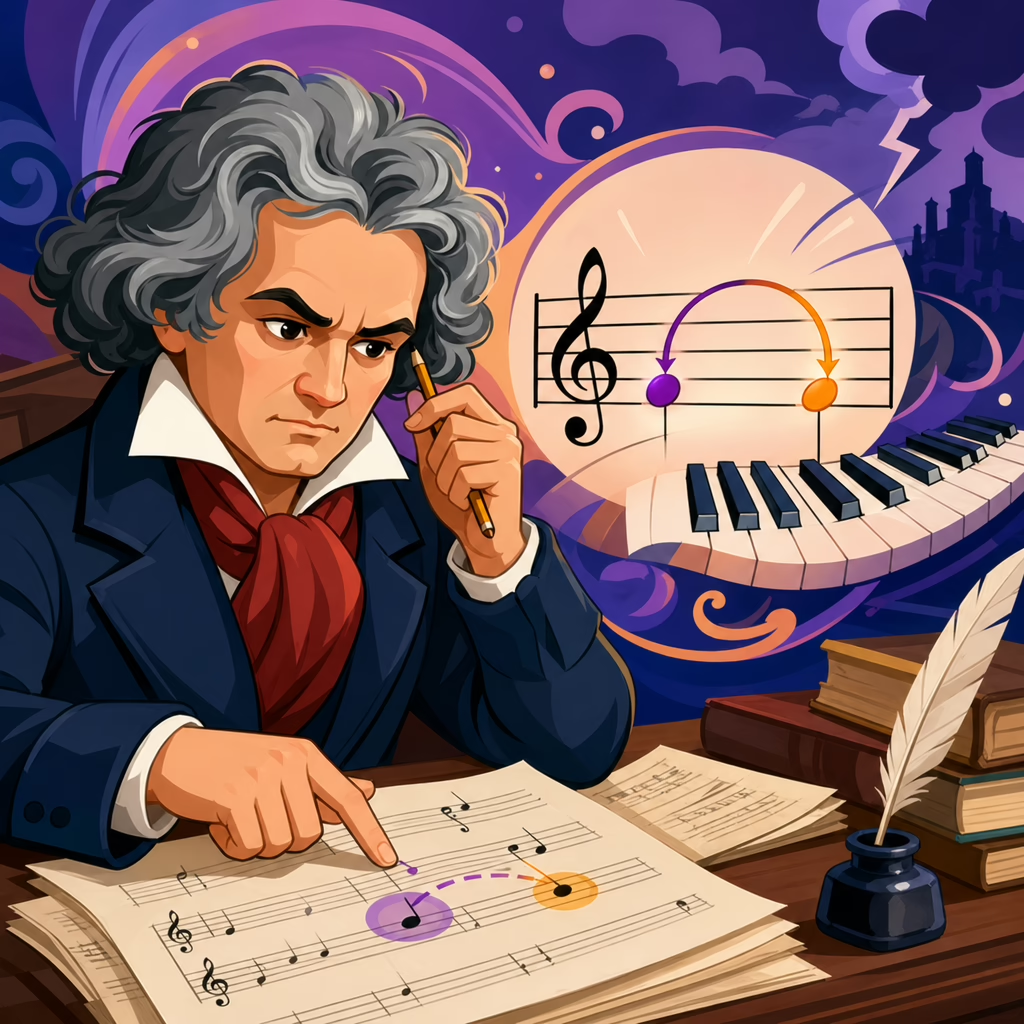
Analyzing Beethoven’s Use of the Tritone
Analyzing Beethoven’s use of the tritone reveals how a single unstable interval became one of his most flexible expressive tools, shaping harmony, drama, form, and character across the “Beethoven Music” repertoire. In basic terms, the tritone is the interval spanning three whole tones, usually labeled an augmented fourth or diminished fifth depending on spelling. In common-practice tonal music, it is the interval listeners often hear as tense, ambiguous, and in need of resolution. Yet in Beethoven’s hands, that tension was never merely decorative. He used the tritone to sharpen cadences, destabilize tonal centers, intensify transitions, depict conflict, and bind distant sections through motivic design. I have found, when teaching and analyzing Beethoven, that following the tritone often clarifies passages that otherwise seem only “dramatic” in a vague sense. It exposes the precise machinery of that drama.
This matters because Beethoven sits at a turning point between Classical balance and Romantic expansion. Haydn and Mozart certainly used tritone-based dominant function, diminished sevenths, and expressive cross-relations, but Beethoven pressed those resources harder and more structurally. He enlarged the interval’s role from local dissonance to architectural agent. In sonata forms, slow introductions, scherzos, quartets, and late keyboard works, tritone relations can trigger modulation, articulate thematic contrast, or fracture expectations at exactly the moment the listener thinks stability has arrived. For readers exploring Beethoven Music as a broader topic, this hub article covers the miscellaneous angles that tie many specialized studies together: harmonic syntax, motivic writing, orchestration, rhetorical timing, and the relationship between learned counterpoint and public drama. Understanding Beethoven’s tritone practice does not require advanced theory, but it does reward close listening. Once heard clearly, it becomes difficult to miss how often this interval marks danger, irony, suspense, or hard-won resolution.
Before turning to repertoire, two definitions are useful. First, a tritone is not automatically “the devil’s interval” in some simplistic historical sense; in tonal repertory, it most often appears as part of standard dominant harmony, especially between the third and seventh of a dominant seventh chord. Second, Beethoven’s originality lies less in inventing new intervals than in deciding where, when, and how long their tension should operate. He often lets a tritone hover at formal seams: before a recapitulation, inside a transition, within a deceptive cadence, or across registral extremes that magnify its bite. That practical placement is the key to analyzing Beethoven’s use of the tritone with accuracy rather than myth.
How the tritone functions in Beethoven’s harmonic language
At the most basic level, Beethoven inherits the tritone’s central tonal job from eighteenth-century practice: it energizes dominant harmony and points toward resolution. In a G7 chord resolving to C major, the notes B and F form a tritone whose contrary-motion resolution defines the cadence. Beethoven uses this norm constantly, but he thickens its effect by prolongation, accent, registral spacing, and rhythmic delay. In the “Pathétique” Sonata, Op. 13, Grave gestures repeatedly suspend tonal clarity with diminished-seventh sonorities and dominant preparations whose tritone content feels exposed rather than absorbed into smooth voice leading. The result is not simply stronger cadence; it is theatrical deferral. The listener hears a question hanging in the air longer than expected.
He also exploits the enharmonic mobility of tritone-bearing chords. Diminished seventh chords, built from stacked minor thirds, can be reinterpreted quickly to move into remote keys. Beethoven uses that property in transitions and developments to make tonal travel feel at once logical and shocking. In the first movement of the “Waldstein” Sonata, Op. 53, harmonic acceleration and bright surface energy conceal how destabilizing certain dissonant pivots really are. The tritone becomes a hinge: one spelling suggests one dominant pull, another spelling redirects the music elsewhere. This is one reason Beethoven’s modulations can feel abrupt without sounding arbitrary. The interval itself carries enough tension to justify motion.
Another recurring feature is Beethoven’s preference for exposing dissonance through texture. Rather than burying the tritone inside a full chord, he may isolate it between outer voices or highlight it through sforzando attack. In orchestral writing, winds often crystallize the interval with a clarity strings alone would soften. In keyboard textures, widely spaced registers sharpen its audibility because the ear catches the intervallic gap before registering harmonic completion. I regularly advise students to listen for where Beethoven “frames” the tritone, not just where he includes it. Framing determines whether the interval functions as routine syntax or as audible argument.
Beethoven’s tritone in sonata form, transition, and large-scale structure
One of Beethoven’s most significant achievements is turning local dissonance into formal leverage. In sonata form, the tritone often appears at the exact places where tonal narrative is most contested: the move away from the tonic, the destabilizing middle, and the route back. In the first movement of the “Eroica” Symphony, Op. 55, dissonant harmonic events and sharply profiled diminished functions contribute to a sense that the exposition is not merely presenting themes but testing the limits of tonal space. The famous disruptive moments in the development are effective partly because Beethoven intensifies instability through intervallic friction, and the tritone is central to that friction.
In many works, the transition section depends on dominant build-up, sequence, and reinterpretation. Beethoven extends these processes farther than many predecessors, so tritone tension is sustained over larger spans. The opening movement of the Piano Sonata Op. 31 No. 2, often called “Tempest,” offers a clear example of unresolved harmonic energy feeding formal uncertainty. Recitative-like interruptions, diminished harmonies, and evasive progressions create a landscape where the tritone is not a single event but a condition. Beethoven wants the listener to feel that tonal gravity still exists, yet access to firm arrival has been temporarily obstructed.
He also uses tritone relations to articulate thematic contrast. A first theme grounded in tonic stability can be answered by material whose harmonic profile leans on diminished color or dominant saturation. Even when no literal tritone transposition governs the themes, Beethoven often gives the second area a sharper dissonant edge so the sonata’s dualism becomes audible before the key change is fully processed. This is especially noticeable in middle-period works where energy, not lyric continuity, drives form. The tritone helps separate rhetorical worlds.
In recapitulations, Beethoven sometimes withholds complete closure until a final dominant conflict is worked through. This technique matters because many listeners assume recapitulation equals immediate security. Beethoven knows better. By allowing tritone-based dominant pressure to persist into the return, he keeps the movement’s central problem alive. The form then becomes dramatic rather than diagrammatic: the home key has come back, but peace has not. That distinction is one of the clearest signs of Beethoven’s mature style.
Representative works and listening cues across the Beethoven Music catalog
Because this article serves as a miscellaneous hub, the best approach is to map where the tritone is especially instructive across genres. The examples below are not exhaustive, but they show how broadly Beethoven deploys the interval.
| Work | Where to listen | What the tritone is doing |
|---|---|---|
| Op. 13 “Pathétique,” I | Grave introduction | Heightens rhetorical dread through exposed diminished and dominant dissonance |
| Op. 31 No. 2 “Tempest,” I | Opening and transitions | Creates suspended tonal logic and stormlike instability |
| Op. 53 “Waldstein,” I | Developmental pivots | Enables enharmonic redirection and long-range momentum |
| Symphony No. 3 “Eroica,” I | Development crisis points | Magnifies conflict inside large-scale sonata design |
| Symphony No. 5, I | Transition and development | Sharpens dominant pressure within the famous motivic economy |
| String Quartet Op. 59 No. 1 | Developmental counterpoint | Integrates tritone tension into linear imitation and texture |
| Op. 106 “Hammerklavier” | Scherzo and fugue-related tensions | Links dissonant intervallic writing with learned complexity |
| Op. 131 | Late quartet continuity | Uses dissonance as connective tissue across contrasting movements |
In Symphony No. 5, the tritone is rarely discussed as a headline topic because the short-short-short-long motive dominates scholarship and popular listening. Yet the interval’s pressure is embedded in the movement’s harmonic engine. Beethoven repeatedly channels motivic insistence into dominant accumulation, and the tritone inside that dominant field gives the motive its sharpened destination. In practical listening terms, the more the movement seems trapped in inevitability, the more likely tritone tension is helping drive that sensation.
The late quartets offer a different perspective. Here Beethoven often treats dissonance less as public shock and more as the medium of thought itself. In Op. 131 and related works, tritone-bearing sonorities can emerge from contrapuntal lines rather than from obvious theatrical chords. That matters analytically. A listener waiting only for loud diminished sevenths will miss how quietly Beethoven can thread instability through voice leading. In these pieces, the tritone frequently participates in continuity rather than interruption.
Expressive meaning: conflict, irony, transcendence, and restraint
It is tempting to assign a fixed emotional meaning to the tritone, but Beethoven’s practice is more nuanced. Yes, he often uses it for conflict. Slow introductions, developmental crises, and storm topics regularly depend on its abrasive quality. But he also uses the same interval for irony, wit, and even spiritual suspension. In scherzos, sudden tritone emphasis can make a phrase sound off-balance in a comic way, as though the floor has tilted under the dancer. In late works, the interval may suggest searching rather than violence, especially when embedded in soft dynamics and contrapuntal texture.
This flexibility comes from context. Interval meaning in Beethoven is determined by meter, register, articulation, instrumentation, and what precedes the event. A fortissimo orchestral tritone attacked by full ensemble does not mean the same thing as a pianissimo inner-voice tritone in a late sonata. I have seen performers overplay every tritone as menace, which flattens Beethoven’s language. The better approach is to ask what problem the interval introduces. Does it obstruct cadence, color a line, fracture symmetry, imply remote tonal space, or intensify rhetorical address? The answer changes interpretation.
Beethoven also understood that restraint could make a tritone more potent than repetition. In some movements, he withholds overt dissonant emphasis until a key formal turning point. When it finally arrives, the effect is amplified because the listener has been conditioned by relative stability. This is one reason close score study matters. Surface drama can distract from strategic economy; Beethoven’s boldest dissonances often work because he has prepared their necessity with unusual discipline.
How to analyze Beethoven’s tritone accurately
A reliable method starts with voice leading, not labels. First, identify the notes forming the tritone and determine whether they belong to a dominant seventh, diminished seventh, augmented-sixth context, or linear passing event. Second, track their resolution. Do they resolve conventionally inward or outward, or are they reinterpreted enharmonically to open a new key? Third, locate the event within form. A tritone at a cadence does one job; a tritone at the threshold of the development does another. Fourth, observe texture and register. Exposed outer-voice dissonance is heard differently from an inner-voice event covered by figuration.
Analysts should also avoid two common errors. The first is overcounting. Not every appearance of the interval is structurally significant; tonal music contains many routine tritones. The second is underhearing. Because Beethoven normalizes high tension, listeners sometimes miss how insistently certain movements are built on unresolved tritone pressure. The best balance is comparative listening. Hear the passage once for melody, once for bass motion, and once for dissonant intervallic events. Tools such as annotated scores in Henle or Bärenreiter editions, plus recordings by performers with transparent textures, make this work easier.
For readers building a broader Beethoven Music study plan, the tritone is an ideal connective topic. It links harmony to form, counterpoint to rhetoric, and local detail to large architecture. Follow it across piano sonatas, symphonies, chamber music, and late works, and Beethoven’s style becomes less mysterious. You begin to hear not generalized intensity but expertly controlled instability. That is the real lesson. Beethoven did not rely on dissonance for its own sake; he used the tritone to make musical arguments feel inevitable, human, and unforgettable. The next step is simple: choose one work from this hub, listen with the score, and trace where the interval creates the movement’s turning points.
Frequently Asked Questions
What is a tritone, and why is it so important when analyzing Beethoven’s music?
The tritone is the interval spanning three whole tones, and in notation it usually appears as either an augmented fourth or a diminished fifth, depending on the musical spelling. In tonal music, it has long been associated with instability because it does not sound settled in the way a perfect fifth or major third does. Instead, it creates a strong expectation that something must happen next. That basic tension is exactly why it matters so much in Beethoven’s music. He understood that the tritone was not just a harsh or unusual interval, but a highly useful expressive device that could energize harmony, sharpen contrast, and intensify a listener’s sense of dramatic direction.
When analyzing Beethoven’s use of the tritone, it helps to think beyond the interval in isolation. Beethoven often treats the tritone as part of a larger system of motion: it can appear inside a dominant seventh chord, emerge in melodic lines, shape accompaniment figures, or define relationships between keys. In each case, the interval contributes to a larger expressive goal. It might suggest conflict, uncertainty, disruption, urgency, or emotional strain. Just as importantly, its eventual resolution can produce relief, triumph, or tragic inevitability. Beethoven was especially skilled at controlling the timing of that resolution, sometimes satisfying expectations quickly and sometimes delaying release to heighten suspense.
This is why the tritone is so important in Beethoven analysis. It offers a clear window into how he transforms standard tonal materials into something dramatically compelling. Rather than treating harmony as a static background, Beethoven uses intervals like the tritone to drive form and meaning. A single unstable sonority can influence the mood of an opening theme, the pressure of a development section, the force of a cadence, or the characterization of an entire movement. In short, studying the tritone reveals how Beethoven turns musical tension into structure, expression, and narrative.
How does Beethoven use the tritone to create drama and emotional intensity?
Beethoven uses the tritone as a concentrated source of tension, and that makes it ideal for creating drama. Because the interval sounds inherently unsettled, even a brief appearance can change the emotional temperature of a passage. In Beethoven’s hands, the tritone often marks moments of conflict, instability, or heightened expectation. It may appear in a melody that suddenly twists away from a stable tonal center, in a harmonic progression that resists immediate resolution, or in an accompaniment that injects anxiety beneath an otherwise simple surface. The effect is often psychological as much as technical: listeners feel that the music has entered a more charged and unpredictable space.
One of Beethoven’s great strengths is that he rarely uses dissonance for its own sake. Instead, he places the tritone strategically, often at structurally important moments. For example, it may appear near the beginning of a movement to establish an atmosphere of unrest, or in a development section where familiar themes are broken apart and reinterpreted. In slow movements, a tritone can deepen pathos or create a sense of aching suspension. In faster, more turbulent movements, it can intensify propulsion and aggression. Because the tritone is so compact yet so potent, it allows Beethoven to compress emotional conflict into a very small musical space.
Another key point is Beethoven’s control over resolution. He knows that the expressive force of a tritone depends not only on its sound, but on what follows it. If the interval resolves smoothly, the result may feel inevitable or consoling. If resolution is delayed, interrupted, or redirected, the listener experiences a stronger sense of struggle. This interplay between tension and release is central to Beethoven’s dramatic style. The tritone becomes a tool for pacing emotion across phrases, sections, and entire movements. That is why it can function not merely as a dissonant interval, but as a generator of musical drama on a large scale.
Does Beethoven use the tritone only in harmony, or does it also shape melody and musical form?
Beethoven’s use of the tritone extends well beyond harmony. While many listeners first encounter the tritone in the context of dominant-function chords, Beethoven also exploits it melodically and formally. In melodic writing, a tritone can stand out as a striking leap or as an implied interval formed across a line. When it appears in a theme, it can give that theme an immediate sense of tension, angularity, or expressive instability. Beethoven sometimes uses such gestures to make a motive more memorable and more capable of development. Because his style often depends on extracting large structures from small motivic cells, even a single unstable interval can become a crucial part of a movement’s identity.
Formally, the tritone can help articulate contrast and transition. Beethoven is famous for building large-scale structures out of strongly profiled harmonic and motivic relationships, and the tritone can serve as one of those organizing forces. It can destabilize an opening key area, intensify the journey away from tonal home, or reinforce the sense that a development section is probing dangerous harmonic territory. In recapitulations and codas, Beethoven may then neutralize or master that instability, turning earlier tension into resolution or transformation. From this perspective, the tritone is not just a local dissonance; it can become part of the larger formal drama of departure and return.
This broader role is especially important for analysis because it shows how Beethoven integrates expressive detail with structural thinking. A tritone in a melody may later reappear in harmonic form. A dissonant sonority introduced as a passing disturbance may end up influencing the tonal trajectory of a whole section. Beethoven’s music often rewards this kind of connected listening. The more closely one follows the interval through different musical dimensions, the clearer it becomes that he is using the tritone as a versatile compositional resource—one that can unify motives, intensify transitions, and support the architecture of entire movements.
How is Beethoven’s treatment of the tritone different from a more conventional Classical approach?
In a conventional Classical style, the tritone is usually handled as a functional dissonance with a clear role inside tonal syntax, especially within dominant harmony. It appears, creates tension, and resolves according to expected voice-leading patterns. Beethoven certainly inherited and used that language, but one of the reasons his music feels so powerful is that he often pushes those conventions toward greater expressive and structural significance. He does not merely accept the tritone as a standard dissonance; he highlights it, prolongs it, dramatizes it, and allows it to influence entire passages in ways that feel more urgent and more psychologically charged.
Compared with many of his predecessors and contemporaries, Beethoven often gives dissonance more rhetorical prominence. The tritone may be emphasized through rhythm, register, orchestration, dynamic contrast, or motivic repetition. Instead of passing quickly and discreetly, it can become the focal point of a musical idea. This does not mean Beethoven abandons tonal logic. On the contrary, much of the force of his style comes from the fact that the dissonance remains intelligible within tonal syntax even as he stretches its expressive potential. The listener senses both the rule and the pressure placed upon it.
Another difference lies in scale. In more conventional writing, the tritone may function primarily at the level of the chord or phrase. In Beethoven, it often contributes to larger narratives of conflict and resolution. He is especially adept at taking a small intervallic tension and allowing it to resonate across multiple levels of the composition. That is one reason his music can feel so tightly argued: a local dissonance is not isolated from the rest of the work, but connected to thematic development, formal tension, and expressive trajectory. So while Beethoven works within the Classical tonal system, his treatment of the tritone often points toward a more expansive and dramatic conception of musical meaning.
What should listeners pay attention to when identifying the tritone in Beethoven’s works?
Listeners should begin by listening for moments of unusual tension—those points where the music suddenly sounds strained, unstable, or dramatically suspended. In Beethoven, the tritone often appears at precisely such moments. If you are following the score, look for augmented fourths and diminished fifths, especially in passages involving dominant seventh chords, diminished harmonies, chromatic motion, or sharp tonal contrasts. If you are listening without a score, focus on the emotional effect: the tritone often feels like a hinge between stability and instability, a sound that demands continuation rather than closure.
It is also helpful to notice context. Ask where the tritone appears: is it in the main theme, a transition, a development section, a climactic buildup, or a cadence? Beethoven rarely places such tension randomly. If the interval appears in a prominent melodic idea, it may be part of the movement’s core expressive identity. If it emerges during a modulatory passage, it may be helping drive the music away from tonal security. If it appears repeatedly, Beethoven may be using it as a motivic signal of conflict or as a structural thread connecting distant parts of the movement. In other words, hearing the tritone clearly is only the first step; understanding its function in context is what makes the analysis meaningful.
Finally, pay close attention to resolution. The most revealing question is often not simply “Where is the tritone?” but “What does Beethoven do with it?” Does he resolve it immediately, delay it, intensify it, or reinterpret it in a new harmonic setting