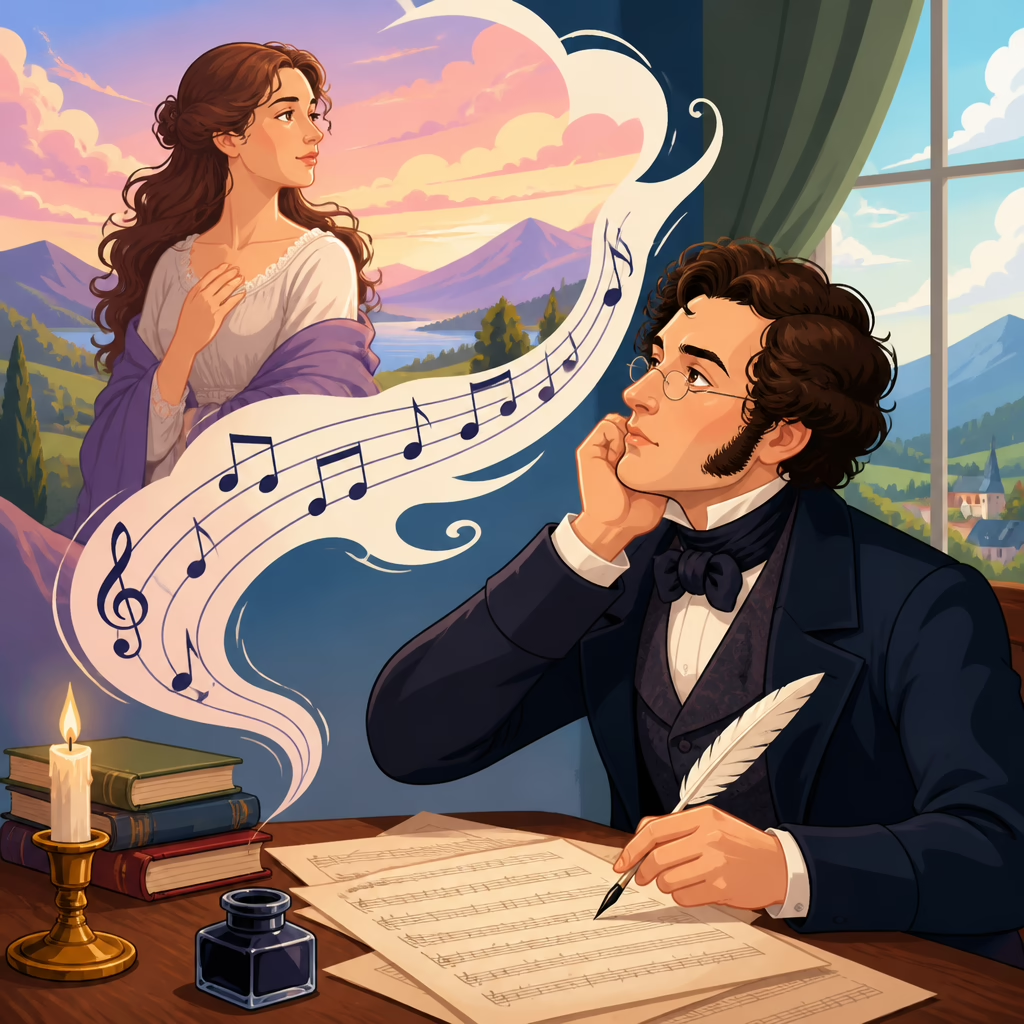
An die ferne Geliebte and the Birth of the Song Cycle
Beethoven’s An die ferne Geliebte, Op. 98, is routinely described as the first true song cycle, and that label matters because it identifies a decisive change in how composers organized songs, shaped literary narrative, and imagined listening itself. Written in 1816 to poems by Alois Jeitteles, the work binds six songs into a continuous arc in which memory, distance, longing, landscape, and imagined reunion are all carried by recurring musical ideas. A song cycle, in the precise sense relevant here, is not merely a published set of songs by one composer. It is a deliberately integrated sequence whose individual numbers gain part of their meaning from order, tonal planning, motivic connection, and cumulative emotional design. Earlier composers had grouped songs before Beethoven, but An die ferne Geliebte makes interdependence the point of the composition. From the first bars to the return of the opening melody at the end, the listener is asked to hear relationship rather than assortment. That structural demand is why the piece stands at the birth of the genre as later nineteenth-century composers would understand it. The cycle also matters because it emerged at a critical moment in Beethoven’s life, after the piano sonatas Opp. 101 and 106 had expanded instrumental form and as his deafness reshaped his artistic priorities. In this compact vocal work, he achieved something equally radical through concentration instead of scale.
The title means “To the Distant Beloved,” and the distance is both literal and psychological. The speaker is separated from the beloved, looks outward to hills, clouds, breezes, and birds, and asks song itself to travel where he cannot. That premise gives Beethoven a practical formal problem: how can six short settings feel like one emotional utterance rather than six miniatures? His answer lies in continuity. The songs are linked without full breaks, their keys are coordinated, the piano does more than accompany, and the final song circles back to the first. In performance and analysis, those features are not incidental decoration; they are the evidence that this is a cycle in the modern sense. Understanding An die ferne Geliebte therefore means looking closely at how Beethoven creates unity from small means and why that unity proved so influential for Schubert, Schumann, and later composers who treated song as a sustained poetic journey.
Historical context: Beethoven in 1816 and the idea of a unified vocal work
By 1816 Beethoven was not primarily known as a songwriter. His public identity rested on symphonies, piano sonatas, chamber music, and concert works, while his songs occupied a smaller place in his output. Yet that position may have helped him. Because he was not bound by the conventions of domestic song publication in the same way as specialist Lied composers, he approached the medium with unusual formal freedom. I have always found that when musicians first encounter Op. 98, they expect a set of refined strophic songs and are surprised by how architecturally it behaves. Beethoven treats lyrical intimacy with the same seriousness he brought to sonata logic.
The poems came from Alois Jeitteles, a young physician and writer in Vienna. Their imagery is conventional enough to seem simple at first glance: hilltops, evening mist, spring landscapes, birdsong, and tears of longing. But their sequence offered Beethoven an opportunity to compose not six isolated reactions but a progression from solitary contemplation to imagined communication through music. This was a period when literary culture increasingly valued interiority and continuity of feeling. Beethoven met that aesthetic head-on. He did not merely select poems about absence; he arranged them into an unfolding argument about what song can do when physical reunion is impossible.
The publication history supports the claim of integrated design. Op. 98 appeared as a single entity dedicated to Prince Joseph Franz von Lobkowitz. Beethoven clearly wanted the work received as one composition. That distinguishes it from many earlier multi-song collections, where publication together did not automatically imply narrative or tonal dependence. In Op. 98, remove a song from its place and the whole weakens. That is the threshold the work crosses.
How the six songs form one cycle
The central innovation of An die ferne Geliebte is not that all six songs concern one emotional theme, but that Beethoven composes their connections so audibly that separation feels unnatural. The opening song, “Auf dem Hügel sitz ich spähend,” begins with a poised, contemplative manner: the speaker sits on a hill, gazing into the distance. The melody unfolds with a plainness that makes its return later deeply memorable. The second and third songs move more actively through images of mountains, blue mist, and light sailing westward, expanding the emotional and spatial range without breaking the line of thought. The fourth and fifth turn more intimate and direct, especially as the speaker imagines natural messengers carrying his feelings. The sixth, “Nimm sie hin denn, diese Lieder,” resolves the premise by sending the songs themselves to the beloved.
What makes this progression cyclical rather than sequential is Beethoven’s handling of recall. At the end, the music returns to the opening melody, now transformed by what has intervened. This is not a casual reprise. It is the compositional act that binds departure and arrival into one frame. The lover has not overcome distance in realistic terms; instead, music creates symbolic reunion. In practical listening, the return gives the entire work retrospective coherence. Material heard first as solitary reflection is heard again as fulfilled transmission.
Equally important are the transitions. Beethoven avoids strong cadential closure between songs, using linking passages that keep the cycle in motion. The listener is not invited to applaud between numbers in the older recital sense. The continuity resembles scenes in a single dramatic span. This through-connection became fundamental to later song cycles, though later composers would pursue it with different harmonic languages and narrative complexities.
| Song | Opening text | Primary function in the cycle | Key structural effect |
|---|---|---|---|
| 1 | “Auf dem Hügel sitz ich spähend” | Establishes distance, viewpoint, and main melodic identity | Introduces material recalled at the close |
| 2 | “Wo die Berge so blau” | Extends longing into imagined landscape | Maintains continuity rather than closure |
| 3 | “Leichte Segler in den Höhen” | Addresses natural carriers of feeling | Increases motion and outward address |
| 4 | “Diese Wolken in den Höhen” | Deepens apostrophe to clouds and birds | Narrows emotion into direct appeal |
| 5 | “Es kehret der Maien” | Contrasts seasonal renewal with personal separation | Sharpens the ache of absence |
| 6 | “Nimm sie hin denn, diese Lieder” | Sends the songs to the beloved | Returns opening melody to complete the cycle |
Musical design: key relations, motives, and the role of the piano
Analysts often point first to the end returning to the beginning, but the deeper achievement lies in how many levels of unity Beethoven coordinates at once. Tonal planning is essential. The songs move through related keys in a way that preserves contrast while keeping the whole within a comprehensible harmonic field. Beethoven does not use key merely to color each poem separately; he uses it to manage momentum across the set. The result feels closer to a multi-movement instrumental design than to a folder of independent Lieder.
Motivic economy is equally important. Small melodic turns, accompanimental figures, and rhythmic gestures echo across song boundaries. These echoes are not heavy-handed leitmotifs in the later operatic sense. They function more subtly, creating memory traces that help the ear register continuity. This is one reason the cycle rewards repeated listening. On a first hearing, one notices the directness of the vocal line. On later hearings, one begins to hear how carefully Beethoven plants relationships among phrases that seem spontaneous.
The piano part is never merely supportive. In performance, the pianist shapes transitions, atmosphere, and pacing as decisively as the singer. The opening accompaniment establishes reflective space rather than decorative texture. Elsewhere the keyboard suggests breeze, movement, or inward suspension, but always with structural purpose. I have seen rehearsals where the breakthrough came only when performers stopped treating the piano as accompaniment and instead read the score as chamber music for voice and keyboard. That shift immediately clarifies why the cycle holds together so strongly.
Beethoven also writes with notable restraint. There is no operatic overstatement, no vast scena, no indulgent excess of ornament. The music is singable, balanced, and lucid, yet beneath that clarity sits remarkable formal discipline. This combination helps explain the work’s durability. It can be performed in a salon, a conservatory studio, or a major hall, and in each setting its construction remains audible.
Why many scholars call it the first true song cycle
The phrase “first true song cycle” can sound simplistic unless carefully defined. Earlier eighteenth-century composers certainly published groups of songs, and Beethoven himself had written sets before Op. 98. The question is not chronology alone. It is whether the composer conceived the collection as an indivisible formal and poetic whole. By that standard, An die ferne Geliebte is the earliest widely acknowledged example that fully anticipates the nineteenth-century cycle tradition.
Several criteria support that judgment. First, the poems are ordered to produce an emotional trajectory rather than a loose anthology. Second, the songs are linked musically, often without pause. Third, tonal and motivic planning create interdependence across the complete span. Fourth, the final return of opening material transforms the ending into a structural closure for the whole, not just the last song. These traits together define the cycle’s modernity.
There is still room for nuance. Some scholars point to earlier precedents in strophic narrative collections or integrated dramatic song sequences. That caution is healthy. Genre history rarely begins from absolute zero. But in teaching and performing repertory, I have found the basic claim remains reliable: Op. 98 is where the fully unified Lied cycle becomes unmistakable. It gives later composers a workable model of poetic sequence plus musical recurrence plus large-scale closure.
For readers exploring Beethoven’s smaller-scale works more broadly, the contrast with his miniature keyboard writing is instructive; the concentrated expressivity discussed in this article complements the perspective offered in the main guide to Beethoven’s Bagatelles at https://lvbeethoven.com/a-complete-guide-to-beethovens-bagatelles/. In both repertories, Beethoven proves that brevity can support serious architectural thought.
Influence on Schubert, Schumann, and the later Lied tradition
Beethoven did not create the nineteenth-century song cycle in finished abundance, but he established its premise so clearly that later composers could expand it. Schubert’s Die schöne Müllerin and Winterreise are larger, psychologically more varied, and harmonically more adventurous, yet they inherit the idea that a succession of songs can narrate a single consciousness over time. Schumann’s Dichterliebe and Frauenliebe und -leben likewise depend on cumulative listening, where the meaning of each song is altered by what came before and what follows after.
The direct musical influence is not always a matter of quotation. It is a matter of permission. After Op. 98, a composer could publish a sequence of songs and expect serious listeners to hear one composition across multiple numbers. That shift changed recital culture, publishing practice, and analytical habits. The piano’s structural role in later Lieder also owes something to Beethoven’s example. By making accompaniment integral to form, he prepared the way for Schubert’s river figures, horse rhythms, and postludes that continue the poem after the voice stops.
Importantly, Beethoven’s cycle also models compression. Later masters often worked on broader canvases, but Op. 98 demonstrates that coherence does not require length. In roughly a quarter hour, Beethoven establishes premise, development, intensification, and return. That efficiency is one reason the work remains central in conservatory study. Students can grasp the entire architecture in a single sitting while still finding enough detail to sustain advanced analysis.
How to listen to An die ferne Geliebte today
The best way to hear the work is straight through, with texts in hand and no interruption between songs. Listen first for perspective: the cycle begins with looking outward from a height and ends with inward certainty that songs can bridge absence. Then listen for recurrence, especially the return of the opening melody in the last song. That moment is the hinge on which the cycle’s historical importance turns. If it feels inevitable rather than surprising, Beethoven has succeeded.
Pay close attention to the piano. Notice how transitions deny complete emotional reset, how accompanimental textures shape space, and how the keyboard often carries continuity more clearly than the voice. Also note the emotional honesty of the work. The beloved never appears, the separation is never practically solved, and the ending’s consolation is artistic rather than literal. That restraint saves the cycle from sentimentality.
An die ferne Geliebte marks the birth of the song cycle because Beethoven fused six songs into one persuasive expressive design. He did so through linked movements, tonal planning, motivic recall, and a closing return that makes the whole feel complete. The result changed how composers, performers, and listeners understood what a Lied sequence could be. If you want to understand why later Romantic song cycles exist in the form we know, start here, hear the six songs without pause, and listen for the moment when memory becomes structure.
Frequently Asked Questions
Why is Beethoven’s An die ferne Geliebte often called the first true song cycle?
Beethoven’s An die ferne Geliebte, Op. 98, is often called the first true song cycle because it does more than simply gather several songs under one title. Earlier composers certainly published groups of songs, and some of those songs shared a mood, a poet, or a general theme. What makes Beethoven’s work different is the unusually deliberate way the six songs function as a single artistic structure. They are designed to be heard as one continuous span rather than as six fully independent miniatures that can be separated without loss. The cycle creates a unified emotional and musical journey centered on distance, longing, remembrance, nature, and the hope of spiritual reunion.
That distinction matters historically. In this work, Beethoven helps establish a new model for how songs can relate to one another across an entire composition. The songs are linked not only by the poems of Alois Jeitteles but also by recurring musical ideas, tonal planning, and transitions that reduce the sense of interruption between numbers. The listener is invited to follow an arc of feeling from beginning to end, almost as if listening to a chamber work or a compact vocal narrative rather than a loose anthology. In that sense, An die ferne Geliebte marks a turning point in the history of the Lied: it shows that a group of songs can form a higher-level design, one in which individual parts gain meaning from their place within a larger whole.
What makes this work a cycle rather than just a set of six songs?
A true cycle depends on interconnection, continuity, and cumulative meaning, and An die ferne Geliebte demonstrates all three. The six songs are bound together through shared poetic themes and through musical techniques that encourage continuous listening. Beethoven creates links between songs so that the end of one seems to lean into the next. This continuity changes the listening experience: instead of resetting after each song, the audience remains inside one expressive world. The songs still have their own character, but they are shaped to contribute to a broader narrative and emotional design.
One especially important feature is Beethoven’s use of recurring material and overall formal return. Musical ideas are remembered and transformed across the span of the cycle, creating the impression that earlier emotions and images continue to resonate. The ending also has special significance because it recalls the beginning, giving the work a circular structure that suggests emotional completion even though the beloved remains physically distant. This kind of large-scale integration is central to why the piece is so often singled out as foundational. It is not merely six related songs placed side by side; it is six songs arranged so that memory, expectation, and return become structural principles. That is precisely what later composers would develop in more elaborate ways.
How do the poems by Alois Jeitteles shape the narrative of An die ferne Geliebte?
The poems by Alois Jeitteles are essential because they provide the cycle with a coherent emotional and imaginative trajectory. Rather than telling a plot-heavy story with external events, the texts trace an inward journey shaped by absence. The speaker addresses a distant beloved and moves through states of yearning, recollection, observation of nature, and imagined communication across space. Landscape is never just decorative. Hills, clouds, breezes, and song itself become mediums through which feeling travels when the lovers cannot. This gives the cycle a poetic logic that is less about action than about psychological continuity.
That poetic design suits Beethoven’s musical aims perfectly. The emotional motion from solitude to imagined connection allows him to organize the six songs as stages in a single meditation. The beloved is absent, but the act of singing becomes a substitute for physical presence. In effect, the cycle dramatizes how art carries emotion across distance. By the end, the songs themselves are offered as messengers, which is one reason the closing return feels so meaningful: the cycle folds back on itself, as if the music has completed the journey the lover could not physically make. Jeitteles’s texts therefore do far more than supply lyrical content. They enable Beethoven to shape a unified sequence in which memory, distance, and the hope of reunion are transformed into musical form.
How does Beethoven use music to unify the six songs?
Beethoven unifies the cycle through continuity of mood, carefully controlled tonal relationships, motivic recall, and a larger formal design that rewards hearing the songs together. Even when each song presents a distinct texture or expressive emphasis, there is a strong sense that all belong to the same emotional world. The transitions between songs help maintain momentum, limiting the feeling of final closure after each number. This is one of the most striking ways Beethoven encourages listeners to hear the work as a complete arc rather than as a series of stopping points.
He also uses recurrence in a way that is historically significant. Musical figures and expressive gestures seem to echo one another across the cycle, reinforcing the idea that the speaker’s feelings are evolving rather than starting over. Most famously, the conclusion recalls the opening material, creating a cyclical frame. That return is not just a clever device; it embodies the work’s central themes. The lover remains separated, yet through memory and song the emotional distance is traversed. The circular design suggests that longing has found a mode of expression capable of sustaining connection. In practical listening terms, this means the cycle gains power when heard complete, because its deepest meanings emerge from relationships between songs rather than from isolated moments alone.
Why does An die ferne Geliebte matter so much for later composers and the history of the Lied?
The work matters because it helped redefine what composers thought a song collection could be. After Beethoven, the idea of linking songs into a unified expressive and structural whole became one of the most important possibilities in nineteenth-century vocal music. Later composers such as Schubert, Schumann, and others would create cycles that are more expansive, more dramatic, or more psychologically intricate, but Beethoven’s Op. 98 stands as a crucial early model. It demonstrates that songs can be arranged to produce narrative continuity, thematic recurrence, and formal closure on the scale of a multi-part composition.
Its importance is also aesthetic. An die ferne Geliebte changes the implied role of the listener. Instead of hearing one song, then another, the audience is asked to remember what came earlier, to recognize returns, and to follow an emotional thread across the entire span. That mode of listening is central to the mature song cycle tradition. The piece also captures a broader Romantic concern with interior life, memory, separation, and the idea that music can bridge what ordinary speech cannot. For all these reasons, the label “first true song cycle” is not just a convenient textbook phrase. It points to a real historical shift in musical form, poetic organization, and listening practice, and Beethoven’s achievement remains foundational to any serious account of how the song cycle came into being.